We are developing the social individualist meta-context for the future. From the very serious to the extremely frivolous... lets see what is on the mind of the Samizdata people.
Samizdata, derived from Samizdat /n. - a system of clandestine publication of banned literature in the USSR [Russ.,= self-publishing house]
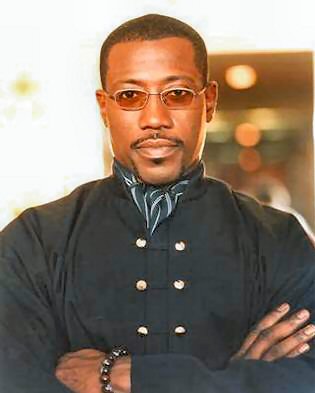
It seems thespian Wesley Snipes has been duking it out with vampires the IRS based on the rather reasonable notion he should not have to pay them his hard earned lucre.
Wesley Snipes’ attorneys admitted his ideas were crazy – that Americans have no obligation to pay taxes and the IRS cannot legally collect them. […] Co-defendants Eddie Ray Kahn, the founder of a known tax protest group, and Douglas P. Rosile, a delicensed accountant, were convicted Friday by the same jury of tax fraud and conspiracy. Both face up to 10 years in prison.
Oh yes, the notion the state has no right to your money is… crazy. If there is one thing the state will not tolerate, it is choking off the kleptocratic basis of all its power. So is Wesley destined to become the poster boy for anti-statist tax protesters? I am far too cynical to think a Hollywood actor could have coherent anti-statist views, but he would cut a dashing figure for ‘our side’ if it were true.
Last year I traveled continuously from mid-May to early November, not to mention a couple other months on the road earlier that year. One of the trips was to Wyoming in July and while there Jim Bennett and I visited Frontier Astronautics rather unique home office.
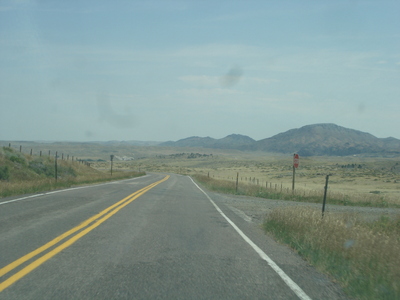
Jim and I drove for a long time.
Photo: copyright Dale Amon, All Rights Reserved
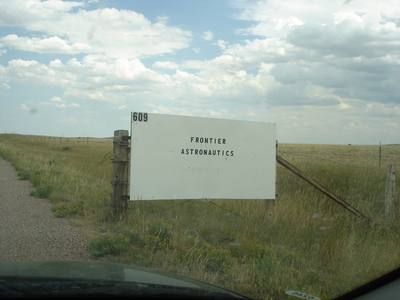
We found their sign miles down a back road off a County road.
Photo: copyright Dale Amon, All Rights Reserved
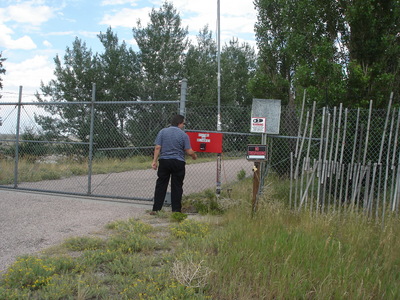
After a ‘short’ drive up their private road we arrived at the main gate where Jim rang the door bell.
Photo: copyright Dale Amon, All Rights Reserved
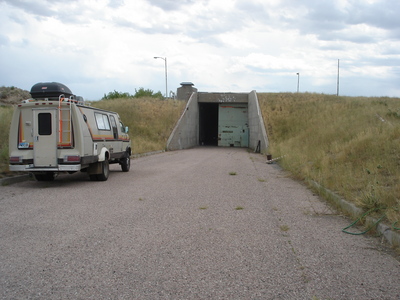
Two engineers came out and led us on the trek to the bunker doors. They are large enough to pass an Atlas missile on a truck.
Photo: copyright Dale Amon, All Rights Reserved
Back in perhaps 1962 the bunker center section held a liquid fueled Atlas ICBM. This is the flame trench that would be underneath the ICBM. The sections of the bunker to the left and right contained the fuel and oxidizer tanks used to fuel it. The center section is now (probably) the world’s only indoor engine test stand. Interior walls are 30 inch thick reinforced concrete: this allows the engineers and their monitoring gear to sit mere feet away from a firing engine.
Photo: copyright Dale Amon, All Rights Reserved
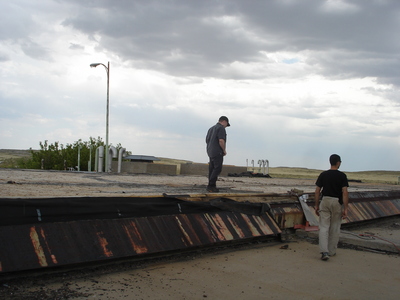
The office also has a sun roof… These many, many ton reinforced concrete doors were built to slide to either side so the Atlas could be raised into firing position.
Photo: copyright Dale Amon, All Rights Reserved
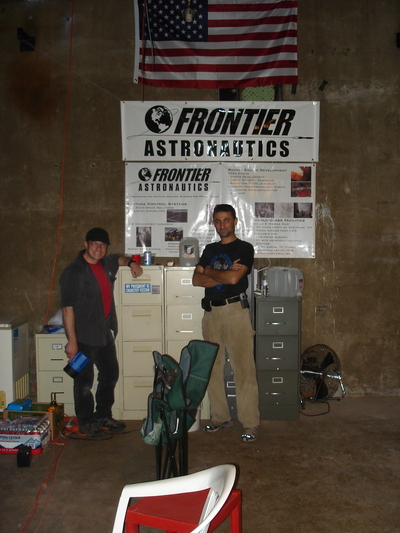
Speaking of the engineers, here are the two who gave us the grand tour.
Photo: copyright Dale Amon, All Rights Reserved
This is the tunnel to what was once a control room. The consoles are long gone and it now contains a modern flat where the owner, a former Titan IV engineer, and his wife live.
Photo: copyright Dale Amon, All Rights Reserved
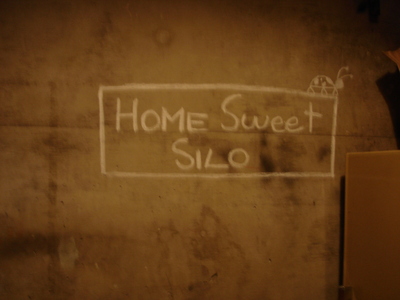
It is without a doubt the only family home with an indoor rocket engine test stand.
Photo: copyright Dale Amon, All Rights Reserved
There is a very interesting story in parts of the media today. Large parts of the Middle East and (in particular) India are suffering a major internet outage. It seems that a storm in Alexandria in Egypt has led to ships going off course and their anchors damaging the SEA-ME-WE 4 and FLAG fiber optic cables connecting India with Europe and Asia, and capacity to India has thus been reduced. There are some older, lower capacity cables still in use, and there are cables to the US also, but these were the main connections to India. It seems at this point unclear whether the two cables were both ruptures near Alexandria, or whether one of the outages was off Marseilles. But in any event, two of the world’s key cables were damaged within a few hours. This seems quite remarkable. The TWO main cables between Europe and India were both damaged within a matter of hours. It seems an extraordinary coincidence. It may or may not be an extraordinary coincidence, and we will find out.
However, as a science fiction fan and a reader of Wired Magazine, the mention of these two cables brings back a thought of one of the finest articles ever published in the magazine. In 1996, science fiction author Neal Stephenson (of Snow Crash fame) wrote a long and wonderful essay for Wired Magazine entitled “Mother Earth, Motherboard”. This article was written as the 1990s telecoms boom was gearing up to great heights of enthusiasm, and in a period in which global telecoms at least appeared to be gaining new levels of competition. Stephenson wrote about travelling to a large number of locations around the world, watching the laying of an undersea fibre optic cable named FLAG (Fiberoptic Link Around the Globe), or more specifically the section of it connecting Europe and Asia. He discussed the technologies, and the politics, and the history of communications and other related matters that went with it, and the history of the places he saw along the way. In return for paying what must have been a very considerable expense claim, Wired Magazine got a spectacular piece of writing, but Stephenson clearly got more than they did, as many of the locations that were researched for this essay popped up again in considerable detail in his novel Cryptonomicon, and to a lesser extent in his Baroque Trilogy that followed. Many of them cropped up in sections of those novels set in various eras in the past, particularly in the second world war.
The list of places that Stephenson visited during the laying of FLAG has a very trading empire quality about it, and mostly a British trading empire quality about it: Alexandria, Port Said, Bombay, Penang, Hong Kong, Shanghai, places that contain, as Stephenson puts it, “British imperial-era hotels fraught with romance and history, sort of like the entire J. Peterman catalogue rolled into one building”. The reason for the confluence with the British Empire makes perfect sense when you think about it: the strongest parts of the British Empire were outposts to defend Britain’s control of trade routes, and so they are at key points on those trade routes. If you are laying an undersea cable, then you want to lay it along the shortest route that it can safely be placed. What is required is a mixture of minimum distance and political stability. The minimum distances for cables today are the same as the minimum distances for ships in the nineteenth century (and generally for ships today, also). Between Europe and Asia, there are two key bottlenecks through which you must travel, as the alternatives are either much longer or much less politically stable. Those two bottlenecks are of course through Egypt between the Mediterranean and the red sea, and through the Straits of Malacca between the Indian Ocean and the Pacific. Hence Alexandria and Penang. Of course, these places have been strategic since long before the British Empire, which is why a lighthouse and a library were built in Alexandria, but the British Empire is recent enough for its mood to linger. → Continue reading: Some thoughts on India’s internet outage
Bill Gates’ Microsoft has made an unsolicited bid – at a cool $44.6bn – for Yahoo!. The offer is either in stock or in cash. I must say there comes a point where the sheer, mind-bendingly large sums of money that are involved (thanks to years of inflation) make it hard to relate to the sizes on offer.
And to think that $44.6bn is chump change to Gates.
Tomorrow evening we are doing a blogger bash and one of the Samizdatistas, Michael Jennings in a bout of generosity is bringing a whole leg of Serrano ham to share. Another blogging groupie is kindly bringing a ham stand and a knife. So the video below is particularly relevant and wonderfully silly:
Fred Thompson, actor and political candidate, will not be President of the United States. As this fine article points out, that is a pity. He was too normal, apparently.
My father told me a while back that I was distantly related to Henry Blofeld, landowner and legendary cricket commentator. The Blofelds are an old Norfolk landowning family. Well, if it turns out I am related to a family that has the same surname as one of the greatest Bond villains, then maybe I should invest in something suitably sinister.
It may be cheaper than a hollowed-out volcano, if only slightly.
Staying with the Bond theme, you can now, if you have the wealth, live in a beach resort in the same part of Jamaica as Ian Fleming’s old beachside home of Goldeneye. Back in 1956, during the Suez crisis, Anthony Eden, then prime minister, stayed at the Flemings’.
On some, if not all issues, Rod Liddle is a man of sound views. He loathes the nanny state; he is unconvinced that we need to crack down on freedom of speech in order to avoid giving offence to religious groups. He is a patriot. In this week’s edition of the Spectator, where other authors rant away splendidly, Liddle rails against the six-month-old government ban on smoking in all public buildings, including privately owned ones (apart from private homes), such as pubs and restaurants. He makes a good case and some of his paragraphs are cheer-out-loud material:
Of course, one shouldn’t drop a policy simply because the pubs are having a rather hard time of it as a result. But in which case, don’t bother to pretend that they’re not, that actually there are queues all down the street consisting of shiny, happy people who wish nothing more than to drink in a new, healthy, smoke-free environment. Stop lying. Say, instead, that the smoke ban is putting pubs out of business but actually we couldn’t give a toss. Truth is, the government — and the health charities — are caught by their previous, gerrymandered poll findings which purported to suggest that the entire country was in favour of a complete ban on smoking everywhere, when — and again, do a quick vox pop if you doubt this — the reverse was true. People would like to see genuinely smoke-free areas of restaurants and pubs, for sure — but only chose a complete ban on smoking when the alternative on the poll sheet was ‘or would you like your testicles sawn off?’.
Or this:
Perhaps it is true, though, that because of the ban, I shall live for ever, for which many thanks, Dawn. But I doubt it; we will have recourse to one or another means of killing ourselves, such as driving a car (4,000 deaths per year), drinking more (40,000 deaths per year) or visiting a doctor (30,000 deaths per year through negligence or incompetence: never forget that figure. It exceeds the numbers killed through smoking-related illness. And it really, really hacks off the doctors).
But as always with Mr Liddle, the carelessness with which he chucks around numbers makes me wonder if any reader will want to get past his first paragraph:
I am still not sure what I hate the most about this government: its decision to invade Iraq and thus either effect or facilitate the murder of 500,000 Iraqis, or its decision to stop me from smoking in pubs and restaurants.
500,000 Iraqis? Is that correct? Liddle gives no source for this or attempts to do so later in the piece. Now Rod may be right to suggest that the overthrow of a power-mad, dangerous dictator was even worse than letting him stay in power (I occasionally wonder why a certain type of right-winger is so indulgent towards evil men like Saddam). But if he is going to make an argument with statistics as part of his core argument, it is probably not a great idea to kick off an argument with a massive figure based on, whatever.
Oh, in case anyone asks, I don’t smoke, except on National No Smoking Day.
The controversial Australian euthanasia advocate and doctor Phillip Nitschke has been arrested in Auckland, New Zealand, and books that he had in his possession have been seized. Nitschke, the moving spirit behind Exit International, had gone to New Zealand to host some ‘workshops’ on euthanasia.
Regardless of the rights and wrongs of euthanasia, this seems to me to be a clear case of ‘thoughtcrime’, and New Zealand authorities deserve nothing but scorn for this.
I was rather surprised to discover that Oklahoma, of all places, is using State power not to just silence critics, but to send them to prison for up to ten years!
I simply never expected this sort of political repression to take hold in America. The Oklahoma government should simply be ashamed of the way they are sullying the American ideal.
I would suggest to Oklahoman’s that they fight fire with fire. The outside agitators who are being shipped in and paid should be investigated and the leaders named and shamed. A private sting operation should work nicely: place a Ballot initiative canvasser somewhere where it is certain the roving gangs will find them. You should have a few photographers assigned to take photos of the individuals who start causing the trouble; then have a few others ready to slip in with ‘wires’ and pretend to be part of the group
Once you have the evidence, put it all in a blog or a web page… and send us the link!
In the Daily Telegraph, Simon Heffer gets stuck right into police forces, and especially the constabulary of Kent, for various offences against liberty and common sense. It is a rather populist article, designed to stir the pot, but I think it is a pot worth stirring. I myself on the other end of the world share his disdain for my local police force, which I regard as nothing more or less then the armed enforcers of the Treasury Department.
I certainly have reservations about their ethics, methods, and purpose, and I suspect much worse of them. Given that the head of Australian Federal Police is trying to push for a media blackout of its anti-terrorist activities, a power that could easily be abused, I think I have good reasons to fear the worst from the boys in blue.
How did it come to this? My own guess is that police forces are just reflecting the nature of the governments that supposedly control them. Monkey see, monkey do.
The Samizdata people are a bunch of sinister and heavily armed globalist illuminati who seek to infect the entire world with the values of personal liberty and several property. Amongst our many crimes is a sense of humour and the intermittent use of British spelling.
We are also a varied group made up of social individualists, classical liberals, whigs, libertarians, extropians, futurists, ‘Porcupines’, Karl Popper fetishists, recovering neo-conservatives, crazed Ayn Rand worshipers, over-caffeinated Virginia Postrel devotees, witty Frédéric Bastiat wannabes, cypherpunks, minarchists, kritarchists and wild-eyed anarcho-capitalists from Britain, North America, Australia and Europe.
All content on this website (including text, photographs, audio files, and any other original works), unless otherwise noted, is licensed under a Creative Commons License. Powered by WordPress & Atahualpa







Recent Comments