We are developing the social individualist meta-context for the future. From the very serious to the extremely frivolous... lets see what is on the mind of the Samizdata people.
Samizdata, derived from Samizdat /n. - a system of clandestine publication of banned literature in the USSR [Russ.,= self-publishing house]
|
As far as I know, it was my very good friend Sean Gabb who first posited a theory about who may be responsible for the hacking of the CRU e-mails that have now formed the basis of ‘Climategate’:
In short, I believe the Russians are behind this. It may be that all those megabytes of data were stolen by a computer hacker. There may be any number of people who are up to such hacking in the technical sense. But this seems to have been an integrated operation. Having the technical skills to get access to a computer archive is not the same as knowing where to look in that archive and what to look for. Nor is it the same as knowing what to do with it.
But the Russians had means and opportunity to do the job. Perhaps their security services are no longer as efficient and as well-funded as in Soviet times. But they are still there. Their mission is no longer to win the Cold War. But making life easier for Mr Putin and his friends is a large mission in itself.
I have no idea whether or not there is any truth in this. Certainly the Russian state has plenty of motivation but then so do a host of others. Sean offers very little in the way of evidence because there is very little in the way of evidence.
But, interestingly, there are some tufts of corroboration emerging:
Suspicions were growing last night that Russian security services were behind the leaking of the notorious British ‘Climategate’ emails which threaten to undermine tomorrow’s Copenhagen global warming summit.
An investigation by The Mail on Sunday has discovered that the explosive hacked emails from the University of East Anglia were leaked via a small web server in the formerly closed city of Tomsk in Siberia.
Have they merely read and then embellished Sean’s article I wonder? Or is there some flickering fire to accompany this smoke? The evidence is, at best, circumstantial.
But what if it does turn out to have been the former KGB? Would it not be an irony of historic proportions that an organisation formerly devoted to establishing a global tyrrany has thrown a big hammer-and-sickle into the works of their would-be successors? And, not just ironic, but also just.
Because if the warm-mongers get their way, then it is not the powerful and the well-connected that need fear their zealotry. The Al Gores and Zac Goldsmiths of the world can afford to bask in the green glow of personal glory, safe in the knowledge that their opulent lifestyles will not be compromised by so much a sterling silver napkin ring. They will soar (both literally and metaphorically) above it all. No, it is the Average Joe/Jane who will be forced to endure the austerity that their new overlords will demand. It is those who struggle to make ends meet who will be told that the planet can no longer afford their humble family saloon or their two weeks a year in the Algarve. It is the little people who will be stepped upon because they can be stepped upon.
Maybe, one day, we will know the true identity of the e-mail hackers. Or maybe we will never know. But I do sort of hope that it does turn out to be some guy called Yvgeny, acting on orders from the Kremlin, tapping away in a windowless room in a drab building on a military base in Krasnoyarsk because then, we will be able to say: congratulations, tovarisch! You have, at long last, established yourself as a Hero of the Proletariat.
I’ve just watched the Channel 4 Sky news video clip to be seen here, in which Bob Ward, policy director at the Grantham Research Institute on Climate Change and the Environment, berates Fraser Nelson, editor of the Spectator, thus:
“… it’s remarkable how the so-called sceptics have been using this as a propaganda tool to promote a political end … People with a clear vested interest in creating public confusion because they want to undermine action on climate change, they should shut up and wait until the investigation is done rather than carry on a witch hunt.”
Fraser Nelson took exception to this, in particular because Fraser Nelson thinks that AGW is quite a bit truer than I now think it is. In other words, said Fraser Nelson, he is a true sceptic, rather than a “so-called sceptic”.
However, if Bob Ward had been shouting at someone like me, instead of at Fraser Nelson, as in his own mind he surely was, then he would have had a point. I definitely want the whole AGW thing to collapse in ruins, and suspect that it quite soon may collapse. In the meantime, I definitely do dislike all the regulations and taxes that Bob Ward and co want to see introduced, and I am most definitely using Climategate as a propaganda tool to promote that political end. I certainly prefer the current state of public confusion about climate science to the public unanimity that this confusion has now replaced. Insofar as I had any tiny part in helping to create and spread such confusion, and I did, I am a proud man.
But, as the true object of Bob Ward’s ire, I do have some incidental disagreements with him.
→ Continue reading: Bob Ward says we should shut up!
I attended Alan Boyle’s book release signing tonight amongst a group of familiar faces. As such things go, this one was a great deal of fun as attendees were actually rather familiar with the material and the debate to which Alan has taken the ‘Pluto is a Planet’ side. If you are interested in the history of the whole debate over what is a planet according to astronomers, this is a worthwhile addition to your shelf.
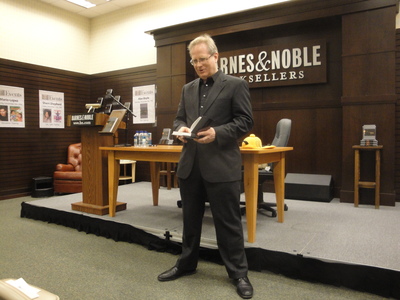
Alan Boyle reading from his newly released book, “The Case For Pluto” at Barnes and Nobles in The Grove in LA.
Photo: copyright Dale Amon, All Rights Reserved
Alan’s book release also presents me with the excuse I have been waiting for to throw in my tuppence in this ‘debate’.
For astronomical purposes, the reclassification of Pluto to officially be a scare quoted ‘Dwarf Planet’ is useful. I can also admit their classification of every element other than Hydrogen and Helium as a metal might also be useful… to them. On the other hand, neither classification is of much use to anyone else. Oxygen might be an astronomer’s metal, but to one like myself whose undergraduate degree was in Electrical Engineering, this method of sorting elements is rather silly. astronomer’s definition of planet is likewise rather worthless outside their discipline.
For those of us who look upon space as a place for settlement, commerce, and a source of resources to feed a solar system wide industrial economy, knowing whether a body clears its orbit of other matter is a “So what?” issue. Settlement and industry have different concerns and will most likely require a more complex system of classification. A planet with a thousand kilometer deep atmosphere that gradually turns to a liquid and then a solid phase is not useful for the same things as a body with a rocky surface. There may be temperate bodies out there covered with hundred mile deep oceans of water; there may be ones with molten rock surfaces. Each presents unique characteristics to the future explorer or industrialist.
From my point of view a planet has sufficient gravity to make it round-ish. Ceres and many of the new bodies outside of Pluto’s orbit are therefore planets in my book. I propose that just as Electrical Engineers ignore the astronomer’s definition of metal, the rest of us should ignore their definition of planet as well.
The UK state sector is two large banks with a medium sized government attached.
– John Redwood. Funny, but the UK government is not really medium-sized at all. This is still a big country on most measures. And the government’s share of GDP, our overbearing officialdom, and state colonization of civil society, are each now uncomfortably upper-quartile among democratic states and heading rapidly upwards. We are arguably now more governed than France, the home of dirigisme.
I am sitting a few feet away from Rand Simberg of Transterrestrial Musings in his home office in LA as I write. I flew in last night partly for some work and meetings having to do with our company (Wyoming Aerospace), and partly for an historic event. Well, more than partly for the historic event… and no, it is not Alan Boyle’s book signing, although I will be seeing him tonight! I cannot actually say anything yet as the press release is still under embargo as far as I know.
I will report on some interesting matters in a few days, hopefully with a lot of photos.
Ah, the embargo must be over!
I will be up at the XCOR and Masten hangers and hope to have access to Scaled as well. I am waiting to hear on that still.
The propensity for libertarians to disbelieve ‘official’, ‘public’ or state-financed work could be viewed on a par with the finger-pointing of anti-capitalists who sniff interest in every corporate donation. Yet, it is not. Those who deride the corporations tend to see no wrong in public action, since the collective is always morally beneficial. The world-weary fighter for freedom is far more sceptical of any agenda promoted by any particular lobby or interest.
Let us not forget that the catechism of climate change is funded from public and private sources. Any lobby faced with the thwarting of its ideology at the expected moment of greatest triumph reveals its limitations. The reversion to denial, verbal assault and language reminiscent of communism:
He [Ed Miliband] said the former chancellor Nigel Lawson and former shadow home secretary David Davis were irresponsible and were acting as “saboteurs”.
Is the answer to throw them into camps? Trends in the groupthink of its political supporters, wedded to the authoritarian apparatus of New Labour, have proven very worrying. The policy has come to be perceived as a sacred duty, the questioning of which becomes a trespass.
The stupidity that characterises their thought extends to their science. I am charmed at the thought that bumbling scientists, taking a ‘string and sealing wax’ approach, proved unable to even set up a programme for data analysis. No audit trail or commercial standards were reproduced within the university, and that oft-quoted British charm of ‘muddling through’ did not work. The CRU thought that something would turn up. It did: the blogosphere.
The only way to salvage any understanding from this mess is the obvious point: outsource the data analysis to a private sector company whose lifeblood depends upon a proven record for reliable data analysis. Not some internal investigation without the wit to understand conflict of interest.
I realise that for any US politician to seriously court the US conservative vote, they have to ‘do the God thing’, but I cannot help wincing when I hear people like Sarah Palin, who I think has much to commend her, say things like “the United States should rededicate itself to seeking God’s will“… whatever the hell that means.
I think what really offends me most about this sort of proclamation is the notion of the need for ‘unity’ rather than just a simple commonality of interests: if I am going to support someone politically, I am damned if I will to seek in that politician an additive “whole world view”. If Sarah Palin wants to trim the intrusive regulatory state, as she seem to want to do, well that is splendid, but I would rather not hear about how she thinks others need to include some anthropomorphic psychological guy-in-the-sky construct in their decision making processes.
Perhaps it is my English sensibilities but I am deeply suspicious of anyone who cannot keep their religious sentiments to themselves. I am willing to tolerate the religious views of others but, like most vices, religion is something best practised behind closed doors with other consenting adults as can be very unedifying when indulged in public.
Tom G. Palmer has a new book out and he is one of those guys whom I read pretty regularly. He recently talked about the book, its topics, in a panel discussion along with Marginal Revolution blogger and NYT columnist Tyler Cowen. Definitely worth your time.
This lead item in the Guardian newspaper today, which I read with a sort of grim satisfaction, explains how he has bought into the whole idea that climage change skeptics are not just wrong, they are baaaaaaaad. The reaction to the scandal of the University of East Anglia CRU emails shows that part of the “Green Establishment”, with odd decent exception, to be in deep denial.
Keep it up, Gordon. The more this plodding, revolting disaster of a politician and his friends continues to take this line, the more it justifies what Lord Lawson, former UK Chancellor, is trying to do in re-framing the debate over the policy of how to address real or alleged AGW. Gordon Brown: he’s the gift that keeps on giving.
Update: fresh developments at the UK’s Met Office. (H/T: Counting Cats).
“The science is so settled it’s now perfectly routine for leaders of the developed world to go around sounding like apocalyptic madmen of the kind that used to wander the streets wearing sandwich boards and handing out homemade pamphlets. Governments that are incapable of – to pluck at random – enforcing their southern border, reducing waiting times for routine operations to below two years, or doing something about the nightly ritual of car-torching “youths”, are nevertheless taken seriously when they claim to be able to change the very heavens – if only they can tax and regulate us enough. As they will if they reach “consensus” at Copenhagen. And most probably even if they don’t.”
– Mark Steyn.
So when Peter Mansbridge went on the National tonight to admit what he had surely known for days, we didn’t watch to find out what’s contained in FOIA 2009.zip, for we’d read it for ourselves.
We only watched to see if he had.
For perhaps the first time in the history of mass media, the gatekeepers broke a major scandal to an audience fully 10 days ahead of them.
– Small Dead Animals describes how the mass media of Canada finally got around to noticing Climategate. Thank you Counting Cats.
I see that Peter Mandelson, now Lord Mandelson of Post-Industrial Northern Wasteland – or whatever, is frustrated, apparently, that he did not get the job of the European Union’s foreign representative. Indeed. His friend, former Prime Minister, Tony Blair, also failed to secure the plum of the EU Presidency. I can see the charms: no grubby electioneering, lots of nice trips and conferences and armies of lackeys serving your needs, driving you around in limos, etc.
To quote Mick Jagger, you can’t always get what you want. I am sure Mr Mandelson will recover his sang froid eventually. These things are sent to test us.
|
Who Are We? The Samizdata people are a bunch of sinister and heavily armed globalist illuminati who seek to infect the entire world with the values of personal liberty and several property. Amongst our many crimes is a sense of humour and the intermittent use of British spelling.
We are also a varied group made up of social individualists, classical liberals, whigs, libertarians, extropians, futurists, ‘Porcupines’, Karl Popper fetishists, recovering neo-conservatives, crazed Ayn Rand worshipers, over-caffeinated Virginia Postrel devotees, witty Frédéric Bastiat wannabes, cypherpunks, minarchists, kritarchists and wild-eyed anarcho-capitalists from Britain, North America, Australia and Europe.
|





Recent Comments