We are developing the social individualist meta-context for the future. From the very serious to the extremely frivolous... lets see what is on the mind of the Samizdata people.
Samizdata, derived from Samizdat /n. - a system of clandestine publication of banned literature in the USSR [Russ.,= self-publishing house]
|
A number of governments – the UK and German – have used information stolen from a Liechtenstein bank in a bid to hunt after alleged tax evaders. And now, there is a story that data has been stolen from HSBC Private Bank (Suisse), divulging data on scores of French clients. The French government, you will not be surprised to learn, gentle reader, is probably not all that shy of using stolen material. It will be interesting to see what happens to such data. Here is another news report.
As I keep saying in my defence of tax havens, bank secrecy is not really about allowing dodgy folk to squirrel away ill-gotten gains, which is the usual image presented these days. (That is not to say that such secrecy has not been abused in the past). In past ages, groups fleeing persecution – such as Jews from Nazi-controlled Europe – availed themselves of banking secrecy in order to protect what was left of that wealth. We should not be so naive as to imagine that even without a repeat of such horrors, there is not a need for client privacy to be rigorously enforced. It is monstrous that governments should use stolen material in this fashion, but then, as the founding editor of this site likes to remind us, the state is not your friend.
Here is a witty description of the way the Climategate story is unfolding, from someone called David Solway:
Witnessing the spectacle of climate warmists scampering hither and thither in the face of predatory evidence that they and their pet theories may be doomed, I’m put in mind of the behavior of hamsters who suddenly find themselves trapped in a cage with a hungry snake. The ensuing drama is instructive.
First the hamsters freeze as if in a state of petrifaction induced by utter disbelief. When it dawns on them that they have what looks like an insoluble problem on their tiny paws, they begin to shake and fidget, and soon they are darting feverishly from one side of the cage to the other, endlessly back and forth, seeking an escape hatch which simply isn’t there. It occurs to them that they are cornered, there is no way out, and they start digging furiously into the sand floor, emitting plaintive squeals of fear and despair as the snake slowly uncoils from its torpor and begins its relentless approach.
Like David Solway, and like our own Johnathan Pearce, I am optimistic about how the Climategate story is unfolding. It will, hamster like, run and run. How many other climate scientists cooked their data, and how outrageously? Which politicians, and which journalists, took the lead in swallowing this story? Who has been paying all these climate scientists to find AGW by fair means or foul and then to recommend global statism? The questions are endless, the answers will be fascinating, and the dextrosphere won’t let go of this now.
But what I want to know is: how does David Solway know all this, about how hamsters behave when set upon in a cage by a snake? His description is suspiciously vivid. Has he actually done this experiment? Has he seen hamsters in a cage being attacked by a big snake, on account of him having just put them there? If so, and if he then did nothing to rescue the poor hamsters, because science is more important than being nice to hamsters, then: what a complete bastard. The Climategate scientists put themselves into their cage, but this cage is only metaphorical and nor are their critics literally going to eat them, however much some of them might deserve such a fate. But David Solway’s actual hamsters did nothing to deserve such torment.
He adds:
One feels for the caged hamsters.
Oh, one feels for them, does one? But not enough, it would seem, for one actually to try to rescue them.
Maybe David Solway just saw this on You-Tube. Or maybe he, or some equally nasty friend of his, set all this up personally, but then later, in the nick of time, he (or they) did rescue the hamsters (in which case David Solway is still a bastard but not as much of one). Either way, I think he should have said.
He ends his piece thus:
Unless, of course, a miracle should occur, the cage door open, and an indulgent hand reach inside to rescue the hamsters from their plight, ensuring that the snake starves to death while the hamsters frolic in relief and gratitude. This, too, could happen. As we know all too well, there is more than one indulgent hand ready to perform an act of tender, self-interested, and hamster-friendly mercy.
It’s almost as if a friend of David Solway’s read everything above this ending, and said what I just said, isn’t it?
As a description of Climategate this final reversal contradicts everything before it. “This too could happen.” How? An “indulgent hand”? What hand?
The idea of such pieces is to raise the morale of David Solway’s side and mine in the Climategate argument. Keep it up lads, we’re winning. And then he goes and ends by saying, for no reason: but then again, maybe we’re not winning.
Why do writers do this? Something to do with ending intriguingly and amusingly, perhaps, with a final and surprising U-turn that you did not see coming? Or maybe it’s a doomed attempt to mollify the unmollifiable opposition, an attempt to turn them into neutrals by being nice to them, an attempt to be inclusive, a friendly nod to all the people who aren’t reading in the first place.
Or maybe David Solway just wasn’t sure that his piece is actually right, in which case I think his doubts would have been better handled by appearing at the start alongside his hypothesis, on a this-may-not-be-right-but-here’s-a-thought basis.
Or, in this case, did he simply want to look less like a hamster-torturing bastard but forget that his way of trying to do this contradicts his entire argument?
What I want to know is, were those actual hamsters actually rescued?
Timothy Garton Ash, writing in the Guardian displays the jarring sensibilities that comes inevitability from holding the sort of fuzzy authoritarian statist views that prevail these days. On the subject of the Swiss ban on new minaret construction…
That is to put the clock of religious toleration back 300 years, to a time when even protestants in Catholic France could not worship in public. Of course, planning regulations and the local townscape must be respected. Architectural tact and syncretic innovation are desirable, as brilliantly exemplified in the new buildings of the Oxford Centre for Islamic Studies or Boston’s Islamic Cultural Centre. But this vote was not about urban planning.
Actually it is about ‘urban planning’, just not for the sort of reasons the writer approves of.
But what makes me laugh is that Ash has no problem whatsoever using the force of the state to make people build in ways he approves of. It is clearly axiomatic to him that the state gets to have planning regulations over what you can build on your own private property, even over mere aesthetic issues (i.e. he likes the fact the political trumps the social completely when it comes to your property). He just wants what people like him thinks is ‘desirable’ to be allowed.
Yet somehow when that political process he accepts as axiomatic produces something he does not think is ‘desirable’ to his Guardianista sensibilities, I doubt it occur to him that maybe it is his acceptance of people exerting force backed political power over others in pretty much every aspect of life where the problem lies.
Muslims in Switzerland wishing to build minarets on buildings dedicated to praising the words of their mass murdering Dark Ages warlord only have the problem they now face because people like Timothy Garton Ash think it is perfectly alright that the state to be allowed to ‘plan’ what people can do on their own property.
Rand Simberg and I left his house in LA at a time he predicted would be optimal from a traffic standpoint, and as he used to commute to work at Rotary Rocket several times a week in the Nineties, he ought to know. We were in rain and overcast until one set of hills before Mojave when the Native American gods blessed the undertaking with a full rainbow bridge. Since photo ops of this sort are not easily scheduled with higher authorities, Rand pulled over.
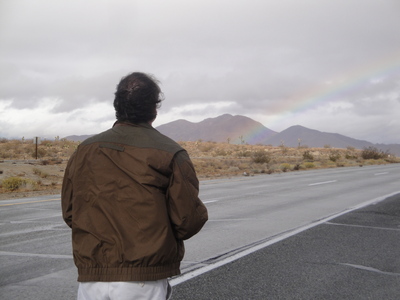
Rand Simberg peers intently into the distance in hopes of spotting the pot of gold we need for our Wyoming Aerospace venture
Photo: copyright Dale Amon, All Rights Reserved
I have not been up to Mojave for a few years and some things have changed. The gate guardian Phantom is now at the airport entry, and it has been joined by a rather rare 1960’s vintage Convair airliner. Most striking to me was Roton standing proud not far from the main building. The first time I saw it was inside the Rotary Rocket High Bay back in 1999 and at that time I was only allowed to record it in my memory.
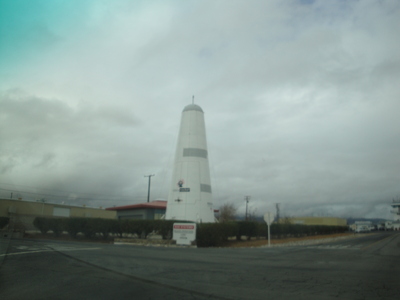
Roton is the first commercial space Gate Guardian that I am aware of
Photo: copyright Dale Amon, All Rights Reserved
Those who have been around the space scene for awhile will remember the Space Studies Institute. It was once a major player but seemed to fade out over the last 15 years and some thought it had died completely. Not so! Lee Valentine and Robin Snelson have moved it from Princeton to an office inside the terminal just behind Rand.
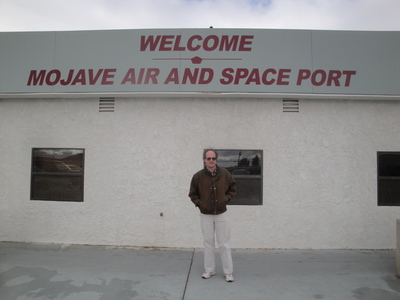
Obligatory tourist style photo of Rand. As if he has not been here a few thousand times before…
Photo: copyright Dale Amon, All Rights Reserved
First stop was the Voyager restaurant, an amenity that is fairly recent. Lunch used to require a trip into town. The first thing I noticed coming in the door was that I knew a large fraction of the people there; the second thing I noticed was the private jet parked just outside with a G-number and a Virgin logo. I wonder who that might belong to?
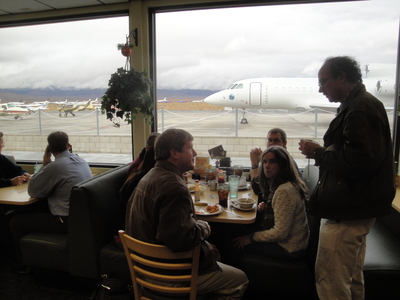
Familiar faces in the lunch crowd at the Voyager.
Photo: copyright Dale Amon, All Rights Reserved

Care to hazard a guess at the owner?
Photo: copyright Dale Amon, All Rights Reserved
After chatting awhile in the lounge we found that someone was over in the SSI office and we could connect to the net or work from there if we wished. As it turned out, we mostly just talked and looked over the large collection of commercial and space industrialization books lining the walls.
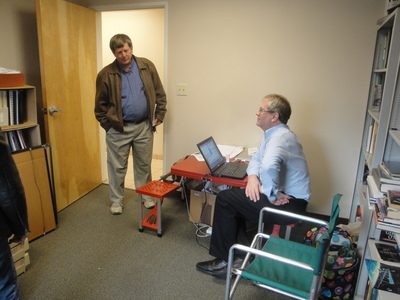
Just hangin at the SSI office.
Photo: copyright Dale Amon, All Rights Reserved
In the next installment I will cover the visit with our old friends and colleagues at XCOR.
You can find an intro article here.
As we await the UK government’s financial statement known as the Pre-Budget Report, expected to be full of stuff designed to appease Labour’s so-called “base” of banker haters, I have been re-reading Ludwig von Mises’ classic explanation of why there has been so much hatred for markets and business down the years from the likes of intellectuals and their media outlets. Some of the names and examples will be a little dated – who now remembers such old monsters like Harold Laski? – but the message is as pertinent as ever.
In an earlier posting today, I expressed the fear that this Copenhagen nonsense would lead to quite a few more stupid laws. But the news right now seems to be rather better than that:
The UN Copenhagen climate talks are in disarray today after developing countries reacted furiously to leaked documents that show world leaders will next week be asked to sign an agreement that hands more power to rich countries and sidelines the UN’s role in all future climate change negotiations.
If this shindig can be a total fiasco I really do not care why (for his own idiot reasons this guy agrees). Sadly, I fear that this leak may just be negotiation as usual. The bodge that results will still probably be pretty terrible.
On the other hand, maybe the rich countries do not actually want a deal. Reading that Guardian report, you can almost hear the rich country negotiators muttering amongst themselves that they would prefer to stay rich. But maybe that is a step too far towards being sensible, and too much to hope for.
Fingers crossed.
This evening I am doing a recorded conversation with Bishop Hill, and by way of preparation have been rootling around in his archives. And I just came across this, which the Bishop posted on November 19th 2006:
In this connexion the thing to be remarked is that the Whigs proceeded by the negative method of repealing existing laws, not by the positive method of making new ones. They combed the Statute-book, and when they found a statute which bore against “the liberty of the subject” they simply repealed it and left the page blank. This purgation ran up into the thousands. In 1873 the secretary of the Law Society estimated that out of the 18,110 Acts which had been passed since the reign of Henry III, four-fifths had been wholly or partially repealed.
Excellent, apart from the odd spelling of “connection”.
That’s not by Bishop Hill himself. It was recycled from somewhere called “Outside Story”, the link to which no longer works. But there’s no reason to doubt theis particular story, which should now inspire us all. For too long we have been ruled by politicians who measured their success by how many laws they could pass. Because of these fools, we now need politicians who measure their success by how many laws they can unpass.
Bishop Hill’s latest posting, as I write this, is to this. Well worth reading. Climategate is not nearly over. It is just getting into its stride. At Copenhagen, lots of laws, seemingly unshiftable from then on, will be made, maybe not as many as would have happened without Climategate, but still, most of us here surely fear, a lot. But the point is: laws can be unmade. There can be, and there must soon be, another great purgation.
George Monbiot, who the other day voiced anger at the misbehaviour of so-called scientists at the University of East Anglia’s climate resarch unit, has reverted to his original mode of George Moonbat by attacking AGW skeptics as deniers who want to dupe the public in the service of Big Oil. It does not occur to this man that he, and others like him, also have made a very nice living out the AGW story. After all, research grants and academic careers have been built on it. Where’s there is muck, there is brass, as they say.
There is a whiff of desperation in the air from these guys, who resemble nothing so much as a bully confronted by those whom he or she has tormented. Opinion polls like this one show high levels of skepticism among the public about the claims made by alarmists, and the fact that the climate has not, on average, warmed up at all since 1998, is not quite helping their cause.
Monbiot and others like him need to drop the hysteria, the smugness, the bullying and the rest of it. They need to grasp the fact that their predictions are debatable and that the CRU leaks are intensely damaging to their agenda.
Even a BBC Breakfast TV presenter, who normally has all the interviewing manner of a soft cuddly toy, asked a guy on the show yesterday about “whether the UEA leaks are undermining the Copenhagen process”. This story is not going away.
The world’s first commercial spaceship was unveiled and christened today at Mojave. I will post more when I have slept and caught my flight home, but here is just one photo of the very full day of activities. I did not have as much time as Rand Simberg to get articles out due the large number of hats I was wearing today. I was also not official press although I could have slipped in as most of the annointed press knew me and would have said nothing
In any case, I will have more to say and I have hundreds of photos. Here is just one.

Christening of the VSS Enterprise.
Photo: copyright Dale Amon, All Rights Reserved
According to Peter Hitchens:
The Atheists must reject Christianity as well as Islam. Alas, for them, Islam responds to their rejection by ignoring them, whereas Christianity tends to retreat before them. And a weakened church laces a vacuum into which Islam can move. Result? The growing power of Islam in our society, our culture, our government, our political parties and our schools, so that an essentially Atheist state pays increasing obeisance to Islam. I’ve said it before and I’ll say it again, the new Atheists, by attacking Christianity, are simply clearing a space for Islam to establish itself in the space they have swept and garnished.
Discuss.
Traditional journal based scientific peer review works as follows. A researcher does his research and writes his paper. He then submits the paper to the editor of a journal. The editor of the journal then sends the paper to a number (usually two or three) of other researchers in the same field. These researchers then write short reports on the paper outlining what is good or bad about it and usually suggesting improvements, along with a recommendation as to whether the paper should be accepted by the journal. The reports are then forwarded to the author of the paper, who responds to suggested changes and then sends a revised version of the paper to the journal. After possibly several repetitions of this, an accepted paper will eventually be published in the journal.
Referees are supposedly anonymous. However, the author, the editor, and the referees often work in small fields where everybody knows one another, and people’s beliefs, foibles and writing styles are often well known, so this anonymity is often more theoretical than real. The theoretical reason for anonymity – that the referee can say what he pleases without consequences – is not always entirely true. The anonymity is one sided: the referee receives a paper with the name of the author at the top. The name of a famous and influential scientist at the top has an impact. The editor is very powerful, as he gets to select the referees and by choosing referees carefully clearly has influence whether a paper will be published or not. A good editor will choose referees of mixed levels of seniority (referees include everybody from graduate students to senior professors), and (in areas of some dispute) of mixed positions in any argument.
There are various ways in which this process can be corrupted, but (certainly in the field I worked in) this generally did not happen. Publishers of journals made a point of appointing people of integrity as editors. It was in their self-interest to do this, because the long term consequences of not doing so would be a loss of credibility for the journal. The danger, always, is that authors, editors, and referees all end up coming from the same clique, in which such a process can be corrupted.
Another danger is that fields become isolated from each other, and workers in one field do not properly absorb knowledge and techniques from other fields. Many scientists (and non-scientists) for that matter use a great deal of statistics in their work, and do a great deal of computer programming in their work. Often, they will not be experts in either statistics or computer programming. Sometimes they will do good work from a statistical perspective, and write good computer code. On the other hand, if their work is to be published in peer reviewed journals, and the referees for the papers selected by those peer reviewed journals are not experts in statistics or computer science, and use similarly sloppy methods themselves, then poorer quality work can at times be gotten away with (similarly, you should beware of anyone in business or finance who tells you that his “proprietary black box model” tells this, and that he cannot show it to you because it is “proprietary”. Similar situations of sloppy code and statistics are endemic here, too).
The obvious point is that, when relevant, the peers who do the peer review should include statisticians and computer scientists as well as other workers in the precise field as the author of the paper. Science has become very specialised, and specialists in the same field do not talk to experts in other fields nearly often enough. However, the techniques different scientists use are not nearly as specialised as many proponents think they are. With some effort, experts in one field can understand the work of experts in another.
Traditional peer review does not encourage this.
Which is why in many of the most rigorous, competitive fields, in which really good, high quality science is done, traditional peer review has lost much of its relevance.
Some history… → Continue reading: Peer review and open science
Bishop Hill, who has been working overtime to keep apace with the whole University of East Anglia climate change kerfuffle, has this remarkable example of how some journalists have been threatened by AGW alarmists. How lovely.
By the way, as a native of East Anglia, I feel ashamed of how my region has been tainted by these arseholes. When the UEA was originally built back in the 1960s, it was constructed, much to my father’s chagrin, on a golf course. Given the collapse in that institution’s reputation as a result of the emails, perhaps it should revert to golf and do less harm to what remains of the UK’s intellectual life.
|
Who Are We? The Samizdata people are a bunch of sinister and heavily armed globalist illuminati who seek to infect the entire world with the values of personal liberty and several property. Amongst our many crimes is a sense of humour and the intermittent use of British spelling.
We are also a varied group made up of social individualists, classical liberals, whigs, libertarians, extropians, futurists, ‘Porcupines’, Karl Popper fetishists, recovering neo-conservatives, crazed Ayn Rand worshipers, over-caffeinated Virginia Postrel devotees, witty Frédéric Bastiat wannabes, cypherpunks, minarchists, kritarchists and wild-eyed anarcho-capitalists from Britain, North America, Australia and Europe.
|





Recent Comments