We are developing the social individualist meta-context for the future. From the very serious to the extremely frivolous... lets see what is on the mind of the Samizdata people.
Samizdata, derived from Samizdat /n. - a system of clandestine publication of banned literature in the USSR [Russ.,= self-publishing house]
|
“The ideal French response might have involved close-formation shrugging, smoking in a pointed manner, farting in the Kiwis’ general direction or perhaps setting fire to a sheep and laying it on the 10-metre line, but the ridiculous namby-pambyisation of modern rugby forbids such incendiary techniques.”
Alan Tyers, writing about the recent match between France and New Zealand.
I don’t see why the French should not be able to treat the Haka with contempt. If a bunch of guys with tattoos did a war dance in front of me, sticking their tongues out and generally carrying on, the correct response, surely, is a look of utter contempt, married with a suitably powerful array of rude gestures, farting, belching and, in extremis, a fully automatic weapon with the safety catch taken off. Just imagine if the French rugby captain said: “Now try this for size, you noisy fuckers!”.
Sport, how we love it.
“Hitler remained closely involved with the crusade against tobacco to the very end. He banned smoking at his Austrian base, the Wolf’s Lair, and in the Fuhrerbunker in Berlin. In 1942, he voiced regret that he had ever allowed his troops a tobacco ration; a ration he would soon be forced to increase to boost morale when the war went from bad to worse. In 1943 he made it illegal for persons under the age of 18 to smoke in public places. A year later, with the Third Reich crumbling around him, Hitler personally ordered smoking to be banned on city trains and to protect female staff from second-hand smoke.”
“Hitler committed suicide in April 1945 and, after burning his body, SS troops lit cigarettes in the Fuhrerbunker for the first time. Within weeks, cigarettes became the unofficial currency of Germany, with a value of fifty US cents each. Hitler ultimately, if inadvertently, succeeded in reducing smoking in Germany but only by bringing the country to its knees.”
Pages 76 to 76 of Velvet Glove, Iron Fist: A History of Anti-Smoking, by Christopher Snowdon.
Last night, when flicking through the TV channels, I watched the “documentary” film-maker, Michael Moore, talk about his own views on the Occupy Wall Street/wherever people. And he adopted that seductively reasonable tone of voice, although the general effect is spoilt by that annoying baseball cap he insists on wearing (who is he trying to fool, exactly?). The questions from the Channel Four interviewer were fairly softball stuff. At no point did the interviewer say something like: “So, given what you have said about greedy bankers and corporations, can we take it that you oppose the multi-billion bailouts of Wall Street banks, Mr Moore?”
I suspect that some of the OWS might indeed think that bailouts for banks are wrong, although if they follow their views through to a logical conclusion, it leads to laissez-faire, not the socialist nonsense of the film-maker from Flint. We need to keep making this point.
First, you unilaterally declare that there is some huge looming disaster a long ways in the future. Using a variety of methods fair and foul, you obtain the full cooperation of other scientists, governments, educational institutions, and the media the world around. With all of you, the whole chorus, baying for skeptic’s blood in full voice, you spend a quarter century trying to convince the people of the oncoming Thermageddon.
Second, after said quarter century you notice that despite having the entire resources of the educational and media institutions of the planet and the blind agreement of other scientists and billions of dollars poured into trying … you have not been able to establish your case. Heck, you haven’t even been able to falsify the null hypothesis. In fact, after a long string of predictions of doom, none of which came to pass, and at the tail end of a 15-year hiatus in the warming, the US public doesn’t believe a word you say. Oops. Over two-thirds of them think climate scientists sometimes falsify their research. Oops.
In response, you say that the problem is that scientists have been too retice … too re … sorry, it’s hard to type and laugh at the same time … you say that scientists have been to reticent, that they haven’t been alarmist enough or aggressive enough in promoting their views.
That’s the problem? After 25 years of unbridled alarm from scientists and everyone else from Presidents to my kid’s teachers, the problem is that scientists are not alarmist enough, they’re too reticent to state their true opinion? Really? That’s the reason the public doesn’t believe you? Is that your final answer?
– Willis Eschenbach takes a sledgehammer to the nut that is James Hansen, a nut who, alas, continues to be employed in a prominent and influential position by NASA.
The word Thermageddon has been around for quite a while, but it’s new to me. I like it.
Disappointingly, it seems that some of these scenes of the happy family life of a Star Wars stormtrooper may have been faked. In the comments to this Daily Mail article, “John, Bristol’ claims that “the small one is a Lego toy.” I shall leave readers to make up their own minds.
‘Why Britain Should Join the Euro’ – a pamphlet by Richard Layard, Willem Buiter, Christopher Huhne, Will Hutton, Peter Kenen and Adair Turner, with a foreword by Paul Volcker.
One of the authors, AdairTurner, now Lord Turner, is interviewed in today’s Observer, which is where I saw the link. He has changed his mind a little since 2002, when the pamphlet was written, but not to an unseemly extent. Now Chairman of the Financial Services Authority, he is concerned about the current situation but remains confident that “sensible decisions are going to be made”.
So there you are then. Cheer up!
[G]reen thinking represents a challenge to the status quo? That’s a laughable idea. From schools and universities to every corner of the Western political sphere, the climate-change outlook is the status quo. It’s the new conservatism, its aim being to conserve nature at the expense of further developing and transforming society.
– Brendan O’Neill
I slept very badly last night, and didn’t watch Wales v Australia in the Rugby World Cup play-off for third place, this morning London time, as it happened. But my recording machine had been set and I now have watched the game. Sadly, in the middle of watching it, I blundered upon the result (an Australian win by 21-18) while looking for something completely different in the www. Pity.
The last try by Wales didn’t stop Australia winning, but it at least ensured that the Northern Hemisphere as a whole was that much less seriously beaten in this tournament than it might well have been, and might still be. Ditto that earlier Ireland win against Australia. After that Ireland win, commentators said: This reflects well on the Northern Hemisphere. But commentators also said: This makes things easier for a Northern Hemisphere side to get to the final. Which gave the game away. What they meant was: As opposed to the Southern Hemisphere monopolising the final stages, which is probably what would have happened had there been Southerners in both halves of the draw, instead of the final stages being neatly divided, North and South.
The sad thing about rugby is how much injuries influence matters. Dan Carter, the New Zealand All Blacks first choice fly half (the rugby equivalent of a quarterback), is already out of it. The Welsh first choice fly half also missed the last two Welsh games, both of which they lost narrowly. Partly as a result of such mishaps, this tournament has, for me, been rather an anti-climax, and not just because England never turned up, as they say. The France Wales semi-final was disappointing because of the unsatisfactory way that France squeaked through, without ever playing as they can. Wales lost partly because the Welsh captain was sent off early on, and partly because Wales, who later scored the only try of the game, missed so many penalty kicks.
In general, this tournament has somewhat lacked dazzle, I think, of the sort that France Wales matches used to supply in abundance, way back when. Shane Williams scoring a try for Wales against Australia in this latest game epitomised the problem. Instead of creating a piece of video to treasure for ever, with a searing run and several dazzling side-steps, Williams scored his try with a forward pass to him, followed by him kicking it forwards some more, and him then catching the lucky bounce and plonking it carefully down over the line. Not the stuff of legend. Watching a TV show the other night about the 1971 Lions tour of New Zealand really brought home what’s been missing, for me. Had the sublime Barry John played in this tournament, he’d have gone out injured after the group games. (When I tried googling for barry john lions, I got a lot of stuff about John Barry, and his music for The Lion in Winter. But rugby fans will know exactly who I mean.) → Continue reading: The Rugby World Cup – nearly done now
This is priceless. It is a Friday, and it is good to have a laugh, even of a dark sort. Halloween’s on the way:
“Sir, I am saddened by the naivety of William Cash in juxtaposing wind farms and housing development as comparable threats to “our heritage”. If we do not tackle climate change there will be no heritage worth preserving, and probably no one around to appreciate the old piles. Not to mention, in the interim, the untold suffering caused to countries more immediately affected, such as Pakistan and the Horn of Africa. Opposing means of reducing carbon emissions is little better, where the likely consequences for human beings are concerned, than appeasing Hitler. Wind turbines are not, actually, particularly ugly, and certainly less so than the pylons we have lived with for decades.”
A letter from “Antony Black”, of Dundee, published in the 22 October print edition of the Spectator, page 30.
I love the way that this man likens skeptical views on Man-made global warming, and resistence to things like giant windmills, to the appeasement of a proven thug. It is worth quoting people like this man, not because it will have the slightest effect in changing their views, which constitute religious belief in its mix of fervour, self-righteousness and faux-rationality, but because it is important to show how such seemingly articulate people can believe such tosh, and get it printed in what is a relatively respectable publication.
James Delingpole, the British journalist, has a good take on the sort of folk that form part of the Climate Change alarmist crowd.
Gaddafi summarily executed by Libyan rebels… the world is a better place today than it was yesterday.
Lets hope this puts the right idea in people’s heads elsewhere.
This isn’t so much a political movement as a form of historical reenactment. That’s why the OWS protesters are so vague about what they want – because what they want is to be camping out at a mass 1968-style protest. There’s little difference between them and Civil War reenactors, except that the Civil War guys understand that it’s not real and the outcome of their mock battles won’t have any effect. The 1968 reenactors down on Wall Street have the quaint belief that what they’re doing is real.
– “Trimegistus” comments here. Like I said a week ago, farce repeating itself as farce.
This evening I attended the E. G. West Memorial Lecture, which was delivered by James Tooley, one of my favourite public intellectuals. The audience was large, and our response was attentive and at the end, enthusiastic.
Tooley started by describing the discoveries of E. G. West concerning the huge contribution to education in nineteenth century Britain made by the private sector, which had pretty much licked the problem of mass literacy and mass numeracy, only for the state then to come crashing in, crowding out the private sector and stealing all of the credit for what the private sector had accomplished.
Tooley then described how he has personally been finding the exact same story unfolding in the Third World right now. There too, the private sector is running state education ragged.
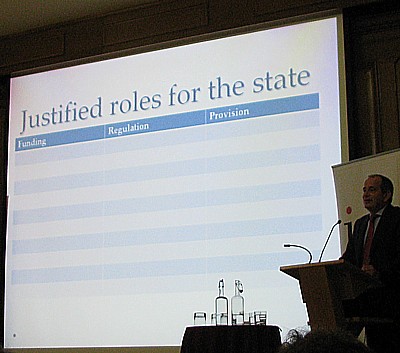
In the course of his lecture, Tooley presented this complete and comprehensive list of exactly what the state should be contributing to the funding, regulation and provision of education:
As often happens with my photos, people who care about such things will quibble about technical adequacy and artistic impression. But, I trust you get Tooley’s message.
I realised while listening to Tooley talk that I have been somewhat losing track of what he’s been up to lately. So when I got home, I ordered a copy of his book, The Beautiful Tree, which he mentioned in the course of his lecture, and in which I hope to learn many more of the details of what he’s been finding out about one of the great success stories of the world now.
During the Q&A after the lecture, Tooley was asked what Britain’s politicians should be doing about it all. What reforms ought they to be trying to contrive? Tooley said he expected very little from our politicians, predicting instead that if changes along the lines he would like do come, it will be because of foreign educational enterprises opening branches here, offering a cheap and effective alternative to state education at very little extra cost. That, said Tooley, will be when the good educational stuff starts happening in Britain, again, if it ever does.
LATER: A few more pictures here.
|
Who Are We? The Samizdata people are a bunch of sinister and heavily armed globalist illuminati who seek to infect the entire world with the values of personal liberty and several property. Amongst our many crimes is a sense of humour and the intermittent use of British spelling.
We are also a varied group made up of social individualists, classical liberals, whigs, libertarians, extropians, futurists, ‘Porcupines’, Karl Popper fetishists, recovering neo-conservatives, crazed Ayn Rand worshipers, over-caffeinated Virginia Postrel devotees, witty Frédéric Bastiat wannabes, cypherpunks, minarchists, kritarchists and wild-eyed anarcho-capitalists from Britain, North America, Australia and Europe.
|





Recent Comments