We are developing the social individualist meta-context for the future. From the very serious to the extremely frivolous... lets see what is on the mind of the Samizdata people.
Samizdata, derived from Samizdat /n. - a system of clandestine publication of banned literature in the USSR [Russ.,= self-publishing house]
|
Prudent savers hit by ‘excessive’ hidden fees on pensions
… sayeth the Telegraph…
The National Association of Pension Funds says that fees are too high and that consumers face an “eye wateringly complex” system of hidden levies. Last year, The Daily Telegraph exposed how pension charges could strip pensioners of up to three quarters of their income.
Well ok, that is entirely possible.
But does the fees that ‘prudent savers’ get charged not pale into insignificance compared to year after year of what artificially (i.e. politically driven) low interest rates has done to the very notion of being a ‘prudent saver’?
Indeed if you simply save your money in some safe low yield instrument, in such an environment as we find ourselves today you are not being a ‘prudent saver’ at all. There is nothing prudent about it as your money is very unlikely to maintain its value vis a vis inflation… and that is exactly the intention behind the policies of the Fed and Bank of England. They want you to spend in order to appease the animal spirits that drive the economy, rather than be a ‘prudent saver’.
That is who would-be ‘prudent savers’ should be railing against.
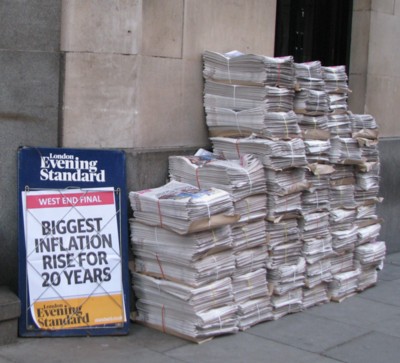
Snapped by me earlier this evening:
One of the key arguments in Detlev Schlichter’s Paper Money Collapse concerns the oft-repeated claim that the world’s central bankers won’t allow inflation to get out of control, because they are fully aware of what a very bad thing it is. But what if they also fear something else that they regard as even worse? Like the monster economic correction that a decades-long policy of easy money is now demanding, from the entire world?
The huge pile of paper next to this Evening Standard billboard seems rather appropriate, I think.
This is interesting:
“In the past 30-or-so years, hip hop has tried politics and it has tried gangsterism. But in the end it settled for capitalism, which energised it and brought it to a position of global dominance. American rappers like Puff Daddy and Master P, men who fought their way into the big time, did so by selling a vision of independence, empowerment and material success. That vision is also found, if less vividly, in Britain’s rap music. And though hip hop retains unpleasant features, the core message, that people can have better lives, is incontestably a good one.”
Prospect Magazine.
A point for we pro-market zealots to remember is that defending the market is not the same as defending all of the stuff that gets bought or sold in a market. The freedom to produce and sell products and services is emphatically not the same as saying that all of these things are splendid. Some are mediocre. Some are bloody awful, like rap music, in my opinion. Musical taste is, in any event, notoriously subjective. (I even know of friends who hate music, period). But it is interesting how even a lefty magazine such as Prospect points out that how the profit motive can have its own benign effect on a genre as aggressive as rap. You can tell that capitalism is weaving its magic when people start moaning that a certain once-rebellious arts and music genre has lost its “edge” (ie, it is no longer downright nasty).
The conventional word that it employed to describe tyranny is ‘systematic’. The true essence of a dictatorship is in fact not its regularity but the unpredictability and caprice; those who live under it must never be able to relax, must never be quite sure they have followed the rules correctly or not. Thus, the ruled can always be found to be in the wrong.
– Hitch-22: A memoir. By Christopher Hitchens, page 51.
This is probably the best autobiography I have ever read. In the passage above, he’s referring to his life in an English public (ie, private) school.
I was responding to a comment under this article… when it struck me: why do so many people find this screamingly obvious fact so bloody hard to figure out?
“The banks stole our money. If you are not banker, that includes you. The banks stole from everyone – businesses, countries, citizens.”
No, the politicians who bailed them out with taxpayer money stole ‘our’ money after they created the moral hazard that led to the banks doing the things that they were given the incentives to do.
In a sane world, said bankers should have simply been allowed to go bust… so the problem is not ‘bankers’, it is the people who refused to let the bastards go broke by giving them third party… taxpayer… money.
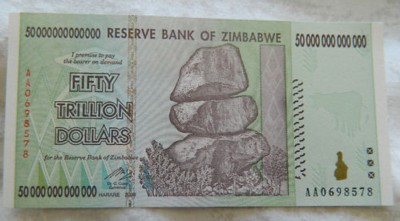
Andy Janes has just bought one of these:
He paid £1.70. Not bad. But how many pounds will such a thing cost in a few years time?
Have a nice weekend.
Here is a website that I have come across about the late, very great John Barry, the composer best known for all those superb James Bond tunes, as well as films such as Out of Africa.
He was never nominated for an Oscar for any of his 007 tunes. As Mark Steyn has observed, a classic case of snobbery at work.
I came across this good collection of messages via Tim Sandefur. “We are the 53 per cent” puts my sentiments across exactly.
I don’t want to sound overly harsh; some of the Occupy Wall Street people, as Brian Mickelthwait notes, might have some decent views and with a bit of outreach, could be helped to understand the statist dimension to our current problems. But I am afraid that with a lot of them, I tend to share the scornful analysis of George Will.
Talking of those who feel they work too hard to spend their time protesting, there are echoes of Sumner’s “Forgotten Man”.
Instapundit chooses the first few sentences of this piece about the Occupy Wall Street … thing, to recycle. But my favourite bit is where George Will summarises the OWS position:
Washington is grotesquely corrupt and insufficiently powerful.
I also agree with the following comment, which was attached to this:
The reason why these occupiers are getting so much attention is that the mainstream media think they’re not idiots and are advertising them, and the right wing alternative media know that they are idiots and are advertising them.
Which says part of what George Will said, and which I agree with because I wrote it.
It is, when you think about it, easier to write about something that is rather small. When you encounter an OWS event, you can listen to anyone there who wants to say anything in about ten minutes. Compare that with working out what the hell everyone thinks at a Tea Party get-together. To do an honest job on that you have to be there for hours.
But then again, these protesters are not, perhaps, all of them, complete idiots. They are very right that things have gone very wrong.
We’re due an OWS copycat demo here in London this weekend. Someone called Peter Hodgson, of UK Uncut, is calling for, among other things, “an end to austerity”, by which he means him and his friends keeping their useless jobs for ever. Good luck with that, mate.
There is actually some overlap between what some of these Occupy London characters may or may not be saying this weekend, and what my team says about it all.
Laura Taylor, a supporter of the so-called OccupyLSX, said: “Why are we paying for a crisis the banks caused? More than a million people have lost their jobs and tens of thousands of homes have been repossessed, while small businesses are struggling to survive.
“Yet bankers continue to make billions in profit and pay themselves enormous bonuses, even after we bailed them out with £850 billion.”
It’s like the Tea Party in Britain is too small, and has to climb aboard Occupy London. Well, maybe not, because Laura Taylor neglects to mention the role of the world’s governments in setting the various trains in this giant train-wreck in motion. Who caused the banks to cause this crisis? That’s what my team wants to add. The banks were only doing what the politicians had long been incentivising them to do, and the banks are doing that still. The banks are only to blame for this mess in the sense that they are now paying the politicians to keep it going. But that is quite a big blame, I do agree.
So anyway, the British government, like the US government, is now also grotesquely corrupt, and it should jolly well pull its socks up, its finger out and itself together. And then be hung from lamp posts.
Seriously, I remember back at Essex University in the early 1970s how the Lenin-with-hair tendency thought that the answer to every problem in the world then was to occupy something, fill it with rubbish and then bugger off and plan their next stupid occupation. They were tossers then, and they, their children and their grandchildren are tossers now. Farce repeating itself as farce.
Maybe I’ll dress up (as in: down) in shabby clothes and sandals with no socks (which I would never dream of doing normally) and join in, with a camera. Although, I promise nothing, because this weekend there is also the Rugby World Cup semi-finals to be attending to.
This caught my attention, at a site called “The Smart Set”.
“If the zeitgeist has a face, it supposedly belongs to Ayn Rand and her capitalist philosophy of Objectivism. Talk radio hosts adore the author’s demands for limited government; Congressman Paul Ryan insists that his staffers read her overstuffed opus Atlas Shrugged; picket signs at Tea Party rallies suggest that we all “READ AYN RAND.” And yet, some pieces are missing. Ayn Rand was anti-war, but spending for hundreds of military bases and two-and-a-half wars remains sacrosanct even as Congress made the debt ceiling a major issue. She found homosexuality “immoral” and “disgusting,” and yet gay marriage has regained the initiative in the public square. And Randian heroes are explicitly — nay, objectively — elitist. They are genius millionaire square-jawed heroes who walked right off the screen at the movie matinee. The average Tea Party rallier, not so much.”
A bit of a jumble. Rand was anti-war, certainly, but she certainly was no pacifist, either about the Nazis or any other totalitarian regimes. She had a problem about homosexuality, but I doubt she favoured the state using its violence-backed powers to suppress it; indeed, from my reading of her journals and other material, I don’t know if she had developed views on this subject at all. As for the line about her support for “elitism”, it does rather depend on what you mean. For Rand, and most who broadly support her views (as I do), the idea was that people are entitled to develop their lives and talents to the greatest extent possible in free trade with their fellows. There is plenty of room for upward mobility, striving and competition. This has nothing to do with privilege, which is often what can be meant by an “elite”, for example. (Elitism is, of course, a boo word for the egalitarian left, and I suspect the author of the piece tilts in that direction).
“There is another writer whose political and philosophical influence is finally being felt in the public sphere. You may have read one of his books as a child. His name is Robert A. Heinlein, and he wrote science fiction. He was a libertarian enamored of military might, a conservative who championed free love. His heroes are certainly competent. They’re also folks who hack the systems in which they live, not elitists who abandon a corrupt world full of moochers and looters to worship the dollar as an end unto itself. And unlike Rand, most of Heinlein’s work is actually readable.”
Some of this is true, though I don’t think Heinlein was “enamoured” of military might; he understood that values need to be defended, of course, so to that extent he understood the warrior ethic and code, but he also understood the trader ethic, too. He was able to see how military codes develop and why they exist (his book, Starship Troopers, is about this very issue).
The idea that the characters in Rand’s Atlas Shrugged “worship the dollar as an end unto itself” proves that the author of this article clearly has not thought straight. The point for Rand is that the dollar, preferably a gold-backed dollar, is a symbol of liberty, not something that you worship as a totem.
It is sometimes instructive when a writer from outside the usual field opines about something about which you know quite a lot, as I do about Rand and Heinlein, having read pretty much everything they wrote. The author of this article hits on some good points, so don’t be put off by my nit-picking.
Somehow, this man, Eoin, appears to be so thick (he’s a Doctor, apparently) that I fear he should be banned from handling heavy machinery:
“We are taught by Cameron to regard small businesses as the engine room of entrepreneurial spirit in the UK. We are led to believe that their inventions, wealth creation and profits lead to employment and growth. But this is the stuff of fantasy. Three quarters of the 4.5million businesses in the UK employ no one. Their wealth creation serves their own ends. They create no jobs and do nothing to solve youth unemployment. The vast majority of small businessmen are in business for themselves. Evidence of civic virtue or a desire to create jobs is in preciously short supply and thus Cameron was wrong to shrug off record rises in youth unemployment as something that could readily be solved by small business.”
So my wife, for example, who set up her own business (marketing for SMEs) has done nothing to reduce unemployment. So all those people who, for example, lost a job at a firm and who set up on their own are not doing anything to reduce unemployment unless they employ someone? Is this man for real?
Of course, given the job-destroying impact of red tape, employment protections on full-time and part-time staff, taxes, and so on, it sometimes is a marvel that anyone ever gets a paid job at all. I am a minority owner, and employee, of a small business in wealth management/media sector and every decision on hiring someone is taken with the utmost care, since it is difficult to fire someone if they are not up to scratch.
There are times when I fear that some people out there are so fucking stupid that Darwinian ideas of natural selection are in need of revision.
Thanks to Tim Worstall for spotting this piece of lunacy.
Yesterday afternoon, I attended the meeting at the House of Commons that I flagged up here a few days earlier. It was a fairly low key affair, attended by about thirty people or more. Not being a regular attender of such events, I can’t really be sure what it all amounted to. Things happen at meetings that you don’t see. Minds get changed, in silence. Connections are made, afterwards. You do not see everything.
But what I think I saw was this.
The first thing to clarify is that this was the Detlev Schlichter show. Steve Baker MP was a nearly silent chairman. Tim Evans was a brief warm-up act. Schlichter’s pessimism about the world economy was the heart of the matter. He did almost all the talking, and I believe he did it very well.
It’s not deliberate on his part. Schlichter just talks the way he talks. But his manner is just right for politicians, because he doesn’t shout, and because he so obviously knows what he is talking about, what with his considerable City of London experience, and that flawless English vocabulary spoken in perfect English but with that intellectually imposing German accent. He foresees monetary catastrophe, but although he has plenty to say about politics, and about how politics has politicised money, he is not trying to be any sort of politician himself. Basically, he thinks they’re boxed in, and when asked for advice about how to change that, he can do nothing beyond repeating that they are boxed in and that monetary catastrophe does indeed loom. But what all this means, for his demeanour at events like this one, is that he doesn’t nag the politicians or preach at them or get in any way excited, because he expects nothing of them; he merely answers whatever questions they may want to ask him. He regards them not as stage villains but as fellow victims of an historic upheaval. Despite the horror of what he is saying, they seem to like that. He didn’t spend the last two months cajoling his way into the House of Commons. He was simply asked in, and he said yes, I’ll do my best.
Present at the meeting were about five MPs, besides Steve Baker MP I mean, which is a lot less than all of them, but a lot more than none.
One, a certain Mark Garnier MP, seemed to be quite disturbed by what he was hearing, as in disturbed because he very much feared that what he was hearing might be true. Mark Garnier MP is a member of the Treasury Select Committee, which I am told is very significant.
Another MP present, John Redwood, was only partially in agreement with Shlichter. He agrees that there is a debt crisis, but doesn’t follow Schlichter to the point of seeing this as a currency crisis. In other words, Redwood thinks we have a big problem, but Schlichter thinks the problem is massively bigger than big.
Redwood was also confused by Schlichter’s use of the phrase “paper money”, by which Redwood thought Schlichter meant, well, paper money. Redwood pointed out, quite correctly, that paper money that has hundred percent honest promises written on it, to swap the paper money in question for actual gold, is very different from the paper money we now have, which promises nothing. Redwood also pointed out that most of the “elastic” (the other and probably better description of junk money that Schlichter supplies in the title of his book) money that we now have is mostly purely virtual additions to electronically stored bank balances. We don’t, said Redwood, want to go back to a world without credit cards or internet trading! All of which was immediately conceded by Schlichter, and none of which makes a dime of difference to the rightness or wrongness of what Schlichter is actually saying; these are mere complaints about how he says it. Such complaints may be justified, given how inexactly “paper money” corresponds to the kind of money that Schlichter is actually complaining about. But Redwood seemed to imagine that what he said about what he took “paper money” to mean refuted the substance of what Schlichter said. Odd.
For me, the most interesting person present was James Delingpole. (It was while looking to see if Delingpole had said anything about this meeting himself that earlier today got me noticing this.) The mere possibility that Delingpole might now dig into what Schlichter, and all the other Austrianists before him, have been saying about money and banking was enough to make me highly delighted to see him there, insofar as anything about this deeply scary story can be said to be delightful. But it got better. I introduced myself to Delingpole afterwards, and he immediately told me that he considered this the biggest story now happening in the world. So, following his book and before that his blogging about red greenery, Delingpole’s next Big Thing may well prove to be world-wide monetary melt-down. I would love to read a money book by Delingpole as good and as accessible as Watermelons. If Delingpole’s red greenery stuff is anything to go by, the consequences in terms of public understanding and public debate of him becoming a money blogger and a money book writer could be considerable. So, no pressure Mr D, but I do hope you will at least consider such a project.
|
Who Are We? The Samizdata people are a bunch of sinister and heavily armed globalist illuminati who seek to infect the entire world with the values of personal liberty and several property. Amongst our many crimes is a sense of humour and the intermittent use of British spelling.
We are also a varied group made up of social individualists, classical liberals, whigs, libertarians, extropians, futurists, ‘Porcupines’, Karl Popper fetishists, recovering neo-conservatives, crazed Ayn Rand worshipers, over-caffeinated Virginia Postrel devotees, witty Frédéric Bastiat wannabes, cypherpunks, minarchists, kritarchists and wild-eyed anarcho-capitalists from Britain, North America, Australia and Europe.
|





Recent Comments