We are developing the social individualist meta-context for the future. From the very serious to the extremely frivolous... lets see what is on the mind of the Samizdata people.
Samizdata, derived from Samizdat /n. - a system of clandestine publication of banned literature in the USSR [Russ.,= self-publishing house]
|
Do not grip fireworks with your buttocks.
– The final entry in David Thompson’s most recent batch of Friday Ephemera, with a link to the video that will convince you of the wisdom of this advice, in the unlikely event that you are not convinced of this already.
In a Twitter discussion my interlocutor suggested that mobile phone companies were behaving like a cartel when it came to data roaming charges. I am not sure about that but in any case such arrangements are less stable in a free market than otherwise, because barriers to new entrants would be lower.
Yes, said my interlocutor, look how well a free market works for Barclays, Enron and privatised rail companies.
If that is what people think free markets look like then no wonder we are having a hard time winning arguments. It is not just a semantic problem where capitalism has been incorrectly defined, though that is part of it. People really believe that rail companies are free to do what they please, and so are banks. There is some doublethink going on because the same people will talk about the failure of regulators.
It might be useful to point to examples of truly free markets. This is quite difficult as almost everything is subject to some regulatory interference. I like to think that we are not starving mainly because of free markets in food production and distribution, but there are all sorts of EU food subsidies and it can be argued that large supermarket companies have an advantage when it comes to planning permission.
I can think of examples from industries that I am familiar with. Consumer electronics are, as far as I can tell, almost completely free from regulation except for some safety and, lately, power consumption requirements. The rapid advances that have resulted are plain to see. The same is true of the semiconductor industry. Intel, AMD, Qualcomm and Nvidia are achieving ever more performance and making ever smaller transistors, and governments have very little to say about it, thankfully.
I can also think of services like web hosting and cloud computing which have very low barriers to entry and the result is a vast choice of very low cost products for consumers. All this is very nice because we can point to the freedom and the competition and the lack of monopolies, cartels and other unpleasantness, and all the wondrous things that have resulted and would not result if bureaucrats were present to make sure everyone behaved themselves.
There has to more that is free than the tech industry, though. What am I missing?
Last night I watched a television documentary about the career and achievements of Gordon Murray, a very different Murray from the tennis Murray whom I mentioned here on Saturday. Gordon Murray designs cars.
He started out doing racing cars. Time was when Gordon Murray was applying his extraordinary ingenuity to designing such things as “improvements” to McLaren racing cars, improvements whose only rationale was that they drove through some silly loophole in the rules of Formula 1 racing, a loophole that would soon close and render the new design feature utterly pointless. Okay, F1 is fun, and okay, most of what Murray did was make F1 cars go ever faster and get ever cleverer. But that rule-dodging bit in particular seemed like a serious waste of a talent, and I am sure the television people intended it to.
But Gordon Murray then took a big step towards applying his stellar engineering skills to a task more worthy of them when he designed the McLaren F1, which is the fastest car that multi-millionaires can buy to drive on regular roads. Better.
And now, Murray has designed a small car. This small car looks like a superior version of one of those covered over motorbikes, but actually it is a lot cleverer and more capacious than that. It is cleverer because it embodies half a lifetime of Murray’s experience in Formula 1, making everything in cars lighter, smaller and just plain better.
There are many ways to innovate. A good way is to innovate in just one aspect of a design, while relying on tried and tested technology for everything else. That way there is only one thing to go wrong and to get right. Very wise.
But Gordon Murray’s way is different. More “courageous”, you might say. He looks at everything. He looked at small cars the way huge teams of aircraft designers are perpetually looking at aircraft design, chiselling little ounces of bulk from here, there and everywhere, and where possible trying more serious rethinkings and rearrangements, adding up to a seriously improved product.
Innovation done this way can unleash a ton of mistakes, with all the good ideas getting overwhelmed by a few bad ones. Everything has to work. You have to get, near enough, a hundred out of a hundred, or you fail. You need lots of skill and experience to get a score like that. Gordon Murray, it would seem, has an abundance of both.
In particular, just as a for instance, this small car is interesting (courageous?) in using the same seating arrangement as the McLaren F1. In the McLaren F1, instead of the driver sitting on one side at the front, and then another bunch of people sitting behind on another big seat, or not, the F1 has the driver in the front in the middle, and two other seats on either side, but set back, in an arrow formation. The passengers can presumably stretch out their legs beside the driver’s bum. And the new small car has just the same seating set-up. Which makes it feel bigger inside than a regular small car, but much less bulky from outside.
Also, the doors to the new small car are an all-in-one door, which opens up and forward, like the top of an airplane. Combined with that seating arrangement, this makes it easier to get in and out of than the competition.
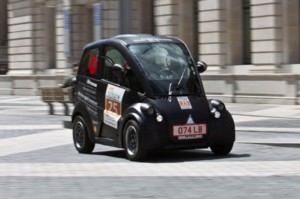
This small car comes in two versions. There is the black T25, which is petrol driven, and which looks like this:
And there is the blue version, the T27, which runs on electricity. They showed the T27 towards the end of the television show, in the company of some veteran cars in a place that looked a lot like central London, and I thought: hang on, this rings a bell. Sure enough, after a little digging in my photo-archives, I found this snap:
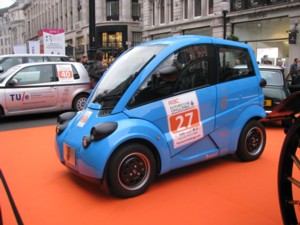 I took that picture of the T27 on the same day, early last November, that I took all these photos of veteran cars in Regent Street. (There is a slice of veteran car there on the right.) I far prefer the look of the black T25. Its strangely retro styling reminds me of a delivery van of the sort I recall from my youth. The blue T27 looks to me, still, like a boring little car only pretending not to be boring, which is why I had no idea how interesting it was when I first set my eyes and my camera on it. Oh me of little faith. Kudos to me, though, for taking “too many” pictures whenever I go out a-snapping. Time and again, as in this case, I only realise later, and sometimes a lot later, what I photoed.
Being so unbulky, this new T25/27 is much more fuel efficient than regular small cars, but its energy efficiency does not stop there. One of the most interesting moments in the programme came when they talked about how this new car will be made. There is more to cars being efficient than cars being efficient to drive. They also have to be as efficient and as cheap and as easy as possible to make, and this new car requires far less in the way of capital investment before you can start cranking them out. The huge manufacturing costs of regular automobiles, said my television, explained why most car makers prefer making expensive cars to cheap cars. Cheap cars don’t make any money. But this cheap car will make money for those who make it, or that’s the idea. That’s another huge potential step forward.
The claim was repeatedly made in this programme that this T25/27 is the biggest innovation in car making since the Model T, what with the revolutionary way that the Model T was manufactured. But the cars that this new gizmo makes me think of are the Citroen 2CV and the Volkswagen, which were likewise designed to be more easy to make than regular cars, were they not? The Citroen 2CV, I seem to recall reading, was banged out by peasants in a big barn, or some such thing, just after WW2, when manufacturing skills were scarce. This seems a lot like the T25/27 plan, which is a twenty first century version (i.e. with shipped in magic bits) of the same thing.
The T25/27 secret, apparently, is that the structural frame of the car is made of metal tubing, and that is far easier for cheapo, Third World type fabricators to work with than however small cars are made now, by the likes of Toyota and Ford and the rest of them.
The upshot of all this is that here is a small car, a truly small car, that will make regular non-multi-millionaire motoring massively less of an energy gobbler.
Which in fact means, if it all goes to plan, that many more people will drive around in such cars than drive around in any cars now, and the total amount of energy consumed by these cars as they wizz hither and thither will then go up. But, a lot more people will be having fun and getting themselves and their stuff from A to B. So: very good.
Or, it could be that too many of Gordon Murray’s innovations will turn out to be mistakes, in which case car historians may point back to the T25/27, to say where Toyota and Ford got their next bunch of ideas, while the rest of us may soon forget this most interesting and admirable man. What if, for example, we regular punters just can’t be doing with that strange new seating arrangement? What if drivers just have to have company sitting right next to them when driving? And what if that radically rethought manufacturing method turns out to have too many mistakes built into it? So maybe the T25/27 will go down in car history as an heroic failure, rather than getting flagged up as a triumph, Volkswagen or Deux Chevaux style. It may be remembered, that is to say, as a very gutsy shot at a real car that was actually only a concept car. We shall see.
Earlier yesterday, in the afternoon, I caught Jenson Button and Lewis Hamilton moaning on the telly about their (McLaren) racing cars had been way off the pace in the British Grand Prix. Are they missing Gordon Murray, I wonder?
Right about now, Henry IV Part 1 was supposed to start on BBC2 television, and I had my TV hard disc timed to gobble it all up. But luckily, I did not actually go out, and have thus been able to learn that Henry IV Part 1 has been postponed, until such time as the Wimbledon Men’s Doubles Final reaches its conclusion. Final set, and a Danish bloke and – get this – an English bloke – are leading 4-2. This is not a movie. This is the real thing. Even weirder, the English bloke reads like a spelling mistake. He’s called Johnny Marray. Like all of England that ever pays any attention to tennis, I am saying, who is he? And: how about that for a funny name, just one letter away from the Scottish bloke. Marray is now serving. For the match. 0-15. Pity the poor commentators.
Tomorrow, that same Scottish bloke, Andy Murray, has the seemingly hopeless task of defeating the titanic Roger Federer, in the Men’s Final.
15 all.
30-15.
Strange how the long awaited Great Hope of British tennis is now, following years of Henmaniacal disappointment, Scottish. For Andy Murray is indeed the first Brit to get to the Wimbledon Final, apart from Paul Bettany, since King James 1 lost in four sets in 1607.
30 all. 40-30. Match point.
I’m kidding, but the last British finalist was called “Bunny”, and he lost his final long before most of us around here were born. He was a shorts pioneer, apparently. Blog and learn.
In 1932 he decided that the traditional tennis attire, cricket flannels, weighed him down too much. He suffered from jaundice and was handicapped by the weight of his sweat-soaked long trousers in hot weather.
“They’ve done it!” So. One down. One to go? For a Brit like me, tomorrow is a win win. If Murray follows Marray’s example and wins against Federer, hurrah! If he loses, then it’s: Oh yes, that was when Scottish Murray lost and English Marray won. For a Scotsman, imagine the horror if Murray loses, as I fear he will. Already, I imagine they are cursing Marray for pissing in their soup.
In extreme contrast, the Scots seem entirely to have lost the knack of playing football. Like all English people who have not been actively and successfully dodging the news, I know that England won the World Cup in 1966. (I remember it well. I watched it live on television, in Finland, while on a bicycle trip.) But what I also remember is that in, I think, about 1967 (yes), Scotland famously beat England at football, and it was that same World Cup winning side that they defeated. Names like Denis Law and Jim Baxter are still remembered, and not only in Scotland. Only weeks after that, Glasgow Celtic became the first British club to win the European Cup, the direct precursor of the the current European Championship. And remember that this was the time when if the name of the club was “Glasgow” Celtic, that meant that most of the people in the team were, if not actually from Glasgow, at least from very close to it. Which is not how it is now at all. (Scroll down to the bottom there to see the names of the Chelsea team who beat Bayern Munich in the final of the Euro Cup this year.)
Man U (also featuring Dennis Law, I seem to recall) won the European Cup a year later, but it was Celtic that won it first.
But now, look at the Great Britain Olympic soccer team. Not one Scotsman in it. And no matter how many foreigners they have in their teams now, neither Celtic nor Rangers seem ever to get far in the Euro Cup these days.
Henry 4/1 will now start at 10pm, exactly one hour later than advertised.
Ed West wrote a short but odd article about The Shard in the Telegraph:
Being a patriot, and a massive sexual inadequate, I should be pleased that Britain now has the tallest, most dominant, thrusting skyscraper in the whole of Europe. […] Why is it that with the exception of the US, which has very high inequality levels, all the other monster buildings are in tyrannies ruled by oil sheikhs or politburos? What does it say about Britain that we’re now part of this group?
It says nothing whatsoever. And I suspect Ed West cannot glean the future from tea leaves either. Why does he persist in looking for meaning where there is none?
That he sees it as a “middle finger” says nothing about the Shard but it tells us quite a lot about Ed West.
Strangely for a self-styled “patriot”, he uses many Americanisms, such as the middle finger as his rude gesture of choice rather than the English ‘mighty forks’…
…and when he says “kids” he means children rather than baby goats, also an Americanism…
He is however very English in his use of defensive self-deprecation. And he sees the success of others as somehow diminishing himself and in that way at least he is really very English indeed (he presumably holds with the fixed quantity of wealth fallacy)… but as he seems motived by envy, perhaps describing himself as a sexual inadequate was not ‘defensive self-deprecation’ after all.
The EU is a Seventies solution to a Fifties problem
– Nigel Farage
“The assumption of natural rights expressed in the Declaration of Independence can be summed up by the following proposition: “first comes rights, then comes government.” According to this view: (1) the rights of individuals do not originate with any government, but preexist its formation; (2) The protection of these rights is the first duty of government; and (3) Even after government is formed, these rights provide a standard by which its performance is measured and, in extreme cases, its systemic failure to protect rights — or its systematic violation of rights — can justify its alteration or abolition; (4) At least some of these rights are so fundamental that they are “inalienable,” meaning they are so intimately connected to one’s nature as a human being that they cannot be transferred to another even if one consents to do so. This is powerful stuff.”
– Randy Barnett.
Long time readers have no doubt wondered why I have become a scarce commodity on the pages of Samizdata; such readers also are aware of my long term connection with things spatial and free market.
For many years I have made some portion of my mostly meagre living in the Commercial Space arena. Staying in the game has been a costly proposition in terms of what I might have earned by simply forgetting the dream and just going for the gold. Those on the left seem to think that is what Libertarians do; but they are wrong. We are not about maximizing our wealth; we are about maximizing our liberty and doing what we want to do to the extent we can manage with our own resources. In my case, lacking much in the way of resource to begin with, that has meant surviving day to day on whatever short term contracts I could manage while I worked by myself or with others to gain a foothold in the then tiny NewSpace economy. I always thought it would be soon, really soon now… but this world for which I was born for took far longer than I had ever imagined to come to pass.
But it is finally happening and that is why there has been so little heard from me. I am now working under contract for XCOR, a number of whose members are long time Samzidata readers, out at the Mojave Spaceport in California. The future looks very bright for XCOR and many others in this industry. The big milestones are starting to get ticked off. SpaceX has had a stunning launch record and flew its Dragon to-be-manned reusable capsule in ProxOps [Proximity Operations] with the space station; Armadillo will probably bust the Von Karman line this year.
SpaceX is bending metal on the Falcon Heavy which will launch next year and will have the biggest lift capacity in the world. Of all the launchers that ever existed, only the Saturn V moon rocket was bigger. I suspect SpaceX will surpass even that before this decade is out. Bigelow has launch contracts in place and customers for his inflatable habitats that should be up around the mid-decade and will have a significant fraction of the capabilities and volume of the government owned space station. By the end of the decade or earlier in the next he will almost certainly have surpassed them.
By the end of this year or early next year the XCOR Lynx suborbital space plane will see air under its wings. As to when it will see vacuum under its tail, I could not tell you even if I knew for sure. It will happen when it happens and it will not be all that far in the future.
At first blush, Mojave is a speck in a vast desert, an old Western town that grew up into something not far removed from what you saw in old 1950’s SciFi movies. It is so much so I would not be at all surprised to find that the folks from 2 hours drive West in Hollywood did some of those movies here. At night when I drop into the local gas station, there is usually a Sheriff and several troopers hanging out talking with the woman who runs the store: just like it was in those old films.
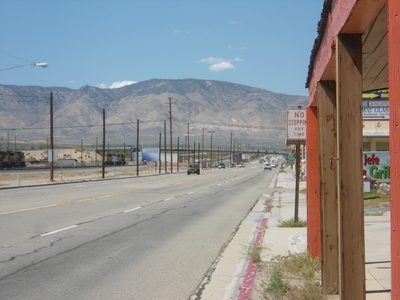
No gunfighters, but it looks the part.
Photo: copyright Dale Amon, All Rights Reserved
The current day town has three main industries. Wind farms and the railyards. If you are a train buff you would love the view from my motel as mile long freights go by just about every hour of the day.
→ Continue reading: On the scarcity of one Dale Amon and rumours regarding his whereabouts
This inscription is carved onto the Memorial to those who died serving in Bomber Command during World War II.
The memorial was unveiled by the Queen just under a week ago, on June 28th. It is at Hyde Park Corner, in London, at the western end of Green Park. I photographed it this afternoon.
I live close to one of the great old cities of Britain, Newcastle upon Tyne. In two centuries it has been transformed from a hive of enterprise and local pride, based on locally generated and controlled capital and local mutual institutions of community, into the satrapy of an all-powerful state, its industries controlled from London or abroad (thanks to the collectivization of people’s savings through tax relief for pension funds), and its government an impersonal series of agencies staffed by rotating officials from elsewhere whose main job is to secure grants from London. Such local democracy as remains is itself based entirely on power, not trust. In two centuries the great traditions of trust, mutuality and reciprocity on which such cities were based have been all but destroyed – by governments of both stripes. They took centuries to build. The Literary and Philosophical Society of Newcastle, in whose magnificent library I researched some of this book, is but a reminder of the days when the great inventors and thinkers of the region, almost all of them self-made men, were its ambitious luminaries. The city is now notorious for shattered, impersonal neighbourhoods where violence and robbery are so commonplace that enterprise is impossible. Materially, everybody in the city is better off than a century ago, but that is the result of new technology, not government. Socially, the deterioration is marked. Hobbes lives, and I blame too much government, not too little.
– A paragraph near the end (pp. 264-5) of The Origins of Virtue by Matt Ridley. Time was when the best popularisers of science were left wingers, and they bolted left wing conclusions onto the end of their popularisations. Ridley does a similar thing there, but in the service of capitalism, progress and freedom.
Ridley is a terrific writer, and there are dozens of quotes scattered through this book which I could have chosen for the SQotD treatment.
“In order to punish Barclays further, they should have to start life again as a third division Scottish football club.”
Mark Littlewood, boss of the Institute of Economic Affairs, in a private communication via Facebook. It is so good that I don’t think he’ll mind me quoting him here.
He is talking about the resignation, announced today, of Bob Diamond as CEO of Barclays. That bank has been fined a total of £290 million by US and UK authorities for manipulating the inter-bank interest rates known as LIBOR. Criminal prosecutions are high possible and the net could widen very far indeed.
Barclays is one of those UK banks – HSBC being the other big high street one – that did not receive, nor ask for, bailouts by the UK taxpayer. However, that bank, like all the rest, did benefit from the privilege of being able to get access to cheap Bank of England funding; and it also benefited from state-backed guarantees. The point cannot be made too often: we don’t have a proper capitalist banking system but at best a hybrid. But it also needs to be recognised that even in a world of total laissez faire and no funny fiat money, there might still be market conventions for setting a benchmark reference rate for interest rates between banks, just as there is a daily “fix” for the gold price in the London spot gold market. Such market benchmarks arise, like a sort of Hayekian spontaneous order, because they are useful for other economic actors in pricing products of their own.
However, when a bank or other institution fiddles the prices submitted for these benchmarks, it erodes confidence in the system and the reputation of the miscreant will be badly damaged. In a crude sort of way, what has happened is a good sign that organisations which screw up suffer.
Update: Guido Fawkes weighs in, and points out that the manipulation of interest rates has also been government policy for years.
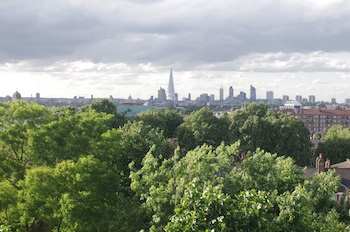 London, England. (Photographed from a rooftop in Peckham) . 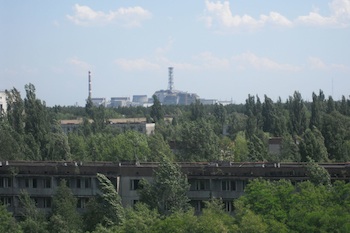
Chernobyl, Ukraine. (Photographed from a rooftop in Pripyat).
|
Who Are We? The Samizdata people are a bunch of sinister and heavily armed globalist illuminati who seek to infect the entire world with the values of personal liberty and several property. Amongst our many crimes is a sense of humour and the intermittent use of British spelling.
We are also a varied group made up of social individualists, classical liberals, whigs, libertarians, extropians, futurists, ‘Porcupines’, Karl Popper fetishists, recovering neo-conservatives, crazed Ayn Rand worshipers, over-caffeinated Virginia Postrel devotees, witty Frédéric Bastiat wannabes, cypherpunks, minarchists, kritarchists and wild-eyed anarcho-capitalists from Britain, North America, Australia and Europe.
|






Recent Comments