We are developing the social individualist meta-context for the future. From the very serious to the extremely frivolous... lets see what is on the mind of the Samizdata people.
Samizdata, derived from Samizdat /n. - a system of clandestine publication of banned literature in the USSR [Russ.,= self-publishing house]
|
There is an article by David V. Johnson, which is an interview with American leftist Martha Nussbaum, during which she conflates ‘respect’ with ‘tolerance’ and that is a telling category error. Nussbaum at least accepts (I sense rather grudgingly) that many ‘bad’ views must be accepted within civil society but…
Am I willing to tolerate Muslims? Certainly… at least the ones who will reciprocate and tolerate an atheist like me. And those who will not? Well no, I will not tolerate them either. For much the same reason I will happily tolerate any communist or socialist who wants to go live on a kibbutz, because I do not have to join them. And fascist socialists who want to live in judenfrei whites-only retreats on private property in the back of beyond somewhere, well knock yourself out guys, the farther away you are from me, well, lets just say it is a win-win for all concerned.
However the ones who wish to impose their oppressive views on me via the state? The ones whose views move them to do politics (which is what we call the struggle to control and use the means of collective coercion)? No, they will not tolerate me so I will reciprocate and try to use the force of the state, or whatever other means are available, to suppress them too. Tolerating those who will not tolerate you is more correctly know as “cowardice”.
But that is it. Tolerance. That is all that anyone can expect, provided they reciprocate it. Never respect.
Do I have ‘equal respect’ for Islam? Or socialism in all its ‘left’ and ‘right’ forms? Or racism? Hell no. I do not respect them at all as I do not respect any religion or any intrusive collectivist political order. But I will tolerate adherents of things I think are wrong if they tolerate me, which means not imposing their wishes on me by force. Several contributors to this blog are religious and I respect them, because they earned it, and their religious views do not require them to impose their beliefs on me by force. Tolerance.
Oh and another annoying thing in this article is the use of the term ‘liberalism’ to mean the exact opposite of the term as understood by classical liberals.
“It is the job of economists to point out trade-offs; it is the job of politicians and planners to deny that trade-offs exist.”
– William Easterly, The White Man’s Burden, page 256.
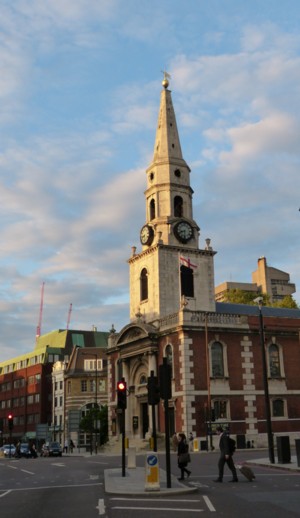
Early yesterday evening, taking advantage of a small window of nice weather in our mostly appalling British “summer”, I took a stroll across the river. I ended up in the London Bridge area, where, just before descending into the Tube to go back home, I took this picture:
That is a church called Saint George the Martyr.
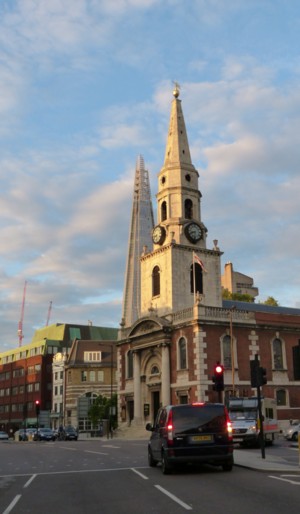
Now, you may think that this church is behaving itself, but actually, it is seriously interrupting the view of the recently completed Shard. To show you what I mean, here is another picture which I took seconds later:
Now you see it, now you don’t.
I’m just kidding (I had in mind sentiments like this) about the church being an eyesore. Saint George the Martyr looks very nice, and I find these two buildings particularly pleasing when they are thus aligned.
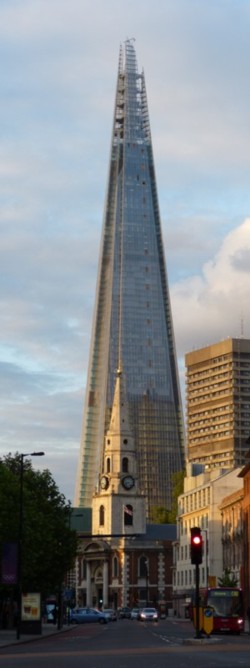
Earlier I had taken another picture of St George the Martyr and the Shard, but from further away. The church looks smaller, just as you would expect. But the Shard looks bigger the further away you get from it, because it becomes so much clearer that it actually is so very big, and so much bigger than everything else.
My more serious point is that the Shard, far from being an alien and intrusive presence, actually fits into big old London very well indeed, not least because it echoes some of London most characteristic and most loved architectural shapes. That’s what I think, anyway.
Some declare themselves offended by the Shard, as has already been noted here. But for me, London without its recent crop of skyscrapers would be a less appealing and far duller place. Had the Shard only got as far as the pretend photo stage, but had it never actually materialised, I’d have been very sad. If lack of money had caused that, well, that happens, when boom turns to bust. But had the Shard been politically aborted because of its alleged aesthetic offensiveness, I would have been offended myself.
Who’s the coolest? Terry Deary, the author of “Horrible Histories” or Lars the Emo Kid?
Deary: “Attack the elite. Overturn the hierarchy.”
Lars: “I’ve got so much passion in my body that I just wanna … kill you!”
Deary: “I started challenging authority at school, really, and just kind of never stopped.”
Lars: “I’m just so complicated that you’d never understand me.”
Deary: “It’s why I’m dangerous; inculcating rebel ideas into the minds of innocent young people using humour.”
Lars: “I got the cops called in on me last week because I walked outside with a gun and professed my love to a flower.”
Thanks for doing Horrible Histories, Mr Deary. As I said in 2005, when my then eight year old son asked me “Who is your favourite Habsburg?”, I knew that was £200 we could afford after all. He literally read those magazines to pieces; we still have them in their free cardboard holders, and the best-loved issues are reduced to stacks of flaky individual sheets of paper, like illustrated filo pastry.
Furthermore, Mr Deary, I have a lot of sympathy with your views on education and its ruination by twonks in government, or would if I thought you meant them, though could I just add that it is not without the bounds of human variety for trigonometry, chemistry or French to turn out to be “the skills you are going to need.” Now please stop being such a poseur. You are not Han Solo. Lars is cooler than you.
Even “knobhead” makes six appearances.
– Matt Scott, reporting on the judgment in the John Terry racism trial for the Telegraph. This trial holds the distinction of making everyone involved, from the accused, to the accuser, to the sport’s governing body, up to the politicians who came up with the law, look very stupid indeed.
Earlier this week I watched a television show which was advertised as being about London’s underground railway system, and the technology that made it possible, but which was really about underground railways in general.
I really, really enjoyed it, when it was first shown on Wednesday night. And I am writing this in some haste because the show is being shown again tonight, at 7pm, Channel 5. If you love stuff about high tech engineering and the extraordinary ingenuity and cunning and (not least) bravery and physical endurance that goes into it, then watch it. Or (if you have a life) set your video, or whatever videos are called these days. (Or be twenty first century about it and watch it on the www, which I can’t do because of something about my computer blocking adverts.)
My favourite bit was when they explained how a noted French engineer with the delightful name of Fulgence Bienvenue put a tunnel through the bank of the River Seine in Paris. Problem: the bank was not made of proper earth. It was made of mud. How do you drill a big tube through mud? Answer: you freeze the mud, and then drill through it, insert the tube, and … well, job done. By the time the … I was going to say permafrost, but make that tempafrost … has turned back into mud, the tube is in there and train-ready.
Another major engineer whom I’d never heard of until now also got a well deserved pat on the back from the television. This was an American called Sprague:
Hailed during his lifetime as the “Father of Electric Traction” by leaders in the fields of science, engineering and industry, Frank Julian Sprague’s achievements in horizontal transportation were paralleled by equally remarkable achievements in vertical transportation.
In other words, Sprague didn’t just make underground trains work far better by replacing one massive steam engine at the front with lots of far smaller electric engines all the way along the train, which as I am sure you can imagine worked far better, not just because of all that steam, but also because it meant the trains could be as long as you want. He also pioneered electric engines for lifts, as we call them over here. As a result of Sprague’s elevator engines, skyscrapers scraped the sky a lot more than hitherto, as was well explained in this TV show.
The bit at the end about how they squirted a new concrete foundation under Big Ben, to stop it falling over when they were sticking the Jubilee Line extension right next to it, was not so epoch-making. But it was fun.
Here is a terrific piece on the problems posed by the mounting costs of funding retirement, and the tax implications thereof, from Reason’s Nick Gillespie. It is obviously written from a US perspective but as always, the lessons are broader than that.
I particularly liked how he lampoons old Baby Boomers calling for a return of the draft. That bad idea never seems to entirely die off.
Today’s SQotD is already taken, and in any case yesterday’s SQotD was also about banking, but here is more quotability, from regular quotee here, Steve Baker MP, writing for the Spectator Blog about the LIBOR scandal:
The really important question today is not whether the Bank of England encouraged manipulation of credit markets by self-interested rogues but why we tolerate systematic credit market manipulation by the central banks as a matter of policy: nowhere else in the economic system would we accept explicit planning of the price and quantity of a vital commodity. If it worked, we’d all be communists.
In the Cobden Centre round robin email flagging up this piece, the words “linked from Guido” were included in the email title. This stuff is not merely being said, relentlessly. It is getting around.
Here is some further evidence of that, from the BBC:
A popular solution to the financial crisis has been to print more money, but is there another way of fixing our economy? Would the financial system be more stable if each pound, dollar or euro in our pocket was once again backed by gold?
And they go on to provide the answer given to them by Detlev Schlichter: yes.
All of which confirms the Austrianism as Number 2 meme.
LATER: More incoming from the Cobden Centre flagging up this programme, the first part (of two) of which will be shown at 9pm on Channel 4 this evening. Various Cobdenites contribute. Plus, see also this.
“We’d rather like people not to live on flood plains. Because, you know, their existence is evidence that that’s where it floods sometimes. Not being able to insure your house against floods if you live on a flood plain is what is known, in technical language, as a “fucking clue” that perhaps you shouldn’t be living there. Surely to God at least one person in government knows someone at Lloyds of London?”
– Tim Worstall. I love it when he gets justifiably riled.
Here:
Beijing Olympics officials approached the 2008 Games as an opportunity to host the world’s biggest sporting event, not to create infrastructure of permanent importance. Now Beijing is left with a post-Olympics landscape that better suits the taste of ruin porn aficionados than urban development officials. Its a story that should serve as a warning not only to London but future cities that have their sights set on investing billions into new infrastructure for a two-and-a-half week event.
I do wish people would be less free with that word “invest”, when what they actually mean is “spend”. But you can’t blame this particular guy, for our entire Keynes-soaked culture is saturated with such confusion. The modern Olympics are a gigantic exercise in digging huge Keynesian holes, running about in them, and then filling them in.
Ruin porn pictures follow.
I’m actually a tad more optimistic about London’s Olympic “infrastructure”. Our Olympic clutter will cost us many arms and many legs, for little immediate benefit or longer term benefit. And presumably, in the short run, our Olympic leftovers will suffer some disrepair and delapidation. But most of it is in a part of not-outer London that will be simply too valuable to be left to rot indefinitely. Also, our media will sneer too much if what now appears to be happening in China were to happen here. In China, media sneering is, I presume, less of a problem.
My guess is that the Dome is more of a guide to what will happen to London’s Olympic stuff. There was much faffing about in the immediate aftermath of the Millenium, but eventually, a meaningful use was found for it. Likewise, London Olympic remains will either be used or done away with and built over.
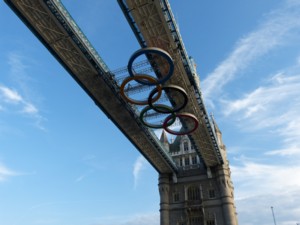
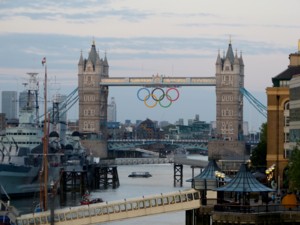
Meanwhile here are a couple more Olympic snaps I took recently. Both are of the Olympic rings now hanging from Tower Bridge. First, before they were swung down into place:
And second, after:
For further fun, you can enjoy a recent Chinese homage to Tower Bridge. It’s twice as good as the original, because it has twice the original number of towers!
Enough diagnosis. What is the cure? A change of personnel will not do it. The search for chief executives who are not motivated by greed and for regulators who are sufficiently god-like to know how to design rules that cannot be gamed will never succeed. The truth is, the financial system, like the whole of human society, was not designed in the first place; it evolved. And the answer is to allow a better one to evolve.
– Matt Ridley
You have probably read of the North Koreans shamelessly ripping off a suite of Disney characters in one of their infamous stage shows.
Why all the pageantry? OK, it’s North Korea, silly question. But why now? Well, it may have something to do with the young leader Kim Jong-un being freed from Dad’s shackles and finally being able to get his leg over recently married (not to Fatty Kim, as the Chinese call him) new mother and former popstar, Hyon Son-wol.
But she’s an interesting one, is Madame Comrade Hyon. An accomplished musician in her own right, she has a string of hits as long as your bayonette, such as Footsteps of Soldiers, I Love Pyongyang, She Is A Discharged Soldier, and We Are The Troops Of The Party. Real toe-tapping stuff. However, her star rose highest when she embraced her fans in the countryside with the 2005 chart-topper Excellent Horse-Like Lady.
Something lost in translation, or a manifestation of the severe shortage of tractors?
Update: by popular demand, Youtube clips provided. No translations, sorry. And I am unable to verify whether the clips match the actual songs, not being versed in Korean.
Further update: call that pop music?? This is pop music. (And no I don’t expect you to sit through that atrocious K-Pop; just trying to make a point…) That being said, it is worth noting how freaking massive K-Pop is throughout Asia, a market of 2 billion+.
Comparing the vigour of South Korean K-pop with its nothern counterpart as churned out by the likes of Kim Jong-un’s latest squeeze reminds me of this well-known photo. God bless capitalism!
|
Who Are We? The Samizdata people are a bunch of sinister and heavily armed globalist illuminati who seek to infect the entire world with the values of personal liberty and several property. Amongst our many crimes is a sense of humour and the intermittent use of British spelling.
We are also a varied group made up of social individualists, classical liberals, whigs, libertarians, extropians, futurists, ‘Porcupines’, Karl Popper fetishists, recovering neo-conservatives, crazed Ayn Rand worshipers, over-caffeinated Virginia Postrel devotees, witty Frédéric Bastiat wannabes, cypherpunks, minarchists, kritarchists and wild-eyed anarcho-capitalists from Britain, North America, Australia and Europe.
|





Recent Comments