We are developing the social individualist meta-context for the future. From the very serious to the extremely frivolous... lets see what is on the mind of the Samizdata people.
Samizdata, derived from Samizdat /n. - a system of clandestine publication of banned literature in the USSR [Russ.,= self-publishing house]
|
I am not often found defending the BBC or its offshoots, but this is just out of order.
The Welsh Government (for so the lads with the office on the fifth floor of Tŷ Hywel have styled themselves since May 2011 – there’s posh for you) demanded that the Welsh-language TV station S4C give the government a right of reply and refrain from ever repeating an episode of the soap opera Pobol y Cwm because a fictional character said the Welsh government “doesn’t have the backbone” to cull badgers.
Quite rightly, S4C repeated the programme as scheduled.
Like anyone else, the Welsh government has the right to complain if it believes that the BBC has failed in its statutory duty of impartiality as a tax-funded broadcaster, and that includes complaining about fiction. I did so to the point of exhaustion here. But what gave the Welsh Government the impression that it could try to impose impartiality right down to the level of re-writing the script for a particular actress in a soap opera?
The Leveson Report, probably.
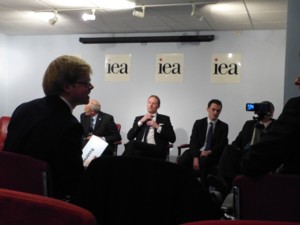
Yesterday, as earlier reported, I attended an event about road pricing. It was typical IEA. Men in suits and ties with irreconcilable beliefs took it in turns to be irreconcilably polite about everything, while other men in suits and ties listened with equal politeness:
There are some of the men in suits and ties waiting their turn to be polite. And look, one man in a suit and a tie is even straightening his tie, James Bond style, although there the resemblance ends. That’s Oliver Knipping, co-author, together with Richard Wellings (the man in a suit and a tie on the right whose face is blocked out by the video camera) of a recent IEA publication entitled Which Road Ahead – Government or Market? Do you see what they did there? Which road, as in policy, metaphorically speaking, for dealing with roads, as in roads, literally.
I am being much too rude. It was actually pretty interesting if you like that sort of thing, which I only somewhat do, hence my rudeness. I went because I knew that although I would be rather bored during the event, I would afterwards be glad that I had attended, and so it has proved. I got a copy of Which Road Ahead for only a fiver, and better yet, I met a man with a blog, called Road Pricing.
I like road pricing, for the same reasons I think that governments shouldn’t give away train tickets to everyone just because the train system is government owned and/or government controlled and people have already paid for it that way. What if some people don’t like trains and never use them? It’s not fair. Without journey pricing, the trains will get even more impossibly crowded. Privacy? That argument was won and lost when they introduced number plates, I reckon. A man called Gabriel Roth was quoted as saying that the road systems of the world are the last bastions of Soviet style central planning. Which isn’t true. What about central banking? But I like the sentiment. This is a product for which people queue for the product on top of the product thereby destroying the product. That can’t be the right road ahead, now can it?
Scott Wilson, the Road Pricing blogger, agrees. But you won’t read many arguments at his blog about why road pricing is good. What you will read is reports about how road pricing is being done in various parts of the world, well or badly, and criticisms of places where it is being done badly, like, surprise surprise, the UK. In that posting there is a picture of people being charged to get across the Thames which makes you think, not road pricing, but: crossing a national frontier, of the sort that is taken seriously.
I ought to have known about this blog two years ago, when it started. But no matter, now I do. This is the kind of thing that you learn if you go to rather boring meetings instead of just staying home glued to a computer, the way I am now. Besides which, a blog is merely a blog. If you actually meet the man who runs it, see his suit and his tie, and hear him talking, quite intelligently, that makes you actually want to pay attention to his blog.
One thought that occurred to me when thinking about reaction to the Leveson Report – which calls for statutory regulation of the UK press – is that those journalists frightened of such regulation, and concerned – rightly – about the dangerous consequences have had a very sharp lesson in the problems of regulation. (Here is the official Leveson website for those who have the stamina).
Consider the following: After the recent financial crisis of 2008, almost the entire media, political world and associated industry put up a chorus that what the world needed or still needs is “more regulation”. The fact that the banking industry already is subject to the laws against fraud and force, that it operates under rules about capital (the Basel system), has to lend to certain groups (US legislation to help minorities), or that central banks set interest rates like Soviet planners, seemed not to matter one jot to those arguing that we need even more rules. And rules enforced by such paragons of wisdom and omniscience as the Financial Services Authority or Bank of England.
Yet this time, when the media itself is in the cross-hairs, we see journalists from across the spectrum arguing about the dangers of quangos, of unelected boards of governors running the show, of the dangers of moral hazard, of the problems of losing freedom of action. It is as if George Monbiot had morphed into FA Hayek.
As I say in the title, maybe this is a teachable moment for the British media. Of course, the state-supported BBC and, for that matter, the partly state-subsidised Guardian (all those public sector ads) might be more amenable to state controls, although in the case of the Guardian, even those guys might understand the dangers. (Would, for example, the Guardian be able to use the likes of Wikileaks in future under a statutory regime?).
I might be optimistic here, but when people find their own livelihoods and freedoms come under attack, it can make them understand the value of liberty and rule of law more generally. Let’s hope that the next time a journalist writes an article which calls for more regulation of X or Y, that they see the irony, and think again.
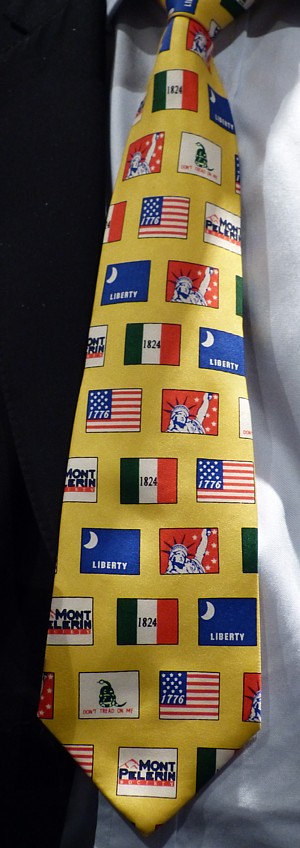
Well, things seem a bit quiet around here today, so here is something I photoed earlier:
I encountered the tie at an IEA event about road pricing. The tie proclaims the fact of and the principles espoused by the Mont Pelerin Society. It was being worn by Dr Eamonn Butler, Director and co-founder of the Adam Smith Institute, and, among many other distinguished things, the author of many fine books explicating and popularising the ideas of freedom and of the free market.
One thing puzzles me, though, and my limited googling abilities were unable to solve the puzzle for me. What was so special about the year 1824? That’s an Italian flag, right? So what happened in Italy that the Mont Pelerin Society regards as so worthy of commendation?
I would have asked Eamonn Butler, but my camera has better eyesight than me, and I only saw the 1824 references when I got home.
The Spectator have made it clear that regardless of what state regulation parliament imposes upon the press…
They will not not cooperate.
We say in our leading article that we would happily sign up to any new form of self-regulation which the industry proposes, no matter how onerous. But we would have no part in any regulatory structure mandated by the state. That is to say: we would not attend its meetings, pay its fines nor heed its menaces. To do so would simply betray everything that The Spectator has stood for since 1828.
To say this is ‘admirable’ would be to damn it with faint praise. It is magnificent.
A recurring theme in Steven Pinker’s The Better Angels of Our Nature (see some earlier postings here about this book, here and here) concerns how a modern and humane principle, cruelly ignored in the past, then gets over-emphasised. Such a price is worth paying for the triumph of the principle, says Pinker, but the price is indeed a price, not an improvement.
An example being the extreme lengths now gone to in order entirely to eliminate child abductions by strangers (p. 538):
And even if minimizing risk were the only good in life, the innumerate safety advisories would not accomplish it. Many measures, like the milk-carton wanted posters, are examples of what criminologists call crime-control theater: they advertise that something is being done without actually doing anything. When 300 million people change their lives to reduce a risk to 50 people, they will probably do more harm than good, because of the unforeseen consequences of their adjustments on the vastly more than 50 people who are affected by them. To take just two examples, more than twice as many children are hit by cars driven by parents taking their children to school as by other kinds of traffic, so when more parents drive their children to school to prevent them from getting killed by kidnappers, more children get killed. And one form of crime-control theater, electronic highway signs that display the names of missing children to drivers on freeways, may cause slowdowns, distracted drivers, and the inevitable accidents.
The movement over the past two centuries to increase the valuation of children’s lives is one of the great moral advances in history. But the movement over the past two decades to increase the valuation to infinity can lead only to absurdities.
We here nod sagely. This book is full of cherries like that, pickable by people who think along Samizdata lines. But it also includes fruits to please those deviating from correct opinions in quite other directions.
With regard to the matter of children’s rights, libertarians like me are fond of urging property rights solutions for problems not now considered properly soluble by such means, such as preserving endangered species or sorting out such things as the right to transmit radio waves. But it is worth remembering that we applaud the fading of the idea that parents own their children, to the point where they may destroy them with impunity, as if binning unwanted household junk. And yes, such a right to kill faded because it could. The world can now afford to keep all newborns alive. That doesn’t make this any less of an improvement. Well done us. We can understand why so many people were child killers in the past, and still rejoice that times have changed.
The pages where Pinker describes the murderous cruelties inflicted upon many newborns are very vivid. I will never think of the ceremony of christening in quite the same way. He reminds us that what is being said with it is: this one’s a keeper.
A bit of crime-control theater is surely a small price to pay for the pleasure of living in less cruel times.
Conservative MP Dominic Raab has some good sense on the case against regulating the press here. (Again, non-UK readers should be aware that they might not be able to read this in full). Excerpt:
On Thursday, Lord Justice Leveson will report on press standards. If, as Churchill declared, “a free press is the unsleeping guardian of every other right that free men prize” then statutory regulation is an insidious sedative that threatens our democracy. We take for granted investigative journalism that speaks truth to power – from the exposé of Stephen Lawrence’s killers to the revelation of MPs’ expenses. But, look to France to see what a state-regulated press means. It left Dominique Strauss-Kahn to walk through the raindrops to the cusp of the presidency, despite a string of ugly reports of sexual violence. It allowed Jacques Barrot to be appointed European Commissioner, despite a conviction for embezzlement masked by law. From Hungary to Russia, regulating journalists has inevitably stifled media freedoms.
Sometimes I overcome my squeamishness and read the comment sections on pieces like this. Here, below the article above, is an example from a guy called Keith Meldrum of why I sometimes wonder whether I should regard some of my fellow Brits with pity or contempt:
“It appears that 80% of the British public want greater press regulation. That 80% still holds with readers of the Telegraph and Daily Mail. The complaints of journalists and newspapers that they are sorry and they will not do it again remind me of my children. Although I’m sure the protestations are sincere, I find them hard to believe.”
Well no doubt Mr Meldrum can assume what he likes, but I notice no horror here from him as to the fact that such a high percentage of the UK public are fine and dandy with taking this country back 300+ years in terms of freedom of the press. I guess he regards such ideas as “hopelessly out of date”, rather as how former UK prime minister Tony Blair, in a disgusting speech a few years ago, referred to a concern for such “19th Century values” as the presumption of innocence in criminal cases, habeas corpus, respect for privacy, and so on.
And then there is this creature, by the name of “Celtictaff”:
“What’s so special about the press, they have always worked hand in glove with politicians. The people of Britain don’t have free speech, that freedom has been slowly eroded for years. There are subjects that affect the very future and stability of our country, which are far too anti-diversity and PC to even discuss, our country is being stolen from us, and we are not allowed even a whimper of protest. Couple that with the constant barage of propaganda from the MSM. The press deserve all they get.”
In other words, because the MSM have behaved like berks at times – and they have – we won’t be missing much if the media are regulated like doctors or whatever. Great. This is classic dog-in-the-manger thinking: Other people don’t have liberty, so why should you? This is dangerously short-sighted and foolish. The proper response, of course, is to demand equality before the law and repeal the current restrictions of freedom of speech that now exist, by copying the US First Amendment and enforcing it.
Instead, like bitter, sad people in despair, we lash out at a decent argument for free speech because of the imperfections of this world. It is a classic case of the best being the enemy of the good. We are not going to achieve a perfectly free society soon, but let’s surely fight to protect what liberties are left.
And remember, as the playwright Tom Stoppard said some years ago, you can tell we have a free press in this country because of the amount of crap that gets printed. Inevitably, a lot of what we read and see in the press and TV will be mediocre at best, or sensationalist rubbish, at worst. But that no more invalidates media freedom than it would justify state regulation of party clothing on a Saturday night because most Britons have the style sense of a toad. The point is that a free press, unshackled by the chilling effects of regulation, has the potential to do good and useful things.
Of course, when the UK media is so dominated in the terrestrial broadcasting sense by a state-financed broadcaster such as the BBC, any idea that we operate a full free market in media and broadcasting needs to be hedged with a bit of a qualification anyway.
An organisation that ought to be regarded with suspicion is the National Union of Journalists, which says that regulation of the media is okay. The NUJ must surely know that the next, almost inevitable step would be state licencing of journalists, something that the NUJ, no doubt keen to enforce a closed shop on journalism, would see as bolstering its power.
Finally, if the letter-writers to the DT and other places think the media needs to be regulated by the sort of people who have done such a splendid job regulating financial services, for example, then they might want to emigrate to a place more to their liking, such as North Korea. Or maybe they should choose France, which operates under a draconian privacy law as Raab points out. Given that many French people are fleeing France due to its high taxes, though, there may not be many takers for this idea, however delightful that country is in many other respects.
I am glad that Adrian Smith has won his case against his employer, Trafford Housing Trust. These links give the story:
– Christian wins case against employers over gay marriage comments (The Guardian)
– Social media, employment, religious views and freedom of speech (Law & Religion UK, a specialist blog.) This link makes that point that although Mr Smith’s Facebook page did identify him as an employee of the Trafford Housing Trust, no reasonable observer would suppose that Mr Smith’s opinions represented the Trust’s opinions.
– Facebook gay wedding comment man wins demotion case (BBC)
Adrian Smith lost his managerial position, had his salary cut by 40%, and was given a final written warning by Trafford Housing Trust (THT) after posting in February last year that gay weddings in churches were “an equality too far”.
The comments were not visible to the general public, and were posted outside work time, but the trust said he broke its code of conduct by expressing religious or political views which might upset co-workers.
Given that “might upset co-workers” could apply to just about any conceivable opinion, and that his actual words were almost comically mild, I am not surprised that there was a widespread sense that Trafford Housing Trust could not be allowed to set a precedent. In the end the judge went so far as to regret in public that for technical legal reasons he could not award Mr Smith any more than a token sum on top of his old job back.
All in all this was one instance where a probing attack by the Creatures from the Dungeon Dimensions was overconfident and was repulsed. I think it likely that the same will prove true of the UKIP fostering case mentioned in Johnathan’s post from Sunday.
Nonetheless, I feel obliged to note that in a free society employers would have the right to make their offer of a job conditional upon an employee shutting up utterly about his personal opinions, or vowing slavish adherence to the opinions of his employers however stupid, or wearing a pink carnation up his nose, or being black, homosexual, Muslim, Nazi or all of the above. Not that I would believe such demands would be at all common. Most people, naturally, would elect to work for a less controlling employer – and in a free society we would not be in the position that so many jobs were in the gift of the government or its proxies. The Trafford Housing Trust is one of these deniable chimeras that have spawned under every rock lately; half “charity”, half government.
There are two phrases that we rarely hear these days: “it’s a free country” and “there ought to be a law against it”. We do not hear these any more for the simple reason that we are no longer a free country, and more often than not there is a law about it.
– Nigel Farage
(link is to the Daily Telegraph so some overseas readers may issues accessing it)
Last year, for the first time, sales of adult diapers in Japan exceeded those for babies.
– Here. I found it here.
Look, I want you to know that if I thought there was the slightest chance that it was really going to happen my first reaction to this story would probably not have been to say “Cool”.
Lord Gilbert Suggests Dropping A Neutron Bomb On Pakistan-Afghanistan Border
Even cooler: he is a former Labour defence minister.
Responding for the government Lord Wallace said the coalition did not share the “rumbustious views” of Gilbert.
Quite.
Any statutory regulations/provisions against the press in the UK will most gleefully be lapped up here for use against the local media. The one argument we have had; that the modern liberal democracies around the world have self-regulation rather than statutory laws for the media will fall down should the UK opt to embrace statutory legislation as well to police the press. Such moves will only strengthen the hand of oppressive, regressive governments around the English-speaking world.
– Sinha Ratnatunga, Editor, Sunday Times, Sri Lanka
|
Who Are We? The Samizdata people are a bunch of sinister and heavily armed globalist illuminati who seek to infect the entire world with the values of personal liberty and several property. Amongst our many crimes is a sense of humour and the intermittent use of British spelling.
We are also a varied group made up of social individualists, classical liberals, whigs, libertarians, extropians, futurists, ‘Porcupines’, Karl Popper fetishists, recovering neo-conservatives, crazed Ayn Rand worshipers, over-caffeinated Virginia Postrel devotees, witty Frédéric Bastiat wannabes, cypherpunks, minarchists, kritarchists and wild-eyed anarcho-capitalists from Britain, North America, Australia and Europe.
|





Recent Comments