We are developing the social individualist meta-context for the future. From the very serious to the extremely frivolous... lets see what is on the mind of the Samizdata people.
Samizdata, derived from Samizdat /n. - a system of clandestine publication of banned literature in the USSR [Russ.,= self-publishing house]
|
Last night being the last Friday of March, there was a meeting at my place, as already flagged up here. But it was also Good Friday, so I did a bit of extra hustling and emailing around beforehand to ensure some kind of turnout. It worked. Great talk, and there were nine libertarian-inclined Londoners present in the form of: two Americans, a German, a Frenchman, a Spaniard, a New Zealander and three Englishmen.
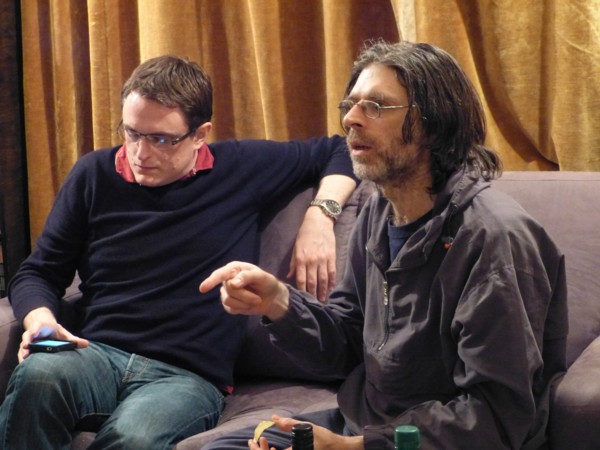
I neglected photography at the January meeting, which I already regret, and did hardly any better at the end of February. This time I tried harder, this being one is my favourite snaps from last night:
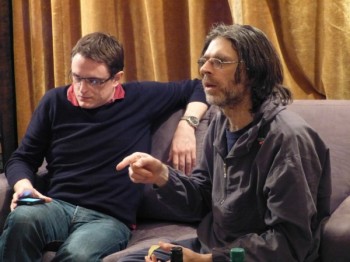
Those are two of the three Englishmen who were present, the other being me. On the right there is speaker for the evening Richard Carey, and on the left Simon Gibbs, both of Libertarian Home fame. Gibbs was not rudely ignoring the conversation and catching up on his emails; he was looking up names and titles that were being mentioned in the conversation. I particularly like the potato crisp in Carey’s left hand at the very bottom of the picture.
The talk was everything that I personally was hoping for. There was lots of biographical detail of who the key early Austrians were (Menger, Böhm-Bawerk, Wieser) and what kind of intellectual context they were operating in and what they said. And then the same for the later figures of note (von Mises, Rothbard). Other twentieth century figures were mentioned. Given how admiringly Carey spoke about him, I was particularly intrigued by Frank Fetter, only a name to me until now.
Carey made no attempt to disguise the fact that he is a recent arrival to the task of getting his head round Austrian Economics, which for me was a feature rather than a bug, just as I thought it would be. And he made no attempt to suggest that he understood more than he actually did about the subject. His talk entirely lacked that sub-agenda that you so often sense with some speakers, that half the point of telling the story is to tell the story, but the other half of the point is to prove how very clever and well informed the speaker is, more so than he actually is. That Carey had no time for such nonsense only made me admire his intellect all the more.
I had been expecting that the abstract theorising about what it all meant, what the intellectual guts of it all consisted of, would come at the end. The economic way of getting stuff versus the political way, trade versus stealing, individualism versus collectivism, the subjectivity of value, and so forth. Actually that bit came, at some length, at the beginning, so much so that I at first feared that all that biographical detail that I had been so looking forward to would be somewhat skated over. But all ended well, and I learned a great deal.
I did not record this talk in any way. However, Simon Gibbs, the man on the left in the picture above, has already invited Richard Carey to do a repeat performance of this talk for Libertarian Home, and a video camera will presumably then be running. Meanwhile, I am very happy for Carey to have given this talk a first outing in friendly surroundings, and for him to get some early feedback on it. I find that I am making a point of getting speakers to speak about things they’ve not spoken about before, but will undoubtedly be speaking about again, for just these sorts of reasons.
Two books were mentioned in the course of the discussion afterwards that I intend to investigate further.
Christian Michel mentioned this collection of lectures by Michel Foucault, in one of which he apparently said something embarrassingly (given the kind of people who were listening) nice about the free market as the only place where freedom actually happens, or some such surprising thing. I’ve already emailed Christian asking for chapter and verse of the quote in question.
And second, Aiden Gregg (who is an academic psychologist and who has already been fixed to speak at a later one of these meetings) mentioned the writings of somebody called Larken Rose, a new name to me, and in particular this book, which appears to cover similar ground, albeit in a somewhat different style, to that discussed in Michael Huemer’s The Problem of Political Authority, which has been written about here recently.
Evenings like this don’t have any immediate world-changing impact, but every little helps.
For the first time ever, labourers were able to purchase cheap goods for themselves. The first factories focused on mass production of cheap goods for the poor. Shoes, for example, were produced for the proletariat – the rich bought made-to-measure shoes. This was different from France, where the government’s mercantilist product standards, designed to uphold quality, ensured that nothing was produced for the poor at all. In France, mercantilism continued to be state policy for much longer than in England. This is the reason why industrialisation took fifty more years to arrive on France’s shores.
– This is a typical “I did not know that” moment from J. P. Floru‘s excellent new book Heavens on Earth: How To Create Mass Prosperity, from the chapter about the British industrial revolution.
Well, I myself did not know it. If you did know this particular thing about shoes, you will still probably find a hundred other such titbits in this book that you did not know. In an equal-but-opposite way, this made me think of how we can now buy excellent yet vastly-cheaper-than-before spectacles on the internet, that being a case of a made-to-measure product becoming available to all at a mass production price.
Besides the world-changing success story that was British industrialisation, Floru writes about: the USA and West Germany just after WW2, Hong Kong, China, Chile, New Zealand and Singapore. The miseries of despotism are not glossed over, but the inevitable failure of statist economic policies and the almost automatic benefits of free market policies, provided only that you can make them stick, are made unmistakably clear.
I hope, Real Soon Now, to be supplying a longer posting here about this fine book, along the lines of the five star reactions to it here. Short version: it is a fine book.
“Money, when paid into a bank, ceases altogether to be the money of the principal; it is then the money of the banker, who is bound to an equivalent by paying a similar sum to that deposited with him when he is asked for it…The money placed in the custody of a banker is, to all intents and purposes, the money of the banker, to do with it as he pleases; he is guilty of no breach of trust in employing it; he is not answerable to the principal if he puts it into jeopardy, if he engages in hazardous speculation; he is not bound to keep it or deal with it as the property of his principal; but he is, of course, answerable for the amount, because he has contracted.”
Detlev Schlichter, quoting a 19th Century ruling about the status of bank deposits in the UK. It is, in fact, a sobering thought that many members of the general public might not be fully aware of what actually happens to their deposits, and be aware that to all intents and purposes, they do not “own” their deposits.
Let’s just say that for a lot of people, the Cyprus episode has been a learning experience about the fundamental nature of what banks, today, actually are and do.
“I want a “leave me alone” society — one where Christian schools can turn people away for rejecting their doctrine, just as gay rights groups can reject those who don’t share their beliefs. I don’t want us all to get along — not because I’m misanthropic (well, not just because I’m misanthropic), but because I know that “consensus” is usually a fancy word for muting minority viewpoints. I want us all to be free to be annoyed with each other from our separate corners. Is that too much to ask?”
– Troy Senik
He’s writing about Michael Bloomberg, who is up there with Hugh Grant and George Galloway in my current “rogues’ gallery”. Competition for membership of the gallery is proving quite competitive at the moment.
Last week I attended a book launch (picture of author J. P. Floru here), and after the formal proceedings had been concluded, I meandered into a conversation involving the ASI’s Sam Bowman, about something called “Soylent”. Until then, Soylent to me only meant that Charlton Heston movie about food made of people. Sam and his pals were talking about something rather different, but the subject changed to something else and that night I learned very little out what this twenty first century version of Soylent is, beyond the fact that Sam Bowman was excited about it. Later, however, Sam sent me an email about it that got me chasing the story a bit.
Soylent is food, sort of, but not made of people. Basically, what the Soylent guy, whose name is Rob Rhinehart, says he did was … well, let him explain it, in the piece he wrote a month into the experiment that he performed on himself:
I hypothesized that the body doesn’t need food itself, merely the chemicals and elements it contains. So, I resolved to embark on an experiment. What if I consumed only the raw ingredients the body uses for energy? Would I be healthier or do we need all the other stuff that’s in traditional food? If it does work, what would it feel like to have a perfectly balanced diet? I just want to be in good health and spend as little time and money on food as possible.
I haven’t eaten a bite of food in 30 days, and it’s changed my life.
So how did this make him feel?
I feel like the six million dollar man.
If Rob Rhinehart, or anybody else who thinks as Rob Rhinehart is now thinking, ever got a job in government that involved him or her telling other people what to consume, then I would join what I hope would be a loud chorus of hatred and derision. But given that Rhinehart is experimenting on (a) himself, and now also on (b) other consenting Californians, I am a tentatively enthusiastic admirer of what he says he is doing, only tentative because my enthusiasm is subject to all the obvious caveats and hesitations about it all later turning out to be fraudulent nonsense.
But assuming all this to be for real, a particular point that Rhinehart makes is that the human body is resilient, in the sense that it can survive without quite a few “essential nutrients”, which would thus seem to be not quite as essential as that word implies. Even if the Soylent that Rhinehart has so far arrived at misses out on some supposedly essential nutrients, it didn’t kill him, despite worries that others expressed:
Perhaps this does not constitute the ideal diet, but I am quite confident that it is healthier than any easy diet, and easier than any healthy diet. I’m touched so many people are concerned about my intake of possible unknown essential nutrients. No one seemed to worry about me when I lived on burritos and ramen and actually was deficient of many known essential nutrients. The body is pretty robust. If you can survive on what most Americans or Somalians eat, you can surely survive on Soylent. I’m no longer just surviving, though. I’m thriving.
It sounds like a really interesting operation, both from the scientific point of view and as a potential money spinner. Nutrition that is as cheap as truly nutritional nutrition is capable of being, and as unheavy and unvoluminous as nutrition can be, has obvious applications, both in reducing the money spent by poor people feeding themselves healthily, and reducing the payloads consumed in the process of feeding such people as astronauts or submariners. Obviously, to start with, it will only be rich Californians giving this stuff a go, but everything has to start somewhere.
This whole story, and in particular that word “Soylent”, still has me and I am sure many others thinking: internet hoax. When I started reading Rhinehart’s stuff, I did a quick check to see if we had yet reached April 1st. But if all this is a hoax, quite a few people seem to have fallen for it, at any rate as far as I have, by writing about it.
But, if it is not an internet hoax, this would appear to be a classic case of suck-it-and-see (in this case literally that) technology-stroke-science, of just the sort I was writing about in this earlier posting here about where science (and art) come from. It really is very striking how very much, in this enterprise, the advance of science and the potential making of a mega-mountain of money would appear – touch wood – to be advancing hand in hand. At the very least, Rob Rhinehart is going to learn about why food, as opposed merely to Soylent, is, after all, necessary for human flourishing. But, if it isn’t, and if Soylent 4.2 (or whatever) will actually suffice … Rhinehart could be on his way to making a hell of a lot more than six million dollars.
Another nice titbit of news about all this is that Rhinehart would appear, judging from his use of the word “regulation” in the second sentence of this, to be some kind of free marketeer, libertarian type, although maybe I am reading too much into one word there.
I think Rhinehart ought to change that name though. His “Soylent” is not made of people, only for them. Nor does it contain any Soya.
Details. Another way of saying all of the above is: if this really is only a hoax, it is an extraordinarily interesting and inventive one, and some other Californian should be persuaded to try this on himself for real.
I await developments.
David Cameron’s immigration speech fails to capture the imagination
This is a headline on the Coffee House blog of the Spectator. I am not picking on CH – it is a good site generally – but it ought to be a default position, borne of years of following Cameron’s speeches and sayings, that nothing he has to say, nothing at all, captures the imagination. Even when he apparently stands up for certain things, such as press freedom, and it gives us all a glow of approval, it is quickly destroyed when the grubby reality intrudes. Cameron, and the coterie of buffoons, hangers on and knaves who work with and around him, have no ability to fire anyone’s imagination. Far better to have a headline saying “Cameron says some things about immigrants”.
The speaker at my next Last Friday of the Month meeting will be Richard Carey of Libertarian Home, and the title of his talk is: Austrian Economics: What It Is and How It Relates To Libertarianism.
And yes, Friday March 29th is not any old Friday. It is Good Friday, which may thin out the ranks of attenders somewhat. Not too much, I hope.
About what he will be saying, Richard Carey says this:
What I intend to look at is as follows: the Austrian School: what it is; what it was; its relationship to libertarianism and its relevance to today. I’d like to look at how it fits into the development of economic thought, its distinguishing features, the main protagonists, some of the most important works. If the task of answering such questions is beyond me, I should at least be able to provide a guide to where such answers can be found.
Here is some video of Richard Carey talking on another subject, about doing libertarian politics. And here is the list of his recent bloggings for Libertarian Home.
I have a very selfish motive in getting Richard Carey to talk about Austrian Economics, which is that I personally find it rather hard to get to grips with this subject, and with subjects like this. What I mean by “subjects like this” is subjects which consist of a lot of logically interconnecting concepts, each of which you have to understand, and the interconnections between which you likewise have to understand, in order to make sense of it all.
What makes me want to make sense of Austrian Economics is that I have become entirely convinced, as have millions of others in recent years and decades (years especially), that Austrian Economics doesn’t just supply the best explanation of what has been going on in the financial world lately (and for that matter for the last several decades and even several centuries); it supplies the only explanation. All else in the way of economics is statistically disguised, fumbling, blundering nonsense, enlivened with many amusing details and incidental truths, but nevertheless, underneath it all, when it comes to the most important questions of all, just plain wrong. I already feel about Austrianism (as I like to abbreviate it) in the way many self-declared Marxists felt about Marxism when the Great Crash and then the Great Depression were unfolding. They didn’t really understand Marxism, but they had heard enough to be utterly convinced that This Is It, as in: This is the place to keep looking to work out what the hell is happening, and what the hell to do about it. The difference being that whereas the Marxists were all deluded and stuck up an intellectual and political blind alley, the Austrianists, and I, are not.
My problem is that I find the great Austrian School writings very hard to actually read, and I typically find your average spoken exposition of Austrianism, by someone long steeped in the subject, very hard to follow.
Part of this is that I am a slow and easily distracted reader, slow partly because so easily distracted, but also just slow. And when listening to a talk, I likewise get easily distracted (for example with trying to get my head around the previous interconnected concept but one, even as the latest one is being expounded), and if the talk is the kind of talk with a logical thread to it (as it so often is when the subject is Austrian Economics), any distraction guarantees that I lose that thread.
But I have another problem, which is that a great deal of Austrian School writing consists of belabouring the obvious.
→ Continue reading: Why I am looking forward to Richard Carey’s talk this Friday about Austrian Economics

Some organisation has recently filled my local neighbourhood in the inner London borough of Southwark with a remarkably large number of the above signs. These have been attached to stop signs and other traffic signs, poles holding street lighting, and a few are even attached to poles that hold nothing else and have presumably been installed specially for the occasion. It is hard to imagine government of some kind not being involved, given the public places where they have been erected, but WTF?
Are these supposed to make me feel safe? Reassured? Threatened? Creeped out? Vaguely worried? Concerned that money that could otherwise be spent on something useful is being used to pay the salaries of people with far too much time on their hands? Also, WTF?
Going to the advertised website is only of limited help. Something about fighting crime with fighter jets? In any event, a badly designed website of the kind one would find from some small company that is desperately short of capital and trying to impress investors after an unsuccessful listing on AIM. Oh, okay, there is something about some kind of partnership in London with the Metropolitan Police elsewhere on the website, but it is virtually impossible for me to link to due to the horrendous overuse of Flash. So taxpayer money probably is involved somewhere.
Once again, WTF?
Voting to leave Brussels will cause your wife to have bigger breasts and increase your chances of owning a BMW M3.
– Boris Johnson, leader of the Conservative Party during the EU referendum of 2017 (as imagined by David Charter in Au Revoir, Europe: What if Britain left the EU?)
Cyprus has a ‘bailout‘ deal blessed by the EU. Certain bondholders face being wiped out.
Now I seem to recall when Ireland got its bailout blessed by the EU, it was expressly forbidden to wipe out bondholders, I am right?
Now if I also recall, many of those bondholders were German, whereas many of the bondholders in Cyprus are Russian.
I am reminded of a certain song…
Why has this [Earth Hour] not expanded into a day when toilets go unflushed?
– Samizdata commenter RRS
The annual Earth Hour, in which people are requested to turn their lights off out of respect for the planet Earth, commences at 8.30pm this evening, local time. Here in London this is seven minutes from now. Please do what you think is right.
|
Who Are We? The Samizdata people are a bunch of sinister and heavily armed globalist illuminati who seek to infect the entire world with the values of personal liberty and several property. Amongst our many crimes is a sense of humour and the intermittent use of British spelling.
We are also a varied group made up of social individualists, classical liberals, whigs, libertarians, extropians, futurists, ‘Porcupines’, Karl Popper fetishists, recovering neo-conservatives, crazed Ayn Rand worshipers, over-caffeinated Virginia Postrel devotees, witty Frédéric Bastiat wannabes, cypherpunks, minarchists, kritarchists and wild-eyed anarcho-capitalists from Britain, North America, Australia and Europe.
|






Recent Comments