Commerce is real. … Aid is just a stop-gap. Commerce, entrepreneurial capitalism, takes more people out of poverty than aid, of course we know that.
– Bono
Madsen Pirie concurs.
|
|||||
|
Commerce is real. … Aid is just a stop-gap. Commerce, entrepreneurial capitalism, takes more people out of poverty than aid, of course we know that. – Bono Madsen Pirie concurs. July 24th, 2013 | 26 comments - (Comments are closed)
 Appropriately enough, in a discussion about (Nobel laureate) Paul Krugman, someone mentioned a speech by (Nobel laureate) Hayek that he gave after winning the prize:
This works for all kinds of lauded experts, not just in economics but in climate science, nutrition, psychology and education, for example. July 24th, 2013 | 18 comments - (Comments are closed)
I do not claim to be an expert on the Balkan Wars which were fought in 1912 and 1913. If I understand correctly, in the First Balkan War Turkey was almost completely thrown out of Europe while in the second Bulgaria embarked upon a war of conquest and ended up with rather less than she’d started with. 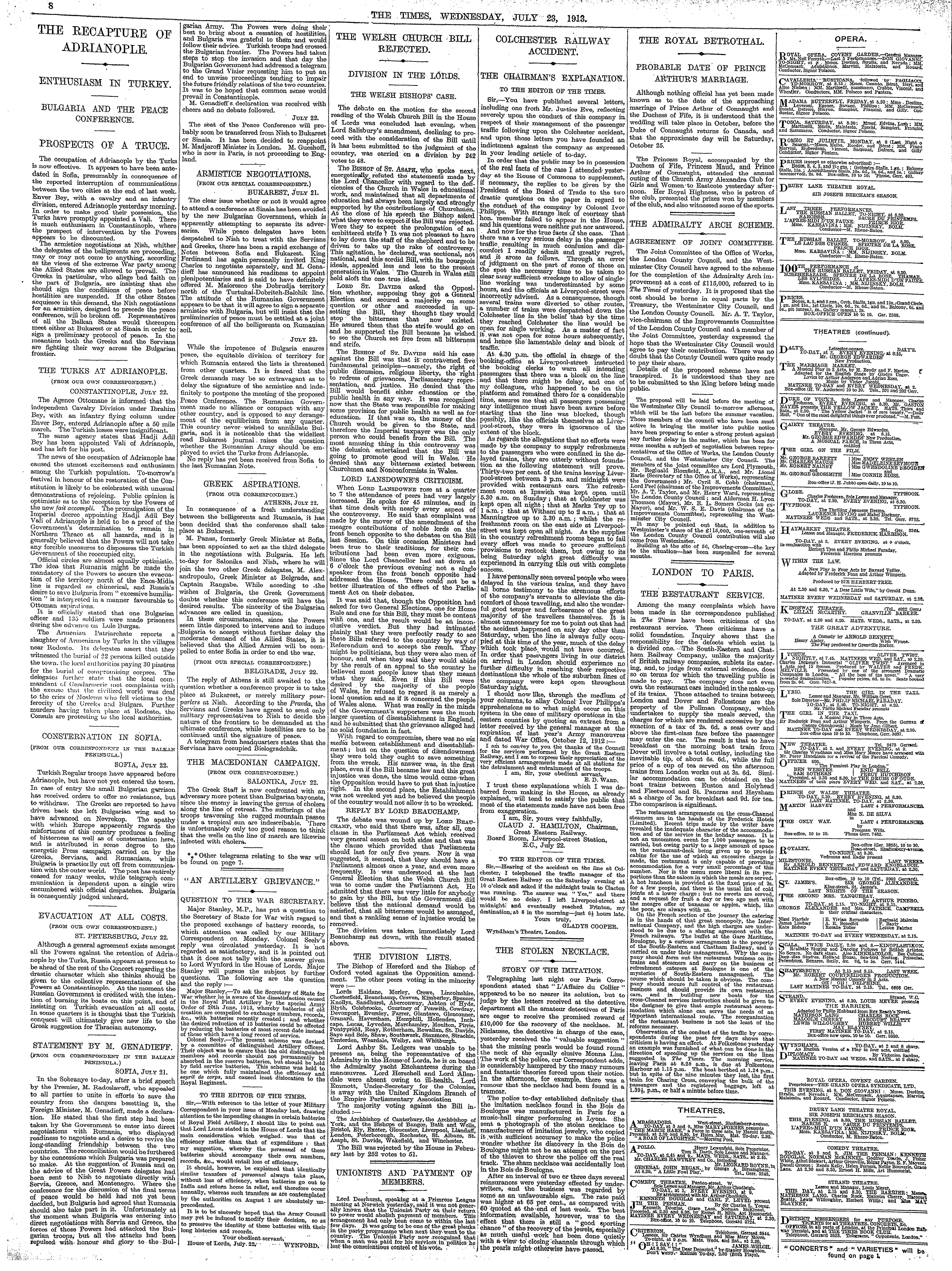 The Times 23 July 1913 p8 The significance of all this, as Eric Sass points out, lay in how it altered Russia’s relationship with Serbia. Russia, Serbia and Bulgaria were Slavic states. Russia, being the biggest, wanted to be the leader. Serbia and Bulgaria, being small wanted Russian protection. So, when a dispute rose over the borders between them the two small states submitted their dispute to the big one. When Bulgaria failed to get what she wanted she went to war. Defeat led to Bulgaria allying herself with Austria-Hungary while Russia responded by allying herself ever more closely with Serbia. Hence, perhaps, the robustness of Russia’s response to Austria’s declaration of war against Serbia in 1914.
Update For a while now I’ve been in the habit of linking to the whole page rather than just the article. This has been to give readers the chance to see what else was making the news at the time and, perhaps, to find something just as bloggable. Well, it appears Simon Gibbs has done just that. July 24th, 2013 | 10 comments - (Comments are closed)
Instpundit gleefully links to an article entitled (my reaction to this sentence was to see if SQotD was already taken – it was): Why? Well, partly of course it’s all the usual public sector stuff, about a big old nationalised industry getting worse and worse, no matter how much other people’s money they throw at it. Unions won’t allow bad teachers to be fired. Politicians won’t allow bad kids to be disciplined. And so on. Public sector education in the USA is a like a great big Detroit, spreading out across the entire country. All true. But I think there’s another big force at work here. Another key sentence in this piece, aside from its title, is a quote from Walter Russell Mead:
A few years back, I did a spell of education blogging, and one of the big conclusions I reached was that countries where teaching was a much coveted career were at a fundamentally different stage in their development to ones where teaching was what you did when you couldn’t get a better job. Basically, in develop-ing countries, teaching was and is a great job. Everyone knows education will separate you from the pack of the dirt poor, but the jobs you’ll then get offered will still be pretty terrible, so a very appealing job is to be a teacher. But in a develop-ed country, where the economy has worked out how to make seriously good use of educated people, teaching is strictly a second best, if that. The result is this odd flip-flop. The more developed the country, the crappier its schools tended to be, at least compared to what you might have expected. Lavishly funded, crammed with textbooks and computers, but still a horrible disappointment. To put all this another way, what I am saying is that the familiar slogan saying that Those Who Can Do and Those Who Can’t Teach applies with unequal force, depending on what else there is to do. I recall reading, long ago, in a book by the late Peter Drucker (he was one of the first people I ever read who told it like it was about the public sector), about how computers had, for the first time in human history, created an abundance of well paid jobs for mathematicians. Given that the world now cries out for maths geeks, to do things like programme computers, analyse share prices, stop bridges collapsing, streamline cars, predict market share, sort out logistics in warehouses, and so on and so on and so on, it’s no wonder that maths teachers are on the whole not what they used to be. The same principle applies to education generally. A hundred years ago, the typical American kid’s best chance of learning good stuff about the world was to go to a school and pay attention to the teachers there, who tended to be far better educated than his own parents. Now, increasingly, the same kid would do better to skip school and spend time with his now far better educated parents. (The big question now being: can those parents spare the time? Suggestion: a developed economy that is in an economic slump is especially good at encouraging home education.) As commenters will surely explain, there are plenty of other influences that explain the current inexorable rise of home education, the fact that computers are now to be found in every home – now, in just about every hand – being another obvious fact about this story. But I do believe that the tendency, now as opposed to a century ago, of well educated people in rich countries only to want to be teachers if they are too mediocre to do any better is a big part of this story. July 23rd, 2013 | 40 comments - (Comments are closed)
This article caught my eye in the Economist (Paul Marks, avert your gaze now), stating that in many nations, crime rates for offences of property, violence and the like have fallen significantly over the past few decades (but that’s no reason for complacency):
The magazine looks at a range of others issues, ranging from drugs, policing methods, fewer opportunities, stronger protections on things like cars and houses, and so on. (Of course, modern burglar alarms and all the rest cost money, and there are the potential civil libertarian issues arising from developments in modern policing, arguably). Even so, with all the ifs, buts and niggles about statistics, etc, it seems there has been a genuine improvement, and in quite a short – relatively – period of time. Maybe we are seeing, in accelerated form, the sort of decline in misbehaviour that Steven Pinker has written about in his book, The Better Angels of Our Nature. And perhaps because certain forms of crime are in decline, that might also explain how this creates a vacuum for the worriers out there, as they focus on issues such as health, drinking, smoking, paedophiles, and the rest. I am not trivialising such concerns – especially the latter – but it might explain part of what it is going on. It is almost as if we humans need to have stuff to get anxious and worry over and there are plenty of people, with good and less positive motives, who are only to keen to pander to that need. July 23rd, 2013 | 19 comments - (Comments are closed)
There you have left-wing hypocrisy in a nutshell. When a government official like New York mayor Michael Bloomberg tries to reduce the public consumption of sugary beverages with a tax that makes the drinks more expensive, he’s a public health hero. But when it’s a profit-generating company that stands accused of increasing beverage costs, it’s a greedy manipulative Wall Street blood-sucker. July 23rd, 2013 | 5 comments - (Comments are closed)
The dependably nauseating David Cameron is demanding a massive infrastructure for internet censorship… oh to protect the children, of course. And also of course, this is not really about porn… that is a bare faced lie. It is about political control. The state wants to easily be able to log what you look at and to easily block access to whatever it deems ‘unacceptable. The notion any government can be trusted with the infrastructure to control what people can see is madness. July 22nd, 2013 | 37 comments - (Comments are closed)
By the time Detroit declared bankruptcy, Americans were so inured to the throbbing dirge of Motown’s Greatest Hits — 40 percent of its streetlamps don’t work; 210 of its 317 public parks have been permanently closed; it takes an hour for police to respond to a 9-1-1 call; only a third of its ambulances are driveable; one-third of the city has been abandoned; the local realtor offers houses on sale for a buck and still finds no takers; etc., etc. — Americans were so inured that the formal confirmation of a great city’s downfall was greeted with little more than a fatalistic shrug. But it shouldn’t be. To achieve this level of devastation, you usually have to be invaded by a foreign power. July 22nd, 2013 | 30 comments - (Comments are closed)
Allan Massie has it absolutely right:
Like the author and professional cricketer Ed Smith, I think that sport is a part of life and therefore a worthy subject in what it tells us about the state of our culture. It is perhaps a shame that it takes a smiling, cheerful chap such as Root to remind us that playing games should be fun. Fun? How frightfully old-fashioned. I am a football fan, but even I am quite happy to stop tormenting myself on Saturday afternoons when Ipswich Town is playing. There is a long autumn/winter/spring to come when that can happen. In the meantime, the Ashes cricket season continues. July 22nd, 2013 | 6 comments - (Comments are closed)
For as long as I have been reading blogs, one regular blogger I followed has been Radley Balko. And Balko has developed a strong reputation for targeting threats to civil liberties in the US and the militarisation of the the US police forces. He has a strong article over at the Wall Street Journal, and here are a couple of paragraphs:
Here is another good article at the Atlantic Monthly on the same issue. Back here in Britain, there are echoes of this. In the Huffington Post over a year ago this point was made, although Samizdata regulars might want to adopt a skeptical stance about HP material, but in this case the argument seems sound enough.
July 21st, 2013 | 10 comments - (Comments are closed)
It had just occurred to me that the Zimmerman-Martin story highlights something interesting about where the American Left finds itself at this point in time. From the beginning it was clear to me, as well as to many others, that someone with Obama’s ideological background on the one hand, and his lack of any relevant experience on the other (not to mention absence of any real charisma), would have remained mostly obscure, and would have never made it to the national political stage – let alone the Presidency – had he not been black. Whoever picked him and groomed him for this job, played the implicit black-race/white-guilt card quite well, and it paid off big time at election (and re-election) time. But now, against the backdrop of the Z-M story, Obama’s race actually proves to be a liability. Just imagine any white person sitting in the White House right now (well, granted, any white person but Bill Clinton): would the black communities have remained as indifferent to the verdict as they are proving to be? Where are the riots their leaders and organisers had promised us? Could it be that finally having a black President for the first (well, second) time in history has rendered the whole perceived racial divide hollow? It used to be that they pitched the poor against the rich. When that got old, they switched to pitching blacks against whites. Then it was women against men, gays against straights,…. They still seem to have the immigrants against the rest of us up their sleeve, but something tells me it is not going to deliver as promised. And it is not that they have ever abandoned any of the older, mostly artificial but useful divisions – rather, they always managed to find new ones to add to their arsenal of manufactured hatred. Thing is, I think they are now, or soon, will be running out of those. What that means is that they are going to go back to the oldest division of them all, and it looks like they are working hard on creating enough of the new poor, to be pitched against whoever it will be that manages to remain relatively rich – or, more likely, whoever will be deliberately labeled as “rich”. Interesting times are still ahead. July 20th, 2013 | 23 comments - (Comments are closed)
I regularly read David Thompson’s blog, and like many of his postings, this recent one pokes fun at a Guardian article, this time a piece by Mike Power, complaining about the alleged sexism of barbecues. The outdoor cooking of meat is bad, because men think that this is men’s stuff! Thompson copies and pastes Power asking the following:
My immediate reaction to reading this quote at Thompson’s was that Mike Power was confusing a comedy routine with a seriously held idea. I recall enjoying a TV show that happened on ITV4 TV a couple of years back, called Richard Bacon’s Beer and Pizza Club. Series 1 was particularly good, I thought. Series 2 got a bit above itself and happened in a bigger studio and with a bigger budget, and the guests became less quirky and amusing, and I didn’t enjoy it so much, but it was still great fun. The basic agenda was a bunch of blokes sitting around discussing their man-ness, with a mixture of genuine pleasure at often decidedly daft male rituals but also a healthy dose of self-mockery. I recently caught a repeat of one of these shows, in which comedian Rufus Hound described how a typical male stunt, namely doing something that looked dangerous but wasn’t actually that dangerous, had become truly dangerous. It involved him putting a small puddle of something flammable in his hand and setting fire to it. His story of how this had all gone very wrong, on account of him making the puddle too big and then the setting of it on fire being delayed until the fluid had seeped between his fingers, won Hound the round where they were taking it in turns to recount their worst injuries. That his injury was self-inflicted while pursuing manly fun was central to why Hound was victorious. Doing it to yourself trumps anything that merely happens to you. How manly is that? In both a good way, and a ridiculous way. The Beer and Pizza Club regularly featured shots of women in the audience, creasing up with laughter at the various masculinities that were being thus both enjoyed and mocked. Ah, men. And, getting to back to the original point of this posting, I recall another Rufus Hound fire-based comedy moment on the B&P Club, when they were each describing their idea of a perfect day. Hound’s perfect day involved him cooking meat out on his patio and inviting the neighbours round. He said something like: “Nothing says manliness like cooking meat, out of doors, over a naked flame.” Much audience laughter, from both men and women. And from me. “Bacon” being a good name for the man genially presiding over this meaty mirth. This is the kind of thing Power was on about. But what he misses, probably on purpose because he’s such a puritan, is that … it’s a joke! No, says Power. It’s not funny, I tell you! Stop enjoying yourselves! And guess what, David Thompson agrees with me, although really he said it first and I am agreeing with him. He quotes Power again:
And he responds thus:
Gendered fun. Spot on. Can’t have that. I particular like Thompson’s invention of:
Not that men oppressing women is always and everywhere such a joke. That other favourite blogger of mine, Mick Hartley, recently did a posting about how a woman in Pakistan was stoned to death by her male relatives for the crime of possessing a mobile phone. What does Mike Power make of that, I wonder? My guess (please prove this wrong if you can) is … nothing, on account of him being (I further guess) an anti-anti-Islamist. It’s not that stoning women to death for having mobile phones is right, you understand. Merely that complaining about it is wrong. July 20th, 2013 | 20 comments - (Comments are closed)
|
   |
||||

All content on this website (including text, photographs, audio files, and any other original works), unless otherwise noted, is licensed under a Creative Commons License. |
|||||

Recent Comments