We are developing the social individualist meta-context for the future. From the very serious to the extremely frivolous... lets see what is on the mind of the Samizdata people.
Samizdata, derived from Samizdat /n. - a system of clandestine publication of banned literature in the USSR [Russ.,= self-publishing house]
|
Admit it. You love cheap clothes. And you don’t care about child slave labour…
So sayth Gethin Chamberlain in The Observer.
Well… seeing as he puts it that way… I suppose it would be better if these Third World folks were unemployed (and thereby provide a lower carbon footprint of course, not to mention gainful employ for First World NGOs involved in the Pity & Guilt Industry) and depending for their survival on First World aid money, disbursed via their government. The important thing is that The Islington Set can feel good about increasing the price of clothes for the British lumpenproletariat… and just remember that a lot of those bastards with their false consciousness and lack of class awareness voted for Thatcher back-in-the-day!
Of course much the same was said about The Dark Satanic Mills of the industrial revolution. But just as in India, people moved into the ghastly factories of the Midlands and elsewhere because it was better than the subsistence of grinding rural poverty… and this ultimately led to the technological mass affluence of today that has taken the vast majority of humankind beyond one-failed-harvest-from-starvation.
As a liberty-loving individualist, it is easy to become pessimistic in the face of the ever growing authority of The State. Perhaps you were delighted to be a part of replacing your centre-left governing party with your centre-right opposition party, but your lesser of two evils still turned out to be pretty damn evil. Or perhaps you were one of those libertarians who embarrassed themselves way back in 2007 by getting all excited over that compelling Democratic candidate whose background screamed **extreme belief in government action across society** to the point that his beltway CV was visible from space, yet was Hopefully going to usher in a libertarian-flavoured Change somehow. Or perhaps you’re just one of those goodly folk drinking in the glorious sight of the irrepressible green shoots of free association, free enterprise and free will that sprout up in spontaneous order everywhere, whilst simultaneously despairing of their vulnerability to the everpresent Big Farmer (how to work a Big Pharma pun in here?) who really loves to harvest. Is his scythe getting sharper? That’s not a soithe, this is a soithe.
Even when faced with the depressing reality of the modern welfare state, you can still find hope in minor but heartwarming tales of individual defiance and bureaucratic incompetence. Consider an article with a very boring title published by Popular Mechanics. If I were the PM subeditor, I think I would have gone with a food metaphor; Several Small Delicious Canapes Of Little Nutritional Consequence Which Nevertheless Make For Highly Enjoyable Eating Plus A Few Which Give You The Trots. Much snappier than 10 Crazy Red-Light Camera Cases, right?
Not feeling it? Well, me neither. I’m not a fan of pieces with excessively long titles. Still, there’s plenty of grist for the anti-authoritarian mill here, anyway. O, the palpable, glorious schadenfreude felt reading about how the city of San Bernadino tried to wring extra red light camera tickets out of motorists by illegally shortening the yellow/amber/orange light (this is an international blog, after all) duration by a second and got busted. The blood-red light revenue infusion henceforth became a revenue haemorrhage, particularly when the company the city had hired to run the haemorrhage insisted on sticking to the terms of their contract. Most unsporting. This contributed to the city’s bankruptcy. What a shame. All right, you may feel pity for the unfortunate residents of San Bernadino – well, perhaps only for those who didn’t vote for a Democrat to create new problems as well as expand existing problems created by a previous Democrat. (Regarding the majority of those who didn’t vote for a Democrat, what was I saying about the lesser of two evils above? Drat.)
Ah, San Bernadino, sitting pretty in the California sun. No rustbelt industrial decay there. Things aren’t so bad. Its bankruptcy was not the biggest municipal default in American history. Detroit’s was bigger. It’s not the poorest city of significant size in the USA. Detroit is poorer. That must be of some comfort.
However, the tale of San Bernadino’s red light blues isn’t my favourite vignette from the article. It is the following:
When Tacoma, Wash., motorist Kevin Schmadeka received a ticket accusing him of running a red light, courtesy of the Australian company Redflex that installed the system, he wanted to face his accuser and challenge the ticket. Just one problem: He was told he’d have to pay $670 in travel expenses to bring in a Redflex employee from out of state. “When I was at the clerk’s office inquiring about chain-of-custody information, the employee at the counter mentioned that if I wanted to subpoena a camera company representative that there was a fee,” Schmadeka told TheNewspaper.com. The judge singled out the Sixth Amendment right to face one’s accuser and dismissed the charges against Schmadeka.
This has got it all! A city authority falling afoul of their nasty little arrangement with one of those horrible private sector firms which exist solely to assist government authorities big and small to meddle in the lives of their subjects more effectively. A plucky individual fighting City Hall by asserting his natural born rights – and winning. A judge telling the state where it can stick its not-just-ridiculous-but-also-unconstitutional bureaucratic imposts. USA! USA! USA! There’s hope for us all yet!
Incidentally, I found this jolly article on the venerable Instapundit. Trouble is that the venerable Instapundit is liable to follow such an article up with a link to some story about how the NSA’s been collecting your e-mails, toenail clippings and belly-button lint, or perhaps an update on the IRS’s campaigning efforts during the recent Presidential campaign, or maybe even the media’s primary role in exorbitantly publicising and racialising the Zimmerman trial…and you, as an Australian small government-type, you start to feel a bit depressed again. Come on, America! We’re relying on you to somehow tow us out of this illiberal bog our ruling class has quite contentedly driven us into! It is really quite depressing to see that you are stuck in the same mud (if not quite down to your wheel arches like us)!
But after that flush of exasperation has passed, your thoughts may drift back to sunny California and San Bernadino, and you realise…well, at least we’re not Detroit. There will always be Detroit.
There is a lot of debate as to whether the FSF’s “free software” or the OSI’s “open source” is the better term. But I don’t think either fully describes the idea, or why it’s a good thing in this context. I prefer something like “open development”, because the point isn’t simply that you or I can read the code – I’m not much of a coder, and most people aren’t at all – it’s that as a result, the development of that code takes place in public. (It’s worth emphasizing, because although it appears obvious when put plainly like that, it’s not always immediately apparent to anyone who hasn’t been involved.) Even if the leaders of a particular project were to have closed-doors talks with some governmental agency, the code they produce will be seen and examined by all. Nothing is impossible, but this makes the sort of collusion we’ve seen between Microsoft and the NSA extremely difficult to pull off.
Hardware, as Shuttleworth points out, could still be a problem. Open drivers help, but the chips themselves could be doing nasty things that we don’t know about. Open hardware is the next frontier.
– Sam Duncan
I recently blogged about how open source software is one of the answers to government using technology against us. Mark Shuttleworth, space tourist, venture capitalist and founder of Canonical and Ubuntu, was answering questions yesterday about a new smartphone he is working on.
We’re entering a really interesting phase where in a sense our very own tools spy on us.
We will certainly have an easier time providing transparency on the origin of the code in the platform than, say, your average android device, where it’s all a big hacky mush. The core OS which will be updated regularly on the Ubuntu phones is all traceable directly back to standard Ubuntu source and binary packages.
There will be a core piece on each phone which handles the hardware, consisting of kernel and drivers and firmware and interfaces to things like the radio. That’s where unhealthy things could creep in from manufacturers and carriers. We can offer… constructive guidance there.
I am not sure the comparison to Android is entirely fair, though some phones are more open than others. What can be done about remaining blobs of closed source code on phones? The resistance to opening this code comes from device and chip manufacturers as well as mobile network operators.
There may be blobs in the first generation device. The way to a blob-free future is to show demand from folks who care about that, not to be ideological about it.
Incidentally, the same discussion also contained this nice piece of evidence of open source software creating wealth:
Thanks for empowering millions of people from developing countries like India (I’m from India) to have an alternative to Pirated Windows XP. We can’t afford OS like Windows and the simplistic nature of ubuntu (native graphic and audio support with indic language support) really helps many people in the villages to learn computers.
“I keep telling you fellows I don’t like to do this sort of thing. I can think of nothing more boring, for the American public, than to have to sit in their living rooms for a whole half hour looking at my face on their television screens… I don’t think the people want to be listening to a Roosevelt, sounding as if he were one of the Apostles, or the partisan yipping of a Truman.”
– Former President Eisenhower, via PowerLine. That whole paragraph is deadly.
It is hard to imagine a less narcissistic POTUS than “Ike”. It is often the way with those who have boasted genuine achievements. As for the current occupant of the White House…
This is the headline from today’s Daily Telegraph:
Training and employing British workers is more important than a firm generating profit, business minister Matthew Hancock has indicated.
In the article, the wretched individual goes on to state that his comments should not be seen in the same light as Gordon Brown’s infamous nonsense in favour of “British jobs for British workers”. Well, it certainly looks to anyone with a grasp of language that this man is stating that national origins should count for a lot in hiring, and goes to the extent of saying that choosing a Brit is more of a factor in hiring than whether that person will increase the prosperity of a firm, which is normally why people get hired in a free market.
Ah, I mentioned the term “free market”. Silly me.
Here is some background from his website:
Matthew John David Hancock grew up in Cheshire. He attended Farndon County Primary School, West Cheshire College and The King’s School, Chester. He studied Philosophy, Politics and Economics at Exeter College, Oxford, and gained a Master’s Degree in Economics from the University of Cambridge.
So he read economics, and thinks he knows better than commercial organisations as to whom they should hire.
Matthew’s first job was with his family computer software business. Later, he worked for five years as an economist at the Bank of England and in 2005 moved to work for the then Shadow Chancellor of the Exchequer, George Osborne.
Blow me down – the man had a stint in the private sector! But that did not last long and soon enough, he was working for the Old Lady of Threadneedle Street, which is now run by a Canadian governor, so presumably he disapproves of his government’s own decision to take a chance on hiring a foreigner.
This man represents a safe-ish seat in West Suffolk, which is near where I come from originally; he loves horse racing and in many ways I am sure he is a splendid chap, a bit of a Tory “knight of the shires”, as he hopes. But the thudding ignorance of his claim that firms should hire Britons first rather than take the “easy option” of hiring foreigners ignores the reasons why firms are doing this. I assume he realises that firms hire foreigners not just because of costs, but due to issues such as behaviour, character, work-ethic, and so on.
We should of course recall that the Tory party – as it used to be called – was the more protectionist force in the past – as demonstrated by the ruckus caused when Sir Robert Peel scrapped the Corn Laws in the 1840s, triggering a split in his party, and at the early part of the 20th, the attempt to re-impose tariffs caused a similar uproar. On immigration, the position has altered over the years: during Maggie’s time in office, and after, Tories were sometimes (unevenly) quite keen to stress how welcoming the UK is to certain people from overseas, not surprisingly perhaps given that several members of the Cabinet and parliamentary party were the descendants of immigrants (Nigel Lawson and Michael Portillo). It is a shame to see zero-sum thinking return to the party under the patrician, “nudging”, government-knows-best approach of David Cameron.
I hope businessmen give this minister a sharp kick in the shins. Better still, it would be no great loss to see his department closed down.
Here’s the situation. It’s 1913 and the owners of the Crystal Palace need to sell it. Lord Plymouth has agreed to temporarily save it for the nation by ponying up the asking price (£230,000 in 1913 money – £46m in today’s if you convert to and from gold.) The deal is that if a fund can pay him back then the Palace will be “saved for the nation” and if not it will be saved for the builders.
The City of London and the nearest councils to the Palace have agreed to pay for half of it. Now, it is up to the general public and The Times. And this is how they are going to get people to cough up: the subscription list.
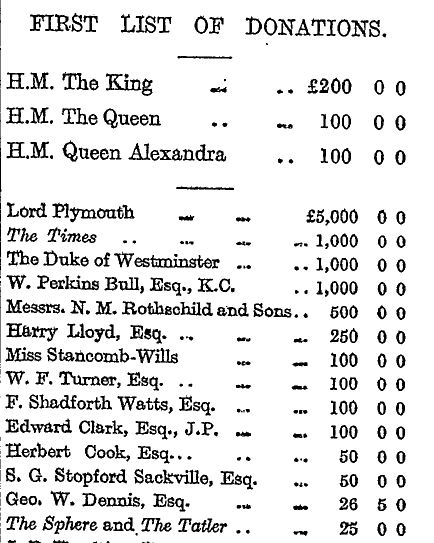 The Times, 2 July 1913 page9 It’s rather clever. Whether you think preserving the Crystal Palace is a good idea or not, if your peers do, you’d better pay something. And it had better be a reasonable amount or else they’ll think you’re a skinflint. This is a very common way of raising money. My mother tells me that this is how they used to raise money for her local church. One wonders why the technique fell into disuse.
The necessary funds were secured in slightly less than a fortnight and the Crystal Palace continued to stand in Crystal Palace until it was wrecked by fire in 1936.
The other thing that really got me thinking was seeing the sort of people that would appear on television, proselyting about the coming tragedy that it would imminently become too late to prevent. Whether from charities, pressure groups or the UN, I knew I had heard their strident and political use of language, and their determination to be part of the Great Crusade to Save the World before. These were the CND campaigners, class war agitators and useful fools for communism in a new guise. I suddenly realised that after the end of the Cold War, rather than slinking off in embarrassed fashion to do something useful, they had latched onto a new cause. The suggested remedies I heard them espouse were always socialist in approach, requiring the installation of supra-national bodies, always taking a top-down approach and furiously spending other peoples’ money. They were clearly eager participants in an endless bureaucratic jamboree.
Now don’t get me wrong: a scientific theory is correct or not regardless of who supports it. But recognising the most vocal proponents of CAGW for what they were set alarm bells ringing, and made me want to investigate further…
– Jonathan Abbott writes on WUWT about his personal path to C(atastrophic) A(nthropogenic) G(lobal) W(arming) skepticism.
Aside from the slightly odd word “proselyting” … snap.
A few commenters here have expressed boredom about this whole climate thing, and a lot of people certainly are very bored indeed with the climate alarmists. But when you consider how much power and money are still being diverted into arrangements based on climate alarmism being true, by people for whom the science still seems to be settled like it was 1999, it would surely be a big mistake to stop discussing these matters now. This would be the equivalent, during the Cold War (an earlier huge argument to which Abbott rightly compares the climate debate), of reading someone like Von Mises explaining in about 1950 that communism is economically irrational and hence in the long run doomed, and saying, right, we can forget about that then. Communism still had many decades of damage to do. And it didn’t just fall. It was also pushed. Climate alarmism is the same now. The damage it will do has, arguably, only just begun. Just how much damage climate alarmism ends up doing depends on how much it continues to be challenged.
In his ‘Seen Elsewhere’ section, top right, Guido is today linking to a piece entitled An Anarcho-Capitalist Defence of the Royal Family. Sounds like fun, and it is.
For me, the most amazing bit is not any bit in this piece, but the bit at the bottom where it says who wrote it:
Christina Annesley is a 21 year old anarcho-capitalist and the founder of Leeds Liberty League. She has a BA in History from the University of Leeds and is currently writing a dystopian fantasy novel.
There are just so many things that are great about that.
A few days ago, while I was on holiday in Santorini – one of the Greek islands – I was contacted to be told that one of my oldest friends, David Botsford, had died. He was only 49 years old.
David, a graduate of King’s College, London, is someone I first got to know back in 1988, when he was working at the time for an outfit called Outlaw Films. David was part of that libertarian circle of friends in London that I hung out with (Brian Micklethwait, Antoine Clarke, Tim Evans, Chris Tame and Kevin Macfarlane, among others) in that time. David was not the most high-profile libertarian activist, maybe, but he was certainly one of the most prolific, and insightful, in terms of the material he produced.
In the early 1990s, David decided on a change of career: he entered the field of psychology, and studied fields such as hypnotherapy, using his skills to treat people who wanted to give up smoking, beat stress or eating disorders. Shortly thereafter he went to the US – he held a dual British-US passport – and worked for a while in Los Angeles. He returned to the UK a few years later to develop his work in the UK, and spent a long time living in the Notting Hill area. I spent many happy hours in his company – David seemed to know just about every cool restaurant in the area and, given his interests, he also had a wide circle of friends. (One of them invited me – to his perhaps regret – to play in his cricket team). David was a stage performer. On one memorable night, he gave a stage hypnotism performance in deepest Soho and he also performed such acts in the US, such as Las Vegas, and gave talks to various groups and appeared on television.
His essays for libertarian publications on issues such as gun control, the arts, foreign policy and education stand the test of time. David was also a kind, generous and funny person to know and he was very dear to me and my wife. He will be greatly missed. Later this year, some of us who knew him intend to go to a restaurant and raise a glass or two in his memory.
When I read this…
THE country’s top political blogger, Paul Staines – better known as Guido Fawkes – has threatened to sue Tory MP Claire Perry after she alleged he had “sponsored” a hack attack on her website.
… I was moved to say that this Perry is very much in favour of Guido using the courts to kick the living hell out of that Perry, the thuggish ‘Honourable’ member for Devizes.
Put the boot in, Guido!
From the Wall Street Journal today:
A $91 billion industrial project here, mired in debt and unfulfilled promise, suggests part of the reason why China’s economy is wobbling – and why it will be hard to turn around. The steel mill at the heart of Caofeidian, which is outside the city of Tangshan, about 225 kilometers (140 miles) southeast of Beijing, is losing money. Nearby, an office park planned to be finished in 2010 is a mass of steel frames and unfinished buildings. Work on a residential complex was halted last Christmas, after workers completed the concrete frames. There is even a Bridge to Nowhere: a six-lane span abandoned after 10 support pylons were erected.
“You only need to look around to see how things are going,” said Zhao Jianjun, a worker at a plant that hasn’t produced its steel-reinforced plastic pipes for months. “Look north, west, east,” he said, gesturing to empty buildings. Chen Gong, chairman of Beijing Anbound Information, a Chinese think tank, says Caofeidian shows the flaws of the Chinese economic-growth model, in which the government plans investment and companies are expected to follow suit, regardless of market conditions. Chinese local governments are “driven by the blind pursuit of GDP,” said Mr. Chen.
There are reasons why I have doubted much of this “China will overtake the US and dominate the world” stuff and the details referred to above are part of it, though goodness knows state-driven mal-investment is hardly the preserve of China. Far from it. But there has been enough evidence around to suggest that vast sums of money poured into Chinese projects of this type will not bear fruit. And there will be a reckoning.
|
Who Are We? The Samizdata people are a bunch of sinister and heavily armed globalist illuminati who seek to infect the entire world with the values of personal liberty and several property. Amongst our many crimes is a sense of humour and the intermittent use of British spelling.
We are also a varied group made up of social individualists, classical liberals, whigs, libertarians, extropians, futurists, ‘Porcupines’, Karl Popper fetishists, recovering neo-conservatives, crazed Ayn Rand worshipers, over-caffeinated Virginia Postrel devotees, witty Frédéric Bastiat wannabes, cypherpunks, minarchists, kritarchists and wild-eyed anarcho-capitalists from Britain, North America, Australia and Europe.
|





Recent Comments