We are developing the social individualist meta-context for the future. From the very serious to the extremely frivolous... lets see what is on the mind of the Samizdata people.
Samizdata, derived from Samizdat /n. - a system of clandestine publication of banned literature in the USSR [Russ.,= self-publishing house]
|
If Snowden had gotten things his own way, he’d be writing earnest op-ed editorials in Hong Kong now, in English, while dining on Kung Pao Chicken. It’s some darkly modern act of crooked fate that has directed Edward Snowden to Moscow, arriving there as the NSA’s Solzhenitsyn, the up-tempo, digital version of a conscience-driven dissident defector.
But Snowden sure is a dissident defector, and boy is he ever. Americans don’t even know how to think about characters like Snowden — the American Great and the Good are blundering around on the public stage like blacked-out drunks, blithering self-contradictory rubbish. It’s all “gosh he’s such a liar” and “give us back our sinister felon,” all while trying to swat down the jets of South American presidents.
These thumb-fingered acts of totalitarian comedy are entirely familiar to anybody who has read Russian literature. The pigs in Orwell’s “Animal Farm” have more suavity than the US government is demonstrating now. Their credibility is below zero.
The Russians, by contrast, know all about dissidents like Snowden. The Russians have always had lots of Snowdens, heaps. They know that Snowden is one of these high-minded, conscience-stricken, act-on-principle characters who is a total pain in the ass.
– Bruce Sterling, who I think has his own head up his arse half the time (my god he is still clinging to the Climate Change shtick and is thus as credulous as many of the people he is inclined to mock)… but Sterling is nevertheless always a fun read because in addition to being half wrong, it is also (generally) half right.
The first problem I have when I read of ‘austerity’, meaning less state spending… is that the amount the state is spending is not really going down at all, it is just getting moved around a bit.
But there is a second definitional problem I have with this term ‘austerity’ as it is being used.
When I see members of the kleptocratic classes, the receivers of appropriated state largess, describe less public spending as ‘austerity’, I often wonder if such people regard the steadily lessening rates of burglary in the UK as also being a long term trend towards ‘austerity’.
Look at it this way: people are (allegedly) having less of their property appropriated by burglars, which means the burglars have less of your money to spend. So clearly this means society is experiencing ‘austerity’, as you, in your un-burgled household, get to keep more of your own property and spend more of your own money, rather than having it spent by someone else.
So… less people having their stuff taken away from them by the state, and by burglars (but I repeat myself)…. that is ‘austerity’, right?
What happened here was the gradual habituation of the people, little by little, to being governed by surprise; to receiving decisions deliberated in secret; to believing that the situation was so complicated that the government had to act on information which the people could not understand, or so dangerous that, even if the people could not understand it, it could not be released because of national security… Each step was so small, so inconsequential, so well explained or, on occasion, ‘regretted,’ that, unless one were detached from the whole process from the beginning, unless one understood what the whole thing was in principle, what all these ‘little measures’ that no ‘patriotic German’ could resent must some day lead to, one no more saw it developing from day to day than a farmer in his field sees the corn growing. One day it is over his head.
– An excerpt from: They Thought They Were Free: The Germans, 1933-45 by Milton Mayer, published by the University of Chicago Press. 1955
… this is not really about porn, other than very tangentially. And it is not even about pederasty or terrorism or any of those nasties that we tend to agree are Rather Bad Things and which get trotted out at the first sign of opposition to the rapidly coalescing Panopticon. No, it is about exactly the same things that induced the Chinese state to put the so called Great Internet Wall of China in place.
It is about political control, pure and simple, which a very substantial number of people support. Indeed most people who works in a government job think what they do is sufficiently important to justify having any information that they want about you.
So Jimmy, this is not really about porn at all.
Yes, tomorrow night at the Rose and Crown in Southwark, Aiden Gregg will be giving a talk entitled Sax and Violence, hosted by Libertarian Home.
Aiden Gregg already did an earlier version of this same presentation, at my home on May 31st. The second half of his talk that night was him reading out this essay, which concerns a country called Equistan. Attenders tomorrow night are asked to acquaint themselves with this interesting and thoughtful text.
Equistan is afflicted by extreme sexual inequality between different men, caused by there being many more men in Equistan than women. Luckily for Equistan, however, it has a government which addresses this issue by imposing sexual justice, of a sort that redistributes some of the sexual favours bestowed by women upon appealing men to less appealing men. Most Equistanians understand that these arrangements are both fair and necessary. A few sexual libertarians (such as the so-called “Liberty Belles”) grumble about them, but such malcontents are an extremist fringe, whose arguments are briefly described and refuted.
The talk at my place was not recorded, but this one at the Rose and Crown, assuming nothing goes wrong, will be. Highly recommended.
LATER: Libertarian Home has more.
Top Conservative Lord Howell sparks fury over ‘desolate and uninhabited’ North claim…
…trumpets the headline in that paragon of Little England statism, the Daily Express. This is because Lord Howell thinks fracking for gas in the north of England would actually be a good idea given that most of its inhabitants are goats and seagulls.
As a quick glance at this map indicates, he called the North of England ‘desolate and uninhabited’ because it is, er, desolate and pretty damn uninhabited.
Jude Leitch, of Northumberland Tourism, said the North East was known for its spectacular scenery, and although it had a history of heavy industry, those areas were concentrated and relatively small. She said: “It’s not hard to refute what he said. He’s probably never been up here in his life.”
Well I have no idea if Lord Howell has ever been up north but I have and yeah, it is desolate and uninhabited for the most part and many of the inhabited bits are ugly as hell. So I am very much in favour of fracking the fracking hell out of it.
“Nudges can turn into shoves pretty quickly.”
– via Glenn Reynolds
I see that the Church of England is about to go into the moneylending business. They appear to think that it is easy. If so, they might like to consider this moneylender’s words:
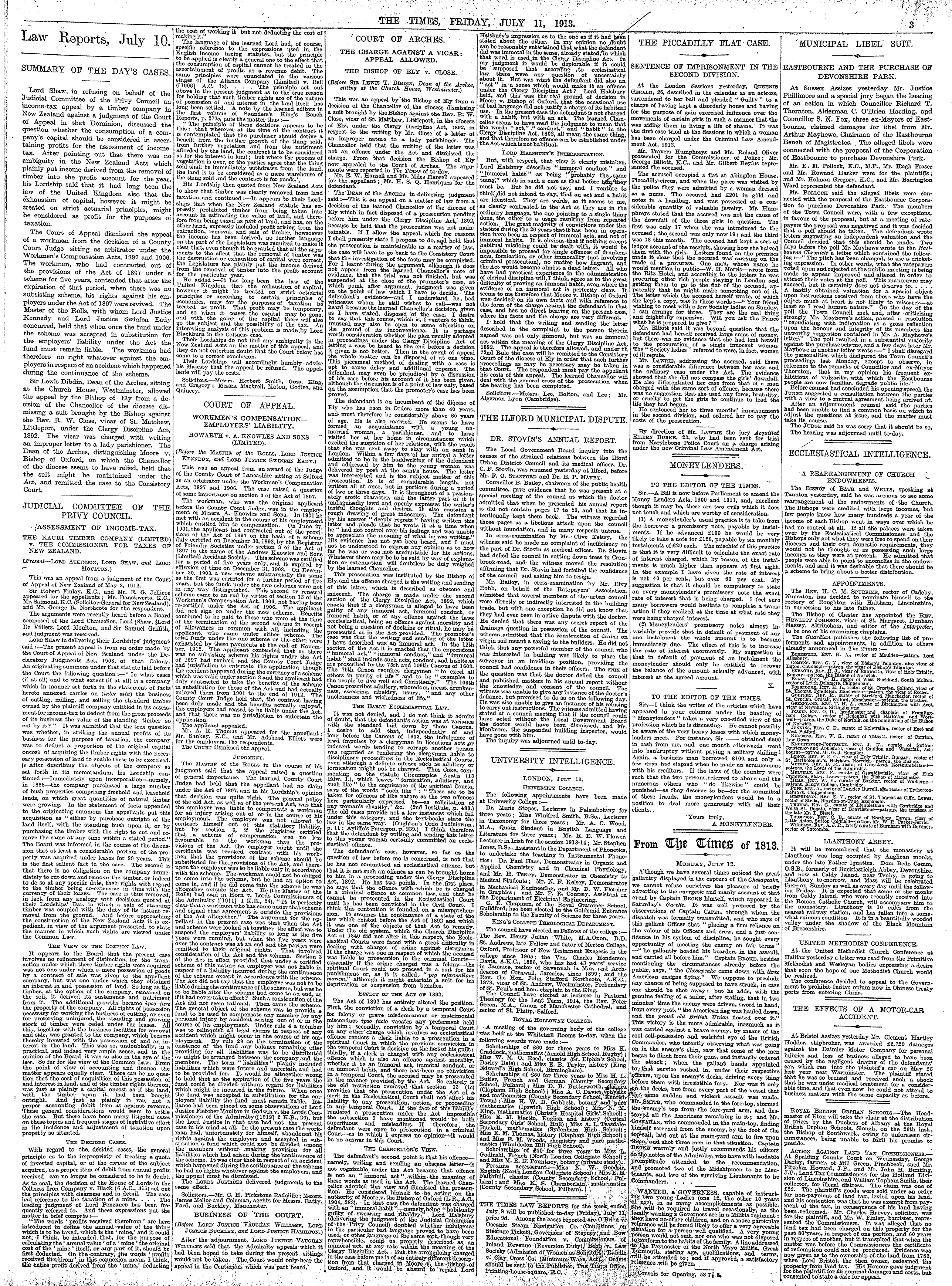
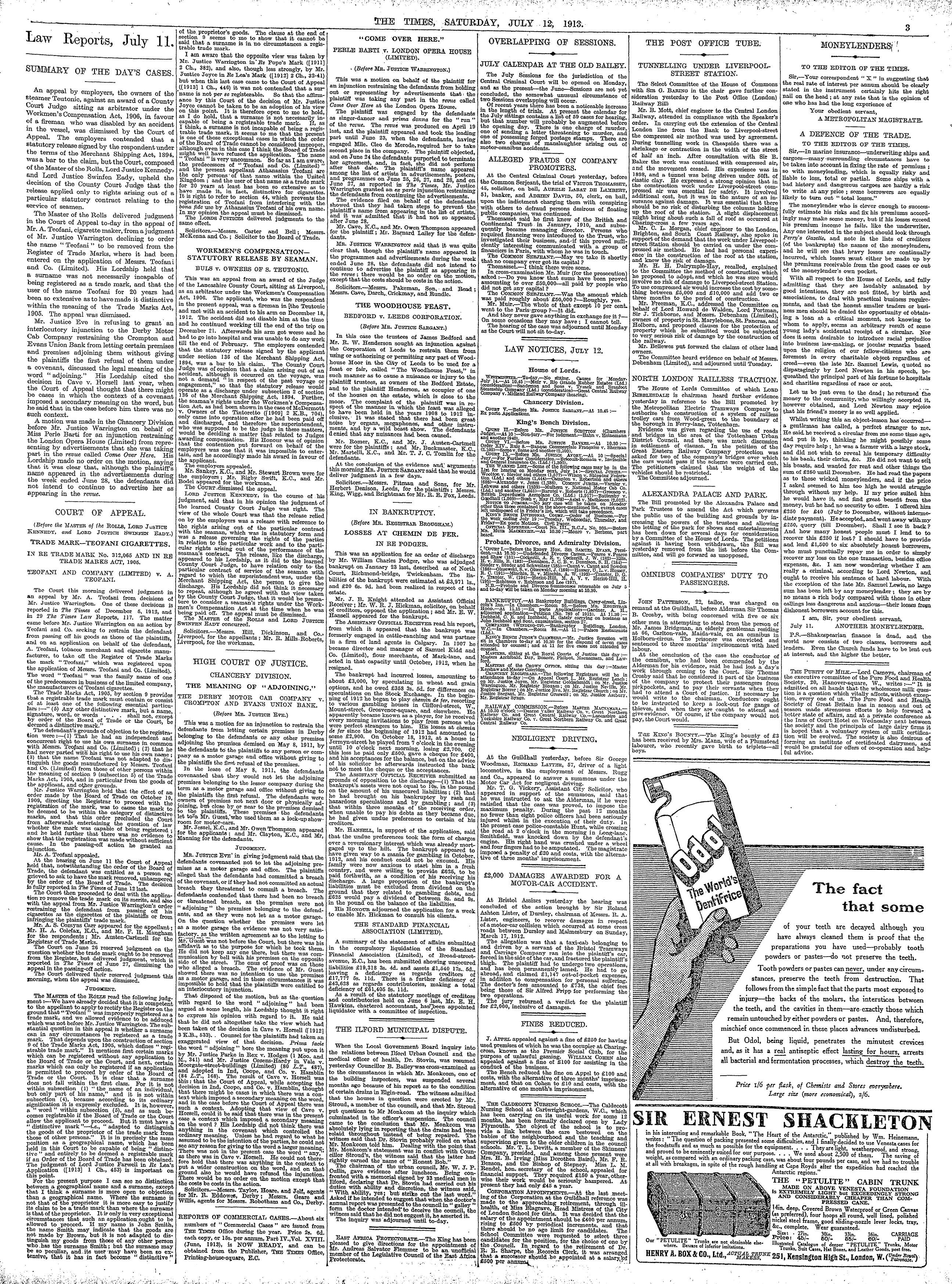
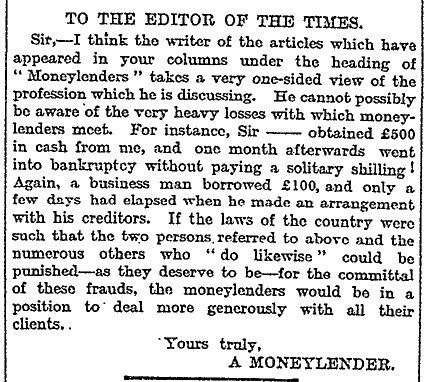 The Times, 11 July 1913 page 3. Or this one. (I liked the bit about even the Church having to lend out its money.)
The Liberty and Property Defence League also has a few things to say.
Once upon a time there was a wise princess. She lived in a magic castle together with her friends, who were also wise. One day, the princess, taking pity on the ignorance of the common folk, decided to go among them and teach them.
Alas! Some rough people said rude and nasty things to the princess. She had to run back to her castle and issue a proclamation. This what it said: Anthea Butler: Conservatives bashed me for speaking out about the Zimmerman verdict.
The princess was very sad. She even wondered if the people were worthy to go on being allowed to hear her wise words.
What is the role of a public intellectual in the age of Twitter and soundbites? Is it to share your thoughts for the public good, or is it to curate the heaps of hate emails, tweets and right-wing articles that trash your intellectual and social work?
The princess felt that she had to choose between sharing her wisdom and keeping a record of all the bad things the rough people had said to her. Why she felt that way, we do not know, but we know the reason was wise.
Anyway, the princess held her head high as befitted her rank. Who cares what peasants say anyway? Then she had a good idea. She gave herself a medal.
In the age of conservative grievances about education however, how many people will be willing to go through what I do every time I publish an op-ed or in order to share what they have spent a lifetime to learn?
QE has had another effect which is rarely quantified. The Newedge study calculates that 47 per cent of all S&P 500 earnings growth since 2009 has been derived from the interest expense savings from declining interest rates, a large chunk of which has been created by the Fed’s interventions. A puncturing of the credit bubble would send the cost of borrowing shooting up, and thus reverse many of these gains.
We have had the tech bubble (partly driven by cheap credit); we had the property bubble (driven by cheap credit), we now see a bond bubble (ditto)…….
Read the whole article. The CityAM piece is not the first to broach the issue, but as an overview, it is very good indeed.
It’s a problem when the people who are supposed to be the curators of your culture fundamentally don’t like it.
– Instapundit
“How did it come to pass that so many teachers and students, in some of the freest and most scientifically accomplished nations in the world, entertained such an illiberal, illogical, and politically repressive account of the relationship between science and society? Part of the answer may be that universities generally, and humanities departments in particular, are more backward than is universally recognised. For most of their history, universities functioned primarily as repositories of tradition. It was professors, not priests, who refused to look through Galileo’s telescope, and who drove genuinely progressive students like Francis Bacon and John Locke to distraction with their endless logic-chopping and parsing of ancient texts. Similarly it was twentieth-century humanities professors who, confronted with the glories of modern science and the triumph of the liberal democracies over totalitarianism, responded by denigrating virtually every political philosophy except totalitarianism.”
– The Science of Liberty, by Timothy Ferris, pages 257-8.
This is the Timothy Ferris who writes mostly about science, not the Timothy Ferris of the “Four-hour body” and other such works.
|
Who Are We? The Samizdata people are a bunch of sinister and heavily armed globalist illuminati who seek to infect the entire world with the values of personal liberty and several property. Amongst our many crimes is a sense of humour and the intermittent use of British spelling.
We are also a varied group made up of social individualists, classical liberals, whigs, libertarians, extropians, futurists, ‘Porcupines’, Karl Popper fetishists, recovering neo-conservatives, crazed Ayn Rand worshipers, over-caffeinated Virginia Postrel devotees, witty Frédéric Bastiat wannabes, cypherpunks, minarchists, kritarchists and wild-eyed anarcho-capitalists from Britain, North America, Australia and Europe.
|





Recent Comments