We are developing the social individualist meta-context for the future. From the very serious to the extremely frivolous... lets see what is on the mind of the Samizdata people.
Samizdata, derived from Samizdat /n. - a system of clandestine publication of banned literature in the USSR [Russ.,= self-publishing house]
|
Here is a comment, from someone called “Sean II”, on a posting done just over a year ago at Bleeding Heart Libertarians entitled Freedom and Feminism. I think (but am not sure) that I got to this via one of the links here. He attached a ping to this posting about JK Rowling, which I got an email about.
Whatever, I think that the following comment is interesting, and entertaining, and just all round deserving of a little bit more attention than however much attention if got a year ago:
Interesting you should mention the friends and family dimension.
Of the people close to me, I’ve only ever put forth a serious effort to share libertarianism with my wife. And even that mostly took the form of me saying casually “these ideas can be found lying around the house, if you should ever happen to develop an interest in them. Obviously, I’d like it very much if you did, but please feel no more pressure than that.”
Everyone else in my private life gets sorted into the category of “Don’t argue. Not worth the risk of hostility, alienation, and rancor.”
As you might guess from that, I spent the holidays holding my tongue while some people praised Chris Christie’s “handling” of the weather, others spoke (in a convincing mimicry of informed discussion) about the urgent need to hold magazine capacity below 30 rounds, and one dear in-law rhapsodized about the perfectly obvious necessity of federally funded light rail NOW!
My wife asked me why I never say anything. I told her: “The same reason why Doctor Who doesn’t give everyone a physics lecture when he visits the 16th century. He’s too far ahead, they’re too far behind, any dialogue that arose between them on the subject would be little better than a session of verbal abuse. All the information and all the practiced arguments would be on my side. They’d have no choice but to fight back against me with maximum nastiness.”
The odd thing is … they’ve all seen my library. Floor to ceiling, it’s politics, philosophy, and history. You’d think, at some point, one of them would get suspicious of my silent partner act, and wonder why I grow quiet whenever my own favorite subjects come up for discussion.
That’s pretty much how I feel about my family. My friends not so much, because the majority of them are libertarians, or at least libertarian-sympatico. But I also have plenty of friends whom I do treat in exactly this silent way, although not with the Doctor Who-ish sense of silent superiority that Sean II says he feels. After all, if I’m so clever, why ain’t I winning them over?
An interesting bit of the libertarian movement is the bit that consists of people – like Sean II? – who behave like and feel like and have similar personal and consumer tastes to “liberals”, and who actually get along very well with liberals and who often marry liberals, but who are, actually, on the quiet, libertarians. These are the double life libertarians, the libertarians in the closet.
And an interesting moment in intellectual and political history may one day happen when such libertarians feel more free to tell it like it is to their friends and families. Will this moment ever happen? Has it already, for some? Discuss.
Here is a splendid explanation of why you really do not want to trust any government with wide un-targeted surveillance powers.
I mean, who knows where that might lead eh?
“A decade or more ago, I used to have conversations with journalists who reflected that their industry’s business model was collapsing, but who somewhat sheepishly hoped the collapse wouldn’t come until they reached retirement age. Now I have the same kind of conversation with academics.”
– Glenn Reynolds, Mr Instapundit himself.
Sometimes it is worth pointing out the obvious…
Rand Paul, the Great White Hope of people who want things to be Less-Statist-Than-Now, is a career politician. As a result, he may be preferable to authoritarians like McCain or Obama or just about any of the mainstream politicos in the US right now… but it is still a career politician.
So… when it was suggested to me that if Edward Snowden were really one of the good guys, he should have taken his revelations to that tireless fighter for liberty, Rand Paul, rather than getting said revelations published in The Guardian, the assumption seems to have been that Paul was going to be a better custodian of these secrets than the dismal pinkos at the Guardian. Moreover Snowden would not have had to go on the run to avoid prison to whatever country dislikes the USA enough to not extradite him as Rand Paul would have made sure we would be safe.
Think again.
Senator Paul thinks Edward Snowden deserves a ‘light sentence‘ of a few years in jail, which rather suggests to me that he would rather not have had these revelations made at all, but as they are out there, he might as well make some political hay out of it. I mean one does not suggest prison for someone doing something vital to the cause of liberty, but rather one argues for that person’s vindication.
So on one hand Paul chastises the NSA for its vast programmes of indiscriminate spying based on the Snowden revelations… and on the other, he wants the person to actually told the world about it so that people like him can do something about it… to go to jail for having done so.
More than ever I am convinced Snowden did the only thing he could do rather than place his trust in some career politician. And that includes a career politician called Rand Paul.
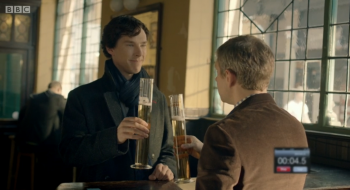
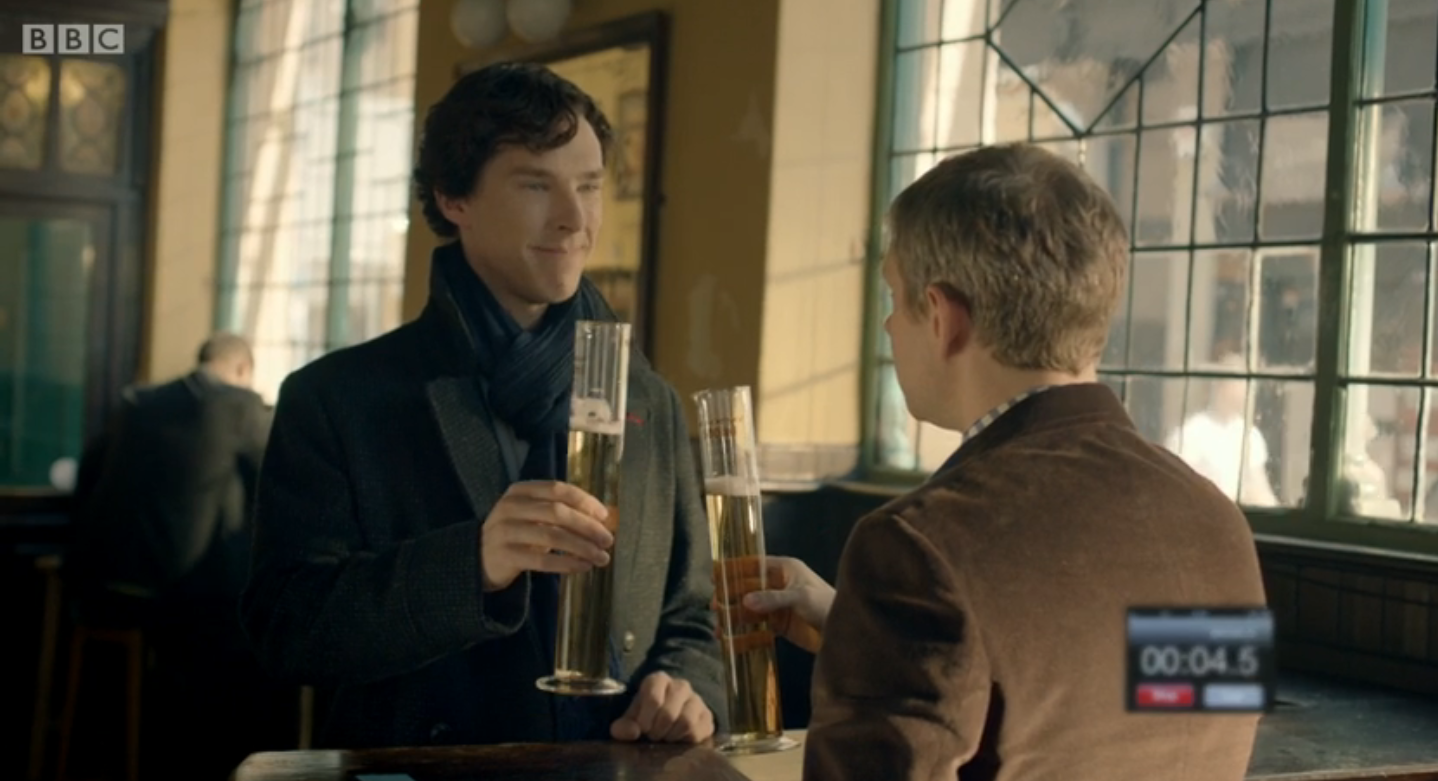
I have also just watched the latest Sherlock. If you live in the UK, the chances that you watched it as it was first broadcast are approximately one in seven. Despite the fact that this is a simultaneous British television watching event of the first order, the percentage of people who watched it is less than half what it was for peak television events of the 1960s to 1980s. That said, I want a set of those beer glasses. Oh Lord, I want a set of those beer glasses.
If you don’t live in the UK, torrents are appearing right now and you will be able to watch it shortly. If you live in China, you are able to watch it on the legal Youku Tudou streaming service right now. If you want to watch it legally in most other places, you will have to wait a few days to a few weeks. I suspect, though, that most of the people who really want to talk about it will have watched it by this time tomorrow. Versions with strange, semi-accurate hacked on subtitles will be out there any moment now. Then they will talk, and talk, and talk, in various languages and through various translation tools.
Things weren’t always thus. I am a middle aged expatriate Antipodean fogey. Watching film and television while growing up in Australia in the 1970s and 1980s in Australia was a strange thing. Inevitably, most of the movies we watched came from America, and most of the television we watched in Australia came from America. In America, television seasons start in October, run through the winter months, and then end in about April. The biggest blockbuster movies are released between May and July. In Australia, though, the summer movie season started on December 26, and the television season went from February to September. This means that movies that had been hits in the American summer would often be held over for more than six months, and television seasons that had started in October in the US would not commence showing in Australia until February of the following year.
Even by 1982 this had become tiresome with movies. I remember reading about a movie called “E.T.” that was supposed to be wonderful, and waiting endlessly. (I found it vaguely disappointing. Some of this might have been the wait). Even the existence of VHS was enough to break this down. By the 1990s, Hollywood had found that it was best to open movies as close as possible to simultaneously around the world as possible, both for reasons of piracy prevention, and because of the simple fact that publicity campaigns and other buzz could not be stopped from crossing borders.
Television was a little more odd, though. For one thing, there was less realisation that there was a problem. Television had certain peculiarities – for instance Christmas episodes of foreign series always aired in May – but this was no more peculiar than eating an enormous Christmas dinner of ham and turkey in 40 degree heat, or watching live major sporting events on TV in the middle of the night, as Australian sports fans are known to do on a weekly basis. In any event, local print media – mostly owned by the same companies that owned the television stations – would play ball, and there would be no discussion of new episodes of television series until the television series aired locally.
But of course, modernity (by which I mean the internet) eventually happened. It became trivially easy to watch any programme almost as soon as it was aired. Those people who wanted to talk about television with other people on the internet (in Australia and elsewhere) found it imperative to watch at the same time, and they did. And they do. (Okay, I admit it. And we did. And we do). Piracy of music and of first run movies seems to have declined, because the legal options for listening and watching at the same time everywhere are now pretty good. Piracy of programming from regular series television seems to have gone way up, though. Television networks around the world are getting closer to airing things on the same day, but they are still probably not good enough for people who want to watch the next day, without spoilers. (In Australia, the same old television networks are still rather tilting at windmills to stop piracy, even with the help of a US Ambassador who believes an important part of his job is to discourage Game of Thrones piracy). National television moments have declined, however it feels when watching Sherlock in the UK. Global television moments have grown spectacularly. The industry is yet to catch up by giving global audiences legal ways to achieve these moments.
Except that in China, piracy is feared to such an extent that the purveyors of legal streaming have actually chosen to give viewers what they want when they want. The rest of the world may follow soon. I hope so.
Also, with Sherlock being such a big hit in the manufacturing capital of the world, I will hopefully be able to order the beer glasses on ebay any moment now.
I have just watched the latest Sherlock. The chances are good that if you live in the UK, so have you.
You know how first videos, then DVDs, then the multiplication of channels and on-demand telly internet replay thingummies killed off the simultaneous collective experience of television?
It’s back. Not, I hasten to add, that I would know anything about Twitface from personal experience, but there are plenty of people nowadays who simply must watch Sherlock or Dr Who live so that they can talk about it on the internet the minute it is over.
“With legal property, the advanced nations of the West had the key to modern development; their citizens now had the means to discover, with great facility and on an ongoing basis, the most potentially productive qualities of their resources. As Aristotle discovered 2,3000 years ago, what you can do with things increases infinitely when you focus your thinking on their potential.”
– Hernando de Soto, The Mystery of Capital, page 50.

Port soaked duck sausages, maple syrup coated bacon, duck eggs, orange tomatoes grilled with olive oil and fresh basil, baked beans with cracked pepper.
I am sure there is a libertarian angle to all that somewhere.
The nice men in periwigs who came up with the Fourth Amendment were recklessly naive to imagine that branches of a government, each of whose power is enhanced when the power of the other branches grows, would serve to check one another. The idea of a judiciary that would police the executive as an arm of a self-correcting tripartite government was worse than naive.
– Ilana Mercer
So who are these people, these soi-disant progressives who keep flogging this swill? They are quite obviously the people who profit most from it in a variety of ways. Well, I’ll tell you, since I was once one of them.
They are the “Soros Socialists,” successful people who want to stay rich and powerful. They do this by espousing social programs and making pronouncements, few of which affect them even minimally. But they have the image of being generous egalitarians and the image is all. It prevents them (their power and greed) from being scrutinized by others — and even more importantly it can prevent them from scrutinizing themselves.
– Roger L. Simon ends his piece (“Back when I was a kid, I used to think Republicans were the party of the rich” is how it starts) whacking the “really rich” people who now spout, and pay for, the continuing progressivist ruination of America.
Let us all hope that there is enough ruination in America for the stupid opinions (personally I have nothing against their “greed” if all that this means is them earning mountains of money by making mountains of great stuff) of this latest generation of plutocrats to be shrugged off.
… but particularly we dedicate this to Professor Turney, who may have done more to raise awareness of the veracity of the AGW thesis since someone somewhere said something about hockey sticks…
(hat tip to Samizdata commenter Mr. Ed, who may or may not be a talking horse, of course)
Professor Turney’s expedition was supposed to repeat scientific investigations made by Douglas Mawson a century ago and to compare then and now. Not unreasonably, it has been pointed out Mawson’s ship was never icebound. Sea ice has been steadily increasing, despite the Intergovernmental Panel on Climate Change’s gloomy forecasts. Had the expedition found the slightest evidence to confirm its expectation of melting ice caps and thin ice, a major new scare about the plight of the planet would have followed. As they are transferred to sanctuary aboard the icebreaker Aurora Australis, Professor Turney and his fellow evacuees must accept the embarrassing failure of their mission shows how uncertain the science of climate change really is. They cannot reasonably do otherwise.
– The Australian
|
Who Are We? The Samizdata people are a bunch of sinister and heavily armed globalist illuminati who seek to infect the entire world with the values of personal liberty and several property. Amongst our many crimes is a sense of humour and the intermittent use of British spelling.
We are also a varied group made up of social individualists, classical liberals, whigs, libertarians, extropians, futurists, ‘Porcupines’, Karl Popper fetishists, recovering neo-conservatives, crazed Ayn Rand worshipers, over-caffeinated Virginia Postrel devotees, witty Frédéric Bastiat wannabes, cypherpunks, minarchists, kritarchists and wild-eyed anarcho-capitalists from Britain, North America, Australia and Europe.
|






Recent Comments