We are developing the social individualist meta-context for the future. From the very serious to the extremely frivolous... lets see what is on the mind of the Samizdata people.
Samizdata, derived from Samizdat /n. - a system of clandestine publication of banned literature in the USSR [Russ.,= self-publishing house]
|
As the world is ever more wired together, so too are the threats. So if Russian security companies like Kaspersky cannot be trusted when it comes to Russian state spying, and US companies like CrowdStrike and FireEye cannot be trusted when it comes to US state spying, seems to me that companies based in places like Finland, Switzerland or India might actually be able to parley that into a meaningful competitive advantage.
I anticipated something along those lines for quite some time myself.
Animals loose in a car are never a good idea. Goats are generally the worst, but until you realise there’s a tortoise stuck under your brake pedal you’ve never known the meaning of fear, and possibly not the meaning of ‘old age’ either.
– Sir Terry Pratchett, The Unadulterated Cat. Sadly Sir Terry never really got to know the meaning of ‘old age’ himself. I think he did know the meaning of fear when contemplating a particularly cruel death for a writer, but knew even better the meaning of courage. I would link to the famous “embuggerance” statement to illustrate this point but so many other people are doing that right now that it has melted the internet.
When I think of all the people the world would be a better place without…
… Sir Terry Pratchett was not one of them.
Iraq is over, done, finished. The literally insane paranoiac Nouri al-Maliki guaranteed Iraq was toast and only a wilfully blind fool can pretend it can be put back together, or that doing so would even be desirable at this stage. There is only one tortuous bloody route to regional stability and that needs to be centred on an independent Kurdistan.
And I am delighted to see that both Ted Cruz and now Rand Paul seem to understand this. There are already willing and able ‘boots on the ground’: Kurdish ones. There is totally no need for US boots or anyone else’s boots to be there in any substantive way, beyond training missions and perhaps some SAR capabilities. Enough with the whole White Man’s Burden shtick already! Even a great many locals are embarrassed about how often they need to get bailed out by the US, arguing they really need to do this themselves!
Yes yes, I know an independent Kurdistan will horrify theocratic Iran, the Iranian dominated rump of Iraq, the Ba’athist Socialist rump of Syria and Islamist dominated Turkey. And whilst that is really just awesomely wonderful, it is just gravy on the many benefits that will eventually come from an independent Kurdistan.
Biji Kurdistan azad.
The sundry Communist regimes coddled and celebrated by the American Left managed to kill something on the order of 100 million people during the 20th century. Consider that a lesson unlearnt: In our own time, the anti-fracking movement does the bidding of ex-KGB boss Vladimir Putin’s regime, and so-called progressives such as Thom Hartmann are quite pleased to work hand-in-glove with a Kremlin-backed propaganda network. Things will come to a bad end in Venezuela. Sean Penn won’t be there for it, and neither will Chaka Fattah. Perhaps the ghost of Walter Duranty will file a report.
– Kevin D. Williamson
There is an interesting video well worth a watch here called: What LBJ Really Said About Selma.
Considering the people being protested against by the Civil Rights marchers were members of the Democratic Party, there is a certain sense of irony to be had when looking at who seems to have wrapped themselves in the mantle of those times now.
I tend to avoid party politics but over on Sp!ked, Brendan O’Neill has a very interesting free ranging chat with Nigel Farage.
‘The Conservative Party is as upper class today as it has ever been. Over the past hundred years, the upper classes had more connection to their fellow man than they have today. And I’ll tell you why. Firstly, those that were from the landed classes may have been selfish financially, over the corn laws or whatever it was, but they ran their estates themselves. They actually knew the lads that cut the hay and looked after the horses. And then we had two world wars, which brought the whole class system together. Up until the late 1980s you had senior Tory politicians from posh backgrounds who could talk to the lads doing the scaffolding. They can’t do that now.’
That certainly does ring true. Read it!
One of the oddities (well, it may not be that odd) of our time is when people who wax lyrical about liberty or the evils of oppression of certain kinds seem to be, well, rather weak at the knees when certain “tough guy” rulers flex their muscles in ways that seem hard to justify by reference to any sort of principle other than naked territorial aggression.
And sometimes defenders of these “tough guys” (or women) are so appalled at what they see as the behaviour of the “other side” in a dispute (such as the European Union or the current leadership of much of the West) that they want to make excuses for such tough guys’ actions, often excusing behaviour that one might assume they would, in other cases, condemn or at least question. . There has been a fair amount of “we had it coming and you cannot really blame X or Y since they were were brutalised by us” sort of thinking long before 9/11. (People sometimes excused Germany’s aggressions in the 1930s by invoking Versailles in a knee-jerk fashion, and for all I know, the Ancients were indulged in similar ways.)
A recent example of this sort of behaviour comes from Peter Hitchens, a columnist who, for those who haven’t encountered him before, is almost self-parodic in his scolding right wingery. (He’s the brother of the late Christopher Hitchens). Peter Hitchens is a lapsed Marxist and I sometimes wonder just how deep any conversion away from that intellectual foolishness has ever taken place. Anyway, it appears Mr Hitchens has big man love for Vladimir Putin, so to speak:
Col. Putin, he says, is at odds with the West because he feels unloved. By us, that is. This is an injustice Peter has set out to correct, sticking out for his bit of rough. Vladimir, according to his swain Peter, is like a murderer who, according to his lawyer, only killed because his Mummy was a whore, he never knew his Daddy and the flat-screen TV set in his room was only a 19-inch.
Thus the object of Peter’s affection is only raping the Ukraine the way he previously raped Chechnia, Georgia and his own people because “We have been rubbing Russia up the wrong way for nearly 25 years.” Had we been rubbing Russia up the right way, Col. Putin wouldn’t be murdering everyone he dislikes, including, incidentally, dozens of Peter’s Russian colleagues. He wouldn’t have blown up blocks of flats in his own country to provoke aggression against Chechnia. He wouldn’t have turned Russia into a giant crime syndicate. And he wouldn’t have waged nuclear war in London by using polonium to murder Litvinenko.
This broadside comes from some fellow called Alexander Boot, of whom I had not heard before. Judging by some other postings, I suspect I won’t be in much agreement with Mr Boot about a lot of issues, but he’s right here.
Some weeks ago, when the issue of Russia’s activities vis a vis the Ukraine came up, one commenter sniffed that we libertarians should not be so beastly about Russia, since for all its brutality/corruption/etc, that we must focus our efforts more on Islamic fanaticism, and that Russia, because of its brutality under Col Putin, was a sort of useful, if rather unwholesome, ally. I don’t fully buy that analysis on even the most hardnosed basis, and on a more highminded view, think that genuine defenders of liberty and justice should raise the bar a bit. Part of the dislike of the Putin regime and what it represents on my part comes from a disappointment in what now holds sway in Moscow. It could and should have been far better than this. Much better.
The worthy IEA are hosting a panel discussion tonight called: The future of the BBC.
Guess what I would like to see for the BBC…
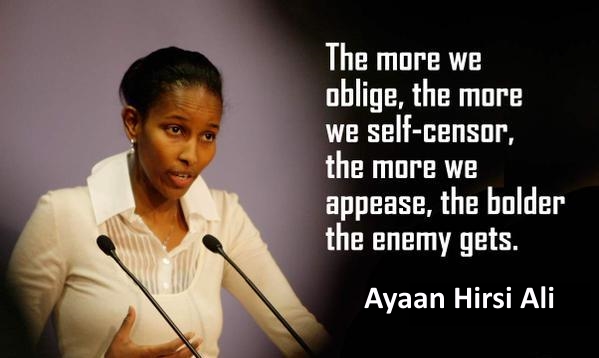
If you do not know who she is, you should because she is quite remarkable.
… but then they discover that the UK has made it illegal to fly there! Rats foiled again! Yeah that should work, hahaha 😀
And on a related note, the three formerly British girls who ran off to Syria to become ‘Jihadi Brides’ have been located at a specific address in Raqqa. My only question was, does the RAF know?
Nick Cohen laments the ‘the sinister treatment of dissent at the BBC‘, as if the state owned tax funded media operation had ever been some haven of even handed rectitude and objectivity.
What a fool I was. Since then, BBC managers have shifted Tom Giles, the editor of Panorama, out of news. Peter Horrocks, an executive who insisted throughout the scandal that the BBC must behave ethically, announced last September that he was resigning to “find new challenges”. Clive Edwards, who as commissioning editor for current affairs oversaw the Panorama documentary, was demoted. The television trade press reported recently that his future is “not yet clear” (which doesn’t sound as if he has much of a future at all).
Why would the top people at the BBC be all that different to any other part of the British state? When being a state body means you cannot go bust as long as there are taxpayers to be farmed, the people suckling from the public teat serve up such wonders as the police and social services did in Rotherham, or the NHS in Staffordshire Hospital. Had the Staffs scandal happened privately, I are quite certain there would be howls in the Guardian for all private hospitals to be nationalised and new ones made illegal, yet I am told the NHS is still the ‘envy of the world‘.
It takes a double shot of navy proof state issued rum to not expect the worst from any aspect of the tax funded Leviathan. And the BBC is a tax funded arm of the state.
|
Who Are We? The Samizdata people are a bunch of sinister and heavily armed globalist illuminati who seek to infect the entire world with the values of personal liberty and several property. Amongst our many crimes is a sense of humour and the intermittent use of British spelling.
We are also a varied group made up of social individualists, classical liberals, whigs, libertarians, extropians, futurists, ‘Porcupines’, Karl Popper fetishists, recovering neo-conservatives, crazed Ayn Rand worshipers, over-caffeinated Virginia Postrel devotees, witty Frédéric Bastiat wannabes, cypherpunks, minarchists, kritarchists and wild-eyed anarcho-capitalists from Britain, North America, Australia and Europe.
|





Recent Comments