We are developing the social individualist meta-context for the future. From the very serious to the extremely frivolous... lets see what is on the mind of the Samizdata people.
Samizdata, derived from Samizdat /n. - a system of clandestine publication of banned literature in the USSR [Russ.,= self-publishing house]
|
We seem to shy away from constitutional matters at Samizdata. I think in part this is because we have a distaste for government and would like to see an end to the whole shebang.
I can’t argue with that but it seems to me that freedom is a slow process and the state is going to hang around for a good while yet. So, how it is set up is something we probably ought to concern ourselves with.
Amongst all the other rows engulfing UKIP last week, one concerned whether they should accept so-called “Short” money. This is money handed out to opposition parties to help them with their parliamentary duties. If memory serves, the argument is that the government has an army of civil servants to help them, so the opposition needs the help to even things up a little. For us libertarians, there would be no need for Short money if we had less government but there you go.
All this can be traced back to 1910. Before then, as I understand it, MPs weren’t paid a penny: no salary, not even expenses. The problem was what to do with these newfangled Labour MPs. They tended to be less well off and were unable to support themselves by either private means or by moonlighting as barristers or journalists as figures like Carson and Churchill were able to do. The obvious solution was to allow trade unions to pay them. But this fell foul of the principle that MPs could not be bought.
Scared of the implications of denying Labour voters representation – riots were a frequent occurrence at the time – MPs started paying themselves. Pity. The great advantage of the previous system was that energetic statists had to do something useful before becoming MPs. This meant they had some idea of the difficulties of running a business. While we can’t prove that it was a bulwark against socialism it is difficult to imagine it did a great deal of harm.
By the way, on the question of UKIP and Short money I understand they decided to take no money at all. If this turns out to be true, good for them.
It’s been an interesting couple of months a hundred years ago. There have been the landings at Gallipoli, the German use of gas at Ypres, the imminent departure of both the First Lord of the Admiralty and the First Sea Lord, the failure of the British attack at Aubers Ridge and the “Shell Scandal” – the claim that the Aubers failure was due to a lack of shells. Meanwhile, the Lusitania has been torpedoed, Zeppelin raids are continuing and the Bryce Report into alleged German atrocities in Belgium has concluded that most of the allegations are true. In shades of the London riots of 2011 – demonstrators have asserted their right to protest at the uncivilised behaviour of the German government and – additionally and in consequence – to steal and break the property of all those who have German names.
There are a couple of ideas going on here.
The first idea is that we – the British – are dealing with a ruthless and unprincipled enemy and that therefore we must at least be equally ruthless and possibly equally unprincipled. The second idea is that it is the state’s responsibility and privilege to lead and enforce British ruthlessness. There must be no more amateurism or muddling through. Everything must be systematic and uniform and directed from the top. Early signs of this change in approach will be the formation of a coalition government and the foundation of the Ministry of Munitions. Already there have been calls for conscription which is odd given that the New Armies raised in 1914 have yet to fight.
I suspect that, like most things that government does it didn’t work, or at least, worked no better than if they had left things to market or – given the central role of government in any war – near-market forces. However, he who wins gets to write the myths. And so the myth that government direction works got established in the UK. Probably.
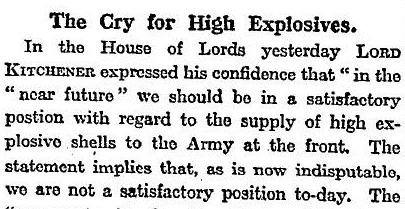 The Times 19 May 1915. Talk about “The Thunderer”. I particularly like the reference to the “mutilated and twice-censored” Times article.
“Bring back self-defence classes for women – it’s the feminist thing to do”, writes Rhiannon Lucy Cosslett in the Guardian. That’s right, Rhiannon Lucy Cosslett, more typically to be found writing such gloriously quotable effusions as “Why it’s OK to cry about this election”, is writing kick-ass pieces about kicking ass in the Guardian. This is strange but good.
I do not entirely understand why Rand Paul spoke in the Senate for ten hours, accompanied by ten other senators, three Republicans and seven Democrats. It was something to do with derailing an extension of the Patriot Act. Apparently if he had gone on fifteen more minutes longer, past midnight, it would have been a proper filibuster. But he did not. Weird. Still, Paul is a man whom I credit with having a decent reason for pretty much whatever he does. Well done, I think.
The Times reports (paywalled):
Christian bakery guilty of discrimination over ‘gay cake’
A bakery whose Christian owners refused to make a cake carrying a pro-gay marriage slogan has been found guilty of discrimination after a landmark legal action.
Ashers Baking Company discriminated against Gareth Lee when it refused to create the cake featuring the Sesame Street puppets Bert and Ernie, with a slogan “Support Gay Marriage”, a judge has found.
Ruling in the case that has split public opinion in Northern Ireland, Isobel Brownlie, the district judge, said: “The defendants have unlawfully discriminated against the plaintiff on grounds of sexual discrimination.”
So, you can be forced to say “Support Gay Marriage”, on the grounds that if you don’t say it someone will be left feeling “like a lesser person”, to quote Mr Lee, the plaintiff in this case.
How might this principle be extended?
Added later: in answer to my own question, a scenario:
Following the Labour victory in the closely-fought election of 2020, the new prime minister made good on the pledge made to the Muslims who had formed such a reliable part of the winning “coalition of the oppressed”. (In fact the promise to outlaw Islamaphobia had first been made by Ed Miliband back in 2015.) The relevant amendments to the Equality Act 2010 having been made, it seemed a natural next step for many Muslims to press for the UK to follow the example of several Canadian cities and give legal weight to the verdicts of the existing informal network of Sharia tribunals to which Muslims could choose to bring civil cases as an alternative to the regular channels of English or Scottish Law. It was as part of the campaign for this that the plaintiff, Mr A, approached the Rainbow Baking Company, run as a family business by the defendants Mr B & Mr C. The judge ruled that “The defendants have unlawfully discriminated against the plaintiff on grounds of religious discrimination” when they refused to bake a cake bearing the message “SUPPORT SHARIA LAW”.
As it happens I am not in principle opposed to parallel systems of arbitration running in parallel to the ordinary law, so long as they are strictly voluntary. But my imaginary gay bakers might well profoundly object to being obliged to make a cake bearing that slogan. However by then the precedent that they can be forced to by law will have been set.
The Government has quietly ushered through legislation amending the anti-hacking laws to exempt GCHQ from prosecution. Privacy International and other parties were notified of this just hours prior to a hearing of their claim against GCHQ’s illegal hacking operations in the Investigatory Powers Tribunal.
– Privacy International
So basically the state broke the law, got caught breaking the law, and then when challenged, changed to law so exempt themselves from the law they broke.
If we wanted to be “together” in the ways Obama envisions, then no force would be necessary. If public schools were any good, people would not flock to private education the minute they could afford it (and sometimes even when they can’t.) The same with other government-mandated activities or programs. People would voluntarily, en masse, “invest” and “come together” and do all the other things that Obama, and other progressive statists like him, believe we should do.
– Michael Hurd
It seems that in the final year or so of his dreadful presidency, Obama is becoming ever blunter in his public pronouncements, disparaging business and America’s individualism. It reminds me a bit of that scene in the Fountainhead where Elsworth Toohey, the arch-villain, confesses to his powerlust.
Remember: the world’s most powerful country voted for this shit – twice, and by handy margins.
Prince Harry calls for the return of slavery. Time for the tumbrels to start rolling methinks.

When was the last time you saw a very light-skinned Nigerian criminal? All the armed robbers that are paraded by the Nigerian police are usually dark skinned. Yes the SSS paraded the light-skinned Kabiru Sokoto, but they did him the courtesy of buying him a brand new t-shirt after they caught him hiding. When they showed him to news men, his face showed no signs of being tortured. So also the light-skinned alleged mastermind of the Nyanya bombing, Aminu Ogwuche. No swollen face or beating. If they were dark skinned, they would have been shirtless and sitting on the floor with a split lip or swollen eye. That is why I always advice dark skinned people to avoid crime. Because they will be the first to be caught. And when they get caught, no one will feel bad about giving them a good beating.
– Elnathan John
I would not have expected such enlightened thinking from the Daesh Islamic State, but they have now ruled that women may now take jobs without the permission of their husbands!
ISIS doc says women can become suicide bombers without husbands’ permission
Way to go, guys!
Some decisions made for an infant are not easily undone. Circumcision, for instance. Hence the controversy on this blog. Or the decision of what language the child will hear first, and whether and when a second one is taught. This topic seems to generate similar anger for similar reasons.
My long post, a sequel to this one on how those who wish to preserve minority languages are self-destructively fixated on the use of force as the only possible means of doing so, is stalled. A line about how Welsh-speaking parents should be free to delay teaching their children English if they wish grew until it took over the post. I have cut off that part as one cuts off the end of a… worm. Let’s see if it can live independently and wriggle off into some new direction of its own.
We are libertarians, right? We defend fee-paying schools, religious schools, selective schools, single-sex schools, schools where the children do not have to attend lessons, “unschooling” and homeschooling. We do not wimp out from defending all these just because they may not be where we would choose to send our own children. Yes, I meant Islam. Islamic schools must be free to exist on the same grounds that Islamic speech must be free to exist. Compared to many of the controversial types of school above, the average Welsh, Maori, Irish Gaelic or Navajo medium school is beloved by all. I must say, I would prefer that no school were funded by force, i.e. by taxation, but that happy state is at present no more than a dream.
As for schools, so for languages. We defend everyone’s right to his or her own language and culture, this time joined by practically the entire developed world. It was not always so here in the UK, nor in the rest of the English speaking world, and even now there are many countries where minority languages are still suppressed covertly and overtly. In modern rich countries the boot is very slightly on the other foot, but by the standards of world oppression it’s not a big deal.
As for languages, so for passing on your language to your children. The idea that being bilingual confers a cognitive advantage is not utterly universal, but it is very widespread, and, for what it’s worth, intuitively makes sense to me. I have never met a bilingual who wished they were not one; I have met several people who lament that they could have been raised bilingually but were not. Fine for the kids, then… but maybe not so fine for the minority language. Bilingualism does not seem to be stable. “Half the world is bilingual,” say the enthusiasts. Yes, and half the world’s languages are in danger of dying out. Welsh, the minority language I know most about, is comparatively healthy with its half million plus speakers, but its trendline gently noses downwards. Every Welsh speaker also speaks English. That’s the trouble. There is this myth that when an English person comes into a pub all the locals start speaking Welsh. They don’t. On the contrary. I have lost the link for this*, but when I saw it I believed it instantly from personal observation: there is research to show that when a single person who only speaks English joins a Welsh-speaking social group every other person in the network switches to English, out of politeness. And then comes the internet, and pop music, and the TV, and the adverts, and the whole great wave of English… increasingly, Welsh-schooled or not, young people in Wales seem to be jumping in and enjoying the surf. Often they are sad later that they have let their Welsh go, but gone it has. The same pattern of decline applies to young speakers of other languages spoken in proximity to English.
Some might calculate that only way to ensure the survival of these languages is to increase the exit costs.
→ Continue reading: The morality of not teaching your child English
The Witcher 3, a much anticipated computer game from a Polish studio based on a series of Polish fantasy novels, is released next Tuesday. Reviews of it are already being published and I have been reading a lot about it, including one review on Polygon by Arthur Gies that spent a lot of words complaining about the lack of black people and the treatment of female characters in the game.
Another Polish developer, Adrian Chmielarz, whose studio made the acclaimed adventure game The Vanishing of Ethan Carter, has responded. On the complaint that there are only white people in the game:
the fact that a post-modernist remix of fantasy and the Polish folklore made by Slavs does not feature non-white characters, is a non-issue.
Note that I am not sure that adding “strangers from the strange lands” to the game would solve anything for the chronically offended. Based on everything I learned about them in the last year, and I learned a lot, if you put a person or a few from any non-white race, they would be called “token characters”.
The Polygon review goes on to complain about the women in the game:
the world CD Projekt has created is oppressively misogynist. In some ways, the game deals directly with this — characters acknowledge again and again that it’s hard to be a woman there, that it’s a place of violence and terror and that women must work harder to be recognized and respected.
Then it kills them, over and over.
[…]
I get that the setting of The Witcher 3 is meant to be a dark, dirty fantasy. But in a world that so explicitly goes out of its way to build a believable, distinctive take on the genre, the inclusion of so much violence explicitly directed against women feels like a clear, disconcerting choice. It’s not just present, it’s frequently a focus.
When they’re not being murdered, women in The Witcher 3 are comically sexualized. Nudity is everywhere…
Chmielarz responds:
As we can see, The Witcher 3 apparently simply mirrors the real world (as according to Feminist Frequency).
This is a group whom the reviewer admires, and who argue that “violence against women is a serious, global epidemic”.
I have to assume that Gies understands that when compared to the actual real world, the violence is exaggerated in The Witcher 3. That it’s basically an often grim, often cruel fantasy world.
But …why is such a world a problem? Is the reviewer confusing portrayal with endorsement? Should art be propaganda for a peaceful life? Should art avoid disturbing universes?
There is a lot more; this is just a flavour of the debate. It is good to see people like Chmielarz standing up to this kind of criticism, because for a while it looked as if everything was going the way of those who would be offended by everything.
Also encouraging is that, if you read the comments on a news story about this debate at Gamezone, it appears that nobody really cares. They just want to enjoy games.
|
Who Are We? The Samizdata people are a bunch of sinister and heavily armed globalist illuminati who seek to infect the entire world with the values of personal liberty and several property. Amongst our many crimes is a sense of humour and the intermittent use of British spelling.
We are also a varied group made up of social individualists, classical liberals, whigs, libertarians, extropians, futurists, ‘Porcupines’, Karl Popper fetishists, recovering neo-conservatives, crazed Ayn Rand worshipers, over-caffeinated Virginia Postrel devotees, witty Frédéric Bastiat wannabes, cypherpunks, minarchists, kritarchists and wild-eyed anarcho-capitalists from Britain, North America, Australia and Europe.
|





Recent Comments