We are developing the social individualist meta-context for the future. From the very serious to the extremely frivolous... lets see what is on the mind of the Samizdata people.
Samizdata, derived from Samizdat /n. - a system of clandestine publication of banned literature in the USSR [Russ.,= self-publishing house]
|
When I was abroad recently, I watched the hotel TV, like you do. The same big story got repeated over and over again, like it does. Do you know what BBC World News thought was the most important story on Earth?
Cecil the lion (peace be upon him). The BBC had a reporter with the crowd outside the house of that American dentist who broke the world’s heart. “Nothing has been seen of Mr Palmer,” smirked the reporter, “which isn’t surprising considering what some people here are saying they are going to do to him.” Then the camera panned to the house for a good long look at it so that anyone else wanting to kill the man would know where to go. I always wondered what it would take for the BBC to see the merits of vigilante justice.
Not to be outdone by the Yanks, now Britain has its own Walter Palmer. Not to be outdone by the Beeb, the Daily Mail is at the head of the mob.
Former GREEN PARTY councillor revealed as a big game hunter who poses for trophy photos with his kills – and defends shooting Cecil the Lion
A former Green Party councillor has defended his hobby – as a big game hunter.
Defiant Ben Wightman, 27, has proudly posted trophy photos of himself next to a series of animals he has shot in South Africa.
The controversial images – on his publicly-open Facebook page – show a grinning Wightman, rifle in hand, crouched beside a host of dead animals, including two antelopes, a bloodied warthog*, an ostrich, buffalo and a zebra.
Wow, a Green Party apex predator. I like it. The Daily Mail commenters don’t. “The comments below have not been moderated”, it says. You can tell. The Mail would not deprive its readers of the manly pleasures of making death threats to people they’d never heard of ten minutes ago. But doesn’t this blockhead know the script? He’s not backing down:
‘I am a firm believer that one of the best ways of management and conservation is with a rifle.
‘We are taking out old, lame or unfit animals that are causing problems for local farmers.’
*Note to the Samizdata elves. A warthog is practically a hippo. I’ve waited years to use this category.
I don’t usually find much to sympathise with over at the Bella Caledonia blog. This account by Jonathan Rowson, whose brother has been committed to a psychiatric ward, was an exception:
Smoking and the Forbidden Garden – a Dereliction of Sanity?
Defending the rights of the mentally ill to do something that harms them is not a popular cause, but this much needs to be said: preventing psychiatric patients from smoking on hospital grounds is inhumane.
I am responding to the situation in a particular ward in a hospital in NHS Grampian region. At the time of writing my forty year old brother Mark is there, as he has been before. He is surrounded by other adult patients, many of whom are thought disordered, dysfunctional, and up to their eye balls in medication. Mark has given me permission to write publicly about his situation, but he is not well enough to grasp the full context. I am taking the liberty of making the following case on his behalf.
Many psychiatric patients are habitual smokers, but at the moment they are strictly not allowed to smoke anywhere on hospital grounds. Smoking has been banned in hospital buildings for about a decade, but in the hospital in question secure gardens adjacent to the locked wards and smoking shelters within the general grounds of hospitals were available to smoke. This arrangement seemed to work until the authorities decreed that the shelters should be knocked down and the secure gardens should be smoke free. Some psychiatric patients, staff and visitors now face the mild stigma and hassle of having to escape the hospital to smoke, but if you are sectioned under the mental health act it’s not so simple. The hospital ward is your de-facto home, and also your de-facto prison, so where do you go?
The ruling is unenforceable. In fact most staff feel they have no choice but to turn a blind eye. Patients are now smoking in their rooms or in the bathrooms; anywhere where the staff can have plausible deniability of not seeing them. Alas, the collateral damage of this necessary open secret is that none of the patients can now go to the outdoor area assigned to the ward. The small secured gardens are the most humanising place on the ward and a vital source of fresh air, but they lie unused due to the risk, not that patients will smoke, but that they will be seen to be smoking, and get staff into trouble as a result.
Most of the comments are supportive, but not all. This one by Clive Scott was notable for its self-righteousness:
What about the employer’s responsibilities to provide a safe working environment for employees and the rights of non-smokers for wholesome air? It would be ridiculous to permit the mentally enfeebled to flout regulations for the common good simply because of their illness. Smoking is a disgusting foul habit and addiction and every step possible should be taken to eliminate it from society.
Nor is gay marriage the only issue around which strict orthodoxies are calcifying. Climate change, multiculturalism and feminism are all issues on which there is only one correct view. To be sceptical of the impact of climate change, or to challenge the censoriousness of feminism, is to incur the wrath of the right-thinking. Not that critics of the new orthodoxies are challenged on their views. Rather, they are branded – as deniers, as misogynists, indeed, as bigots. By their labels, they shall be known – and shamed.
– Tim Black
So the idea this letter represents mainstream economics must be challenged. When Sky is reporting it without an alternative viewpoint, it can mislead the public. But this also shows something interesting about the political left. People across the political spectrum like to appeal to the authority of “experts” to improve credibility. But for the left, this is crucial. Unlike supporters of markets, left-wing interventionists believe experts can direct economic activity for us. Building up the idea that “experts” support these interventions and believe they work is therefore of critical importance to obtaining public acceptance.
– Ryan Bourne, Institute of Economic Affairs.
Trevor Dupuy was a US soldier and a military historian who took a statistical approach to evaluating combat performance. He paid particular attention to casualty statistics. Casualties – in case you did not know – include deaths but also include wounded, missing and captured. They answer the general’s question: how many men do I have who are able to fight?
Of course, statistics aren’t everything. For instance, the North Vietnamese took vastly more casualties in the Vietnam War than the Americans but they still won. But all things being equal, being able to kill more of your enemy than he can kill of you is a good thing to be able to do.
In A Genius for War Dupuy enquired into the nature of the German army. He found that the statistics told a remarkable story: the German army was very good and had been for a long time. From the Franco-Prussian War to the Second World War the Germans were consistently better at killing the enemy than the enemy were at killing them.
Now you may be thinking that such comparisons might be skewed due to the Russians and Dupuy found that that the Russians were indeed every bit as bad as you might think. But even when he removed the Russian numbers Dupuy found that the Germans still held a clear and consistent superiority over the French, British and Americans. This superiority existed regardless of whether the engagement was offensive or defensive.
Chauvinists might be surprised to learn that there seems to have been no great difference between the western allies. French and British performance was more or less equal in the First World War. British and American performance was more or less equal in the second. The Americans in the First World War and the French in the Second are special cases.
Having satisfied himself that the German army was indeed superior, Dupuy asked why this was. His key finding was that there seemed to be nothing inherent in being German. Dupuy found a number of historical examples where the Germans proved to be anything but good fighters. These included largely-German units in the American War of Independence and various battles between German mercenaries and the Swiss.
So, if being German didn’t make you a good soldier what did? Dupuy’s theory was that it was all due to the German General staff. So what was so good about the General Staff? Dupuy listed several criteria. These included selection by examination, historical study and objective analysis. In other words it was an institution that thought seriously about war.
The doctrine that all this thinking led to might be summed up as bold plans tempered with flexibility. Perhaps the best-known example of bold planning was the invasion of France in 1940. No one on the allied side thought a tank-led thrust through the Ardennes was possible. But it was and France collapsed soon afterwards.
As many of you will know far from being an official General Staff masterplan the invasion of France was in fact dreamt up by Erich von Manstein in opposition to his superiors. But Manstein was still every inch the General Staffer.
Flexibility was also important. Contrary to the stereotype the German army did not want blind obedience. Not only did it allow subordinate commanders to figure out how to achieve their objectives but if opportunities arose which were unforeseen they were not only allowed to take advantage of them but expected to do so. “His majesty made you a major because he believed that you would know when not to obey his orders.” as Prince Frederick Charles put it.
I would like to thank Perry de Havilland for pointing me in the direction of Dupuy and his works.
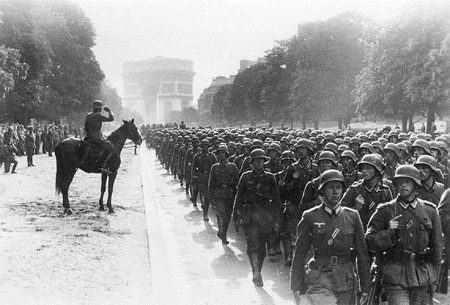 What swots can do
In my recent post on rent control, I quoted approvingly a comment from someone who said he had come round to our point of view on the harmfulness of rent control while still claiming to be a lefty. “You are not there yet, my friend,” I murmured. “But does not every journey begin with one step? Let us encourage this partial recantation, that it may be reproduced.” Perry de Havilland took a less tolerant view, while still encouraging reproduction. Niall Kilmartin took the middle road:
The naive young lefty, partly idealistic and partly enjoying the ego rush of being the good guy fighting the bad guys, gets successive hints from reality as they grow older. Over time, the accumulating hints force a choice: the idealism _or_ the ego rush; it can no longer be both. The more they shouted their hatred of the bad guys when they were young, the more dubious deeds they did “for the cause”, the harder it is for them to choose the idealism rather than the ego rush (as some college professors well know when they make activism part of the curriculum), but becoming “an apostate” is emotionally hard in any case. It can be a slow process. It can take years. From Robert Conquest to Thomas Sowell, some quite effective people were marxists when they were youngsters. So I’m sufficiently with Natalie to say that signs of doubt should not be discouraged (though I do understand why actual encouragement of those who are still fighting to retain their ego rush even as they admit doubt can sometimes stick in the throat).
If it sticks in the throat to welcome an incompletely-converted convert from an opinion we oppose, how much more so when the defector has joined and then abandoned a literal enemy.
Mother of five begs for rescue from Isis
THE British wife of an Isis fighter stranded in Syria with her five children is appealing for help to return home to Manchester.
In a video passed to The Sunday Times, Shukee Begum, who is of Bangladeshi origin, is heard repudiating Isis as “not Islamic” and telling how she had spent 10 months with her young children in the northern Syrian town of al-Bab, where she taught English to the children of foreign fighters.
She said the final straw was when the US-led coalition bombed the house where they were living, killing seven Isis commanders and members of their families.
While her husband, Muftah el-Deen, was away fighting, she escaped and was given shelter by members of the Free Syrian Army (FSA), a moderate group opposed to Isis.
Begum, filmed with her three girls and two boys on what appears to be a low-quality video phone, said she left Britain and was smuggled through Turkey into Syria late last year. She claimed her aim was to persuade Deen, who had joined Isis three months earlier, to come home.
This view is typical of the most popular comments to the story:
She ran off with five children to join her jihadi husband and now she says ISIS / Daesh are not Islamic? I might have a bit of sympathy if she said she completely rejected this cult of death, but she’s just saying that now she believes that sadistic slaughter, beheading and crucifixion is going a bit too far.
She wants to come back “home” and no doubt be quite Islamic, but eschew the mindless slaughter of unbelievers. Why should we believe a single word she says?
To which my reply would be that answering exactly that question is the job of the intelligence services to whom this lady will sing like a bird as a condition of being allowed to return. I hope and trust it does work that way and the local consular staff haven’t gone completely softheaded. We want defections and should make them easy but not cheap. It is painful to see crimes go unpunished – and I consider joining a group that boasts of its murders, enslavements and rapes to be a crime in itself – but renegades can help to stop the murders, enslavements and rapes, not to mention prevent the attacks here in the West that ISIS has promised. We have long allowed known criminals to turn Queen’s evidence / State’s evidence for very similar reasons. And her children are innocent.
It would be nice if the world as a whole was a less awful place. The average country is, after all, a democratically elected kleptocracy with a desperately poor population. (For evidence, see India or Haiti or Nigeria or Honduras.)
However, sustained progress worldwide, at least if we’re going to run legal systems based on popular votes instead of more rational methods, depends on most of the world understanding basic economics. The recent rise of Bernie Sanders and Donald Trump in U.S. polling demonstrates that even the bulk of people in the U.S. have no understanding of the barest rudiments of economics.
H. L. Mencken once said “Democracy is the theory that the common people know what they want, and deserve to get it good and hard.” However, the argument of most statists, on both the left and the right, is that we are our brother’s keepers, that the better off are obligated to run the lives of those who are not so well off, and this includes the more educated running the lives of the less educated.
If you don’t believe me, look around you: we are told that people cannot be trusted to figure out on their own if they should take intoxicating substances or if they should save for retirement or how they should educate their children — all those decisions must be made by the intellectual elite via the state. This is meant quite literally. Drugs must not be legalized because people can’t make their own judgements about taking them, or so we are told. People in the U.S. may not be allowed to privately manage the 14% of their income that goes to government “pensions” — savings would be an awful idea, since they’d just be duped out of their cash by investment firms, so the state must handle that money for them via Social Security. Voucher systems where children go to private schools selected by their parents are unacceptable, only a state run public education system run by the teaching elite is acceptable.
We could go down the list, everything from negotiating salaries to deciding if they want to eat raw milk cheeses. If people were allowed to run their own lives, they would make bad choices, and so it is not merely right but necessary that others, among the elite, should make their choices for them.
So, the smarter must, according to statism, run the lives of the less intelligent and educated, but at the same time it is obvious that even most of the educated in developed countries are incapable of even understanding comparative advantage or supply and demand curves. They are, when it comes to economic education, mere children, unable to help themselves.
The inevitable conclusion, therefore, is that statist morality is not compatible with democracy, but only with a dictatorship run by libertarians.
Note that this isn’t the conclusion I would come to myself, as I don’t share this moral belief system. I don’t personally want to be the dictator — I have no interest in running everyone’s life. However, it is the conclusion that believers in the state, and especially believers in programs like Social Security and public education, must logically come to — applying that morality, a reasonable outcome can only be expected if I and my colleagues are made absolute rulers. Indeed, according to those moral claims, this is not merely a superior solution but is actually morally required.
And yes, I’m trolling you, but at the same time I’m completely serious about what the statist belief system implies.
For centuries, people living in Western Civilization have been accumulating capital. They have not simply subsisted, and left the world the same as when they entered it. They have been creating more than they consume, passing on new wealth to their children. The Fed’s falling interest rate has slammed this process into reverse. It has put the entire economy into liquidation mode. It has forced people to consume their capital.
– Keith Weiner
An aircraft believed to be a World War II Hawker Hunter fighter jet crashed onto the A27, causing the road to be closed in both directions…

…Hawker Hunter first flight was 20 July 1951. I guess City A.M. does not allow their journalists access to the internet or the use of Google.
Even so, with eight months of the fiscal year still to go and often large revisions to early borrowing estimates, it is too soon to conclude that the Chancellor is meeting his fiscal plans with room to spare and could therefore reduce the scale of the austerity measures set to hit the economy.
– Samuel Tombs, economist at Capital Economics, quote here.
Listen up you ‘tard, it would be a very good thing indeed if even more ‘austerity’ measures were “set to hit the economy”. ‘Austerity’, as you Keynesian fuckwits like to call the state spending slightly less of other people’s confiscated money, means the money in question gets used in the economy under private economic direction, rather than malinvested by the damn state.

Between 1945 and about 1965, atom bombs and then hydrogen bombs were devised and demonstrated by the two biggest Great Powers, and then manufactured and attached to rockets in sufficient numbers to cause any all-out war between these two superpowers very probably to be a catastrophic defeat for both, to say nothing of being a similar catastrophe for all other humans, within a few hours. This new kind of destructive power also spread to a small club of lesser Great Powers.
This did not happen overnight. It didn’t all come about in 1945. But it happened pretty quickly, historically in the blink of an eye. It changed the world from a place in which Great Wars between Great Powers had to be prepared for, at all costs, to a place in which Great Wars between Great Powers had to be avoided, again, at all costs. That is a very big change.
I do not assert that all wars have ended. Clearly they have not, as one glance through a newspaper or news website will tell you. Small powers still have small wars, and Great Powers regularly join in, in small ways. Sometimes, Great Powers start small wars, like the one in the Ukraine now. But even these small wars have been getting less numerous and smaller in recent decades. Small wars can get big, so even small wars are now discouraged by Great Powers.
Nor do I assert that all preparations for war by Great Powers have ceased, or that they should. But more than ever, the purpose of such preparations is to enable mere confrontations to be emerged from victoriously or failing that satisfactorily, rather than for such preparations – such weapons – constantly to be “used”, in the sense of being fired, fought with, and so on. The purpose of weapons is to scare, as well as to win fights, and they are being “used” whenever anyone is scared by them. Great Powers will still spend lots of money on weaponry.
But what has not happened, for many decades now, and what still shows no sign of happening despite all kinds of diplomatic, ideological and financial turbulence, is an all-out fire-every-weapon-we-have war involving two or more Great – by which I of course mean nuclear – Powers. In this sense, countries like mine, and almost certainly yours too given that you are reading this, have become peaceful in a way that they have never experienced before in all of human history before 1945.
In case anyone mentions Iran, I don’t believe that Iran’s leaders want to use nuclear weapons, as in: detonate them. I think they want to scare their enemies while trying to win other, non-nuclear victories, just like any other nuclear power. I didn’t believe Chairman Mao when he played the nuclear madman either. He was just trying to scare people, and he succeeded also.
And if you want to say that like all historical trends, this one could end, because of this or that imaginable or unimaginable circumstance, then I of course agree with you. History keeps on happening. But for the time being, the trend is as I have described it. We now, still, live in an age of peace more profound than any of our ancestors have ever experienced.
There have already been many, many consequences of this historic turnaround, this Great Change, and there will surely be many more. Indeed, I would say that just about everything of importance, not just politically but in the wider culture, that has happened to the world, anywhere and everywhere, between 1945 and now, can only be understood properly if you factor in the invention of and the deployment of nuclear weapons.
Do I really mean that? Yes, I really do mean that. Indeed, I offer the world, and in particular the Samizdata commentariat, a challenge. Tell me about a change that has happened in the world in recent times, any change, to absolutely anything, and I will be able to show you, at about one or at the most two or three removes, how your particular change has been affected by this great thermonuclear transformation, this Great Change, that I have just described. Indeed, there is nothing in the entire world, I assert, that has not been affected, often very profoundly, by this Great Change. (I don’t promise actually to answer all such comment-challenges on the spot. I merely announce that if I had nothing else to do for the next week, I could. So, let’s make it a team effort. Let those of us who already understand the truth of what I am saying respond as a tag-team to those who are still unconvinced.)
Talking of team efforts, let me offer the example of sport, and in particular the inexorable rise in the importance and in the social and economic impact of professional sport, during the last clutch of decades.
→ Continue reading: From the Great Peace … to the ordeal of Adam Lyth at the Oval cricket ground
In the olden days, anyone got a letter from the Labour Party telling them their support was rejected and their vote wouldn’t count because “we have reason to believe you do not support the aims and values” would moan about it to a few friends and that would be that.
But it is not the olden days any more, so get your popcorn out!
|
Who Are We? The Samizdata people are a bunch of sinister and heavily armed globalist illuminati who seek to infect the entire world with the values of personal liberty and several property. Amongst our many crimes is a sense of humour and the intermittent use of British spelling.
We are also a varied group made up of social individualists, classical liberals, whigs, libertarians, extropians, futurists, ‘Porcupines’, Karl Popper fetishists, recovering neo-conservatives, crazed Ayn Rand worshipers, over-caffeinated Virginia Postrel devotees, witty Frédéric Bastiat wannabes, cypherpunks, minarchists, kritarchists and wild-eyed anarcho-capitalists from Britain, North America, Australia and Europe.
|






Recent Comments