We are developing the social individualist meta-context for the future. From the very serious to the extremely frivolous... lets see what is on the mind of the Samizdata people.
Samizdata, derived from Samizdat /n. - a system of clandestine publication of banned literature in the USSR [Russ.,= self-publishing house]
|
For centuries, people have pondered the meaning of evil. But the solution to the riddle is that evil has no meaning. Evil is the absence of meaning; it is meaninglessness. To build, to create, to act in the world—these all have meaning. Evil cannot. It is only a black hole that can tear apart meaningful things, and return them to the hollow silence of the universe. This is what we mean when we say that evil is “banal.” It lacks the infinite grandeur of even a grain of sand, let alone of laughter, or of a kiss. In that sense, evil does not matter. It is incapable of mattering. It cannot live or mean things. The best it can do is look on in ire, envy, and despair. And the envious are always walled off from the world that we, the living, inhabit, by an invisible and impervious barrier that they erect themselves; they always have the deadly touch of King Midas. We defy evil and envy when we live. Living in this world sheds light into darkness. It is all we can do, and all that needs to be done, and it is more than enough. Therefore, we shall live. We shall be joyful, hard-working, silly, creative, and smart and sexy and brave and fun. Be a brief candle that helps spread another light.
– Timothy Sandefur, writing a long and moving item about a close relation who was one of the 14 people murdered in San Barnadino recently by Muslim terrorists. Read the whole, outstanding piece. I don’t know how Tim had the fortitude to write so well about such a terrible event to affect his family. The article contains links to charities and organisations well deserving of support.
I like these people:
Free speech campaigners have secretly evaded a student union ban on two speakers who were deemed to have broken rules on causing offence.
The speakers, Milo Yiannopoulos, a self-styled men’s rights activist, and Julie Bindel, a feminist writer, were originally due to address the University of Manchester’s free speech and secular society in October to debate tensions between feminism and free speech until the student union stopped them.
Student leaders said that Ms Bindel’s views on transgender people were “transphobic” and that Mr Yiannopoulos was a “professional misogynist” and “rape apologist”.
However, Manchester’s free speech society proved to be made of sterner stuff. Its members created a new association, used a lecture hall as a venue and publicised the event only on the morning that it was to take place.
– The Times, today.
Several aspects of this story lead me to wonder if I have slipped into a nicer timeline than the one I’ve been living in recently.
It was about students standing up for free speech against po-faced authoritarians. In 2015.
The university didn’t surrender. In 2015.
Better yet, it actually helped the good guys:
The university authorities themselves were part of the plot, agreeing to provide a lecture theatre as a venue for the rescheduled event and arranging for a large retinue of security staff.
More fun things to note include the fact that the process of nimbly outwitting the lumbering Students Union by adroit use of social media was obviously huge fun. These days if you want to build up a bank of happy memories of a rebellious youth to comfort you in your old age, you rebel against the Students Union. You could make a name for yourself that way. So could the Student Union apparatchiks make their names, as sour, whiny prematurely-withered prunes who couldn’t stop the music. No one will boast that they were part of Manchester Student Union in the good old days.
I have a personal grudge against Julie Bindel, and I could get irritated by Milo Yiannopoulos. Three cheers for them both for this.
Ars Technica says than in the UK “you may soon need a licence to take photos of that classic designer chair you bought”.
Changes to UK copyright law will soon mean that you may need to take out a licence to photograph classic designer objects even if you own them. That’s the result of the Enterprise and Regulatory Reform Act 2013, which extends the copyright of artistic objects like designer chairs from 25 years after they were first marketed to 70 years after the creator’s death. In most cases, that will be well over a hundred years after the object was designed. During that period, taking a photo of the item will often require a licence from the copyright owner regardless of who owns the particular object in question.
There are lots of exceptions hinted at here: what is a classic designer object and why will the photograph only require a license “often”? It also seems as if such copyright enforcement already exists and only the timing is changing. Perhaps in practice the effects of this change in the law will be minimal.
Nevertheless, it is wrong to meet with violence the non-violent act of photographing an inanimate object. It is also so unintuitive that people will be surprised by it. And it is so unenforceable that it will be applied selectively.
There is another possibility. A Star Wars fan recently had his Facebook account suspended for posting a photograph of a Star Wars toy.
One possibility is that at least someone at Disney was openminded about Carvalho’s thoughtful response, but the organization has a software-enabled copyright enforcement regime in place that they simply can’t stop.
Pattern recognition software means that previously unenforceable crazy laws and policies can now be uniformly enforced. I find this…interesting.
It is indeed interesting, and worrying, that students are so sensitive and censorious today. But I have a question for the hand-wringers, the media people, academics and liberal thinkers who are so disturbed by what they’re calling the ‘Yale snowflakes’: what did you think would happen? When you watched, or even presided over, the creation over the past 40 years of a vast system of laws and speech codes to punish insulting or damaging words, and the construction of a vast machine of therapeutic intervention into everyday life, what did you think the end result would be? A generation that was liberal and tough? Come off it. It’s those trends, those longstanding trends of censorship and therapy, that created today’s creepy campus intolerance; it’s you who made these monsters.
– Brendan O’Neill.
The bigotry and oafishness of these places is now a well-known feature of life in the US and here in Europe. These places are causing damage; these young people are, remember, future voters and legislators. Have we perhaps reached a stage where not going to such a place is in fact a desirable state?
O’Neill argues that the current generation hasn’t arrived at its intolerance from nowhere:
The Yale snowflakes are pathetic, yes. But what’s even more pathetic is the ridicule of the snowflakes by the very generation who created this world in which words are seen as wounding, judgement is considered harmful, and everyone is treated as fragile. Having claimed for 30 years that offensive discussion, or porn or racist newspapers, create a ‘hostile environment’, can the older generation really be surprised that students are now setting up Safe Spaces? The Safe Space is the logical solution to the notion that words and images cultivate a ‘hostile environment’.
Item: Another example of just how messed up American education now is.
Here is a chart of average life spans for women from the Office of National Statistics with the dates replaced with letters. At some point on the X axis the National Health Service was created. Can you guess where? Answer below the fold.
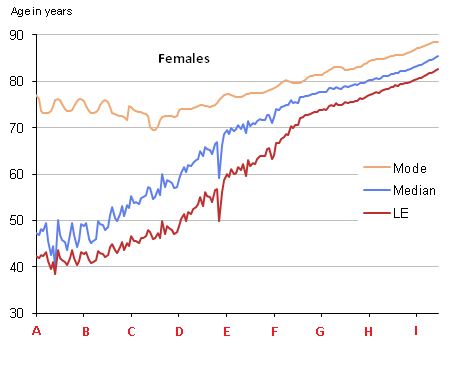
→ Continue reading: When was the NHS created?
There can only be one explanation for the disgrace that is Donald Trump: he must have failed to realise that the film industry’s demonic portrayals of conservative politicians are politically motivated caricatures, not role models to be emulated. In Love Actually, the villain is a crude, lecherous redneck Republican president on a visit to London. He is keen not just to bully Britain but also to force himself upon Martine McCutcheon’s character. Prime Minister Hugh Grant – an anti-war version of Tony Blair – tells him to get lost, tearing up the “one-sided” special relationship in the process, to the cheers of a grateful nation. As an insight into the Left-liberal mind, this scene takes some beating; the US president at the time was George W Bush and the invasion of Iraq had just been completed. But Trump, who unfortunately remains in the lead for the 2016 Republican nomination, seems to be auditioning for the remake.
– Allister Heath.
Read it all. By the way, I have noticed in some other online forums that Trump fans get very annoyed at we Brits opining about his views. Well, he chose to refer to the UK as part of his recent remarks about Muslims, so he puts himself in the frame for criticism. If you cannot take the heat, etc. The same would apply if a Brit, such as the broadcaster Piers Morgan, chooses to bash America for its 2nd Amendment.
“the jihadist movement that ultimately spawned Daesh is far closer to the spirit of internationalism and solidarity that drove the International Brigades than Cameron’s bombing campaign”
… given that the International Brigades fighting on the Republican side in the Spanish Civil War were Communists who followed Stalin’s line, which was to ruthlessly suppress rival militias such as the Trotskyist POUM in which George Orwell found himself by accident. Once I would have believed that the Spanish Civil War was simply a trial run for WWII with the Republicans as the Allies and the Fascists as the Axis. Nothing will make me view Franco’s overthrow of a democratically elected government with approval, but I can no longer see either side as the good guys. That, too, is a parallel with the current situation in Syria and Iraq.
That quote, by the way, is from a piece called “Groundhog Day in Syria as Mr Benn goes bombing”originally published by the Stop the War Coalition (National Chair: Jeremy Corbyn MP) but since removed from its website. The whole piece can be still found on the website of Matt Carr, its author, here. A fuller version of the controversial quote is:
Benn does not even seem to realise that the jihadist movement that ultimately spawned Daesh is far closer to the spirit of internationalism and solidarity that drove the International Brigades than Cameron’s bombing campaign – except that the international jihad takes the form of solidarity with oppressed Muslims, rather than the working class or the socialist revolution.
Many left wingers have reacted with anger. The sole Green Party MP, Caroline Lucas, has resigned from the committee of the StW Coalition partly as a result. The Guardian commenters laud her wisdom in stepping down without questioning her wisdom in ever having anything to do with the Stop Some Wars* Coalition in the first place. It is, and has been for years, the Emu to the Rod Hull’s hand of the Socialist Workers Party. As I said in 2011,
Three quarters of the posters [at the left wing demos I attended in the 70s and 80s], and almost all of the printed ones, were produced by the Socialist Workers Party. Busy little bees, they were. They still are: it is an astonishing fact that this tiny and fissiparous Trotskyist sect has twice dominated massive popular protest movements in my lifetime; the Anti-Nazi League / Rock against Racism movement of the 80s and the Stop The War Coalition of 2001-2008. Sorry, 2001-present, only they stop wars much more quietly now that Mr Obama is president.
*Wars against Israel are OK.
I am away in foreign parts and thus there may be delays in moderation and content…
Claire Lehmann describes some of the work of contrarian social psychologist Lee Jussim:
It appears that descriptive stereotypes are a crutch to lean on when we have no other information about a person. When we gain additional insights into people, these stereotypes are no longer useful. And there is now a body of evidence to suggest that stereotypes are not as fixed, unchangeable and inflexible as they’ve historically been portrayed to be.
So, it would appear that “we” make use of stereotypes exactly as I make use of stereotypes (or as I try to), as crude first approximations, rather than as the last word. Bigotry, it has always seemed to me, means not having no prejudices, but rather having prejudices which you are unwilling to alter, when faced with circumstances which do not fit your prejudices. And it seems that “we” think like that also.
Good to know. My thanks to Bishop Hill for telling me about this piece.
Having written all of the above (apart from the thanks to Bishop Hill), I see that the previous posting here is also about stereotyping.
From a Comment is Free article by Nick Cohen:
Leftwingers have benefitted for years from being typecast as decent people. They may possesses the self-righteousness of “a teenager who had just become a vegetarian”, as Jess Phillips, the marvellous Labour MP for Birmingham Yardley, warned. But like teenage vegetarians, they mean well. If the world does not always turn out the way they planned, that is the world’s fault. It would be a better place if it did as the left told it to, sat up at the table and ate its greens.
Stereotypical rightwingers could not be more different. They are sexist, racist and hypocritical. Tories are motivated by greed and prejudice. The far right is driven by brutish blood lusts.
The hold of these stereotypes among the progressive, university-educated middle classes explains why you never hear a rightwing political comedian on Radio 4 or see a leftwing villain in a television drama. Comics and writers tear into Daily Mail and Sun readers but never Guardian and Observer readers. They assume that you are virtuous.
The article goes on to explain how Jeremy Corbyn means that people do not think the left are nice any more. I do not think we are there yet.
But I do wonder if it is possible to market libertarianism as the right choice for nice people. We are, after all, the ones who want everyone to be rich.
Would it not be useful if self-righteous teenagers were declaring themselves to be libertarians instead of vegetarians?
Let’s do some word association.
McCarthyism: Senator Joseph McCarthy, witch-hunts, reds under the bed, blacklists, Hollywood, the House Un-American Activities Committee.
Or to put it another way: it was a Jolly Bad Thing. Hey, the term “McCarthyism” still gets used to this day, so it must be true.
Not so fast. We can dismiss a few of those things straight away. McCarthy had nothing to do with either Hollywood or blacklists. His focus was Soviet sympathisers in the Federal Government, initially the State Department (the US Foreign Office) and, later on, the Army Signals Corps. And as a Senator he could have had nothing to do with a House committee, un-American or otherwise.
But what about the rest? Is it true? Did he hound entirely innocent people or was he on to something? The vast majority of books and articles written on the subject claim that he made it all up. M. Stanton Evans begs to differ. In Blacklisted by History: the Untold Story of Senator Joseph McCarthy and his Fight Against America’s Enemies he argues that in the vast majority of cases those accused by McCarthy of being communists were exactly that. Some were out and out spies. Some were agents of influence. Some were happy to help in the running of communist front groups. But the argument still stands: they were aiding a power that was hostile to the United States.
Evans comes to this judgement mainly by leafing through the files that have become available. These include the FBI files and what have become known as the Venona transcripts: Soviet messages de-crypted by the US military in the 1940s.
It is important to realise that these weren’t just spy games. Communist activity had a real impact. In the early 1940s, for instance, John Stewart Service, the State Department’s man in China produced a string of reports. In them he praised Mao’s Communists to the hilt claiming that they were democrats and successfully fighting the Japanese while condemning Chiang Kai Shek’s Kuomintang (KMT) for being incompetent, corrupt and uninterested in prosecuting the war. This was a travesty of the truth. Reports like this led to the KMT being starved of money and weapons which may well have tipped the balance in the Civil War leading, in turn, to the misery that was subsequently inflicted on the people of mainland China.
So, if he was right why has he been condemned and why does he continue to be condemned by history? Some of it appears to have been McCarthy’s own fault. He puffed up his war record. He over-stated his case. He bullied witnesses. He made the odd mistake. He criticised revered war heroes. Some if it was snobbery. McCarthy was from the wrong side of the tracks. There was no Ivy League education for him. He left school early but through hard work still managed to become a lawyer. He was also a Catholic. But most of it was because he was up against the combined forces of the communists and the establishment.
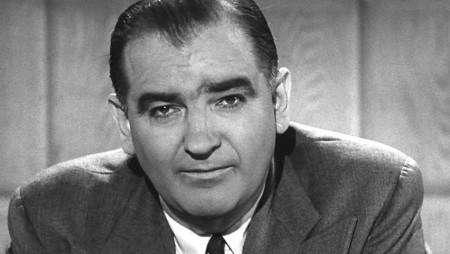
The Tydings Committee – a special sub-committee of the Senate Foreign Relations Committee – was established to get to the bottom of his initial 1950 claim that there were 57 communist agents working in the State Department. It did no such thing. In fact it didn’t even try.
According to Evans it was a cover up from start to finish. There was almost no attempt to get at the facts. Often a denial from the accused was sufficient. At one point they even asked the leader of the US Communist Party if certain people were members. He had to be prompted to say “no”. Most of the hostile questioning was not aimed at the accused – who were often evasive – but McCarthy himself. An inordinate amount of time was given over to attempting to prove that McCarthy had initially claimed a figure of 205 rather than 57 – as if it mattered. There was a definite suggestion that State Department personnel files had been tampered with. It was no great surprise when the official report concluded that McCarthy had made it all up.
You would have thought that even Democrats might have been interested in whether the State Department was full of communist moles. But no. Were they communist sympathisers themselves, or attempting to save the reputation of their side (in Truman, they had their man in the Whitehouse)? Probably the latter but you do wonder.
The Tydings Committee established a pattern for the McCarthy era. McCarthy would make a claim and then the establishment would investigate McCarthy while obstructing the investigation of his claims at every turn.
One of the surprising things for me is how poor Congress was (and probably still is) at holding the Executive to account. More than once the Executive showed utter contempt for Congress’s attempts to get at the truth. This included, as mentioned earlier, tampering with files but also making witnesses unavailable. But this never led to any consequences. Whenever, a confrontation got serious, Congress backed down.
There is a tendency amongst libertarians to imagine that there was some golden age when politicians were decent and honest. If there was, early 1950s America wasn’t it.
If there is one organisation that does come out well out of this it is the FBI. They were onto communist subversion at a very early stage and were responsible for producing most of the evidence that McCarthy later used. This may explain the extraordinary lengths communists and others have gone to over the years to tarnish the reputation of J. Edgar Hoover.
You’d would have thought that with the election in 1952 of Eisenhower as President things would have been different. After all why should a Republican Cold Warrior have any qualms about removing communists from the government especially when he had no need to defend the decisions and practices of a previous administration? Sadly, as it turned out, Eisenhower was every bit as bad as Truman. With Republicans divided between McCarthy and Eisenhower and the Democrats an anti-McCarthy bloc, the Senate voted to censure McCarthy. That was the end of the McCarthy era. He died a few years later, ignored, if not forgotten. He was 48.
Blacklisted by History is an extraordinary achievement but it is not without its faults. One gripe is that it is not particularly well-written – frequently I’d find that I had read several paragraphs without really understanding what was going on. I it is also not particularly well-organised. The same topics seem to crop up again and again often many hundreds of pages apart. And it is also worth bearing in mind that this is not a biography: it is an examination of McCarthy’s claims. McCarthy, himself, doesn’t really appear until 200 pages in and we get very little sense about what he was like. But it makes its case: Joseph McCarthy was a hero.
If Stalin was 75 percent violence and 25 percent propaganda, Putin is 75 percent propaganda and 25 percent violence.
– Peter Pomerantsev, from “Nothing Is True and Everything Is Possible: The Surreal Heart of the New Russia”
|
Who Are We? The Samizdata people are a bunch of sinister and heavily armed globalist illuminati who seek to infect the entire world with the values of personal liberty and several property. Amongst our many crimes is a sense of humour and the intermittent use of British spelling.
We are also a varied group made up of social individualists, classical liberals, whigs, libertarians, extropians, futurists, ‘Porcupines’, Karl Popper fetishists, recovering neo-conservatives, crazed Ayn Rand worshipers, over-caffeinated Virginia Postrel devotees, witty Frédéric Bastiat wannabes, cypherpunks, minarchists, kritarchists and wild-eyed anarcho-capitalists from Britain, North America, Australia and Europe.
|





Recent Comments