A sample text widget
Etiam pulvinar consectetur dolor sed malesuada. Ut convallis
euismod dolor nec pretium. Nunc ut tristique massa.
Nam sodales mi vitae dolor ullamcorper et vulputate enim accumsan.
Morbi orci magna, tincidunt vitae molestie nec, molestie at mi. Nulla nulla lorem,
suscipit in posuere in, interdum non magna.
|
My friend Preston pointed me at what the Adam Smith Institute calls the “EEA Option”, which would apparently provide many of the free trade and movement benefits of EU membership without being in the EU or beholden to most of its rules.
Certainly worth a read as people start contemplating what one would want the negotiated exit from the EU to look like.
And they worry the pound might crash? Pay attention to the euro.
– Zero Hedge
There has been much speculation the government will simply ignore the LEAVE result of the Brexit vote and not invoke Article 50 to start the clock running to leave the EU.
So why do I not think that will happen?
The one word answer:
UKIP
The slightly longer answer:
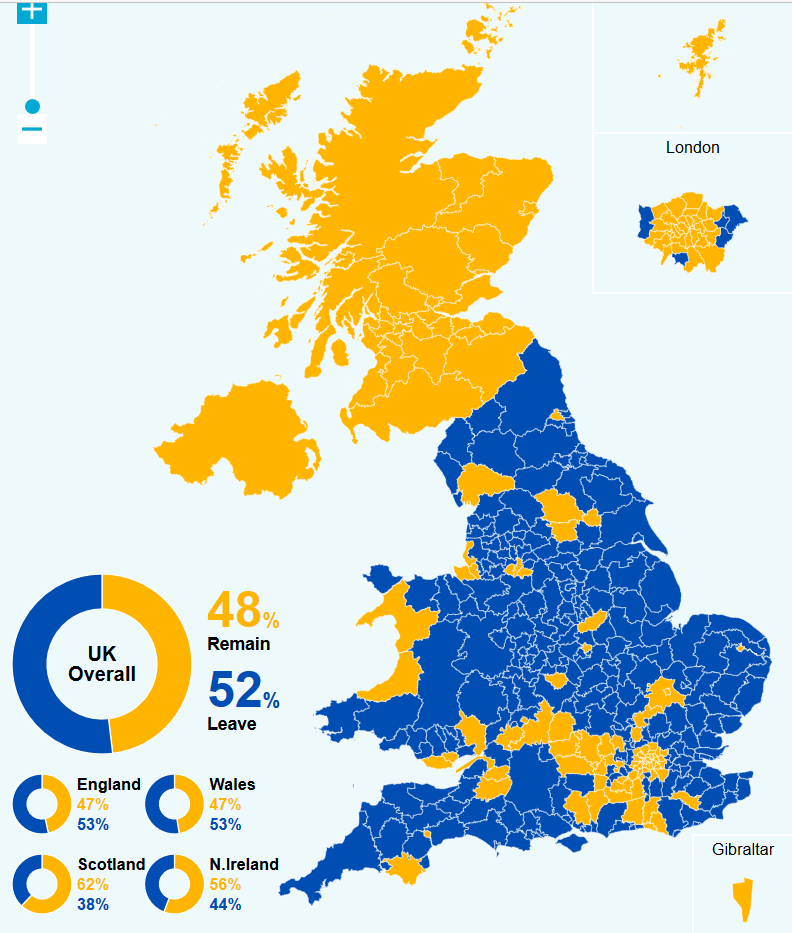
Look how many Tory (and indeed Labour) MPs supported REMAIN, but their constituencies voted for LEAVE: i.e. most of England.
Now imagine come the next election, and we are still in the EU because the political establishment basically said “fuck you, we are just going to ignore the vote to LEAVE”.
Does anyone seriously think UKIP will end that election with the one MP it currently has? In my opinion they could quite literally wipe out the Tories as a meaningful political party a la what happened to the Liberal Party by 1935 (and UKIP would probably take a nice big bite out of Labour in Northern England). I would rather that not happen, but if that is what it takes…
That is why I think Brexit will indeed happen. Political self preservation. But I hope Farage has bodyguards.
In all the talk and words about the UK Brexit vote last Thursday, a regular line is that the Leave side has been “misled”, and doesn’t know what it is doing, and it is going to have buyer’s remorse, etc, etc. Who knows, maybe that criticism is apt. However, it is a bit rich for those who, for example, favoured the creation of the European single currency, as many pro-Remainers did (they might hope we’d forget) to claim that those who wish to leave an entity with pretensions to be a superstate are not thinking of the risks. That is a bit rich.
The launch of the single currency is arguably one of the riskiest, most hubristic transnational projects of recent decades, and I still see very little sign of contrition for rolling out a new form of fiat money without creating the economic and political architecture to deal with life inside a one-size-fits-all interest rate.
One reason why remaining EU states are scared of what has happened is the fear that a eurozone member state, envious of how the UK has just voted, might have similar ideas.
I’m not British. However, I’m a reasonably frequent visitor to the United Kingdom.
I spent last Thursday night having dinner in New York City with a bunch of Brits from the home office of the London based consulting company I’m affiliated with. I’m not an employee, but I’m a close-enough friend of the company’s management that there that there’s much more of a spirit of “we” than “they” when I talk to them.
The whole firm was, of course, heavily on the “remain” side since they have contracts all over the continent and The City is a huge source of revenue. The reason The City itself has grown to be so huge is because it is the finance capital of Europe, and it vies with New York for finance capital of the world as a result.
That, sadly, may be over soon.
The firm’s business also relied (I should say relies, it isn’t gone, at least not yet) on being able to do things like taking a contract in Frankfurt and sending people there from London without more of a thought than an American firm would have about taking a contract in Stamford, Connecticut even though they’re based in White Plains, New York – another state entirely.
We in the U.S. are of course used to such things – we don’t give thought to the idea of someone from New York selling something to someone in Los Angeles or flying there to do work for a month. No one needs to give you permission to do this, you just go and do it. We’re one big market, and that has helped our economy tremendously over the centuries. Europe had finally become like that, a place where you could do business all over without permission, and with it, a whole new class of companies like the one I work with rose up, companies that didn’t trade with Europe but in Europe.
→ Continue reading: An outsider’s view of Brexit
Hi! I’m the guy who hosts, and looks after, Samizdata. I’m a software engineer.
Several years ago I did the port from old Samizdata for Perry, largely as a favour, but also because I believe strongly in free speech and that it should be heard. I’ve looked after it since that time.
So I’m basically a free speech activist rather than any stripe of “libertarian”.
And I don’t generally post, but Perry invited me to do so years ago, and I thought this was a worthwhile opportunity.
So why did I vote ‘Remain’?
→ Continue reading: Why the Samizdata System Administrator voted ‘Remain’
The Liberal Democrat party, with its host of 6 MPs (much reduced in 2015) have pledged to ignore the Brexit referendum result and to campaign for the UK to remain in the EU.
“Nigel Farage’s vision for Britain has won this vote, but it is not a vision I accept”, declared Lib Dem leader Tim Farron yesterday. “Even though the vote was close, the majority of British people want us to leave. But we refuse to give up on our beliefs”, he said.
Mr Farron, the relatively obscure leader of the party of heavyweights such as Cyril Smith, went on:
Mr. Farron argued that his party’s proposition was justifiable in a democratic society as older people’s votes were somehow less valid and because a vote against the EU was really a vote against Westminster.
“This was not a vote on the European Union alone”, he said, but a “howl of anger” against politics.
So, once the votes are counted, and if that ‘fails’, they are then ‘interpreted’ and in line with socialist logic, they don’t mean what a plain reading might fairly be taken to show that they mean. But is he not also saying that the vote was against him, as a member of the Westminster Parliament?
I would like to contrast this attitude with that of General Pinochet, well-known ‘strongman’ of Chilean politics from 1973 to 1990, who held a referendum on his junta (well, him) continuing to rule Chile in 1988, and who respected the outcome rejecting his continued rule, with a little prodding perhaps from General Matthei, the Air Force member of the junta (and friend of the UK in the Falklands War), who called for the result to be respected.
I suppose what we are seeing is a political auto-endoscopy by the Left, each trying to get further up their own arses than the other, with Nicola Sturgeon, Scotland’s First Minister indicating that the Scottish Parliament may have a veto on Brexit, a surprising interpretation of constitutional law from someone who is a solicitor.
I am confident that the bulk of people will see through all this, and see the Left, in all their shades, for the totalitarians that they are.
And yet just because the establishment failed, that doesn’t mean the demos have won. Not fully, anyway. We must stay vigilant. For there will now be a concerted effort to thwart our democratic statement, to weaken it by calling into question its legitimacy. This is already happening. Apparently the demos behaved rashly. We ‘voted emotionally rather than considering the facts’, says Labour MP Keith Vaz. We were in the grip of fear, say others. Or we were making a xenophobic statement, they claim, overlooking the irony of their pontificating about prejudice while suggesting that the 17.5million people who said No to the EU, this vast swathe of people, is a tabloid-poisoned blob given to disliking foreign people. Demagogues ‘injected poison into the nation’s bloodstream’, commentators are already saying, the implication being that we were brainwashed, made mad by evil men. We know not what we do. We’re children.
The efforts to rebrand this vote as a kneejerk thing, an emotional thing, a racist thing, are already underway. And others will no doubt argue that because the vote was very close, perhaps we shouldn’t take drastic measures; perhaps we should reform our ties with the EU rather than sever them. We must stand against all this, and insist that the people have spoken, and the people are sovereign, or ought to be. Indeed, that is fundamentally what the referendum was about: do you think Brussels or the parliament in London should be sovereign? The people voted for themselves.
– Brendan O’Neill
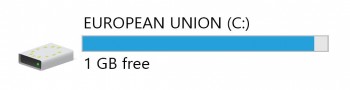
(I do not know who made this image. If you are the creator, let me know and I will be happy to give credit.)
“England has saved herself by her exertions, and will, as I trust, save Europe by her example.”
– William Pitt, the Younger
The Brexit vote has been an event of massive political importance, but what really fascinates me is that this has clearly not been a party political event.
The day before the vote I was chatting with a group of congenial LEAVE campaigners in Dover, and they were evenly split between Labour and Tory supporters. And as we nattered, the nastiest things I heard said about Corbyn were from the self-described Labourites… and the cattiest remarks about Cameron came from the self-described Tories… and both groups laughed as they listened to the others trashing the leaders of their own parties, as if it was a competition who could heap more expletives on their own nominal leaders. I must confess I have never seen the like in all my years.
The long term fallout from this will be very interesting indeed.
Brexit. How about that then. Well, well, well. Many other writers here have been thinking aloud about this, and so, now, will I.
The London weather was very wet yesterday, and violently so in the late afternoon. But, it then calmed down. Did the violent rain disrupt travel and permanently muck people up, so they didn’t vote? Or, did the abatement of the rain enable Londoners to get out and vote without too much discomfort? I have just got up and look forward to finding out. I took an umbrella to my (very) local polling station, around 7pm, but I didn’t use it. Someone said last night that it would be just typical if Britain left the EU because of the weather, but it looks like it wasn’t that close.
Re the Jo Cox murder. Many Remainers used this horror to imply that voting Leave was like voting in favour of MPs being murdered. (The Remainers who refrained from using this argument were not so audible.) I surmise that (a) some potential Leavers were persuaded, (b) some potential Leavers were angered and caused to vote Leave having only previously been thinking about it, and (c) quite a few continued to move towards Leave for reasons unrelated to the Jo Cox murder, but in silence. When the Cox murder happened, there was a shift towards Leave taking place. I surmise that this continued to flow, but underground, so to speak. Minds continued to move, but people stopped telling the pollsters. But, they’ve told them now.
The above two points were already made by me here last night, in comments on Natalie Solent postings. Here are a few more Brexit thoughts.
→ Continue reading: Some more Brexit thoughts
|
Commentary
Economics
Politics
Specialist
Tech
|