We are developing the social individualist meta-context for the future. From the very serious to the extremely frivolous... lets see what is on the mind of the Samizdata people.
Samizdata, derived from Samizdat /n. - a system of clandestine publication of banned literature in the USSR [Russ.,= self-publishing house]
|
The idea that an economist is an expert even in Economics is a dubious one. I would like to see two control groups shadowing every team of ‘expert’ economists – one making random predictions, the other a group of astrologers. After five years we compare their predictions for accuracy.
– Samizdata commenter Rob
As I work away at a talk I am to give tomorrow evening at Christian Michel’s, I am also, of course, wandering about in the www. And during the latest wandering I was provoked into thinking about another talk, one that I will be hosting rather than giving, on the last Friday of February. Marc Sidwell will, that evening, be speaking about: “Twilight of the Wonks? Promoting freedom in a post-expert world”.
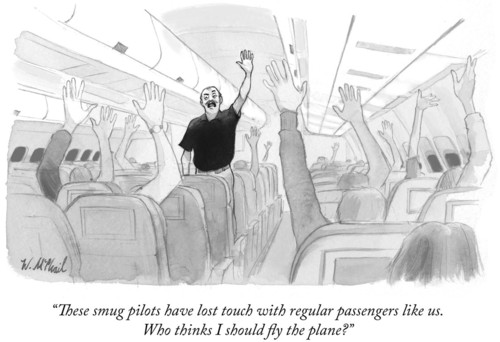
This rather witty cartoon, which I came across here, is very pertinent to Marc Sidwell’s talk, I think:

This cartoon is now to be seen all over the www, partly because, I surmise, both sides of the argument that it alludes to are drawing attention to it. The Clintonians are pointing at it and saying: there, look at those silly Trumpsters, all voting to crash and burn America. And the Trumpsters are pointing at it, and saying: look at those smug liberals assuming that they are better at flying the airplane of government, in the way that a pilot obviously is better than his mere passengers at flying an actual airplane. They just don’t get it, blah blah.
The point being: there is being an expert, where you actually do know essential stuff. And then there is being an “expert”, where what you say you know or think you know ain’t necessarily so.
Personally I favoured and favour Trump, partly because I put Hillary Clinton into the latter category, of being an “expert” with sneer quotes rather than without them. She has a long career of crashing whatever metaphorical airplanes she flies, her email fiasco being only one of the more recent of such crashes. Crashing rather than flying is what she is “expert” at. And her speeches over the airplane intercom only convince those already convinced. Many feel the exact same way about Trump, but my impression, reinforced both by his campaign and by how he has conducted himself since his campaign ended in victory, is that when it comes to being less un-expert, Trump wins compared to Clinton. We shall see.
I also prefer, with all the usual libertarian reservations, the ideological agenda that Trump, almost despite himself, is now dragging into greater prominence. The agenda (see this gigantic crash) that Clinton would have kept in great prominence is one that I detest.
I will now send the link to this posting to Marc Sidwell. If you would like to learn more about attending the meetings I host every month, and/or those that Christian Michel hosts, email me by clicking on where it says “Contact”, top left, here.
LATER: See also what Instapundit says.
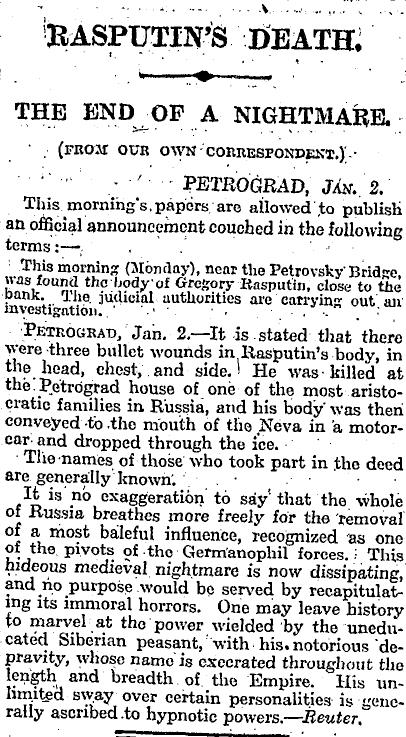
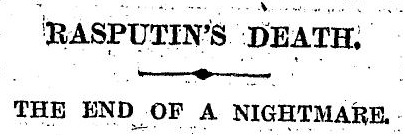 The Times 4 January 1917 p7
I recommend this essay by Jack Staples-Butler for his “HistoryJack” blog, Starvation and Silence: The British Left and Moral Accountability for Venezuela.
DENIAL in the face of catastrophic failure of one’s ideas is a predictable reaction from a believer, as per Leon Festinger’s theory of cognitive dissonance reduction in response to the failure of one’s beliefs. Denial in the face of shame for one’s actions is an experience well-studied by psychologists and criminologists. One 2014 study summarises the role of ‘shame’ in creating both denial of responsibility and recidivism among offenders:
“Feelings of shame… involve a painful feeling directed toward the self. For some people, feelings of shame lead to a defensive response, a denial of responsibility, and a need to blame others — a process that can lead to aggression.”[1]
Combining both faces of the phenomenon of denial is the behaviour of the supporters, apologists and promoters of the ‘Bolivarian Revolution’, the late Hugo Chávez and the PSUV regime in Venezuela, and their response to the present state of the country. Humanitarian catastrophe of an apocalyptic scale is now unfolding in the most oil-rich state in the world. The magnitude of human suffering is indescribable. The scenes of bread queues and shortages familiar to Eurozone-crisis Greece are long since surpassed. Venezuela has become a ‘Starvation State’[2] which “today drowns in a humanitarian crisis”, with lawless cities and hunger for the majority.
And
The Chávez apologists are confronted with two cognitively distressing facts; that a favoured political project has failed, dragging millions into an abyss of hunger and despair in the process; and that they played an instrumental or even essential role in bringing this state of affairs about, whilst enabling the regime responsible to suppress and destroy its opposition by legitimising and even providing its conspiratorial narrative, pro bono. What is most striking in the Western socialist left’s response to Venezuela’s agony is the absence of response.
The vacuum of recognition or even acknowledgement in the face of disaster is followed by an absence of moral accountability. Knowing full-well that Venezuela is still there, suffering beyond measure, those who involved themselves intimately in the politics of a South American republic now conduct their lives “as if” nothing had happened. In a devastating article, the writer Paul Canning named this as ‘The left’s giant forgetting’[16]. Venezuela has become a collective unperson to those who formerly proclaimed it an example for humanity’s emulation; although tacit recognition of their previous behaviour is found in some of the apologists, as in Labour leader Jeremy Corbyn’s deletion of any reference to ‘Venezuela’ from his website in March 2016, after two decades of promoting the Chavismo ideology in articles, demonstrations and media appearances.
Bookmark the essay. It would take some time to follow all the many references and links provided by the author, but they are a resource in themselves. This one, about the ambiguous and contradictory testimonies given by two British Communist veterans of the Spanish Civil War decades later, caught my interest.
The logical end-point in the reach of government is either state ownership of all private property, which is communism, or state control over what people do with their property, which is fascism. With communism discredited, the world is moving inexorably towards the latter. Every business is regulated in some way or other, and economic freedom is being progressively restricted with ever-tightening regulations.
– Alasdair Macleod
Recently a friend who works for the BBC asked if I knew of any good general interest but topical stories coming up any time soon, and I said that when they finally finish London Gateway, the new container port now being constructed and even already slightly used, on the north bank of the Thames Estuary, that will be made a big fuss of.
She then told me about a series that the BBC World Service is doing about 50 Things That Made the Modern Economy. I said that the Container certainly should be one of these Things. She later determined that the Shipping Container does indeed feature in this series, and she sent me that link. Amazing what a difference an email with a link makes to your willingness to attend to something.
This piece about the Shipping Container lasted under ten minutes, and, although I had heard most of the story before, I liked it. So I then sampled a couple of the other Things, about which I knew less and nothing, namely: the Barcode, and the Haber-Bosch Process. The latter is for turning the nitrogen in the air into fertiliser.
The next Thing I listen to will be Concrete. I already know what concrete is, but I expect to learn a lot more, about it, and about what it did to and does for the world. Made life a lot easier for farmers, apparently. Which, to a townee like me, is one of those many things which is obvious, but only if someone makes me think about it.
Recommended. An economist and economic historian by the name of Tim Harford has done a number of these Thing broadcasts, including the ones about the Container and about the Barcode. He is already very well known, but not so well known to me. But, I can already tell you that he also is to be recommended, going only by how he talks about these Things.
LATER: See also this earlier posting here, about similar Things.
Julia Reda, a German Pirate Party MEP, has issued this list of 10 everyday things on the web the EU Commission wants to make illegal.
In a few days, scandal-prone Günther Oettinger will stop being Europe’s top internet policy maker – he’s being promoted to oversee the EU budget.
But before leaving, the outgoing Digital Commissioner submitted dangerous plans that undermine two core foundations of the internet: Links and file uploads. While Oettinger is going away, his lobby-dictated proposals are here to stay.
These proposals are pandering to the demands of some news publishers to charge search engines and social networks for sending traffic their way (yes, you read that right), as well as the music industry’s wish to be propped up in its negotiations with YouTube.
These proposals will cause major collateral damage – making many everyday habits on the web and many services you regularly use downright illegal, subject to fees or, at the very least, mired in legal uncertainty.
Not that the UK government needs the EU’s assistance to pass stupid and repressive laws about the internet, but if Ms Reda is correct about what this proposed law means, and it is ever enacted, that will be ten more things to paste into my “better off out” file. Quite possibly it would be the progenitor of many more “better off out” files created by angry internet users all over Europe. But I admit that do not know enough to judge whether these proposed measures are likely to come to pass, or would really be as bad as she says, or whether there is anything to be said in their favour.
I am always on the lookout for elevated platforms, natural or artificial, to look out over London from, and to take photos from. And as luck would have it, one of my favourite such platforms is one that I live directly under. Yes, if I go up to the roof of my block of flats, I can see, and I can photo, things like this:

That thing being the MI6 Building, made famous by the Bond movies. In the Bond movie that they were showing on Brit TV earlier this very evening, this building suffered an explosion. Dame Judi Dench looked on, aghast.
Another entertaining thing to be seen from this spot is the new US Embassy, now nearing completion just up river, as luck would have it, from the MI6 Building. Those peculiar structures sticking out to the side, on both sides as we look in the photo below, intrigue me. Officially they are sunshades. So, nothing to do with stopping people from eavesdropping? Absolutely not. Never crossed their minds. Mind you, there won’t be any such structure on the windows facing us, so maybe this is true. But, I prefer to believe otherwise:

All around this new US Embassy there is a huge building boom in progress. That Special Relationship that people keep saying is about to end remains pretty special, I would say.
Whereas the cranes working away around the above building are there to build it, the crane in this next picture is there to dismantle the big block of a building that we see. This is “New” Scotland Yard. The Metropolitan Police have already moved out, to an even Newer Scotland Yard, nearer to the river.

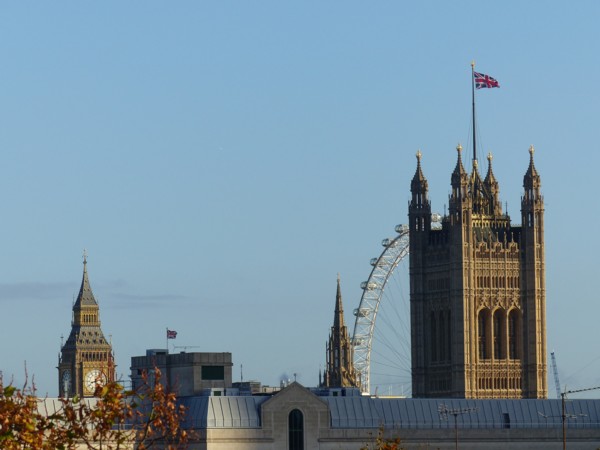
Next up, the two familiar towers attached to the Houses of Parliament, Big Ben and …, you know, … the other one. On the far side of the river but directly in line, The Wheel.
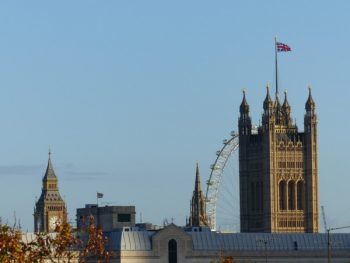
Finally, here are two snaps of how the same bit of the skyline was looking last night, just after midnight. I had guests with me last night, and after we had counted in the new year while watching these fireworks on the telly, I suddenly realised that we could see these same fireworks for real, if we just ran up a few staircases, and provided the fireworks kept on going for a bit. Which we did and they did:

Such is the quality of the cameras on mobile phones these days that several of my guests were also able to take photos.
In the above picture, The Wheel is totally blotted out, but in this final picture, you can clearly see it:

All of this was in aid of everyone wishing everyone else a Happy New Year, and I wish that to all my fellow Samizdatistas, and to everyone else who reads this.
An assortment of presumably minor left-statist American figures have been howling about Milo Yiannopulis getting his book published, presumably deciding that they should not just give Milo more publicity, but given that they are of the ilk Milo targets, they should endorse his book by loudly reacting with horror to it. To be honest I have no idea who the hell Judd Apatow or Sarah Silverman actually are, and I cannot be bothered to even stick their names in DuckDuckGo to find out, but the fact they are annoyed by Milo means I doubt I would care to invite them around for a G&T.
2016 has been a momentous year, the most earthshaking event being Brexit in my opinion. Trump is ‘interesting’ but ultimately the underpinning structure of the USA today will be more or less the same when Trump leaves office. Like all presidents, he is a transitory political figure. He may (or may not) prove to be a significant player in the on-going culture wars, but we will just have to wait and see.
Brexit on the other hand, like it or loath it, fundamentally changes the ground rules in the UK, and it may take some time before we understand what that shockwave has actually shaken loose. It presents dangers and opportunities for friends of liberty in almost equal measure.
Yes it really has been an interesting year and I suspect the impending one will be filled with ‘interesting times’.
So allow me to wish readers of Samizdata a prosperous and hopefully freer new year in 2017. Let us not be unduly careful out there 😀
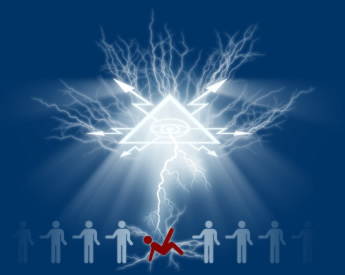
Oh dear! Sir James Munby has had ever such a clever idea. His friend Frances Gibb has written a story about it for the newspaper. But they have both forgotten something very important. Can you help them find it?
Family courts chief calls for ban on abusers cross-examining victims
Abusers should be banned from cross-examining victims of domestic violence as a “priority”, says England’s most senior family judge.
Sir James Munby is pressing ministers to legislate to stop such cross-examinations, which still happen despite efforts by senior judges to prevent them.
The president of the family division, who raised the issue in 2014 amid concerns over the stress that such questioning puts on victims, is dismayed at the lack of action. He argues that the family justice system “lags woefully behind the criminal justice system” where cross-examination of an alleged victim by the defendant is not allowed by law.
In a statement today Sir James said that he would welcome a ban, adding: “Reform is required as a matter of priority.”
He added: “But the judiciary cannot provide this because it requires primary legislation and would involve public expenditure. It is therefore a matter for ministers.”
Senior judges are in talks with Women’s Aid, a charity that helps victims of domestic violence, to try to have the practice banned.
A spokesman for the judiciary added that Sir James, who is president of the family division of the High Court, was “disappointed by how slow the response to these issues has been and welcomes the continuing efforts by Women’s Aid to bring these important matters to wider public attention.”
Judges and women’s groups are discussing the workings of the existing rules, contained in a practice direction which has been reviewed by a senior family judge, Mr Justice Cobb. Cross-examination by violent partners has continued, despite the practice direction.
A survey by Women’s Aid found that a quarter of victims of domestic violence had been cross-examined by abusive partners.
Polly Neate, chief executive of Women’s Aid, told The Guardian: “When we talk to judges about this they say that this never happens. But it is happening, that is clear, and it seems fairly difficult to get this across.”
Concerns about cross-examination of vulnerable witnesses were raised by Sir James more than two years ago, prompting the setting up of a working party to deal with what was described as a “pressing need”.
The working party reported in 2014, condemning procedures for taking evidence from alleged victims as inadequate and pointing out that one High Court judge, Mr Justice Wood, had drawn attention to the issue as long ago as 2006.
Research by an all-party parliamentary group on domestic violence found that 55 per cent of women had no access to special measures in family courts, where 70 per cent of separation and child contact cases involve some form of domestic violence.
The group’s report, in April, called for an end to abusers cross-examining victims and was backed by two MPs, Jess Phillips and Maria Miller, who launched a joint call for action. The all-party group said it had launched its inquiry after becoming increasingly concerned concerned about the safety of women and child survivors of domestic abuse within the family courts.
I wanted to believe that Hillary Clinton would lose the recent US presidential election, so when I started reading Scott Adams saying that she was indeed going to lose, to Trump, I kept on reading him. Like so many others, I like to read within my bubble, as well as outside it. That means I also now read Scott Adams on every other subject he deals with in his blog. I am now digging back into his archives for more wise and witty verbiage. I am surely not the only one doing this now.
Scott Adams has a girlfriend called Kristina Basham, who, it would appear, is working and working at becoming one of those people who is famous for being famous. This is one of those labels that most people seem to assume is an insult. But being famous is a skill and a job, like any other skill and job. Your basic skill is that you know how to attract attention, and you basic job is that you sell this ability and live with the adverse consequences of it as well as the benefits. Scott Adams describes very well the sort of work that goes into becoming one of these F4BF people, as I will call them from now on. Kristina Basham is not, you see, outstandingly good at anything in particular. She is just pretty good at a whole “stack” of things, which, when you combine them, are making her into someone F4BF.
I say: good for her.
The claim that people who are F4BF contribute nothing to the world is the latest iteration of that very old and very bad idea that there is a “real” economy, consisting of work that people are used to doing and which their ancestors even did, like farming and then after that factory working; and then there is the “unreal” economy, consisting of silly things that add nothing to the “real” economy, but instead just leach off it, like financial services (which actually make farming and industry massively more productive by telling farmers what to farm and industrialists what to industrialise), and more recently jobs like being F4BF. (Even being a factory worker was once upon a time denounced as being unreal.)
Being a celeb, and in particular being nothing but a celeb, an F4BF, which is to say being good at attracting attention to oneself but for no single and obvious reason, but still being good at it, is a vital part of the modern economy. Celebs, including F4BFs, enable attention to be diverted away from major economic investments, while the work of creating or building them is being done and needs not to be disturbed, in the secure knowledge that when attention is finally demanded, and you need to attract a lot of business very quickly or else a lot of money will be lost while the word spreads by mere unassisted word of mouth. For that grand opening of whatever it is that you have been quietly working on for however long it has been, you hire a bunch of celebs. Including maybe some of that particular sort of celeb who are F4BF, pure and distilled celebs who are nothing but celebs.
Discuss.
|
Who Are We? The Samizdata people are a bunch of sinister and heavily armed globalist illuminati who seek to infect the entire world with the values of personal liberty and several property. Amongst our many crimes is a sense of humour and the intermittent use of British spelling.
We are also a varied group made up of social individualists, classical liberals, whigs, libertarians, extropians, futurists, ‘Porcupines’, Karl Popper fetishists, recovering neo-conservatives, crazed Ayn Rand worshipers, over-caffeinated Virginia Postrel devotees, witty Frédéric Bastiat wannabes, cypherpunks, minarchists, kritarchists and wild-eyed anarcho-capitalists from Britain, North America, Australia and Europe.
|










Recent Comments