We are developing the social individualist meta-context for the future. From the very serious to the extremely frivolous... lets see what is on the mind of the Samizdata people.
Samizdata, derived from Samizdat /n. - a system of clandestine publication of banned literature in the USSR [Russ.,= self-publishing house]
|
The paper edition of the Times that hit my doormat this morning had an interesting headline: “Hi-tech kit keeps rhinos safe from poachers”.
The online version has an even more interesting headline: “Hi-tech kit and ex-spies keeps South Africa’s rhinos safe from poachers”.
Neither headline is untrue, both the hi-tech gadgetry and the spies are helping preserve the rhinos, but both are missing something. My use of the “Deleted by the PC Media” tag is a little inaccurate, as is my use of the “Hippos” tag, but we seem to lack a tag for “Rhinos” or for “Never even entered the PC Media’s pretty little heads despite the facts staring them in the face from their own reporting”. See if you can guess what the missing factor is from this excerpt:
South Africa, home to 80 per cent of the world’s 29,000 rhinos, loses about three a day to poachers, the vast majority in state parks. Private reserves have become essential to preventing the animals from extinction, as long as the owners can afford to protect them.
Turning the 150,000-acre reserve into a 21st-century fortress in the African bush costs £1 million a year but the investment has paid off. The park has not lost a rhino in the past two years. It is hardly surprising. At each of the park’s four gates, guests visiting its five-star lodges, as well as staff, only enter after systems have checked numberplates and fingerprints against a national criminal database and are tracked and monitored until they leave.
Kruger National Park is far less secure and the rate of survival among its 9,000-strong rhino population is poor. Sixty per cent of all poaching incidents in South Africa occur there. Too often its rangers, police and officials are in the pay of poachers. Rhino horns can fetch up to £70,000 per kilogram in Asia, where they are imagined to cure a range of ills from hangovers to cancer.
How did Socialists light their homes before candles? Electricity.
– Conscious Caracal
Recently (by which I mean about six weeks ago), I ordered a 3D printer kit to be sent to me from China. It was much cheaper to order it directly from a seller in Shenzhen than via an intermediary like Amazon. Because I was in no real hurry to get it – and because I am cheap – I selected the cheapest shipping option – Europe Railway Priority Mail.
My printer has clearly been coming via the Trans-Mongolian Railway, which joins the Trans-Siberian railway north of Mongolia. Given that it has taken over a month to get to Budapest, it has clearly not made the journey on a single train, even on the sections where this is theoretically possible, such as Beijing to Moscow.
I give you my wonderful tracking information. I particularly like “Arrived in changsha chardonnay coagulation loading bays”. Also, let’s face it. “Get to Russia off sharply” is good advice for anyone. (Click to make the image larger).

Some farm employees kicked pigs and stabbed them with pitchforks. An organisation called Animal Equity who do undercover investigations with the aim of reducing cruelty to farm animals used hidden cameras to capture the evidence. They gave it to the press, who confronted the farm, who fired the employees.
Helen Browning, who owns an organic pig farm in Wiltshire, insists that consumers need to know more about where their meat is coming from so that customers can make informed choices in supermarkets.
She said: “You can see if something is organic. Ours are organic pigs and you can sometimes see free range or outdoor bred, but actually nothing tells you about perhaps the less attractive side, so nothing will tell you if pigs have been in farrowing crates or kept indoors.
“Most of us buy free range eggs now because it’s clearly labelled whether they have been barn reared, they’ve been in cages or they’ve been free range. We need the same for pigs.”
Co-op is the largest supermarket chain to promise to stop using pork from pigs that have been kept inside their whole life in its own-brand products.
That will come into effect from July and is something that only Waitrose is currently committed to.
The British Secretary of State for Environment, Food and Rural Affairs, Michael Gove, said:
What are you talking to me for? This has nothing to do with the state. Everything is working as it should. People who care about the welfare of animals took it upon themselves to investigate and convince other people that this is a bad thing. The farm has received negative publicity and will suffer in the marketplace unless it mends its ways, which it has started to do by firing the employees involved. And food retailers have identified a demand for meat from animals that have been treated more kindly and are working towards meeting it. The market works.
Now go away. My department only has two part-time employees and we have some disputes over field boundaries to advise people about so we are very busy.
Oops, sorry, wrong universe. He actually said that he has pledged to restore the UK as a leader in animal welfare.
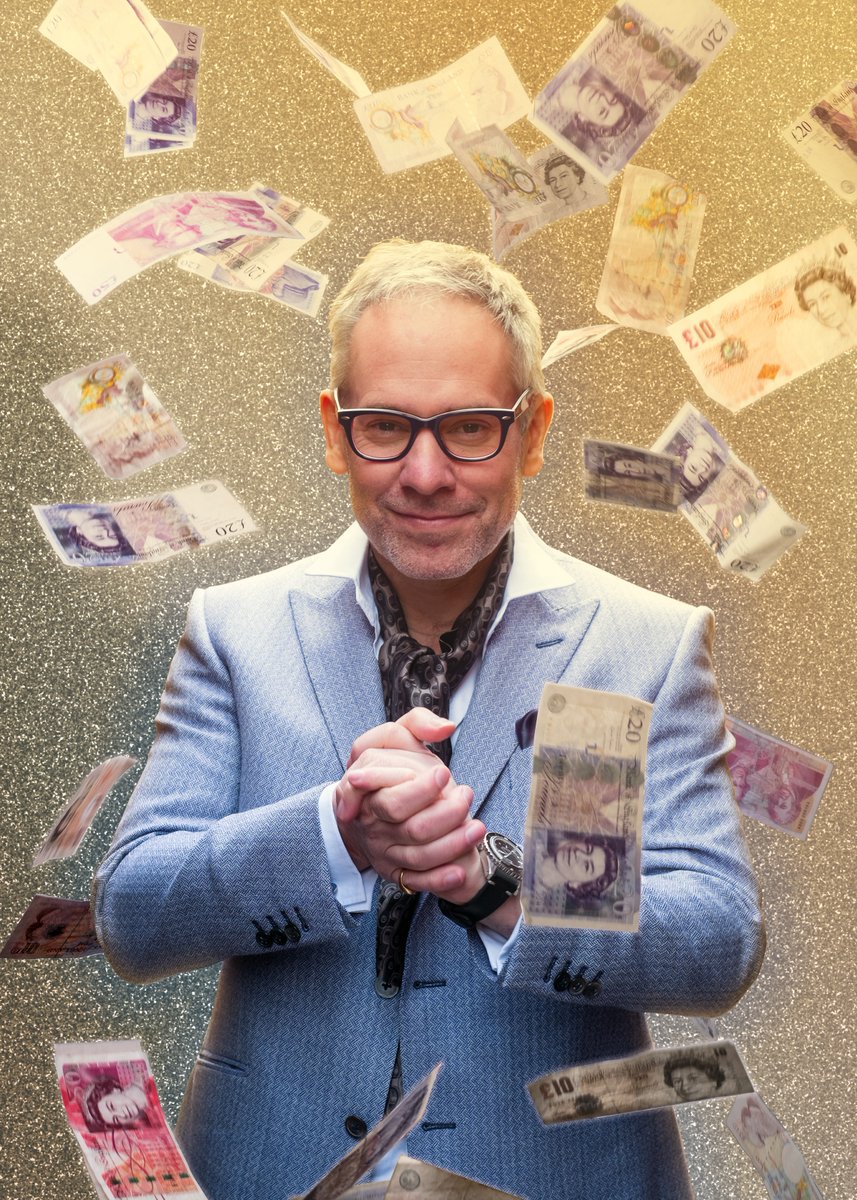
Yes. Dominic Frisby tweets:
North Londoners. The next try-out of my Financial Game Show is Tuesday May 22 at @downstairskhead. Entertaining, informative, exciting. What more could you want on a Tuesday evening?

Get tickets here. More about the show here.
I can confirm that this is a fun show, having already seen two earlier try-outs of it. One of these was in my own home, at my last Friday of the month meeting on April 27th. And earlier that week, I attended the very first try-out of this show (to check out what my Friday was likely to consist of), and greatly enjoyed it.
That first outing was in the same venue, downstairs at the King’s Head, that tonight’s show will be at Despite the extreme contrast in the space he had available, Frisby then made his second try-out performance at my place work very well, because he is a good humoured, thinks-on-his-feet performer. Nevertheless, a bigger venue is certainly needed for the show to have its full effect. I’m thinking in particular of how successful competitors in the quiz, such as the lady I went with to the first show, get asked to sit themselves in different and more visible seats as they progress, none of which could happen in my postage stamp of a living room
Nevertheless, Frisby seems to find early run-throughs at my place helpful, because he did a similar early run-through of his previous Edinburgh Festival show at my home, a couple of years ago, and now here he was inviting himself back to do this year’s show. Glad to be of assistance.
Without giving away too much in the way of answers, I can tell you that Frisby’s questions all point to the subtleties and surprises and oddities of economic life, of the sort that are familiar to devotees of Austrian Economics, with its emphasis on the subjectivity of value and the way that economic decisions so often involve making sometimes rather strange bets about the future. The contrast in the price of this small but expensive house and that bigger but cheaper house; Fading Footballer A getting paid, counter-intuitively, more than Superstar Footballer B; that kind of thing. Frisby thus communicates an inquisitive and amused attitude to economic life that will likely draw at least some of the people who see this show in Edinburgh towards his more opinionated intellectual products.
Who knows, some of these people may even end up reading this book? I wrote admiringly about it here.
LATER: More dates here.
It occurs to me that there’s perhaps a bit of guilt on show here. You see those pregnant 11 year olds in Telford got in that state because the local authorities, in fear of being branded racist and/or islamophobic, allowed gangs of muslim men to groom and abuse white girls for decades and ignored complaints/reports etc. that this was occurring. One suspects that the distaste for this joke is more because it reminds readers of the failures of the Briitsh Nanny state than actual concern for the feelings of 11 year old sex abuse victims. If the writer actually cared about the victims and subsequent potential victims he’d be campaigning to have the perpetrators and their facilitators in the police/social services punished appropriately (personally I think being nailed to a fence by their genitals would be reasonable, but I can see that people might differ on the details. Would a bit of rebar up the bum be better? both? or how about the traditional English hanging, drawing and quartering?) so as to make clear that this kind of behaviour is unacceptable in the UK.
– Francis Turner
Nongqawuse was a fifteen year old Xhosa girl who in 1856 had a vision in which three ancestral spirits told her that if the Xhosa people showed their trust by destroying their crops and killing their cattle, then on the appointed day the spirits would raise the dead, bountifully replace all that was destroyed, and sweep the British into the sea. Thousands believed this prophecy and slaughtered their cattle. But the dead slept on and the British remained in place.
Nongqawuse explained that this lack of action was due to the amagogotya, the stingy ones, who had kept their cattle back from slaughter. She urged everyone to greater efforts. A new date was set for the prophecy to finally come true. The rate of cattle-killing rose to a climax.
Eventually the Xhosa lost patience, and, with remarkable mercy, handed Nongqawuse over to the British. By then famine had reduced the population of British Kaffraria from 105,000 to fewer than 27,000.
*
City A.M. reports that John McDonnell says Venezuela is failing because it is ‘not a socialist country’.
Oh, and our Chancellor-in-waiting says that he will overthrow capitalism.
If you want to watch the Sunday Politics interview where he said all this, this BBC link will work for another 28 days.
The strangest things remind the BBC of the evils of the west – and fail to remind them of the evils of socialism.
If you watch through the BBC’s ‘Why mums-to-be are fleeing Venezuela’ and then wait, you will see an earlier piece ‘Begging for food in Venezuela’. Watch that and keep waiting and you will see ‘Where a coffee costs wads of banknotes’ after which you’ll be offered ‘Venezuela indigenous group flees crisis’. Finally, having worked back to 2 August 2017, you will encounter ‘What’s going on in Venezuela?’, during which you will learn that in 2013, Chavez was succeeded by “fellow socialist” Maduro. This is the first – and AFAICS the last – encounter with the word socialist or any word resembling it.
If watching late-stage-socialism-reporting-that-dares-not-speak-its-name depresses you, you can cheer yourself up by watching Tony Robinson (Baldrick as was 🙂 ) in a series of programmes on Britain’s cathedrals. If cathedral architecture and history is your thing, these are perfectly watchable – he even comes across an actual baldrick at one point – with only occasional excursions into BBC-style history.
Liverpool Cathedral was built in the 20th century, funded by public contributions. Building began before WWI and was not yet finished when German bombers hit it several times without managing to flatten it in WWII.
– Did you know that the Earle family contributed £25,000 of its £500,000 building cost? Did you know that a full century and more before the first plans for Liverpool cathedral were drawn up, an ancestor of the Earle family made money in the triangular trade? Well, you would if you’d watched the programme on May 4th.
– Did you know that in the century between these two events, British people – possibly including an Earle ancestor and of-statistical-certainty including ancestors of other donors – made the slave trade and then slavery itself rare in the world. Well, if you didn’t, you wouldn’t have learnt it from the programme.
I liked the cathedrals, though. And if you watched through all those Venezuela shorts then you would likely suspect that something that government was doing was unwise.
What I found particularly annoying is the degree to which certain commentators elevated the importance of Meghan Markle’s race. If the media hadn’t told me, and then not shut up about it for months, I would never have guessed she was the daughter of a black mother and white father. To me, she looks as much Spanish, or Italian, or Lebanese as mixed-race American. Her mother simply looks like someone you’d see shopping in Marks & Spencers in Croydon, so why anyone should think her race is even worth mentioning I don’t know. Actually, I do: it’s because some people think race is the be-all and end-all (e.g. David Lammy, Katie Hopkins), and others simply took the opportunity to virtue-signal, rubbing people’s nose in the subject of immigration.
– Tim Newman
We have heard the Rights of Man called a levelling system; but the only system to which the word levelling is truly applicable, is the hereditary monarchical system. It is a system of mental levelling. It indiscriminately admits every species of character to the same authority. Vice and virtue, ignorance and wisdom, in short, every quality, good or bad, is put on the same level. Kings succeed each other, not as rationals, but as animals. It signifies not what their mental or moral characters are. Can we then be surprised at the abject state of the human mind in monarchical countries, when the government itself is formed on such an abject levelling system?—It has no fixed character. To-day it is one thing; to-morrow it is something else. It changes with the temper of every succeeding individual, and is subject to all the varieties of each. It is government through the medium of passions and accidents. It appears under all the various characters of childhood, decrepitude, dotage, a thing at nurse, in leading-strings, or in crutches. It reverses the wholesome order of nature. It occasionally puts children over men, and the conceits of non-age over wisdom and experience. In short, we cannot conceive a more ridiculous figure of government, than hereditary succession, in all its cases, presents.
– Tom Paine
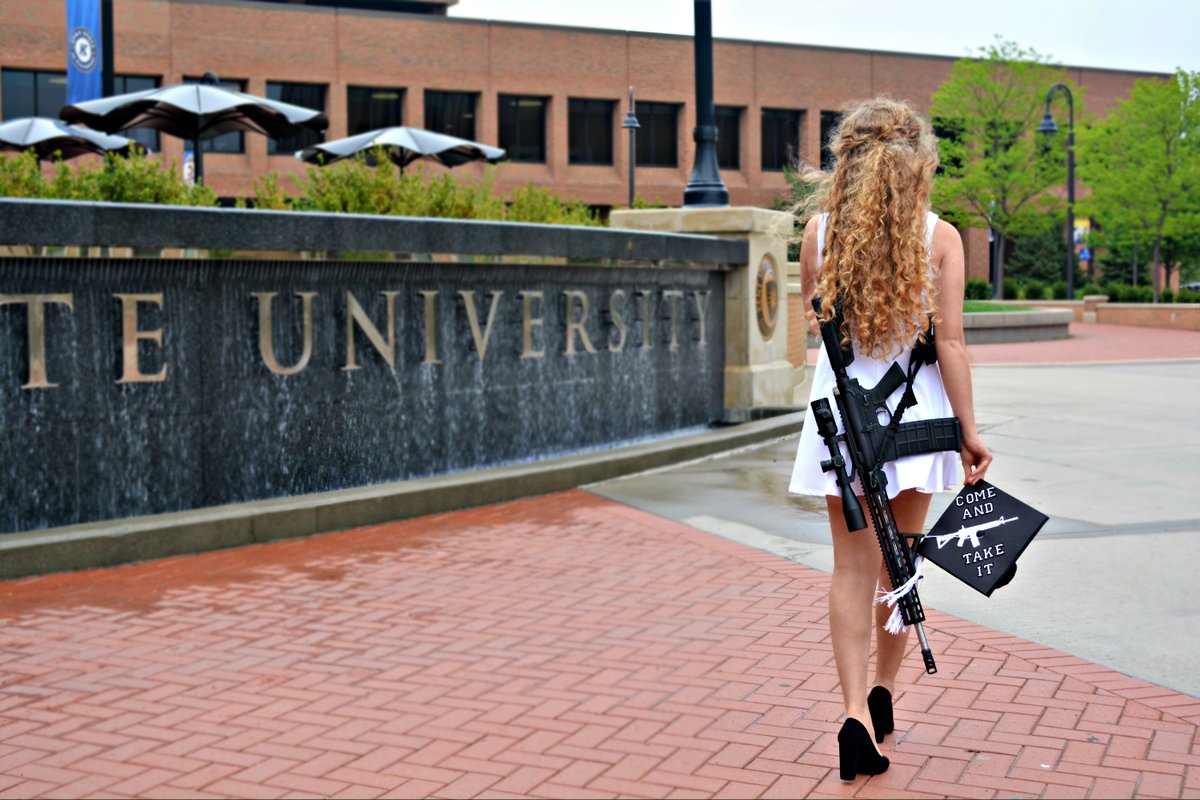
I give you Kaitlin Bennett from Ohio, as reported by BBC News:
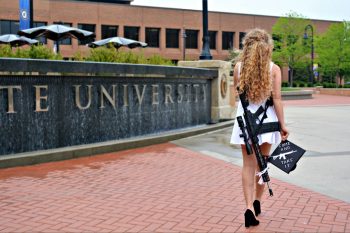
As a woman, I refuse to be a victim & the second amendment ensures that I don’t have to be.
.@KentState puts up fliers in dorms w/ the stat that 1 in 4 women will be sexually assaulted in college, but denies women the right to protect themselves with their firearm. In 2016 KSU reported 3x as many rapes on campus than 2015. Stop letting women be victims. #CampusCarryNow
The 2nd amendment isn’t about hunting deer. It’s about being able to protect yourself from an out of control, tyrannical government.
I am a radical on Town & Country planning as on other economic issues. I would abolish it. To me it is offensive that the value of a man’s land is stripped from him by laws that deny him the right to put it to its highest and best use without grovelling to local politicians in thrall to his envious neighbours.
– ‘Tom Paine’
|
Who Are We? The Samizdata people are a bunch of sinister and heavily armed globalist illuminati who seek to infect the entire world with the values of personal liberty and several property. Amongst our many crimes is a sense of humour and the intermittent use of British spelling.
We are also a varied group made up of social individualists, classical liberals, whigs, libertarians, extropians, futurists, ‘Porcupines’, Karl Popper fetishists, recovering neo-conservatives, crazed Ayn Rand worshipers, over-caffeinated Virginia Postrel devotees, witty Frédéric Bastiat wannabes, cypherpunks, minarchists, kritarchists and wild-eyed anarcho-capitalists from Britain, North America, Australia and Europe.
|






Recent Comments