This is an amazing piece. To censor China’s internet, the censors have to be taught the real version of Chinese history so that they know what to block.
– Mike Bird comments on this piece in the New York Times.
|
|||||
|
This is an amazing piece. To censor China’s internet, the censors have to be taught the real version of Chinese history so that they know what to block. – Mike Bird comments on this piece in the New York Times. January 4th, 2019 | 23 comments - (Comments are closed)
 Similarly to the sentiment expressed by Cowperthwaite, the outgoing Governor of California Jerry Brown has said:
He also said:
I do not know very much about Governor Brown’s policies or actions. He improved California’s finances and turned a large deficit into a large surplus. He had a habit of vetoing bills, and complained in the NYT article that “almost all of the bills that I have vetoed have been reintroduced”, but I do not know if a veto rate of 16% is high enough. In any case these are the sorts of thing I want to hear more of. In the USA the role of the state seems to be discussed more widely than it is here in the UK, where mostly the criticism of the government is that it should “do more”. In British politics the recent counter-example of Jacob Rees-Mogg springs to mind:
I would welcome more examples. From anywhere. January 4th, 2019 | 14 comments - (Comments are closed)
The British Army continues to morph into the Blairmacht, it seems. Its new recruitment posters had me thinking that I had fallen into a coma and woken up a few days after our glorious independence due on 29th March. Here is what I mean: ‘The Army targets ‘snowflake’ millennials‘ (as recruits, not legitimate uses for ammo). The posters, taken as fair use:  and this:  Now there are two possibilities I see here, not mutually exclusive, the less likely that someone is trolling the MoD and being paid for it, and the other is that someone is being paid for it. Still, as posters go, I would grant that it is better than this blatant mickey-take. And in terms of assuring the civil population that the Army is no threat, it doesn’t really beat this, but I do wonder if the thinking behind the current Army it is more similar to what produced this. And we should remember that for some British Army recruits, the heat is not the problem, but the cold may be:
Naseby, the Civil War, what would Prince Rupert or Halifax say? But, may I remind you, it is the law of England that the categories of negligence are never closed…
AFAIK, the case continues… What would Field Marshal the Earl (Horatio Herbert) Kitchener say were he spinning in his cold, watery grave? That Wing Cdr Ken Gatward DSO DFC* AE was named for him, and lived up to it, might give one pause for thought. January 3rd, 2019 | 35 comments - (Comments are closed)
“Doing nothing is a full-time job. Don’t imagine that laissez-faire means putting your feet up. All officials want to extend their powers; all bureaucracies will grow if they can. To stop it happening you need to be at your desk before the civil servants come in and still be there when they go home.” Sir John Cowperthwaite, financial secretary, Hong Kong in the post-war period. (Quoted in this excellent CapX article about the terrible mayor of London, Sadiq Khan.) – Here is a profile of Cowperthwaite for those who want to know more about this admirable person, as different from the London mayor as can be imagined in terms of managerial approach and political philosophy. (Here is an interesting leftist’s blog comment on Khan, proof that he is not universally beloved on that side of the spectrum). January 3rd, 2019 | 13 comments - (Comments are closed)
This coming Sunday, January 6th, I am to give a talk at my friend Christian Michel’s home in London, about the historical impact of the technology of information storage and communication. The somewhat cumbersome title I have supplied to Christian goes like this:
Yes, a bit of a mouthful, but it’s a complicated story. The pre-talk blurb underneath that title, that I also sent to Christian, and some of which Christian has just emailed out to his list of potential attenders, went like this:
I’d be interested in what the Samizdata commentariat has to say about all or any of this. For now, I will merely elaborate a little, as I will on the night, on the matter of those “civilisational divisions and nationalist passions”. → Continue reading: On human culture – and on how it got printed and then electrified January 2nd, 2019 | 16 comments - (Comments are closed)
Admittedly it’s a low bar, but Trump is without a doubt the most conservative and most libertarian present of my lifetime, notwithstanding that he’s not really a conservative or a libertarian by instinct. January 2nd, 2019 | 24 comments - (Comments are closed)
A visit to Africa a few months ago produced many, many pictures of wild scenery and wilder animals – and this picture of civilisation after socialism.
In times of inflation, you carry your money to the shop in a basket and carry your purchase home in your wallet. In times of socialist inflation, each note in the basket is for tens of billions. There is a rumour that Zimbabwe will imitate Venezuela and remove some of the zeros. (There is another rumour that says that this had already happened.) The socialist Mugabe is gone but socialism lingers on. I fear Kipling’s poem is not quite right:
Socialism doesn’t work but it also doesn’t die. Socialism is the modern name of an ancient evil that in every generation resurrects and must be slain again. January 1st, 2019 | 25 comments - (Comments are closed)
Here’s wishing all who read and write here a Happy …:
I don’t know why this shop near where I live was proclaiming its enthusiasm for 2019 in the particular way that it was, but I made the necessary adjustments. January 1st, 2019 | 6 comments - (Comments are closed)
It’s the party season, here in London and presumably all around Christendom. Speaking for myself, I attended a dinner party on Christmas Eve, had a quiet day on Christmas Day, but then held a party at my home on the 28th. I have just now got back from a party at the home of a fellow Samizdatista, and will be attending another get-together on New Year’s Eve, i.e. tomorrow evening. All of which events, my own one in particular, make me wonder: How are such events best organised? Rather than elaborate on the imperfections of my own party (imperfections which – before, during and after – got me wondering yet again about this question), let me just ask the question, of anyone who is willing to oblige with an answer or answers. How do you go about laying on a good party? What particular and perhaps rather surprising or counter-intuitive rules or recipes do you find yourself needing to keep in mind? What things, in your preparations, matter the most? What other things that many would assume to be crucial do you consider not to matter nearly so much? Also, and closely related: What makes a great party? What’s the greatest party that you personally have ever attended? What was so great about it? I’m leaving all these question deliberately vague just because I am hoping to be delighted and surprised by the answers, as well as merely, as a future host, informed and improved. There are few joys like the joy of choosing what you hope will be great company and then being delighted at how well your choice worked out. But how do you, or the hosts you most admire, contrive this particular kind of miracle? I hope that any parties you have recently attended or organised, or which you are about to attend or are in the process of organising, are a great success. And I’d be delighted to hear how you think that such joy is best contrived. Being in somewhat of a rush to get this up this evening, before I stagger into bed, I am not including any links to www-places where questions like these are already persuasively discussed and answered, basically because I do not now know of any such places, that being because I have never until now even thought to look. But that need not stop commenters rectifying this omission. December 30th, 2018 | 23 comments - (Comments are closed)
Blogger David Thompson suggests that his round-up of the year might be of interest to Samizdata’s readers. His email to me quoted how this roundup begins:
Thompson adds:
You can read all twelve months here. This piece by Thompson has already been noticed by Instapundit, as have quite a few of his pieces in recent months. December 29th, 2018 | 21 comments - (Comments are closed)
Now there’s an all purpose headline. I could have used it for a dozen posts, but the particular unsurprising event I choose to talk about today is this:
Tim Worstall has been going on about this for years. Anybody that lends to the poor – be it Wonga or the Church of England – is either going to have to charge hefty fees in proportion to the sums lent or lose money. There are two reasons for this. One, any sort of lending has to cover administrative costs. Whoever answers the phone and fills in the form and makes the decision has to be paid. The cost in staff time to approve a loan of a hundred pounds might be less than the cost of paying someone to approve a loan of a hundred thousand pounds, but it is not a thousand times less. Two, you have to cover the losses caused by those borrowers who default. Where does the money to do that come from? That’s right, the borrowers who don’t default. And, um, how can I put it tactfully… the sort of borrowers who need to turn to a payday loan company or a credit union are exactly those who are most likely to default because they are “running on empty” when it comes to money. If a well-meaning government decrees that loan rates should be capped at three per cent per month, then the amount of money needed to cover the lender’s losses ain’t coming in. Soon the law-abiding lenders must leave the lending business, sending the poor who need money quickly into the hands of the loan sharks, people whose debt collection operation tends to be done via steel-capped boots. But never mind that, at least nasty payday lenders have been stopped from making a profit from poverty. December 28th, 2018 | 43 comments - (Comments are closed)
I’ve followed the career of Stephen Davies ever since I got to know him in the 1980s. Here’s a photo I took of him in my home in January 2000, when he spoke at one of my last Friday of the month meetings.
Tonight, I photoed Stephen Davies again. Well, to be exact, he was on TV, and I photoed my TV:
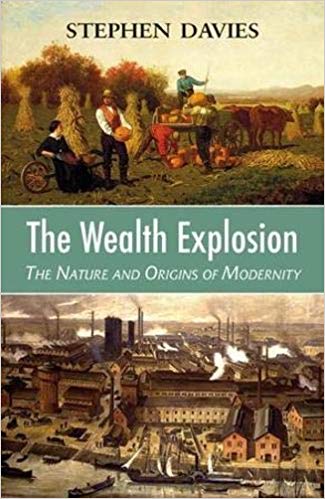
That’s Davies doing a talking head job on the subject of Trains That Changed The World. Good to see the Institute of Economic Affairs also getting a good plug. I’m watching these shows now, as I write this. The transformation of the lives of the great mass of working people and their families in countries like Britain and America in the nineteenth century is being well explained. Karl Marx, were he watching, would be cursing. Immiseration? Forget it. It was more like a wealth explosion, made possible by railways, probably more than any other technology. During the last few years, it bothered me that Davies seemed to be doing so much – lots of educational outreach for the IEA, for instance – that he might not be finding time to write any books. Oh me of little faith. In April of 2019, this book will be published:
And oh look. It will be entitled The Wealth Explosion. If what Davies was saying on the TV is anything to go by, and it surely is, then railways will figure prominently in this book. I just noticed that the Executive Producer of Trains That Changed The World was the famously anti-anti-capitalist Martin Durkin. That explains a lot. December 27th, 2018 | 9 comments - (Comments are closed)
|
   |
||||

All content on this website (including text, photographs, audio files, and any other original works), unless otherwise noted, is licensed under a Creative Commons License. |
|||||







Recent Comments