I went to the Mail for a simple explanation, but they didn’t seem to know.
Do you?
|
|||||
|
I went to the Mail for a simple explanation, but they didn’t seem to know. Do you? March 12th, 2019 | 49 comments - (Comments are closed)
 Vegans have a point: the great thing about civilisation is we can overcome basic natural urges to improve the world. Animals do not want to be eaten; humans have the ability to reduce animal suffering; not eating them is a good thing to do. On the other hand, bacon tastes good. If I honestly answer the question of why I am not a vegan, the answer comes out something like this: I care about eating bacon more than I care about the welfare of pigs. There is a spectrum, though. A well-cared-for pig can live happily on a pleasant farm for years, oblivious to its impending doom. I imagine it is possible to sneak up behind it one day and kill it painlessly. Probably such methods of bacon production are more expensive than intensive factory farming of pigs, but if I have enough spare disposeable income I will pay that price to alleviate a little bit of bacon guilt. It is quite likely the bacon will taste nicer too. This sets the scene for this question:
Or this question:
These questions are asked in the context of a discussion about free trade. If we just allow people to buy food from wherever they want, the argument goes, then they will buy meat from places where animals are poorly treated because it is cheaper. One possible answer to that is: so what? People ought to be able to choose how much they care about things like animal welfare. Honestly, I agree with this. I do not think the non-aggression principle applies to animals. I do not think it is right to harm a human solely to protect an animal. Whatever the role of the state is, it is not to intervene in individual choices about animal farming. That is not to say that treating animals nicely is not desirable. I happen to think there is a good chance that as people get wealthier, they start to be able to afford to care about such things as animal welfare, and they do. This is why there is a market for free range animal products, and in the UK meat branded “Organic” is purchased partly because the Soil Association, who license that brand, mandate strict animal welfare standards. This is exactly how it should work. Somebody cares about animal welfare, somebody puts their money where their mouth is and markets products which promise better animal welfare, people voluntarily buy these products. Banning imports of food from certain countries because they have lower animal welfare standards is harming people solely to protect animals. It is insisting on threatening people with violence for treating their farm animals in a certain way. And it is threatening people with violence for voluntarily trading in animal products from certain sources. It takes choice away from people. It is regressive: by removing cheaper products from the market, poorer people have to eat less meat. It might be argued that eating less meat is better for them, or that the trade-off is worthwhile because it is perfectly possible to cheaply obtain enough protein from other sources, but this is paternalistic nannying. If these things are true then it ought to be possible to persuade people to change their ways. Resorting to the violence of trade regulations is admitting that you can not persuade people to make these decisions voluntarily. Complaining that people make the wrong voluntary decisions is condescending. However, I have a problem. My Big Idea (such as it is) is that the left tends to win arguments because it successfully appeals to people’s sense of virtue, and we ought to get in on that action. Helping people who are suffering is virtuous. Reducing animal suffering is virtuous. Our job is to demonstrate that freedom achieves these things better than the ideas of the left do. A Guardian article by Chris McGreal is an example of the left being really good at this.
The article paints a picture of rural America reduced to a few people farming grain to feed animals in factories in the worst possible conditions. All this is done in the name of profit because nobody cares about animals suffering; they only care about getting dinner on the table as cheaply as possible. This might actually be true. If so we have a paradox: being kind to animals is virtuous; people want to be virtuous; but everybody is choosing voluntarily to buy meat from producers who are cruel to animals. Perhaps they are misinformed, in which case opponents of this type of animal production need only to inform them; there is no need to use violence against people who buy meat from the USA. Or perhaps all this talk of virtue is mere signalling. Perhaps nobody really does care about animal welfare. If true, then persuasion will not work. People who care about animal suffering have no choice but to resort to violence. This is the problem with the state, of course. You use clever semantics to hide the nature of the violence: you call it regulation; you say it is legitimised by democracy. At the ballot box you trick people into thinking that other people will pay the cost of the decision. Someone voluntarily buying Organic bacon pays the price and they see that they are paying the price. If you convince people to vote for the politician who will instruct the police to arrest the person who buys bacon from the USA, you remove from the marketplace the cheap bacon and nobody sees. What path, then, is left for us to convince people that freedom minimises suffering, even of animals? It might just be true that state meddling does not work to minimise animal suffering at all. If so, we should make sure of it and tell people. In Everything I Want To Do is Illegal, Joel Salatin writes,
The picture here is one of the state actively stifling innovative attempts to make a profit at selling well-cared-for animals. It may well be that without all this regulation, being cruel to animals may not be the most profitable way to produce them. Or at the very least that marginally more people would buy meat from well-cared-for animals because it would be marginally cheaper. The other case to make is that economic growth solves all problems. Enough economic growth gets you tasty lab-grown meat at a fraction of the price of tortured-animal meat. Anything that impedes economic growth by a fraction of a per-cent per year directly causes the suffering of millions of additional future animals, not to mention people. If we can market that argument in an appealing way and counter the more-to-life-than-profit rhetoric of the left, we will be onto a winner. March 12th, 2019 | 23 comments - (Comments are closed)
Generally these days ‘liberal’ means someone who supports profoundly illiberal positions. But as ‘socialist’ means someone who wants to replace social interactions with politically mediated interactions, it seems they are named after what they want to destroy. – Perry de Havilland March 12th, 2019 | 4 comments - (Comments are closed)
The British political firmament as a whole is hardly blessed with a multitude of bold, original thinkers, and such figures certainly aren’t among the fabulous seven, the daring eleven or whatever number of forgettable non-entities currently comprise The Independent Group. All of which is a great pity. As this blog has noted over and over and over and over and over and over again, Britain has entered a period of political discontinuity – a time when the existing political settlement, with its narrow range of policy options, are no longer adequate to the challenges at hand. Such periods of discontinuity require politicians to think the previously unthinkable in terms of policy solutions, not to flee their former political parties in an outrage that people are actually starting to do so. March 11th, 2019 | 4 comments - (Comments are closed)
In today’s UK, we can only envy the US its first amendment, but Brits familiar with the PC narrative on race over here still find some US excesses hard to credit. Even Brits who hang out with lefties can be astounded by the wilder shores of the US narrative. Enthroned on this mad narrative, Ta-Nehisi Coates nevertheless gets some push-back. He’s not hard to criticise. In his own memoir, some shoving on a crowded New York escalator is the worst that white people ever did to him in propria persona, but their malign influence is everywhere: when a black kid points a gun at the young Coates, it’s the fault of whites; when a black friend is shot by a black cop in a black majority area, it’s the fault of whites. However, those who dare question this feel they must virtue-signal even as they do so. – “Coates’s book is … angry about things we should be angry about” signals an article that shreds Coates’ memoir. – “Coates reminds us of the shame of the American inner city … His account of slavery and the ensuing discrimination against blacks is powerful and true.” says an article titled ‘The Toxic World-View of Ta-Nehisi Coates’. While cringing white ‘liberals’ tell each other that “Coates is right about white supremacy — but that doesn’t mean that Bernie Sanders is wrong”, other critics seem to be saying that “Coates is absurd, dishonest or channeling racism – but that doesn’t mean I’m a racist for saying so.” This lets lies survive even in the words of those fighting against them. After denouncing “genocidal whiteness”, Coates demands “reparations” for slavery. Consider the following thought experiments. – Suppose the US government tells Mr Coates they have just learned he was in fact born in Senegal and adopted as a tiny infant by his US parents, who neglected the relevant legalities – so he is not a US citizen and should depart for his true country. In this thought experiment, Mr Coates’ true parents were not descended from slaves sold to white traders on the West African coast centuries ago. His true ancestors did not suffer from “genocidal whiteness”. How much money would Mr Coates spend on lawyers and investigators to overturn this assessment? How much money would Mr Coates pay to reacquire the legacy for which he says he should be paid? – As another way of asking the same thing, suppose a powerful witch offers to wave her magic wand over Mr Coates. His ancestors’ past will be changed. The “genocidal whiteness” that has affected that past will be expunged. At every moment when one of his ancestors was about to be pushed onto a white trader’s ship – at every moment when the white western world was about to impinge upon them – they will instead be among the unselected, remaining in Africa. As a special bonus, the witch will ensure that they are not instead sent into the King of Dahomey’s murder spectacle, nor have their eyes gouged out by the Bemba, nor die entertaining the Ashanti, nor be eaten by a cannibal tribe. They will instead live to give rise to Ta-Nehisi Coates, still himself, but now a slave-descended citizen of Senegal from whose past all “genocidal whiteness” has been erased. How much would Mr Coates pay the witch not to wave her wand? It seems so superfluous to point out that the sums Mr Coates would pay (in these hypothetical examples) to keep his heritage are the sums he should pay, not be paid, if his agitation for reparations ever overcame the many better, more fundamental reasons against it. I understand the urge to utter that ‘but’ – but I’m not a racist, but I know evil things were done, but I’m not Adolf reborn. Even I find myself wanting to tell you that being sold as a slave by his jealous brothers, and then falsely accused by Potiphar’s lustful wife, worked out really well for Joseph in the end – but they all needed Grand Vizier Joseph’s forgiveness, not his thanks, and his giving it was an act of grace, forgoing the punishment he could so justly have inflicted. I so needed to make sure you all knew I knew that – even though I already knew you all knew I knew that. Even though I already knew what surely we all know by now: that cringing to the PC only encourages them. Even though I already knew that anyone who would have pretended not to know I thought it if I did not say it will still pretend just as hard although I have. And that is how this need to virtue-signal lets lies survive even in the words of those fighting against them. Yes, all the perpetrators and victims are dead. Yes, how could we unravel all their clashing inheritances. Yes, reparations for the past opens a pandora’s box of endless complications. But all this general philosophy merely hides specific points. You can hate the British Empire or you can hate slavery but no-one honestly hates both – and the PC hate that fact. If Mr Coates’ ancestors had never been put on the ships, their enslaved descendants might have had to wait decades longer for the Empire to reach and free them in their homeland. Reparations for centuries-old events may be philosophically impractical in general, but focussing on that only obscures that when you indict a whole society’s dead past on behalf of another, as Coates does, then you should ask whether that society was peculiarly guilty, or peculiar only in its relative lack of guilt. Slavery was ‘the peculiar institution’ in the pre-war south. In the non-western world, it did not look peculiar – and would not today, but for the western world.
Those who do ‘choose the latter’ know what Burke did about economy of truth: “a man may speak the truth by measure that he be allowed to speak it longer”. But Burke never thought mendacity could be ‘benign’ – and nor do I. I think we should be less economical. March 10th, 2019 | 21 comments - (Comments are closed)
“National service should be compulsory for the young, says Chuka Umunna” Coming out can be a stressful process. All should have sympathy with Mr Umunna’s personal struggle to accept his inner Tory.
Because nothing builds unity in a society like some of its members using force on others. Both sides are participating, right?
Will no one think of the National Citizen Service scheme? We cannot leave it to suffer this way. March 9th, 2019 | 24 comments - (Comments are closed)
“Police waste too much time over silly spats”, writes Clare Foges in the Times. (Paywalled, but I will quote all the bits that matter.)
I do not disagree with any of the arguments Ms Foges makes. But I think she is missing something rather important… Update: I have decided to stop being coy and just say what I think the problem with Clare Foges’ piece is. She talks as if the main thing wrong with the police “increasing the scale of the mission” (as Commissioner Cressida Dick puts it) to encompass the policing of spats on social media is that it wastes police time. So it does, but the scandal of the arrest of Kate Scottow for calling a transgender woman a man on Twitter did not lie in the time wasted by the three officers who bravely took on that mission. It lay in the violation of Kate Scottow’s liberty. March 7th, 2019 | 29 comments - (Comments are closed)
As some in the US will know there have been moves to ensure that when a university/college student (usually male) is accused of rape or some other form of sexual assault, the matter must be handled by a court of law, not simply for the accused to be put in front of some sort of academic panel and, without even hearing from an accuser or with a chance to challenge the version of events, can be expelled, and hence ruined for life. (Here are comments from a while ago from Tim Worstall.) UK journalist and documentary-maker Louis Theroux thinks that when a person is acquitted by a court of law, that’s not the end of the matter. Perhaps he is a bit fuzzy on his understanding of the law of libel. When I trained as a reporter, I distinctly remember that articles about a person who was acquitted of sex assault must never imply that somehow the verdict was, you know, not the end of the matter and that X or Y was probably a bit dodgy, to be shunned and avoided, etc. (In reality, of course, social ostracism is still a factor and people who are thought of as “having got away with it” might find their lives get more difficult. To some extent that’s inevitable.) Anyway, here he writes:
Theroux says that just because a person has been acquitted by a jury does not mean there aren’t problems. Well, up to a point. The reason we have juries, due process, burdens of proof, etc, is because it is considered better to avoid innocent people being wrongly accused of crimes, even if it means a criminal goes free. Given how emotions can and do run high, risks of mistrials are large. (This is arguably even more so when public figures are implicated.) The fact that universities and other entities hold less onerous tests of guilt than courts is not something to celebrate and at the very least, a student who joins a university should be made aware that they could be accused of bad conduct, expelled, and so on, even if their case does not go to court. That’s unlikely to encourage people to go to these places, particularly in the current climate where men are presumed to be “toxic”. (It is worth adding that recruits to the armed forces can go to a court martial that holds slightly different standards to a civilian court, at least under the English Common Law, and that recruits are to some extent waiving due process protections by signing the dotted line. Maybe a student should be asked to do the same.) Theroux takes what I think is a rather odd turn in arguing that maybe sex assault/rape should not be such serious offences so it would be okay to bypass the courts and still get the perpetrators. I think I have got that right:
One of the signs that we live in mad times is the way that the bar is being lowered, it seems, as far as accusations of ill conduct are concerned and over how traditional checks and balances over this are being eroded. The erosion is being called for in plain sight. And scarily, there appears to be relatively little objection to this. March 6th, 2019 | 38 comments - (Comments are closed)
I wrote this on Facebook today in response to a guy arguing that the EU was necessary for the following reasons:
As you can detect, I am not impressed by these statements. This was my response: A few things: it is a big claim that the EU (or what used to be the EEC) has been the major reason for stopping Germany from invading France yet again after 1945. I would argue that the “glue” of the EU has had some positive impact, but surely, the fact that Germany was utterly destroyed in 1945, split in two, and that the Western powers faced the Soviets, and were protected under the NATO umbrella, was the key to why there wasn’t another continental war. And even if all the red tape, rule harmonisation, costly farm subsidies and all the other palaver was justified as a price worth paying on that basis, why would the UK, which wasn’t a defeated power and with a different history, want to subsume itself into a federal project? It does not follow at all. The case is not made. De Gaulle was also correct in his “non” to UK entry in the early 60s as he rightly feared that his Franco-German compact would be bent out of shape. As global trade expands and the world becomes “smaller” with the Internet and jet travel and containerisation, it doesn’t require ever larger, more elaborate bureaucracies of transnational states to be built. In fact, what things require is more, not less, devolution of power, more variety, and less one-size-fits-all thinking. Why should complexity require more centralisation, rather than less? The idea that we need single EU rules on how lightbulbs and other materials of the modern world are made is not justified on the basis of protecting “fairness”, and in fact all too often, such regulations are imposed and lobbied for by industry groups knowing that they raise barriers to entry against cheaper or different manufacturers, and reduce competition. Unless there are very clear-cut safety issues, I invariably smell a rat when people defend government bans on certain mechandise by talking about “fair trade”. It’s protectionism with a nice tie. My position is not an “anarchist” one. It is more in tune with a general classical liberal approach to business, government and diplomacy, and above all driven by scepticism about big projects to reshape very old institutions and national loyalties. The launch of the single currency was an exercise in hubris, the results of which are still with us. Take-home fact: Members of the European Parliament cannot, as far as I know, repeal a directive once it has become law. Nor can MEPs initiate a new law on their own, as an MP can. The MEPs are pale shadows of truly effective legislators and the democratic deficit in the EU is unsustainable. March 4th, 2019 | 15 comments - (Comments are closed)
Martin Howe QC has written an article on the choices facing Parliament with regard to ratifying Mrs May’s agreement (as amended) or extending the Article 50 deadline, the Trojan ass beloved of Remainiacs. Essentially, he sees the worst option as approving Mrs May deal with its indefinite nature, subjugation to the ECJ as an arbitration mechanism and no exit clause (but I think a suitably-phrased Act of Parliament and, in the event of any nonsense from over the water, a few well-aimed cruise missiles as an ultimate fallback would do). I fail to see the disadvantage of breaching such a bad treaty, President Trump is a great one for saying that this arrangement is screwing us, so screw it and if you don’t like it, tough. A short extension would be a nonsense as the European ‘Parliament’ will take a break from rubber-stamping or worse, gilding (never ‘gelding’ it seems) the legislation put before it so that elections may be held, and it is needed to ratify the final Withdrawal Agreement. It would give three weeks for more procrastination and delay (which is the whole point of Mrs May’s premiership, in case anyone hasn’t noticed). As Mr Howe notes of the FFC:
Mr Howe sums up the advantage of a 21 month extension over Mrs May’s ‘deal’.
As Mr Howe notes:
Would an extension be granted by the EU?
So this is where the Conservative Party has taken the country, to a point where threats of something better that a final outcome are being deployed with a view to getting the worst possible deal for the UK? And our best hope may well be another EU member government deciding to put a stick in the spokes of the extension? Could, say, nice Mr Orban be our saviour? We might see just how far the euroscepticism of some European politicians will take them. March 4th, 2019 | 14 comments - (Comments are closed)
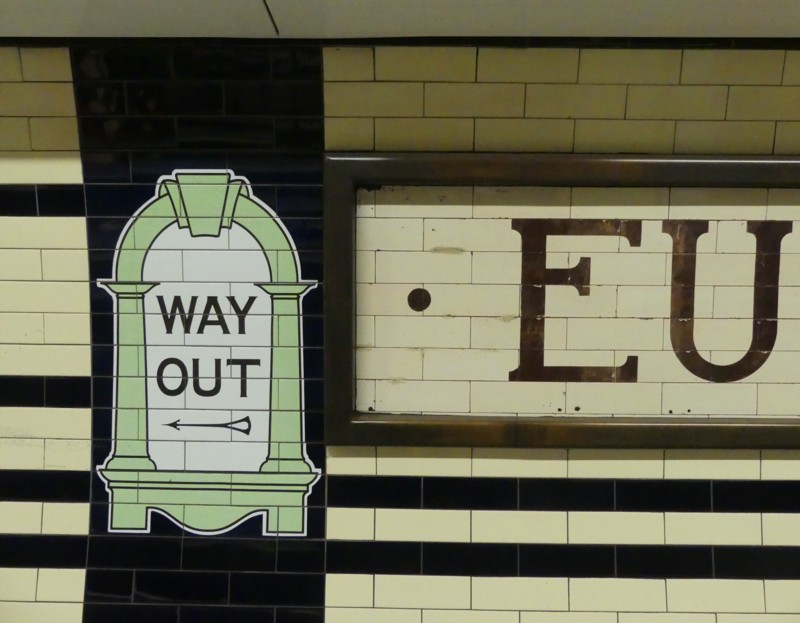
Today I was at Euston tube station, and found myself admiring the antique signage on one of the platforms, the Northern Line I think, done with painted tiles, rather than with a printing press or with electronic wizardry as is the way such things are done now. Way Out signs are not what once they were. So out came my camera. At this point I realised that there was some weekend, Brexit-related fun to be had, by including also part of the bit where it said, in much bigger letters, “EUSTON”:
If only the way out of the EU was turning out to be as simple as exiting from Euston tube station. March 3rd, 2019 | 7 comments - (Comments are closed)
It may be true that some of the support for Momentum comes from the young, but the idea that most 20- and young 30-somethings have the hots for an ageing anti-semite, IRA supporter, Hamas chum and Marxist seems a tad far off the mark. The new and devastating book by Tom Bower is hardly going to make life easier. With their penchant for the goodies of modern capitalism (iPhones and all the rest of it), if not being in agreement with the global trade that makes this possible, it always struck me as more likely that a more genuinely liberal creed would appeal. The problem, as I see it, though, is that the breakaway MPs from Labour and the Tories who have formed the Independent Group are largely motivated by a desire to keep Britain inside the clutches of a federalising EU project marked by disdain for what voters want, and squaring that circle is going to be difficult. Classical liberalism (ie, what I think liberalism actually is) has never been a majority taste among the young, in my experience, but it isn’t doing well at the moment, even though there are student groups and others doing what they can to counter statist nonsense and resist it in colleges, etc. That’s why I applaud the likes of the Atlas Network, Students for Liberty and the work of groups such as FREER, etc. Whatever might be the real support for Corbyn and his fellow socialist troglodytes, more needs to be done to spread better ideas when people are still at a formative stage in thinking about these things. I do what I can in speaking to meetings, and actually a practical step I’d urge those who scoff about such efforts to consider is mentoring students whom they know, giving them reading material and steering them towards ideas that their own lecturers might not be exposing them to. This doesn’t have to be done in a blunt fashion, either. March 2nd, 2019 | 28 comments - (Comments are closed)
|
   |
||||

All content on this website (including text, photographs, audio files, and any other original works), unless otherwise noted, is licensed under a Creative Commons License. |
|||||
Recent Comments