We are developing the social individualist meta-context for the future. From the very serious to the extremely frivolous... lets see what is on the mind of the Samizdata people.
Samizdata, derived from Samizdat /n. - a system of clandestine publication of banned literature in the USSR [Russ.,= self-publishing house]
|
Facts:
- Naomi Wolf is a loony feminist.
- James Delingpole is a heroic leader of the resistance.
- The heroic leader of the resistance has recorded and published a podcast with the loony feminist.
- The loony feminist comes across as sane. I mean really sane. Thoughtful, informed, careful to stick to what she knows and prepared to be honest about what she doesn’t know.
My head hurts. Is this a weird departure from reality? Will the universe will right itself before too long? I hope so, but maybe it isn’t a departure. I am having dark thoughts here, but what if Naomi Wolf has other opinions that are worth listening to? What if other loony feminists have opinions worth listening to? What if some of them are sane? What if a majority are sane? Have I spent a large part of my life being… yernow… wrong?
It feels weird to be explaining the perils of censorship to Americans. It was they who taught me about the absolute value of free speech. It was their readiness—so cool, so confident—to entertain the most heterodox ideas that had made me understand why the Soviet Union never stood a chance against their country. Do I really need to be telling Americans that censorship makes us dumb? That it limits our ability to assess reality and to make the decisions that are best for us, both as individuals and as a society? Do I really need to be telling progressives that progress is impossible without the freedom to think, speak and argue? And do I really need to be telling social justice warriors that social justice is a mere pipe dream in any society that hews to a single, rigid ideological narrative—or that unfreedom of expression oppresses the oppressed and empowers the powerful?
Of course, America is not the Soviet Union, and American governmental bodies aren’t the ones doing the censoring. Nor have the clampdowns on dissent been all-encompassing. But they are still enormously effective, partly because so many groups and individuals now depend heavily on privately owned internet platforms to reach their audiences. The conservative social media platform Parler was effectively silenced when Big Tech wiped it off the internet. The New York Post’s audience was massively curtailed when Twitter froze its account in response to its publication of a damaging story about Hunter Biden on the eve of the US presidential election. (Twitter then tagged the story as “harmful” and joined Facebook in preventing people from sharing it.) For a year and a half, people were ridiculed and kicked out of polite company for suggesting that Covid-19 may have originated in a lab in Wuhan as social media muzzled debate on this crucial subject. Today we are learning that this is a highly realistic hypothesis.
– Izabella Tabarovksy
It has been a well-known fact for the past hundred years that masks are useless against viral transmission. All one has to do is contrast the moon-suits used in virology labs with the “bandana across the face” to understand how actual protection works. I’ve designed military NBC (nuclear/biological/chemical) filtration systems (that I still cannot discuss) and the difference between those and the relatively simple gas turbine filter systems is enormous.
And yet the discussions in the lame-stream media all center on “when can we take our masks off”, rather than the central question of, “do masks perform any positive function in preventing or slowing the spread of viral diseases”. The Danish study alone (more than 6,000 people) of the ‘rona puts the lie to the latter. Every single study done has shown that non-rated cloth and paper masks have no positive effect, and have many negative effects. Hypoxia is only one of them; the negative effects also include higher rates of other infections, including bacterial and fungal. Major dental issues are also now arising from chronic mask use. Despite that, many of the government-funded studies conclude that, “masks should be worn anyway, mostly for the psychological benefit”. I guess that’s now considered “sciencey”.
This despite the fact that places that underwent lockdowns and mask mandates suffered higher infection rates and death rates than those without mandates.
– Commenter Blackwing1
“Chicago mayor’s decision to only speak to journalists of color is commendable, not racist”, writes someone in the Independent. The apparent erasure of the author’s identity was the Independent‘s doing, not mine, but they – the author – describe themselves as a Black and Native American writer who finds Mayor Lori Lightfoot’s demand to only speak with journalists of colour commendable.
On libertarian principle, I support the right of Ms Lightfoot or anyone else to refuse to associate with people of a different race, but unlike this author I disapprove of racism.
Unless someone invents a way to store energy in massive bulk, Net Zero will mean quivering under duvets in the dark on windless winter nights. We are on the path to poverty, misery and a failure to inspire the world to decarbonise.
With costs not yet apparent in people’s lives, MPs have been content to rub along with consensus, dealing with more immediate existential crises, like the political fiascos over Brexit and the pandemic. Only now, with Brexit behind us and as the economy and life open up after the pandemic, a few commentators are starting to question whether families, businesses and the UK economy as a whole can really afford the astronomical costs of renewables. Ministers urgently need to respond candidly in full to those questions.
If ministers don’t obtain and maintain the consent of the public for Net Zero now with full and frank explanations of the costs and changes ahead — as they relentlessly have not during the panic of the pandemic — eventually there will be a terrible revolt. Fear will not be enough. Even the “nudging” government scientists currently engaging in it confess that, “using fear as a means of control is not ethical” and it “smacks of totalitarianism”. Is this really who we want to be?
– Steve Baker discussing the Net Zero insanity.
Unfortunately, if the last year and a half have shown anything, yes, that is indeed “who we want to be”, or at least a great many people do. But until the Tories not just abandon Net Zero but actively repudiate it, there is no way in hell I will even consider voting for them at any level of government.
While Dr Fauci’s wisdom is questioned openly, Britain is haunted by the presence of Prof Neil Ferguson, who repeatedly returns to our screens like a bad horror movie. Rarely has any expert in British life been more wrong about so many major things, and yet still he crops up, where he is given a respectful audience at government level and by most of the media. His latest appearance has seen him warning — with the Prime Minister following suit — that the Indian variant of Covid might necessitate delaying the end of lockdown. But what is striking is not just that Ferguson gets away with repeatedly being wrong, but that his constant urges for greater caution are not balanced by any force urging the opposite.
– Douglas Murray
“CMV” stands for “Change my view”. It is the name of a subreddit where people go to argue, expecting disagreement, as I expect it now.
In the most recent Queen’s Speech, Her Majesty told the Lords and the Commons that “My Government will invest in new green industries to create jobs”, but there were serious proposals as well. She also said, “Legislation will be introduced to ensure the integrity of elections”. This was a reference to the proposed Electoral Integrity Bill. You can read the Hansard account of the debate in Parliament here. Chloe Smith MP, who it appears is the Minister for the Constitution and Devolution, there’s posh now, said,
Asking voters to prove their identities will safeguard against the potential in our current system for someone to cast another person’s vote at the polling station. Showing identification is something people of all backgrounds do every day.
Northern Ireland has used voter identification in its elections since 1985, and expanded this in 2003 during the last Labour Government. In the first general election after photographic identification was introduced in Northern Ireland by the then Labour Government (2005), turnout in Northern Ireland was higher than in each of England, Scotland and Wales. Since then, the experience in Northern Ireland has shown that once voter identification is established as part of the voting system the vast majority of electors complete the voting process after arriving at the polling station. A wide range of countries, such as Canada and most European nations, require some form of identification to vote.
New research published yesterday on www.gov.uk clearly indicates that the vast majority of the electorate of Great Britain, 98% of electors, already own an eligible form of identification, which includes a broad range of documents and expired photographic identification.
And, um, that sounds fair to me. Note that the Northern Irish Electoral Identity Card is not required to be shown before one can vote. It is but one of several acceptable forms of ID, and is issued free of charge to those people who don’t have any of the other forms so that nobody will be unable to vote due to poverty. It is not the abominable high-tech integrated without-this-you-starve Identity Nexus proposed by the Right Honourable Tony Blair. My opinions on that have not changed since 2003. To look at, the Northern Irish Electoral Identity card is a poxy little photocard that looks like it was issued by your local library. This lack of sophistication, the fact that you only need the effing thing once every five years or so, and the fact that voters have been obliged to show ID before voting in Northern Ireland for years without any obvious bad consequences, lead me not to fear the rollout of a similar scheme in the rest of the UK as the first step on the slippery slope towards a national ID card.
As to whether a legal requirement to show photographic ID before one votes is a thing good, bad or indifferent in itself, that is a separate debate. Dawn Butler MP, writing in the Times, says, “This, to me, is nothing more than a cynical attempt at voter suppression by our government — and it must be stopped. It mirrors some of the subversive tactics deployed in some states in America.” Jess Garland of the Electoral Reform Society writes in the Guardian that it would undermine democracy. Over in the US, where the state of Georgia has recently passed its own Election Integrity Act, President Biden said a thing about eagles.
“There’s also the problem of, as our liberal friends would put it, power dynamics. At least when Stewart was battling the Bush administration, you could make the argument that liberalism was a minority persuasion in America. Today, the left is a political and cultural juggernaut, dominating the elected federal government, the civil service, the mainstream press, Hollywood, Big Tech, increasingly even the corporate world. It’s our new civic religion, which has turned its comedians into something like high priests, mouthing its tenets and ridiculing its apostates. All the old rules of satire — don’t punch down, afflict the comfortable — amount to a generally anti-authoritarian and iconoclastic mindset. Yet Stewart’s imitators exist only to reinforce the existing authorities while at the same time pretending they don’t have any authority at all.”
– Matt Purple. He is writing in the US edition of the UK-based Spectator, so usual health warnings apply to the American misuse of the word “liberal”.
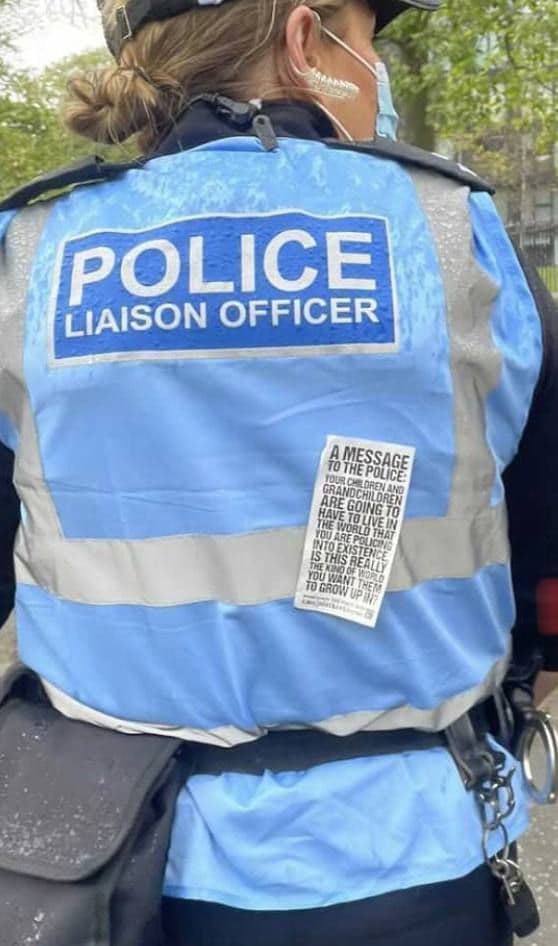
Epic 🤣
Conservatives? What conservatives? The Conservative Party of 2021 is Blairite ideologically, not conservative. If I wanted ruinous NetZero policies and even more state control over civil society needed to impose them, I’d vote for the Green Party. But if I’m going to get those policies even if I vote Tory, then why on earth would I vote Tory?
The educational & media establishment are now utterly dominated by the far left, with the Tories asleep at the wheel the whole time. Woke culture backed by regulation is now rapidly spreading into Big Business, with the Tories equally lackadaisical. And is there a single aspect of civil society not now regulated by the state? If the Conservatives have no interest in conserving civil society, rather than nationalising it, then you people are utterly pointless. If you were a company, you’d be prosecuted under the Trade Descriptions Act for calling yourselves conservatives.
After having only ever voted Tory all my life, the spell was broken in the final Euro elections when I voted BXP. I will not be voting for you people again.
– Perry de Havilland, replying to “Now is a great time to be a Conservative.”
“It has become something of a cliche, but it also happens to be true. If you want to do your bit for the planet, forget Tesla and other super-expensive electric vehicles: just carry on driving the same old gas-guzzling banger you’ve always had. As much, if not more, carbon tends to be expended producing a new car as actually driving one.”
– Jeremy Warner, Daily Telegraph (£).
I own an S-Type Jaguar (V6, 3-litre) – one of the last ones to be built – and it drives as smooth as you like, and what makes it all the sweeter is knowing that every time I turn that big black cat’s engine on, a little bit of Greta Thunberg’s cult hopefully dies.
|
Who Are We? The Samizdata people are a bunch of sinister and heavily armed globalist illuminati who seek to infect the entire world with the values of personal liberty and several property. Amongst our many crimes is a sense of humour and the intermittent use of British spelling.
We are also a varied group made up of social individualists, classical liberals, whigs, libertarians, extropians, futurists, ‘Porcupines’, Karl Popper fetishists, recovering neo-conservatives, crazed Ayn Rand worshipers, over-caffeinated Virginia Postrel devotees, witty Frédéric Bastiat wannabes, cypherpunks, minarchists, kritarchists and wild-eyed anarcho-capitalists from Britain, North America, Australia and Europe.
|





Recent Comments