|
|||||
|
We are developing the social individualist meta-context for the future. From the very serious to the extremely frivolous... lets see what is on the mind of the Samizdata people. Samizdata, derived from Samizdat /n. - a system of clandestine publication of banned literature in the USSR [Russ.,= self-publishing house] Arts, Tech & CultureCivil Liberties
Commentary
EconomicsPoliticsSpecialistTech |
19 comments to On this day in 1805…Leave a Reply |
Who Are We?The Samizdata people are a bunch of sinister and heavily armed globalist illuminati who seek to infect the entire world with the values of personal liberty and several property. Amongst our many crimes is a sense of humour and the intermittent use of British spelling. We are also a varied group made up of social individualists, classical liberals, whigs, libertarians, extropians, futurists, ‘Porcupines’, Karl Popper fetishists, recovering neo-conservatives, crazed Ayn Rand worshipers, over-caffeinated Virginia Postrel devotees, witty Frédéric Bastiat wannabes, cypherpunks, minarchists, kritarchists and wild-eyed anarcho-capitalists from Britain, North America, Australia and Europe. Recent Comments
CategoriesArchivesFeed This PageLink Icons   |
|||

All content on this website (including text, photographs, audio files, and any other original works), unless otherwise noted, is licensed under a Creative Commons License. |
|||||

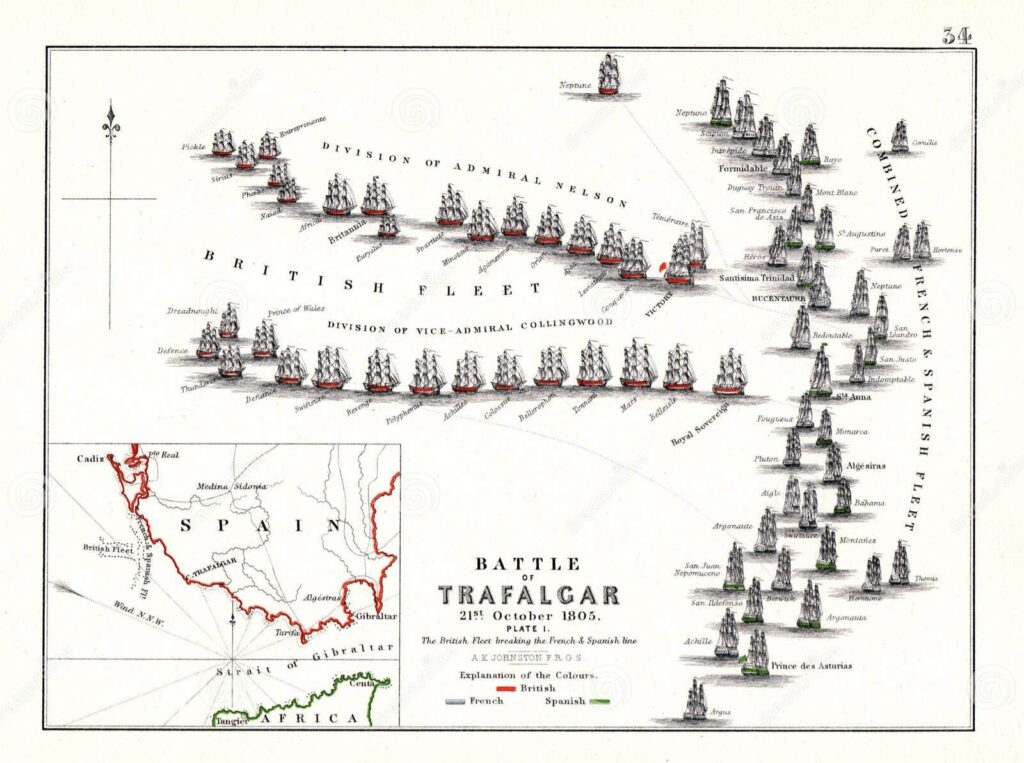
Trafalgar was indeed a great victory – Nelson was outnumbered by the French and Spanish fleets, and responded with unconventional tactics that gained victory at the cost of his own life.
In war there is no substitute for victory – victory must be achieved as quickly as possible and by all means necessary.
Modern leaders who think in terms of the military being a tool in a process that leads to a “diplomatic settlement” are unfit for public life.
Napoleon was an overthinker. Still, if the French fleet had won, could France have invaded Britain? And would he have won, if he landed in Britain?
I associate October 22nd very strongly with grim hangovers and this year will be no different.
Nicholas Gray – the regular British Army was small, but John Reeves had organised the Association for the Protection of Liberty and Property which had many thousands of, armed, members – and overlapped with Yeomanry and official militia forces (i.e. the same people were often in both the private association and the public body), it might have depended on how well (or badly) these part time soldiers backed up the regulars. And on how many soldiers Napoleon landed.
Napoleon despised irregulars – he thought that with a “whiff of grapeshot” (how he had made his name – crushing radicals in Paris, he would be in his element right now) they would all run away and not come back. But in Spain he was shown to have horribly miscalculated – when he betrayed his ally Spain, in order to put one of his own relatives on the throne (inviting the Spanish Royal family for a visit – and then treacherously imprisoning them), the Spanish people rose up with savage fury – and received British help (this is where Wellington made his name).
Even hundreds of thousands of French soldiers could not hold down Catholic Spain – with its strong families and passionately religious people.
If only that Spain still existed.
Napoleon also miscalculated in Russia – counting only the regular army (much smaller than his “Grand Army”) and ignoring irregular forces such as the Cossacks.
The ordinary Orthodox Russians (although NOT the Russian aristocrats and gentry) despised the “syphillis ridden French” – and examination of the bones of some of the Grand Army show the ordinary Russians were not totally wrong, there are tell-tale signs of syphillis in SOME of the remains.
Some observers pointed to another difference – when wounded French soldiers (unsurprisingly) cried out in pain, Russians tended not to. A very grim culture indeed (to cry out in pain is understandable – but Russians regarded it as a sign of a coward and despised people who showed they were in pain) – but not without its stoical advantages.
“Engage the enemy more closely”.
Nelson laid the groundwork for a century of U.K. naval mastery and as a result, shipping lanes were relatively free of piracy and problems. The U.K. was able to benefit from free trade in part because of this.
The greatest man to have come from Norfolk.
His memory is immortal.
Old Jack Tar – good luck to you Sir.
Johnathan Pearce – yes indeed.
Let us remember and honor the brave Saxons and their valiant king who were killed in battle on 14 October 1066, defending their homeland against invading orcs from across the sea.
Harold Rex Interfectus Est. Pipe down you Anglo-Saxon oiks, we conquered you fair and square 😀
“Pipe down you Anglo-Saxon oiks”
Screaming Lord Sutch was right.
Patrick Crozier:
See https://rikramblings.com/2025/07/22/the-case-for-screaming-lord-sutch/
I believe someone claimed the French or Spanish won it?
Napoleon had pretty much given up on the idea of invading Britain when he dispersed the Camp of Boulogne to take on Austria and Russia.
“. . . we conquered you fair and square.”
Och, hardly. When the Saxons formed their shield wall, their greatest warriors, armed with their famous two-handed battle axes, stepped forth and began swinging their weapons, thereby “inviting” the Normans to come and get a taste. At the same time Saxon host banged their weapons against their shields and shouted, lustily, ‘Ut! Ut! Ut!”
Translation: “Come out! Come out! Come out!”
They wanted a stand-up fight. What they got was a ruse: a feigned retreat by the Norman cavalry.
Even at that, after 8 hours of hard fighting, and with evening approaching, the Saxons had almost carried the day. But Norman arrows progressively attrited the shield wall, necessitating contraction, which weakened it overall and gave the Norman cavalry the maneuver room it needed to outflank and finally penetrate the Saxon line.
Still, it was, as one of your later generals said, “”the nearest-run thing you ever saw in your life.”
Also, BTW, William’s claim on the English was spurious, being as Harold acquiesced to it under coercion, while he was held captive by the duke. It was also illegitimate — like William himself — since by law only the Witan had the power to name a successor as king upon Edward’s passing.
Paul Marks: “Modern leaders who think in terms of the military being a tool in a process that leads to a ‘diplomatic settlement’ are unfit for public life.”
You know, as a veteran of the Canadian Army (35 years), this is one time I can say to you in all honesty: I completely and unreservedly agree.
I cannot help but note that engraving of the battle has more British warships than I believe Britain has currently.
Subotai Bahadur
Irish Otter,
Thanks for the link. I really had no idea how successful he was. Alas, the business of repatriating the Normans remains unfinished.
JJM – yes indeed, and thank you for your service Sir.
IrishOtter49 – one of the things I do not understand is how relatively badly the English archers did (compared to the Norman archers) – the English archers had the higher ground and should have done better.
Were they outnumbered? Were there relatively few English archers?
As for Harold – he let his success up north make him overconfident, rather than stay in London and collect a larger army – he marched down into Sussex provoked by the Normans attacking estates that his family (and people connected to his family) owned.
He also failed to use the forests that then covered much of Sussex to his advantage – he could have ambushed the Normans (cavalry are at a disadvantge in woodland) as they moved along the roads.
Instead he choose an open battlefield – and failed to discipline his men.
At the Battle of Tours (centuries before) Charles Martell (Charles “the Hammer” – a war-lord of the Franks – the “Free Men”) made clear to his infantry that anyone who broke formation to chase after the Muslim cavalry (who seemed to retreat several times) would be executed.
He also used dense woodland to cover his flanks – and sent teams of men to attack the Muslim camp (threatening to retake the stolen gold and liberate the slaves) whilst the Islamic army was engaged in battle.
However, leaders like Charles Martell are rare.
By the way – like William, Charles is said to have been illegitimate – he had no right to rule by birth, and so had to prove himself as a war-lord.
Your analysis of the Battle of Hastings and Harold’s actions before and during the battle are flawed. But that’s a discussion for another day.
Moving on.