We are developing the social individualist meta-context for the future. From the very serious to the extremely frivolous... lets see what is on the mind of the Samizdata people.
Samizdata, derived from Samizdat /n. - a system of clandestine publication of banned literature in the USSR [Russ.,= self-publishing house]
|
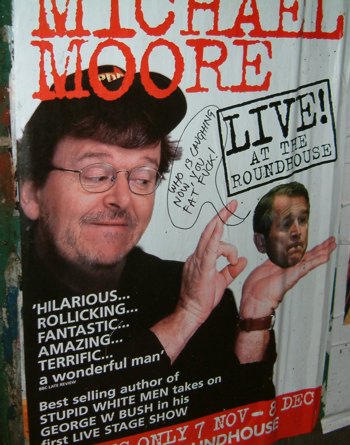
Please consider this modest posting as an addendum to David Carr‘s article As good as it currently gets. I have little in the way of words to add to his observations but it seemed to me that the picture below, which I have just taken here in London whilst returning from the supermarket, is a delightful addition.
Alas, grotesque self-publicist, leading Idiotarian and BBC favourite Michael Moore is currently blighting the shores of these sceptred Isles by his rotund presence… but it would seem that some passing Brit with an impeccable interest in Anglosphere affairs has seen fit to ennoble Moore’s poster with some pithy observations of his or her own…
Paul Marks puts on his kevlar battle-bowler and sticks his head above the ramparts to criticize the Libertarian Party for its role in… helping statism!  Now duck, Paul! Now duck, Paul!
Both the proposition to legalise the growing of hemp (rather than importing hemp products from Canada) and the proposition to put ‘jury nullification’ (i.e. returning to the traditional practice of juries judging both fact and LAW) into the South Dakota Constitution have voted down.
One of the main reasons these propositions were voted down seems to be that they were associated with the Libertarian Party (which is seen, rightly or wrongly, to be a bunch of freaks).
The Republicans have failed to gain the South Dakota seat by 500 votes.
And the Libertarian Party (with its normal 1 percent or so of the vote) has cost the Republican party the Governorships of Alabama and Tennessee.
This will mean (for example) that Tennessee will now get a State Income Tax (the Republican was a very good man – utterly opposed to a State income tax).
True the L.P. failed to prevent the Republicans retaking the Senate (despite a very big effort to defeat a good man in New Hampshire – Sununu managed to beat the Democrats and their de facto allies the Libertarian Party).
However, this can go on. The Libertarian Party people must understand that their work simply helps expand government (see the Tennessee example above). If Libertarian Party people do not think that the Republican party is free market enough (and I agree with them that the Republican Party is not free market enough) then they should join the “Republican Liberty Caucus” and make the Republican party more free market. If the Republicans had backed the two pro-freedom propositions in South Dakota they might well have passed.
The energy of Libertarian Party activists is helping statism. The Libertarian Party takes just enough votes to cost the Republicans close elections and the statement “the Libertarian Party backs X proposition” is enough to defeat that proposition.
This is madness, please stop it.
Paul Marks
There is an interesting interview with Frank Shostak over on the Ludwig von Mises Institute.
The US Federal Reserve discourages savings whilst at the same time encouraging mal-investment. Simple common sense would suggest that if interest rates of a mere 1.75 percent have not jolted the US economy out of its torpor, then 1.25 percent is not going to do it either. Interest rates are effectively at zero in Japan and that has produced little or nothing in terms of economic revival.
Yet again the state’s capacity to do harm far outweighs its capacity to do good. The problem is not so much the policies of the Federal reserve, but that there is such a thing as ‘The Federal Reserve’.
Alas so many people everywhere cannot seem to imagine the world continuing to spin on its axis without things like The Federal Reserve, The Department of ‘Education’, The Bundesbank, the BBC, The National Health Service, Income Tax etc. etc… they are just part of their fabric of reality. I have often found that any person who suggest they simply be abolished is treated as if they had suggested amputating a limb, rather than excising a tumour. The truth hurts and no one ever thanks you for hurting them.
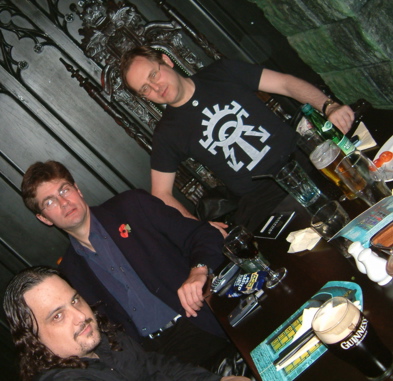
We had everything required for a conspiracy by sinster globalist illuminati: Gothic setting, endless supply of Guinness & crazy camera angles
I must confess the the activities of the UK governments for the past couple of years have been watched with frank admiration and amazement by Lord Vetinari. Outright theft as a policy had never occured to him.
-Terry Pratchett [Lord Vetinari is the rather Machiavellian ruler of the fictional city in Pratchett’s books]
Whig interventionist is a term one could use to describe a partisan of limited government who supports war against tyranny. The problem is deciding on the right target.
UK versus USA
The unilateral decision to impose tariffs on steel by the US president in 2002 was an action which in the nineteenth century might have triggered a war. In this case the UK would unquestionably be the forces of enlightenment and the US the agent of darkness. As far as I have been able to establish, Iraq has no import tariffs.
France versus UK
I recently called for a British War on Chirac. Yet I would have to support a French war of liberation if the causus belli was alcohol prohibition. When taking a ferry to France, the bars and cheap alcohol shops are closed for the first 20 minutes, as long as the ferry is notionally in British territorial waters. Yet they stay open for the rest of the trip until the ship docks in a French port.
Coming back, the scenario is reversed. The shops open at once leaving France and close 20 minutes before landing in the UK. Considering that both countries supposedly operate identical European Union regulations on tax-free trade, this looks like the sort of provocation that China caused to trigger the Opium Wars.
Better still the French authorities do not care how much discounted alcohol and tobacco people carry, the British Gestapo consider 2,000 cigarettes to be organised crime.
In the UK it is illegal to sell alcohol after 11pm without a meal. In France it is illegal to sell a meal after 9pm unless alcohol is available.
French visitors to London now play spot the police camera.
I rest my case.
When Generalissimo de Havilland introduced the ‘comments’ facility on this site, I made a promise to myself that I would never tailor any of my articles to pander to the likely responses that such a facility makes possible. It is a good rule; sort of ‘publish and be damned’ only without the regency swagger.
However, I intend to make an exception in this post and this post only because I know that what I am about to say will attract a whole raft of predictable admonishments from those you of with a Phd in ‘Stating the Obvious’. So here is an FAQs section which I strongly recommend you read and absorb before proceeding further.
- Yes, I know that the Republicans are not libertarians.
- Yes, I realise that Republican policies can be just as damaging to liberty as Democrat ones.
- Yes, I know there are some good Democrats
- Yes, I am quite sure that the Homeland Defence Department will prove to be every bit as sinister as it sounds.
- I am generally indifferent to political parties
- Yes, I am still a libertarian.
That said, there are many things in this life which bring me untold pleasure: the love of my family, the affections of a good woman, watching Chelsea win the FA Cup, a stimulating evening with close friends and a large rump steak with English mustard are all among them.
But, last night, I would merrily have swapped all of those in return for the intoxicating, enervating, memorable, boundless joy of watching the American socialists get shoved through the electoral meat-grinder and turned into hapless, hopeless, abject little patties of self-pity and recrimination.
As the results flooded through in the wee early hours, I squealed with shameless glee, I punched the air in triumph and I even managed to earn a complaint from my downstairs neighbour after waking her up at 5.30 in the morning by marching around the lounge to the lockstep of ‘Semper Fidelis’ blaring from my CD player. Yes, I got that carried away.
I laughed, LAUGHED like a drunken buccaneer at the sight of the BBC newsanchor announcing the Republican victory, looking as if she had just been f*cked with a dead cat. It was more than celebration, it was revenge. I love the smell of the BBC being napalmed in the morning.
As you may already have guessed, I have temporarily suspended my animus towards parties of state because as someone (I can’t remember who) once said it isn’t always a choice between the good and the bad; sometimes its a choice between the bad and the even worse. Well, in my book, the socialists come under the category of ‘even worse’, so I’ll throw whatever muscle I have behind the other guys, though they may be merely ‘bad’. If I was an American, then the Republicans are not what I would want, but what I want (what I really, really want) is simply not on the table, so I’d take the best I can get.
So, thank you President Bush for making this Englishman very happy. Your country is the engine of Western civilisation and, right now, whatever else it may or may not be, it is not in the hands of the left.
On any reading, that is profoundly good news, and I am not so proud that I cannot jump down from that lofty fence, wipe the splinters from my raddled posterior, and give credit where it is so richly due.
I don’t recall any of those “wonders of capitalism” postings lately, so here’s one, scanned in from the November 2002 issue of Prospect (paper version so no link), referred to in an article about nanotechnology (“The Science of the Tiny”) by Michael Gross of Birkbeck College, London.
I’ve been hearing for years about how wonderful nanotechnology is just about to be. But where’s the stuff? Where are the nanotechnologically produced products that we can buy? In the shops? Says Gross:
… There is at least one that you can buy already. It is the self-cleaning window. It uses a combination of two clever molecular tricks. First, it contains a catalyst that uses the energy of light to oxidise common kinds of dirt, to convert them into smaller, more soluble molecules that wash away with rain water. At this point, the second trick comes in. Ordinary glass is fairly water-repellent (hydrophobic), which means that water does not cover it smoothly, but tends to form droplets. The surface of self-cleaning glass, however, is coated in molecules that attract water and encourage it to spread out. So, instead of sitting around as drops which leave drying spots when they evaporate, the rain will cover the surface evenly, dissolve what the photocatalyst made of the dirt, and run off. Simple. Yet it would not be possible without molecular design on the nanometre scale.
I don’t need it. Correction: I don’t want it. But I’m a big fan of skyscrapers, and skyscrapers are going to want this stuff by the square mile, and presumably they already do. I assume that technophiliac Samizdatistas like Dale Amon and Russell Whitaker have known of these magic window panes for years but this is the first time I’ve heard about them, and I’m impressed.
The laser testbed at White Sands has racked up yet another first. It has shot down an artillery shell in flight:
“This shootdown shifts the paradigm for defensive capabilities. We’ve shown that even an artillery projectile hurtling through the air at supersonic speed is no match for a laser,” said Army Lt. Gen. Joseph Cosumano, head of the missile defense command.
You can find out more about it here.
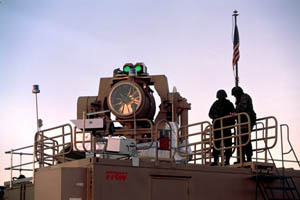 Tactical High Energy Laser Director.
Photo © TRW Inc. 2000. All Rights Reserved. Republished by kind permission of TRW Inc
The Law of Unintended Consequences is a popular one with libertarians seeking to highlight how government rules and actions have perverse consequences. So it was interesting to watch British parliamentarians being reminded about the perverse side-effects of government rules at a committee hearing at the House of Commons this afternoon.
A government-appointed adviser, Alan Pickering, was pointing out to MPs that legislation such as the 1995 Pensions Act, introduced after the Robert Maxwell scandal in the early 1990s, has in fact simply encouraged many firms to shut down pension schemes for their workers. “This is a classic example of the law of unintended consequences,” he told MPs. Quite.
Interesting to watch as MPs listened to this point with expressions of blank incomprehension. You could imagine this thought going through their heads: “You mean that our desire to better Mankind might backfire? Who would have thought it?”
While on one level it made little difference to me (someone as LP as a coalminer was Comm… er… Labour) which of the other American parties won seats, I must admit to some glee at watching the effect of Republican victory on UK correspondents. They are visibly shaken by the implications and I thought it great fun.
Channel 4 News had Michael Moore on for the Democrats and Laura Ingraham for the Republicans. She did rather well, but Mr. Moore had the last word:
“No wonder they win, they look better than us.”
I wonder what would have happened if such a really harmless joke had come from the lips of a liberal or a conservative rather than a Leftist?
Political Correctness is not a matter of what is said; it is a matter of who says it. The annointed are “allowed” freedoms of speech unavailable to the hoi polloi. Had it been myself on ITV news, making the same remark, I would be pilloried for it.
Do not get me wrong: I am not castigating Michael Moore for this remark. I am merely pointing out there is an inherent asymmetry and illogic to the Left’s position on Freedom of Speech. The fact is, I agree with Michael Moore. Laura Ingraham is better looking than he is.
Smarter too.
Rowan Williams, the next Archbishop of Canterbury, has stated that it is more important to “maintain the society of states” than to depose a murderous dictator, namely Saddam Hussain.
Now if Williams was of the opinion that Saddam Hussain was just the victim of western calumny and he was in fact the generous benefactor of the Iraqi people, then it would be quite understandable that he would oppose starting (or more accurately, completing) a war with the object of deposing him and crushing Ba’athist Socialism.
Yet that is not the case: Williams describes Saddam Hussain as “brutal and violent” and yet still takes the view that the stability of those collective edifices called ‘states’ is more important that the right of Iraqi civilians not to be murdered in order to ensure the supremacy of the Ba’athist Party.
Here is a man who, as an Anglican Archbishop, is presumably concerned not with geopolitics but with Christian morality and yet takes the view that the political stability of the Islamic world’s sundry despotisms matters more ending the nightmare of the 23 million people who live or die at Saddam Hussain’s whim. The fact Hussain is “brutal and violent” matters less than the needs of Realpolitik.
This is exactly where collectivism can lead even an Archbishop, because morality and collectivism are antithetical.
|
Who Are We? The Samizdata people are a bunch of sinister and heavily armed globalist illuminati who seek to infect the entire world with the values of personal liberty and several property. Amongst our many crimes is a sense of humour and the intermittent use of British spelling.
We are also a varied group made up of social individualists, classical liberals, whigs, libertarians, extropians, futurists, ‘Porcupines’, Karl Popper fetishists, recovering neo-conservatives, crazed Ayn Rand worshipers, over-caffeinated Virginia Postrel devotees, witty Frédéric Bastiat wannabes, cypherpunks, minarchists, kritarchists and wild-eyed anarcho-capitalists from Britain, North America, Australia and Europe.
|





Recent Comments