We are developing the social individualist meta-context for the future. From the very serious to the extremely frivolous... lets see what is on the mind of the Samizdata people.
Samizdata, derived from Samizdat /n. - a system of clandestine publication of banned literature in the USSR [Russ.,= self-publishing house]
|
Paul Marks reminds us that the motivation to do good does not ensure good is actually done
Today I read the obituary of John Rawls (who died on Sunday) in the Daily Telegraph. Dr Rawls was a brave soldier, a loving husband and a good father to four children – he was also kind and polite to all who encountered him.
However, Dr Rawls was also the author of “A Theory of Justice” (1971) the main modern justification for the ever increasing burden of the welfare state.
According to Dr Rawls no one had any right to increase their income or wealth unless they could prove that by so doing they improved the economic life of the “least favoured”. Just not harming the least favoured would not do – as inequality harmed the “self esteem” of the poor.
Interestingly I also read in today’s Daily Telegraph a little example of how Rawlsian type thinking works out in practice. In the Spanish region of Valencia the government is working in a public-private partnership to improve the lot of the least favoured. Private developers produce a plan for the creation of urban zones (flats, shops, places of business and so on) in sparsely populated coastal areas, the government judges the plan and then levies a tax on land owners in the area to provide such things as roads and drainage.
What a wonderful thing – from either a Rawlsian or a utilitarian point of view.
However, the plan means that retired people who have bought properties by the coast have to pay the government lots of money (or have their property taken away) for roads and drainage (and so on) that do not benefit them.
Why do I think that Rawls (kind and decent man that he was) would have been disgusted by this sort of thing?
before you say “but that is the corruption of the idea” – maybe so, but that is statism in practice.
Paul Marks
In one of the most utterly wrong headed articles I have ever seen in the Daily Telegraph, called Watch out America, the 7st EU weakling may kick sand in your face by Ambrose Evans-Pritchard posting from Brussels (naturally), he would have us believe that, in response to criticisms from the USA that the EU is “a status quo power that resists and resents being hurried into a turbulent new post-Cold War era”:
…Europe is arguably the world’s most dynamic political bloc today. While the US borders have changed little since 1848, the EU is about to swallow eastern Europe up to the edge of Russia and Ukraine.
The EU is about to swallow the poison pill of the basket case post-communist agricultural economies of Eastern Europe, eager to feed at the massively subsidized trough of protectionist Europe and Evans-Pritchard holds this up as evidence of dynamism?
But EU officials are quietly confident that the strategic balance will shift as a decade of debt, over-consumption, and ballooning trade deficits catch up with America.
[…]
“Nobody wants to see America in difficulty, but there’s a high risk that the Clinton boom is going to end badly. Then we’ll find out if Europe’s slow vessel might not prove to be steadier in the long run.” One day soon, America may wake to find itself facing a wealthy superpower of 470 million people.
The European Union… filled with heavily taxed, highly regulated and subsidy ‘protected’ economies… is going to overtake lower taxed, less regulated and slightly less subsidised USA? Oh give me a break. The whole reason that the ruling classes of Eastern Europe want to join the European Union, is that the EU seeks to lock in the position of the all its political classes, to insulate them from the reality of de-politicised markets and the consequences of that anti-market politics brings.
Eastern European businesses, at least some of them, see subsidy and protection from global competition from the USA and Far East beckoning, voters likewise see membership of the EU as meaning the end of restrictions on their ability to travel, work and reside in the more developed West… a ‘brain drain’ heading west of the best and brightest that the middle European former ‘eastern Bloc’ has to offer will soon ensue (good news if you live in the ‘west’), followed closely by an army of welfare parasites looking to help themselves to taxpayer money in Britain, France, Germany, Denmark, The Low Countries and Italy (extremely bad news of you live in the ‘west’).
The very essence of the EU is stasis and yet paradoxically, it is spreading, like some Nordic legend of winter eternal sends its deadening cold fingers into everything. The only people who really benefit are those who are sucking at the teat of the state and even them only until the curves of the EU’s spectacularly aging demographics and that of its increasing tax burden cross, like some cruxiform tombstone.
The First World used to be ‘The West’ and Japan, the Second World used to be the Socialist Eastern Bloc… soon ‘First World’ will come to mean the USA, Switzerland, Japan (maybe), Canada (maybe), Australia and new Zealand and, if it finally breaks clear of the European suicide pact, Britain and possibly even Ireland. ‘Second World’ will just come to mean sclerotic Europe, forever sidelined by more dynamic economies eleswhere and more assertive polities everywhere.
EU as future ‘superpower’? Don’t make me laugh.

The German Chancellor is clearly feeling just a wee bit insecure these days. Why else would would he actually go to Court to sue a news agency because they claimed that he used dye in his hair:
“With affidavits from his barber, Schroeder insisted that the article was false and that it had created a wave of stories that were hurting his image.”
Would that be his image as an incompetent, plundering, unreconstructed tax-and-spend socialist who is wrecking his country’s economy? Oh right, that image.
Anyway, in order to avoid any legal complications here at Samizdata, I hereby categorically refute any suggestions that the German Chancellor has ever dyed his hair. After all, why would he need to? It is a wig.
I don’t suppose any of our readers can have failed to notice the patina of despondency that has, of late, descended upon this corner of the blogland.
I am the usual and evergreen suspect. Optimism has always stood in stark contrast to my natural grain and my comrades have long-since stopped denouncing me for it and learned to live with my periodic predictions of impending doom. However, I am but Pollyanna herself compared to Paul Marks, the poster-boy of the Euthanasia Movement.
There was a time when our brooding presence was felt but nonetheless heavily diluted by the ebullient, thematic jolliness of the remaining Samizdatistas. But now Perry de Havilland seems to have stumbled into a pit of despair and even the stomach-churningly cheerful Brian Micklethwait has ‘fessed up to an onset of the highly contagious Carr-itis.
But why, I hear you inquire. Is this a neurological condition brought on by over-exposure to the internet? Is it because we are perenially-disappointed libertarians? No, it’s because we are British:
“People are growing increasingly pessimistic, with a majority believing that Britain is “grinding to a halt”, a YouGov poll for The Daily Telegraph has found.
The survey shows a country depressed by the prospect of falling pension values, failing hospitals, pot-holed roads, unspoken fears of terrorism and a possible war against Iraq.
Eighty five per cent of people worry that they can no longer rely on public services, while 53 per cent agree with foreign media reports that “nothing in Britain works”.
See, for all these years I was not being contrary, I was merely ahead of the curve and now that all my compatriots are conforming to national type, I can take nought but scant consolation in feeling vindicated.
All exhortations to cheery optimism are futile. It’s too late for therapy and prozac won’t work. We’re not depressed, we’re just British. Pity us.
I saw an interview on ITV news tonight of a fellow in NYC who has seen all of the new proposed designs for replacing the World Trade Center.
He said unequivocably the selected design will restore the New York skyline, make it as it was. All designs are tall and some are even taller than the WTC buildings were. All are said to be stunning. The man could hardly stop from grinning as he spoke. You could see the glee in his eyes.
This sounds more like the America I grew up in.
The way that the blogosphere in particular and West in general is slowly but surely focussing in on the all-too-human life of the very founder of Islam himself reminds me strongly of the way that we anti-Soviet elements in the 1980s finally stopped pratting around with nonsense about how Communism had been “betrayed” by Stalin, and said, no, it had just been done, by Lenin himself, and by Stalin, and by all Communists since then.
This from Scrappleface last Friday is a send-up correction note by the Nigerian newspaper that had sparked off the rioting by venturing a few mildly humorous observations about the Lenin of Islam:
“We regret our statement earlier this week that Mohammed would have chosen a bride from among the Miss World contestants. Upon further study of the life of the religious leader, we determined that he would have preferred to marry someone much younger than these women–since his favorite wife was Ayesha, who was six years old when he wed her.
“In addition, it is unlikely that Mohammed would have chosen just one bride from among the contestants, since he was married at least 11 times after his first wife died. The editors regret having printed such a poorly researched assertion.”
And how about this, from the “in fact” section of the December 2002 issue of Prospect (no link, you have to subscribe to view), picked up from the November issue of Commentary?:
The prophet Muhammad engaged in 78 battles, only one of which was defensive.
→ Continue reading: Muhammed and Lenin – the similarities and the differences
John Ray identifies a teeny little error in my Anglo-Australian cricket piece that can’t be left to correct itself only in comment number 8 on that:
Dear Me!
Somebody has their history skew-whiff!
Australia ruled by the Poms in Bradman’s day?
Australia became independent in 1901.
Clang. Sadly for me, and happily for Australia, John is of course right. First it was Shane Warne not bowling very many googlies, and now this. I feel like an England batsman, again.
My misremembering of Australian history is based on a misremembering of a Bradman biography (Bradman by Charles Williams – Little Brown, 1996) that I read some years ago, and in particular, I believe, a misremembering of the following paragraphs, from Williams’ Prologue, which I quote here at some length because it’s good stuff: → Continue reading: Australia – a correction!!
I went over to Michael Jennings‘ blog to read his cricket piece, the first version of which was apparently eaten by Blogger (the blogospherical equivalent of Wordstar), and which I recommend to all Americans enthusiastically. The cricket piece, not Blogger.
I also found a link to this piece of nonsense, which must be what they mean by the bursting of the internet bubble.
Yesterday Perry and I went to see the Aztecs exhibition at the Royal Academy of Arts in London. The event has been widely advertised, commented upon and heralded as “once in a lifetime opportunity to experience the grandeur and sophistication of this once great civilisation”.
It was certainly unique – most of the Aztec artefacts were for the first time shown outside Mexico and the exhibition presented a powerful image of the extinguished culture. It also felt rather alien, without any reference point to a known cultural context. Greek and Roman art is familiar, and we have grown accustomed to aesthetic norms of other cultures – Indian, Far Eastern, Arabic, Egyptian, Assyrian etc. We have come to terms with the diversity and varied beliefs across history and view them with a tourist’s curiosity and fascination.
We have also restrained ourselves from pronouncing any judgement on other cultures and their ways, satisfied with our understanding of why they did things the way they did. We only heap judgement and condemnation on the European ancestors and their evil, corrupt and dark ways – slavery, imperialism, feudalism, colonialism, fascism, unrestrained capitalism, the list of -ism is long, conspicuously lacking Marxism, Leninism, Stalinism, Maoism… But I digress.
And so I encountered an uncomfortable paradox. The Aztec culture was bloodthirsty, obsessed with death and killing in a way that surpassed any other civilisation known to us in its cruelty and disregard for human life. At the exhibition you can see the stone across which they bent the humans about to be sacrificed, sliced their breastbone open and tore the beating heart out to offer it to one of their insatiable blood-craving gods. There is also a funny looking vessel, with a carpet of little blobs on its surface, complete with a lid to keep the stench of human skins of the flayed victims of Aztec religious rituals. The surface is meant to look like human skin turned inside out. How artistic and in the best possible taste!
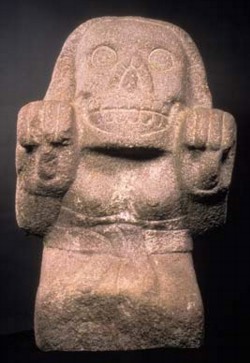
Kneeling Cihuateotl. (one monkey) Stone. The British Museum, London. Photo © The British Museum, London
Yes, there are also many splendid works of art. A rattle snake carved out of stone, a stunning jade mask that was a valuable Olmec antique to Aztecs themselves, numerous statues of people, gods and animals, breath-taking in their beauty and strangeness. The Aztecs’ artistic skill, however, did not make them a civilisation worthy of respect and propagation.
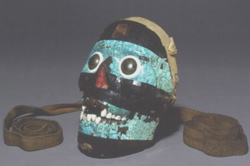
Mosaic mask of Tezcatlipoca, Aztec. Human skull, mosaic of turquoise and jet, eyes of shell and pyrite. The British Museum, London. Photo © The British Museum, London
Their society was rigidly ordered and controlled. It was totalitarian and authoritarian in the most sublime matters and in the most trivial. It required human and blood sacrifice and its warriors were used almost exclusively for capturing humans for sacrifice. It also prescribed to a minute detail what people were allowed to wear depending on which class they belonged to. OK, the last one may sound just like a typical feature of a feudal society with its rigid medieval hierarchy but believe me there is a difference. For the Aztecs, the only good death was a violent death and they believed that dying as a human sacrifice was one of the most ‘valuable’ deaths. Dying in childbirth was another one. Go figure. They also believed that sacrificing humans was essential to all existence. Their gods required blood and without it the sun, moon, earth and other bits would cease to exist. By the time of the Spanish Conquistadors this cosmology ‘required’ them to sacrifice 10,000 people a year in their main temple.
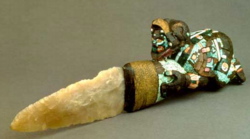
Sacrificial knife, Mixtec Aztec. Flint with turquoise mosaic handle. The British Museum, London. Photo © The British Museum, London
Now, if someone tells me that it was alright for Aztecs to kill 10,000 people, ‘cos the poor dears believed that the sky will fall on their heads if they don’t, I would tell them that they have lost their marbles. To me it is a manifestation of a primitive and barbaric civilisation that was doomed. And if it wasn’t, I am glad it was exterminated. I do not agree with the Spanish Conquistadors and their methods any more than I’d agree with raiding for sacrificial victims but Aztec culture was demonic. I am glad I can see what the Aztec artists created and marvel at their talent and skill but I rejoice that they are in a museum.
I want to be able to condemn what I see as evil in their civilisation just as we criticise societies in our past and present. So in the West we have animal rights activists who would not allow us to wear fur coats but will admire a civilisation whose priests wore skins of their human victims until it rotted off their bodies (their heads too, yuck). Of course, to them it’s not the same, for we want to fiendishly protect our bodies from cold, or God forbid, adorn ourselves (how beastly!), whilst the Aztecs symbolise renewal and the preference for human skin was merely part of their spring festival (how quaint!).
Just like the masterpieces of da Vinci and Michelangelo do not suggest that the contemporary societies and their rulers were just and equally inspired in their expression, let’s not confuse the strange appeal of Aztec art with the inhuman nature of their society. I may be inspired by the Aztec art, but there my inspiration ends and so does my admiration for their culture and civilisation.
Matthew O’Keeffe warns libertarians to be mindful of the company they keep
Antoine Clarke wrote a piece last week called Against Paranoia which got me thinking. In it he lamented:
“the tendency among Libertarians to worry obsessively about every infringement by the state, to link up instances of state oppression, and to deduce from this either that there is a vast campaign to destroy freedom, or that we’re powerless to combat the tide of enslavement. This makes us seem obsessive, paranoid and miserable company, except to others of a similar emotional condition”.
I had similar misgivings about the attendance of a leading conspiracy theorist at the recent Libertarian Alliance conference. Why do we keep such company?
Consider some of the good things in life: the English language, the Common Law, money, the market economy, etc. As libertarians, we appreciate all too well that none of these things were invented by any one well-meaning academic, lawyer, banker or economist. On the contrary, all of these things have arisen by way of a spontaneous order.
Conversely, consider some of the bad things: poverty, for example. I believe that the welfare state manufactures poverty for a variety of reasons to do with incentives, moral hazard, taxation, misallocation of resources, the general inefficiency of the state machinery etc. etc.. What I do not believe is that there is a group of sinister statists somewhere conspiring on how best to impoverish our inner cities.
The point is that, as libertarians, we should appreciate the law of unintended consequences. Where our enemies see a world full of evil capitalists, Zionists, or whoever, we should have a view of the world which is more adult than is. And, because we appreciate unintended consequences, we should see a world full of irony – leaving us with a world view which is also humorous rather than sour. Let’s leave the paranoia and misery to the statists.
Matthew O’Keeffe
“This is my open letter to the Great Satan America.
You may ask, why do I hate America and fight against it? I answer, because America is the propogator of all the evil in the world and you worship only Jewish Usury and Krispy-Kreme Donuts. What kind of a culture is that? Only America sends coach-parties of Senior Citizens to desecrate and despoil our Holy Lands. I can but weep for despair amidst an ocean of Land’s End polo shirts and stretch pants. Is there no end to your cruelty, America?
Until now, I have been content with making rude gestures to them behind their backs and grossly overcharging them for bogus relics and bottled water. But no more can I suffer these indignities. Now is the time to act.
I now declare endless jihad on the Great Satan but, you have one last chance, America, to avoid this eternal war which will lead to your destruction, by agreeing to meet my demands:
1. Bill Clinton is not black and he must get over it.
2. Britney Spears must perform her next music video wearing chador
3. Do something about Michael Jackson. Now!
4. It is time for Barbra Streisand to retire. Nothing worth so much as a camel-dropping has come out of that woman’s mouth since ‘Funny Girl’
5. You must arrange a guest starring role for me on ‘The Simpsons’
6. Please tell Al Gore to shut the f*ck up about the Florida recount. He lost! Enough whining already.
7. You must immediately refund the sum of $275 that was outrageously stolen from my cousin, Musal, by a Jew-inspired tax audit of his dry cleaning business in Chicago.
Unless you accede to all of my demands, America, then I will be all over you like a cheap burqa. You will know no respite from me. I will haunt you both by day and by night. I will take the women from your homesteads, the cattle from your farmsteads and the knobs from your bedsteads.
You have been warned, Infidel.
Osama”
Alice Bachini looks at parenthood without any rose coloured glasses.
I moan a lot about having children. This sometimes makes me feel really mean, and I certainly wouldn’t do it in the presence of my dear friends who have wanted children for years and been unable to conceive so far. But maybe I should.
Of course, children are wonderful. The problem is, they are likely to be only slightly more wonderful than the treatment they get from you, the parent, and we parents have an incredibly difficult time trying to do things right.
Let me take the hypothetical example of, say, a one-year-old baby. This is what a day is like with a one-year-old baby. You wake up, with the baby in your bed, and breastfeed, for maybe an hour. Then you get up, carrying the baby. Then you try to get dressed, while the baby plays with something, if you’re lucky. Maybe you get interrupted a few times. An hour later, you can attempt to get some breakfast.
Entertaining one-year-olds is not easy; there isn’t much they can do, and their attention-span is zero. Another hour later, you can maybe go out, carrying the baby yourself or pushing it in a buggy for maybe fifteen minutes before she gets bored again.
Where will you go? A friend’s house, or a playgroup, where you will follow your baby around trying to make sure she doesn’t eat any live wires or spiders, and constantly looking for anything that will occupy her for ten minutes so you can have a cup of tea and some conversation. About feeding babies, entertaining babies, baby illnesses, and how to get any housework or cooking done.
I won’t bore you any further. It’s not much intellectual stimulation for a person with an adult-sized brain. → Continue reading: The consequences of convenience
|
Who Are We? The Samizdata people are a bunch of sinister and heavily armed globalist illuminati who seek to infect the entire world with the values of personal liberty and several property. Amongst our many crimes is a sense of humour and the intermittent use of British spelling.
We are also a varied group made up of social individualists, classical liberals, whigs, libertarians, extropians, futurists, ‘Porcupines’, Karl Popper fetishists, recovering neo-conservatives, crazed Ayn Rand worshipers, over-caffeinated Virginia Postrel devotees, witty Frédéric Bastiat wannabes, cypherpunks, minarchists, kritarchists and wild-eyed anarcho-capitalists from Britain, North America, Australia and Europe.
|





Recent Comments