We are developing the social individualist meta-context for the future. From the very serious to the extremely frivolous... lets see what is on the mind of the Samizdata people.
Samizdata, derived from Samizdat /n. - a system of clandestine publication of banned literature in the USSR [Russ.,= self-publishing house]
|
Paul Wolfowitz is on my wavelength on this one:
“I guess this is, and I’m going to have to go, but I think it is worth emphasizing that these guys lack the two classical ingredients of a victory in a so-called guerilla war if that’s what you want to say they’re conducting. They lack the sympathy of the population and they lack any serious source of external support. They are getting some of these foreign killers coming in which is fine. It’s better to kill them in Iraq than have to have them come and get killed in the United States. But basically they’re on their own in a population that I think can and will be turned.”
It’s far better for us if we attract the crazies to a killing ground of our choosing. The more the merrier!
And that is about how long I had to get just a little bit of classical liberal thinking out into the more mainstream airways last night.
Though, actually, rather less in view of the fact that I was sharing a platform on the ‘Richard Littlejohn Show’ with two other protagonists. One was a chap named Jay Lee who is an activist in the British National Party (and who has been expelled by his Trade Union because of it) and the other was Kevin McGuire a journalist with the Guardian.
I was placed in the middle in the ‘Mr.Reasonable’ seat which, as it turned out, was not ill-judged. Mr.Lee insisted that the Union had no right to expel him just because of his political views and Mr.McGuire insisted that the Union had an obligation to expel him because of his political views. Applying the voluntarist principle I maintained that Mr.Lee was perfectly entitled to his views, regardless of how stupid and vile they may be, but that the Union, as a voluntary organisation, were free to make any rules about membership that they damn well please and it was nobody else’s business.
Perry, who was watching from home, tells me that the BNP guy actually made a pretty decent fist out of casting himself as the persecuted victim (with just the right degree of indignant self-pity) and that Kevin McGuire came across as an intolerant ranter. I like to think my libertarian message got across as well but it is always so difficult to know for sure amidst the soundbitten and somewhat chaotic nature of TV debates. I think it fair to say that I hit the right chord with Richard Littlejohn but then, as he quietly admitted to me afterwards, he is rather sympathetic to our ideas. It certainly helped that he clearly wanted my voice to be heard. I think we have an ally out there.
So that was that. No resolution of course but these things are seldom solvable and I was content that, aside from nearly melting in the stifling heat of the TV studio, I had managed to emerge unscathed. I was a little frustrated at being unable to get in a plug for the Samizdata so that will have to wait until next time (assuming, of course, that there is a next time).
As Gabriel Syme wrote earlier today, the objective on this blog is to argue for a ‘broad front’ push to regain some ground lost to successive governments in the struggle for individual civil liberties. But as a hard core free market individualist who opposes collectivism in all its left and right flavours, it would fair to say that when I write for Samizdata.net, I tend not to make many friends amongst socialists, social democrats or statist conservatives.
And yet… on White Rose I try to leave some of my narrow political views at the door as the aim here is about forming a much broader front in the resistance to the diminution of individual liberty. Gabriel was right to point out the excellent article by Stephen Robinson in the Telegraph in praising left winger John Wadham for his stewardship of the human rights group Liberty.
I have recently been taken to task by libertarians and conservatives for praising George Orwell, because he was a socialist. Yet it would be hard to overestimate the importance of 1984 and Animal Farm in estabishing a popularised meta-context in which the true nature of tyranny could be understood by millions of people across the world. It is my desire that people reach the conclusion that the state is over-mighty and that its actions pose a clear and present danger to individual liberty… I am far less concerned how they reach that conclusion. If Orwell felt his socialist collectivism could be squared with an abhorance for tyranny, well fine. I may not see it that way but Orwell made many of the right arguments nevertheless. We must take our friends where we find them.
The need to resist the tide of the regulatory state’s smothering of individual rights has appeal far beyond the narrow confines of libertarianism or any particular -ism, and if we are to ever roll back the trend towards a panoptic micro-regulated ‘society’, to quote Benjamin Franklin, we must hang together, or surely we will hang separately.
When reading about the many and disparate anti-globalisation activists who protest against international trade, one often gets the impression that the writers discussing their antics think that what motivates these folks is a relatively new phenomenon.
Not so. The desire to replace free trade with politically controlled and above all, domestic trade has long been a central aspect of collectivism of all flavours.
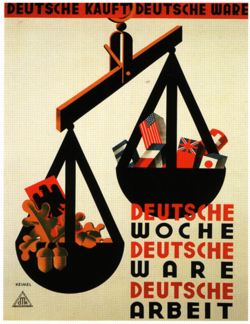
Adolf did not much care for global trade either
At its root, all forms of collectivism have more in common than its supporters might be comfortable admitting.
It appears the US is not the only nation fed up with the UN:
“The Australian government on Thursday branded multilateral forums such as the United Nations as “ineffective and unfocused” and said its future foreign policy would increasingly rely on “coalitions of the willing” like the one that waged war in Iraq.”
Strewth!
In commemoration of Orwell’s 100th birthday, Neuromancer author William Gibson had an op-ed piece in Wednesday’s New York Times, in which he discussed Orwell’s vision, and how it was influenced by its time. In particular, Gibson believes that Orwell’s vision was influenced by the broadcast nature of the media at the time: radio and the nascent invention of television were highly centralised.
The surveillance scheme (and the totalitarian states) envisioned in 1984 were centralised in the same way, from some giant central security apparatus. Gibson believes that today’s world, and the world of the future, is different. Greater surveillance will be mixed with much greater freedom of information. People with access to all this new information will consist of many non-state as well as state actors. We will live in a world with much less privacy, but not necessarily much less freedom.
Surveillance states without this fancy new technology were pretty effective, and still are pretty effective in places (from North Korea to Burma to Cuba) where old technological paradigms still apply. Would these states have been more oppressive if the people runing them had PCs? It’s hard to say. Would the presence of PCs in the security apparatus in East Germany rather than mountains of paper records have prevented the end of European communism? It’s doubtful. Changing surveillance technology is taking us somewhere new, it may be that the vision of Orwell provides a good guide as to what it is.
After quickly observing that Gibson sounds rather like Brian Micklethwait, I will observe that Gibson is at least partly right. The greater freedom of information that results from many to many communications networks changes things dramatically. We saw glimpses of this in the 1980s with the invention of the fax machine, which more or less removed the mass media’s ability to bury a story that the people were not supposed to know about. (The key story was something tawdry: a transcipt allegedly of the Prince of Wales talking to his mistress). This reached every office in London seemingly in minutes. The media and hence the courts could no longer supress things like that. With the invention of e-mail and SMS text messaging, such communications became more ubiquitous, and no longer tied to the home or office.
We are suddenly in a world where a great deal of information is being collected on us and transmitted to other places, and yet at the same time, we are collecting a lot of information on ourselves, and transmitting it voluntarily, and to some extent this controls the flow. Much of this information is and will continue to be cultural rather than political in content. Like Brian, I am fascinated by this phenomenon, which can also be for the good. Due largely to the use of SMS messaging, the Chinese government this year completely failed to keep information secret about the spread of the SARS virus in China. People throughout the country knew far more about what was going on than the government wanted them to know. The Chinese government now seems to know that it cannot keep things secret like this any more, and as today’s Economist discusses, the consequences could be profound. → Continue reading: William Gibson on Orwell and the surveillance state.
Another opinion piece by Stephen Robinson in the Telegraph, this time about John Wadham who resigned this week as director of the human rights group Liberty. He salutes him for his efforts at Liberty:
Mr Wadham argues that the threat posed by the state to individual liberty transcends political allegiance, so he worked hard to make Liberty less of a sectarian pressure group of the Left since his appointment as director eight years ago. He has been a good friend to the Telegraph’s Free Country campaign, dismissing the protests of some of his allies on the Left, who would prefer to exclude any conservative voice from the debate about the state and individual liberty. Thanks to him, the Telegraph has been welcomed at Liberty conferences to speak out on issues such as foxhunting and gun ownership.
This is a good sign. White Rose has been set in recognition of the need to address civil liberties across the widest political spectrum. As long as the common ground is the concern about the state and its impact on invidual liberty, we welcome those with different political opinions. We also add our voice to that of Stephen Robinson:
It would be much better if an independent or conservative figure could emerge and to make the point that individual liberty cannot be protected so long as it is popularly understood to be a concern only of the Left.
A dispiriting reading by Stephen Robinson in yesterday’s Telegraph:
To mark Orwell’s birthday, I rang around some of the people who have featured in The Daily Telegraph’s Free Country campaign since we launched it two years ago. It seemed a good moment to conduct a sort of “freedom audit” and gauge if those who seek to stem the tide of government encroachment on our liberties are managing to hold the line. It was a depressing experience.
[…]
At the beginning of last year, letters and e-mails began pouring in from unpaid parish councillors around England, enraged at being required to sign up to a new Whitehall Code of Conduct and declare all their business dealings. It is when considering the “best practices” aspects of New Labour’s “modernising agenda” that you pass through the looking glass into a world far weirder than anything Orwell could have imagined.
For the list of individual cases the Telegraph Free Country campaign has publicised or was involved in read the whole article.
Purely for the benefit of people who get excited about this kind of thing, a tantalising tidbit to whet your appetites:
The Conservatives have moved into the lead in the opinion polls, bringing to an end the record dominance that Labour has enjoyed for more than a decade.
So is NuLabour on the way out? Are the Tories on the way back? I don’t much care to be honest. For people like me the British Conservative Party promises more of the same, business as usual, social democracy by other means.
And so to bed.
Some further evidence for that buzz I thought I detected a while ago in favour of re-conquering Africa.
A consortium of mercenary groups has made the UN a deceptively simple proposal: give us $200 million, and we’ll help bring an end to the war in the Congo.
Tribal militias are running rampant in the eastern part of the central African nation, slaughtering hundreds of villagers at a time. Since 1998, the violence there has claimed 3.3 million lives.
The world’s response has been, to say the least, underwhelming. A few thousand UN peacekeeping troops have been stationed there since 2001. But these brave souls watched helplessly last month as the militias murdered 430 innocents in the provincial capital of Bunia.
The killings shamed the European Union into sending 1,400 French and British soldiers into the area. But they’ll operate only in Bunia — no matter how bloody things turn in the countryside. And on September 1, the troops are going home. End of story.
What happens then? The UN Security Council is trying to decide that now. …
Personally I would be amazed if anything as sensible and humane as this were actually to happen in the near future. → Continue reading: Regime Change inc.
The trouble with people who ‘come in from the cold’ is that they have unfortunate tendency to bring some of that coldness with them and, every so often, they just cannot help but drop a little of it into our lives.
Take, for example, Christopher Hitchens, a man who has been widely (and justifiably) praised for the excoration of his former leftist colleagues since the WTC attacks. But reports of defection from the dark side may well have been exaggerated if this infuriatingly superficial and condescending bit of Euro-fawning is anything to by:
The Turkish Cypriots did not mount mass demonstrations against partition because they had any romantic idea of the European dream.
They just didn’t want to be confined in a little sweat-shop state, forced to do business in the mainland Turkish lira, and kept away from a prosperity that they could see taking place on the other side of the wall.
See, the Turkish Cypriots want to embrace Europe so why are we Brits being so stubborn? Who is Mr.Hitchens trying to kid? The Northern (Turkish) sector of Cyprus has been the subject of official sanctions imposed by just about every European country since it was established in 1974. If the Cypriot Turks are, indeed,wallowing in a ‘little sweat-shop state’ then Europe is the cause of their misery not the cure.
For them, “protection” and “protectionism” became the
same thing – another name for stagnation and isolation.
‘Protectionism’ does indeed mean ‘stagnation’ but membership of the EU does not mean the abolition of protectionism. It simply means writing protectionism across a whole continent. It is exchanging the almost non-existant risk of ‘Fortress Britain’ for the racing, inescapable certainty of ‘Fortress Europe’. A bad idea does not get better by simply inflating it.
In order to join this club, you had to have a political
democracy and free movement of labour and capital
No, in order to join this club you have to submit to the will of the Commission and agree to trade according to their incomprehensible ziggurat of rules and regulations. → Continue reading: Smack my Hitch up
Australia has a federal form of government, and there is a division of power between the Federal Government and the various state governments. As in the US, security issues are dealt with federally, while day to day matters of law and order are dealt with at a state level.
The agency which the Australian government uses for internal security in Australia is the Australian Security Intelligence Organisation (ASIO).
In the wake of the Bali bombing, which deeply affected Australia, the government has been trying to broaden ASIO’s powers. However, they have not demonstrated how these new laws will actually make Australia safer, nor has there been any demonstrated inadequacies with the already ample powers that ASIO has.
The new law gives the government the right to hold someone for a week. This is not suspects we are talking about, it is dealing with people that might know something about terrorism. They ask you questions, you answer them, we all live happily ever after but they still have the power to detain you for a week.
Moreover, if there is new information that you reveal under questioning, the government have the power to apply for another warrant. There goes another week. And there is no limit to the number of warrants that the government can apply for. This can lead to indefinant confinement.
The provisions of the act are by no means hypothetical; the media is pointing out that journalists can be forced to reveal their sources. Either that, or face a five year jail term.
The key point is that this reform is not aimed solely at those who have committed a terrorism offence. The ASIO plan allows for people to be detained solely because they have information about a terrorism offence – a power even police officers do not have when questioning a suspected murderer.
The police are not given powers to detain people solely to gain information. As a society which respects human rights, this is seen as a power that is just too intrusive.
The issue is dealt with through criminal offences for concealing a major offence. There is no reason to think those laws will not apply to terrorism offences.
Moreover, the powers that the government now enjoy are pretty much unaccountable. The government say that there are sufficient accountability mechanisms in place already, but there’s actually no watchdog for ASIO.
The Australian government has acted very poorly throughout it’s long efforts to get this legislation passed. They haven’t demonstrated why there is such a pressing need for such an oppressive statute. The existing powers at their disposal remain quite adequate to deal with terrorism.
One can’t help but get the suspicion that this bill is a power-grab to take advantage of the troubled times that we live in.
Semi-cross posted from The Eye of the Beholder
|
Who Are We? The Samizdata people are a bunch of sinister and heavily armed globalist illuminati who seek to infect the entire world with the values of personal liberty and several property. Amongst our many crimes is a sense of humour and the intermittent use of British spelling.
We are also a varied group made up of social individualists, classical liberals, whigs, libertarians, extropians, futurists, ‘Porcupines’, Karl Popper fetishists, recovering neo-conservatives, crazed Ayn Rand worshipers, over-caffeinated Virginia Postrel devotees, witty Frédéric Bastiat wannabes, cypherpunks, minarchists, kritarchists and wild-eyed anarcho-capitalists from Britain, North America, Australia and Europe.
|





Recent Comments