We are developing the social individualist meta-context for the future. From the very serious to the extremely frivolous... lets see what is on the mind of the Samizdata people.
Samizdata, derived from Samizdat /n. - a system of clandestine publication of banned literature in the USSR [Russ.,= self-publishing house]
|
EU Observer has an article about the European Commission’s proposal to treat European citizens as criminals or at least as criminal suspects. No really.
Apparently, the heads of state for EU countries who met in Greece last week have given the ‘green light’ to the process of collection of biometric data such as fingerprints, iris scan or DNA for a chip inbedded in the passports of all EU citizens.
Thomas Rupp of the European Referendum Campaign is not impressed:
Somehow – obviously – I suffer from a clash of realities: Didn’t a lot of people last year talk about “democratisation” of the European Union and making it more “citizen friendly”? – Right: this event was called the “Convention on the Future of Europe”. Obviously the future of Europe now begins with the need of EU citizens to provide their most intimate data to the state.
[…]
Provided this law will pass and they ask me for my personal data… Shall I give my fingerprints – or even my DNA – to a growing state which does not fulfil the minimum standards of a modern democracy? Where there is no separation of powers? That has a parliament, which has no right to initiate law? Where – instead – non-elected public servants have the monopoly to initiate law, which in the end is decided by the executives of the member states – avoiding control by their national parliaments?
[…]
Suppose I refuse to give away my fingerprints? What would happen? Would I immediately be classified a criminal? Someone who has to hide something, with bad intentions? Would I have to go to jail? Would I have to leave the European Union?
Well, rhetorical questions aside, there are no surprises here from the European Commission.
Link via World Watch Daily.
I do not believe that I was entirely convinced by the argument of the noble Lord, Lord Wilson of Dinton, that the bureaucracy can be trusted to safeguard our liberty… I believe that, beyond anything else, the preservation of liberty is the business of Parliament and of others who are not concerned with government or, in other ways, with the powers in the land. They must ensure that this critical part of our being a free and worthwhile nation is preserved.
When we consider legislation which, in particular, poses a danger to liberty, we must not give the Government blanket permissions; we must justify each and every trespass. We must ensure that the Government do not only do things because they can but that, when they do things, they are effective. We must also ensure that the Government consider all possible ways of achieving the same end without the diminution of our liberty.
It is common that authorities do things because they can or that they choose to do the things that they can do rather than the things that are important.
– Lord Lucas in Security and Liberty debate in House of Lords, 26th March 2003
Link via FIPR
Usually when we feature pictures of posters in the London Underground the news is bad. But here is some good news, in the form of a poster advertising Steven Pinker‘s The Blank Slate.
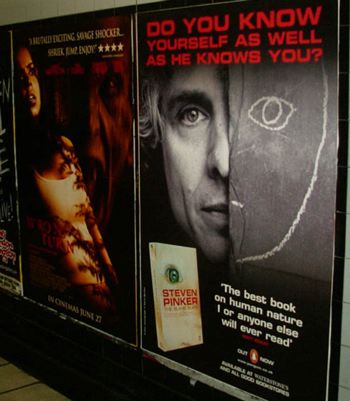
The book itself probably doesn’t need much plugging here, but I’ll plug it anyway. It’s about true and false (as in the “Blank Slate” of the title) views of human nature, and about how they affect politics, education, aesthetics, and so on. Summarising brutally, if you think that human nature is something that a political system can simply shape at will, you’ll tend to say that your preferred political system should shape away, sometimes with murderous consequences.
To me the encouraging thing about this book is that here is a mainstream publishing event, so to speak, which is full almost to the point of saturation with references to the literature of liberty, of classical liberalism and of anti-collectivism. If you were a regular reader of the publications of, say, the Libertarian Alliance, or of the Reason Foundation, or of the Cato Institute, you’d find references to any number of debates and discussions and personalities which would ring bells with you. Among the many names, for example, listed in the References section are: Friedrich Hayek, Thomas Sowell, Robert Nozick, Kenneth Minogue, Ferdinand Mount, Wendy McElroy and Tom Wolfe, to name just a very few such. I suspect that the Reason foundation may deserve particular kudos for helping Pinker’s thinking along these lines.
When I first spotted this poster, there must have been quite a few of them around, but when, digital camera in hand, I went looking for it again yesterday, I had nearly given up when I found one still on view. Presumably this campaign was timed to coincide with this competition, for which The Blank Slate was shortlisted. (Pinker has been shortlisted for this prize three times, but has yet to win it.)
Since this is Samizdata, let me also mention that the lady in the poster to the left of the Pinker poster as we look at it is Eliza Dushku, star of the movie Wrong Turn. “A brutally exciting, savage shocker. Shriek, jump, enjoy!”
Ah, human nature.
Recently, I wrote a piece on my own blog discussing the question of whether today’s electonics products would look as clunky in 20 years as those of 20 years ago look today. My thought was that they probably wouldn’t, due to the superior quality of the design of many of today’s products. This spurred a rather lively follow up discussion, which particularly focused on mobile phone design. As it happened, after this discussion I discovered that I had lots more to say on both this subject and the question of just what features are and are not important to mobile phone users, and how the devices are evolving. People who read on can discover what exactly is I have to say, and will also get a bonus explanation of the meaning of this photograph of Perry.
 → Continue reading: Trends in mobile phone technology. → Continue reading: Trends in mobile phone technology.
Dave Carr’s post reminds me of an idea I’ve had for ages.
I often consult for long periods in in Manhattan. It’s normal there to see people standing outside on the street for a cig break. It’s such a common sight you just stop noticing it.
It also takes up a lot of peoples time. Some co-workers in one company I consulted for (pre dotBomb) went out for a puff nearly every hour.
Perhaps NYC Libertarians should carry gummed stickers sized to fit the US cig package warning. Every time you see someone standing on the street, give them one.
Imagine thousands of New Yorkers standing on the street with packages saying: “If I’d voted Libertarian I wouldn’t be standing here”.
Use your imagination.
There is room for a similar tactic here in the UK. Our health Nazi’s are so overt it leaves them open to really easy ridicule. Why pull punches at all?
“Health Nazi’s make an ASH of themselves.”
“ASH doesn’t know shite”.
“I vote Libertarian: my diseased lungs are my own business”.
The mind just boggles.
I really must try to set aside some time to further develop an idea I have for a ‘Lefty Street Demo Reality Conversion Chart’. I have in mind a handy reference source can be used to translate ludicrously inflated attendance figures for lefty protests into actual numbers that the rest of us would recognise. For example, whenever you read of ‘hundreds of people’ at some lefty demo, simply look up the this figure on your handy conversion chart which will give the real figure of ’50’. Similarly, ‘thousands of people’ converts as ‘150’, ‘tens of thousands’ means ‘500’ and so on.
I better get a move on with this project in order to answer the urgent market need because the buggers have been at it again this weekend:
Thousands of campaigners across the UK are taking part in a marathon lobby of MPs and a series of protests this weekend to call for a shake-up of global trade rules.
The mass demonstration Scale Up for Justice is calling on the government to put pressure on the World Trade Organisation to rewrite its laws in favour of poor countries.
Any idea what they mean, precisely? Well, the organisation behind this latest round of muddle-headed, sandalista squawking is something called the Trade Justice Movement and, if their website is anything to go by, they appear to be long on rhetoric but remarkably short on details.
According to the TJM:
Together, we are campaigning for trade justice – not free trade – with the rules weighted to benefit poor people and the environment.
No mention of what constitutes ‘justice’ nor what ‘rules’ they have in mind. → Continue reading: Send in the clowns
Due to the high risk of an embarrassing misunderstanding here, I think it behoves me to start off by advising our American readers that, in Britain, the word ‘fags’ is a slang term for ‘cigarettes’. It is not generally perceived as having anything to do with homosexual men.
And this is important because cigarettes are no longer just ‘fags’ or even ‘smokes’. Now, they are symbols of defiance as well.
For the past two decades or so, tobacco manufacturers have been forced to print hectoring health warnings on cigarette packets. But now, due to a directive from Brussels (where else?) manufacturers are required cover at least half the space on both the front and rear of the packet with even more lurid warnings. It is the kind of useless, paternalistic gesture that enables the European political classes to posture self-righteously at someone else’s expense.
At last, though, someone is fighting back in the form of a website called ‘Fake Fags’ through which you can purchase waggishly irreverent stickers to cover up the politically-mandated health warnings on your cigarette pack.
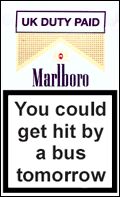
It is a delicious act of subversion and, predictably, it has sent the reactionary health fascists into a blue funk:
Deborah Arnott of anti-smoking group ASH criticised the labels.
“These labels do not strike me as being funny,” she told BBC News Online.
Well they strike me as hilarious and I am very heartened that at least some of my compatriots are not prepared to throw in the towel just yet.
There is no tradeoff between freedom and security. That is the contention put forward by Jonathan Wilde of Catallarchy.net in this essay about why a society that allowed the private ownership of nukes might be safer, yes safer, than ours. It was inspired by the comments to Perry’s Samizdata posting where he describes himself as a “social individualist.”

In Malta the use of ID cards is regulated by the Identity Card Act first enacted in 1976.
Typically, they were introduced as a way of addressing a very specific concern (in our case, it seems to have been the concern over the possibility of electoral fraud) and slowly, but surely, they gained a more widespread use as more and more Government departments introduced them in their transactions with the public.
Here’s an example I can distinctly remember. Fifteen years ago when I was doing my O-levels you were issued a temporary identification document by the Examinations Department. Your official ID card was given to you only later when you turned 16. Then in 1993 the Act was amended so that an official ID card would be issued to all those aged 14 or older as a way of including those students sitting for their ‘O’s. And today, teenagers who are too young to work legally or to sign contracts have to have an official ID card.
It was all done in the name of ‘convenience’ and could anyone possibly be against that? I have been socialised into this system and its convenience and I know that when I encounter officialdom I either pull out the ID card from my wallet or else chant my name and the six digits and a letter that make up my ID to the public official who asks for it. It has become an automatic reflex.
Recently a very minor and a not untypical incident served as a bit of an eye-opener. I was driving back home in the early hours of morning when I happened to encounter a police roadblock. I slowed down and the policeman signalled me to pull to the side of the road. This I did. He took a look at me and my car, noted nothing suspicious and politely asked me for my name and ID number which I gave in a typical knee-jerk reaction when asked this question by a public official. He took note and signalled me to move on.
It was while I was driving away that the question popped in my head: what was the purpose of asking drivers for their ID number at a roadblock when there was nothing that was suspect? And I could not answer that question. The policeman probably could not either. In my case giving name and ID on being asked to do so by a public official has become automatic. In the case of the police officer (and in the case of all public officials) asking the question has also become automatic.
The use of ID cards has become so generalised and they have become so deeply ingrained in our culture that nobody notices. They have become an ordinary part of our everyday lives. Now it is whoever queries these practices who is made to feel awkward, as if he were a paranoid nutcase. In 1976 when the law was introduced there were a few voices, however feeble, who protested; now there are none. And that is what is scariest. Living in an environment that requires official identification all the time is bad enough. Living in an environment that requires official identification and subtly pressuring you never to question such practices is much, much worse.
The Telegraph continues to paddle in the murky waters of our Gallic neighbours with a further editorial devoted to Sabine Herold and what appears to be a growing movement for free market reform in France:
The French long for a Margaret Thatcher to tame the over-mighty public sector trade unions, but despair of ever finding one. In the cafes of Reims, speaker after speaker deplored the weakness of President Jacques Chirac in the face of union opposition, with many echoing the withering Thatcherite critique launched against him by the 21-year-old student Sabine Herold in Paris.
What really caught my eye though, in the sidebar next to the article, is the link to Merde in France.
En avant et vers le haut, nos amis.
lib·er·ty n. pl. lib·er·ties
- a. The condition of being free from restriction or control.
b. The right and power to act, believe, or express oneself in a manner of one’s own choosing.
c. The condition of being physically and legally free from confinement, servitude, or forced labor. See Synonyms at freedom.
- Freedom from unjust or undue governmental control.
- A right or immunity to engage in certain actions without control or interference: the liberties protected by the Bill of Rights.
Like some undead zombie in B-grade horror movie, we have pumped the hideous thing full of lead from our rifles and shotguns… it falls riddled with logical holes and yet somehow the creature staggers to its feet again with bits falling off, lurching forward once more.
Gauche is clinging remorselessly to the term ‘Libertarian Socialism’
But I’m still an enthusiast for egalitarian self-managed market socialism; and I still want the state to leave us all alone as much as possible. My big difference with libertarians of the right is that my ideal minimal state concentrates not on maintenance of property rights and defence of the realm but on redistribution of incomes and wealth to provide basic needs to everyone as of right (citizen’s income and free healthcare, education and housing) so we can all get on with whatever we want. And OK, I know that’s utopian. But so what?
Well on one point I am in complete agreement with Gauche… his view is utopian. In fact, the notion that a state which redistributes wealth by force and provides ‘education’ to its citizens can be a minimal state is more than just utopian, it is fantastical. Wage control? Nationalised healthcare? Nationalised education? Nationalised housing? And how, exactly, would this be different to the non-libertarian modern socialist (i.e. social democratic) states found all over the western world?
The answer is it is exactly the same thing. The only liberty in Gauche’s libertarianism is the liberty to take the money of others by force without prior consent and to run the economy on political, rather than social, interaction.
Sure, there is a long history of people calling themselves libertarians. But so what? Liberty means not having one’s life under the force backed direction of others… socialism means using force backed politics to direct people’s life in accordance with socialist political ends. The two are antithetical.

Arrrggg… I’m a…libertarian…too!
I read of Strom Thurmond’s demise at the ripe old age of a century and it sent me digging madly through an old trunk for this most memorable magazine photo of his 1970 visit to my alma mater:
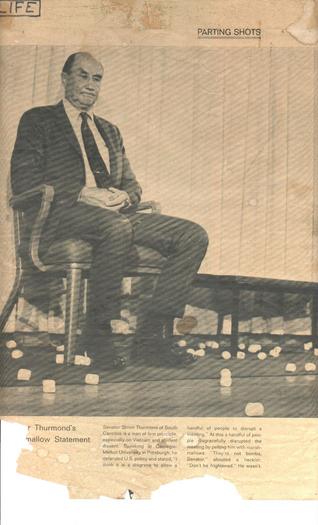
This was at the hieght of the Viet-nam anti-war movement at CMU and Pitt and students of those universities formed a coalition of the willing to pepper the good Senator with Marshmallows.
My guerilla theatre troop later used the deadly Cluster Marshmallow against the Pittsburgh Federal Building with equally devastating results. One of the troop told me a checkout clerk at the grocery store asked him, “What Senator is in town this week?”, when he purchased the case of them for our “event”.
Oh the Horror! The Horror… and the memories. God it was fun!
|
Who Are We? The Samizdata people are a bunch of sinister and heavily armed globalist illuminati who seek to infect the entire world with the values of personal liberty and several property. Amongst our many crimes is a sense of humour and the intermittent use of British spelling.
We are also a varied group made up of social individualists, classical liberals, whigs, libertarians, extropians, futurists, ‘Porcupines’, Karl Popper fetishists, recovering neo-conservatives, crazed Ayn Rand worshipers, over-caffeinated Virginia Postrel devotees, witty Frédéric Bastiat wannabes, cypherpunks, minarchists, kritarchists and wild-eyed anarcho-capitalists from Britain, North America, Australia and Europe.
|





Recent Comments