We are developing the social individualist meta-context for the future. From the very serious to the extremely frivolous... lets see what is on the mind of the Samizdata people.
Samizdata, derived from Samizdat /n. - a system of clandestine publication of banned literature in the USSR [Russ.,= self-publishing house]
|
Another ‘truth’ constantly parroted at us is bin Laden would never work with Saddam. As with the bin Laden was trained by the CIA meme, it can be difficult to remember or find the refuting evidence when you need it. Fortunately, someone has done it for us.
It is a good summary, but Richard Miniter (author of Losing bin Laden) left out at least one item.
The Adam Smith Institute Weblog seems to have hit the ground running, and Jonny Fraser’s piece about harassment in the USA by cops and bureaucrats and stupid laws is provoking a fine old comment fest. Quote:
On entering the country, with no matter what passport, you are treated like a criminal or socio-economic migrant. Several forms need to be filled in, many of their requirements duplicated, unnecessary and arbitrary. This practice does not stop at international boundaries. There are occasional police checks on interstate roads, and even occasionally at state borders. Post 9/11 fear is all encompassing.
Rights are being eroded and regulations piled on like cheese and freedom fries at a burger joint. It seems that obesity and laughable laws have a bizarre relationship. In America, you can die for your country at 18, but you cannot buy a beer until you are 21. In America you can kill on the roads with reckless driving at 15 in some states, but experienced drivers usually have to stay below 55 miles per hour or risk a ludicrously overpriced speeding ticket.
California is the worst state for this sort of thing. Their claim to liberalism extends as far as a blanket ban on smoking in public places, …
I particularly liked Kevin Carson’s comment, responding to American critics of American critics. Final paragraph:
Well guess what? I DO have a bad attitude. It’s because of people with “bad attitudes” that we’re not still working on chain gangs to build a pyramid, or eating our lunches standing up during a sixteen hour shift on an assembly line. For every liberty that sets us above the level of a slave, you can thank somebody with a bad attitude. Rights are not granted by government; they are forced on it from below.
It is good that the ASI blog is not confining itself to municipal bus privatisation and such like. Not that there’s anything wrong with that.
‘Our man in Basra’ is back in the UK, with some first hand stories and a different perspective on what is going on both in Iraq and in the media. His first post (out of three planned so far) is about his view of the media and why they report the events in Iraq the way they do.
Most people have an implicit, nebulous, and generally unthought through understanding of the media and what their job is. It has to do something with getting the facts and reporting the truth or at least the reality to the best of their abilities. The media is a sort of civilian intelligence agency. This is how the military, in particular, view them and when the media are not reporting the facts, they are seen as failing in their job.
The media do not see their job in this light at all. Their job is to find and sell stories. Of course, these should not be completely divorced from the facts, but facts are merely the raw materials of the stories. More importantly, the media do not feel obliged to report all the facts, especially in a place like Iraq, where there is either very intense competition among reporters and therefore not much time to investigate the story in detail. Alternatively, the interest is fading a bit, so it is not worth investing the time. Either way, the result is the same.
What has become obvious to me while in Basra and helped me understand the media better is that they have now decided what their story is in Iraq. They have signed up this story as their product before they even arrive. They are not there to research ‘the facts’ – they are merely looking to illustrate their story. → Continue reading: The media story
Please, prepare yourselves for a shock. Sit down on a comfortable chair and secure that goldfish. For I’m about to rock your world. Yes, friends, some EU corruption has been discovered within the gilded halls of Strasbourg.
I know, it beggers belief, but there it is. Millions of €uros have apparently been diverted into slush funds to pay for holidays, freebies, and extravagant dinners. So, who are the thieves? This money was allegedly stolen by the EU’s own number crunchers. Whisper it quietly to your friends, but apparently they left no audit trail, too! Quelle horreur! And some of the money stolen was used to form a volleyball team! Crikey.
I was sitting on the train, this morning, minding my own business, and this story hove into view. It was such a non-event, such a non-story, that at first it completely passed me by. For I was under the mistaken impression that the entire EU budget already was a giant slush fund, for useless bureaucrats such as Neil Kinnock to dip their greedy snouts into. But I was wrong. Apparently, it is just the EU number crunchers who are corrupt! Thank goodness for that. I’ve been labouring under a misapprehension, all this time.
Fortunately, EU officials have said a full judicial inquiry will establish whether senior number crunching staff have indeed stolen EU funds. No doubt the results from this inquiry will be swift, and the punishments severe. Let’s hope they make some of these naughty number crunchers fly business class, for a change, rather than first class. For at least a whole week. They deserve nothing less.
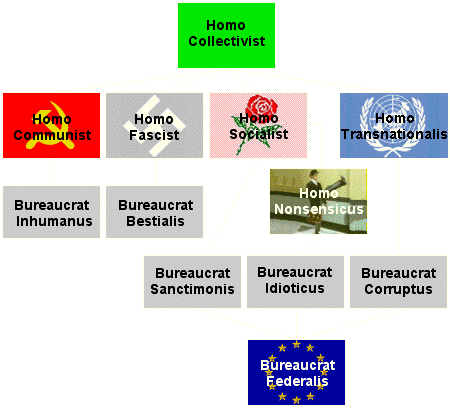
Samizdata.net often makes references to the importance of the ‘meta-context’ in explaining and determining events around us. A question to consider: What would happen if the mainstream media were somehow forced to refer to Saddam’s old regime by its own official title, which is The Arab National Socialist Party or Arab NAZI Party? What a thought…
There seems to be a lot more information floating about now than there was last week. The first Chinese orbital flight might come as soon as October 1st, but probably not until mid month.
You may remember I suggested the Chinese will aim for the moon within a few decades. I’m not a lone voice: here is what Space.com has to say:
Although tight-lipped on a range of technical details, Chinese space officials have hinted at a multi-pronged human spaceflight program, including space station construction, as well as eventual travel to the Moon, all by 2020.
I’ve some friends that hope to be able to offer them a hotel room with a nice Mare view by that time.
Patrick Crozier has a modest plan for the rejuvenation of London…
With the mayoral election less than a year away I feel it time that I declared my hand. OK, so this is not entirely serious. Any candidacy would need funds, an organisation, assembly candidates and all those involved would have to realise that it wouldn’t have a prayer and that the only purpose of the exercise would be to secure publicity. But if we did have all those things this would be my manifesto. That’s the great thing about manifestos: they’re cheap.
Some Observations and Some Basic Principles
London is a great city – after all, it’s home to most of Samizdata’s writers. Millions of people would seem to agree with them coming here from all over the world to find a better life for themselves. But London seems to be getting worse when it could be getting a lot better. In particular it suffers from three major problems: crime, transport and property prices. My aim, if elected, would be to: reduce crime by 90%, reduce property prices by 50% and to make getting around the city a simple and predictable (if not necessarily cheap) business.
I believe that civilisation is at its best when people are free. It is freedom which promotes prosperity, innovation and responsibility. And yet for 100 years we have been chipping away at freedom, progressively heaping taxation and regulation upon a once free people with results that are all too plain to see. If London is to be better then first it must be free.
Housing
Property is too expensive. With a three-bedroom house costing six or seven times the average wage, millions are postponing and even abandoning the idea of having children. This is hardly a sustainable state of affairs. Prices are high because demand is high and supply is low. The answer is to increase the supply.
If elected I would abolish all planning laws and all building regulations. Immediately, people would start to build. Up mainly. And why not? We shouldn’t be scared of living in flats. Many people around the world enjoy good quality high-rise living where raising a family is as easy and as pleasant as living in a semi-detached. All that we have to do is to allow it to happen. I believe that by scrapping the regulations we will see the development of all sorts of new ideas in architecture as well as a massive increase in capacity. We might well see the development of self-build (people designing their own houses) as is seen in places like France and Spain.
Would we lose all our nice old buildings? Some, for sure, but do we really need all of them, especially as there is a chance we might get some nice, new ones in exchange? → Continue reading: Crozier for Mayor
With David Willetts blowing yet another unsolicited Kiss of Death into the rapidly fading twilight of the UK Conservative Party, it was interesting to hear Polly Toynbee say Willetts had been using the thoughts of our old friend, John Maynard Keynes, to push forward the increasing statism of his latest ideas, such as using coerced taxpayers’ money to subsidise working mothers.
No wonder Ms Toynbee has been so taken with Mr “Two Brains” Willetts’ recently published pamphlet. What it contains used to be called social engineering, of the most crude kind, but now it has been re-labelled as compassionate conservatism, and even arch-socialist Ms Toynbee has declared her guarded support. I therefore thought we’d better examine the roots of Mr Willett’s new philosophy, and get an Austrian view on the Keynesianism underlying it.
And what better place could we start than Mises.org? → Continue reading: Keynes, the Man
John Fund of the Wall Street Journal Online has an excellent look at the seamy, sleazy side of the California recall election, and specifically the role of Indian gambling money. If you want an accounting of how politics really gets played in the US, this is a pretty good vignette. Discliamer: John is a pretty loyal Republican, for the most part, but I have met him and I can assure you he is savvy and knows his politics.
There are all kinds of lessons in this article. I will leave you with a few to chew on:
Note the brazen contempt for campaign finance law by the Bustamente campaign. Where politicians can’t get the money they need through various kinds of gray-market loophole-oriented money-laundering operations designed to evade these laws, they just violate them outright because they know that no enforcement will occur until after the election.
Note the heavily cynical and strategic use of political money to build up politicians that the contributors actually want to lose the race, because these dark horses will strip votes from a real rival to the preferred candidate.
Money and power will always find each other. The only solution to the kinds of influence peddling activities on display in California is to strip power from the state.
Arnold has finally come out of the closet. In a Wall Street Journal article he states:
I have often said that the two people who have most profoundly impacted my thinking on economics are Milton Friedman and Adam Smith. At Christmas I sometimes annoy some of my more liberal Hollywood friends by sending them a gift of Mr. Friedman’s classic economic primer, “Free to Choose.” What I learned from Messrs. Friedman and Smith is a lesson that every political leader should never forget: that when the heavy fist of government becomes too overbearing and intrusive, it stifles the unlimited wealth creation process of a free people operating under a free enterprise system.
He then lays out the key elements of his program:
My plan to rescue the economy in California is based on the opposite set of values: I want to slash the cost of doing business in California; I want to unburden businesses from regulations that strangle economic growth; I want to bring taxes down to levels competitive with our neighboring states. Within three years, I want business groups to trumpet the fact that California is once again one of the best places in the country to do business.
He then closes with a statement which is difficult to argue with:
Our state will prosper again when we commit ourselves in California to “Free to Choose” economics. This means removing, one by one, the innumerable impediments to growth–excessive taxes, regulations, and deficit-spending. If we do this we will bring California back as the untarnished Golden State.
Long before the California election I read Mr Schwarzenegger had at least slight libertarian leanings. Given this statement I feel safe declaring he is a fellow traveller at the very least.
The article can be found here. It is well worth reading despite the hassles of getting to it. This is perhaps the first Opinion Journal article I have linked to since they started crashing my browser when I attempt to print to file. In general, I do not refer people to something if I am unable to file a copy for future reference in the all too common case where the link becomes unreachable.
Over at the White Rose, some of us have been lately discussing the consequences of future ubiquitous computing, and whether it spells the end for privacy.
However, ubiquitous computing does of course also have its upsides. Researchers at Trinity College Dublin have invented a smart couch. This couch is capable of recognising any of the people who regularly sit on it (by weight) and greeting people individually. Future versions of the couch will be able to control the room temperature in accordance with the preferences of the individual, turn the lights off automatically, automatically switch the television to show favourite programs, and order your preferred variety of take out food.
At least, I think it has its upsides.
(Link via slashdot).
The Conservative Party has been blessed with a ringing endorsement from none other than Polly Toynbee:
A remarkable document has emerged from the Conservative frontbench. Search it from cover to cover and few would guess its provenance. Its deceptively dull title hides a radical departure: Old Europe? Demographic change and pension reform, by David Willetts, the shadow secretary for work and pensions, transforms Conservative family policy.
Not even his economics smells of Conservatism. The pensions problem does not, Willetts declares, need more saving by today’s workers. “Europe needs more consumption, more spending and more borrowing. Keynes warned in the 30s that ageing societies with high levels of savings and not many investment opportunities face a deflationary nightmare.”
So, is this just a devlishly cunning bit of cognitive jiu-jitsu to throw their opponents? I don’t believe they are anywhere near clever enough for that.
I think the end is nigh.
|
Who Are We? The Samizdata people are a bunch of sinister and heavily armed globalist illuminati who seek to infect the entire world with the values of personal liberty and several property. Amongst our many crimes is a sense of humour and the intermittent use of British spelling.
We are also a varied group made up of social individualists, classical liberals, whigs, libertarians, extropians, futurists, ‘Porcupines’, Karl Popper fetishists, recovering neo-conservatives, crazed Ayn Rand worshipers, over-caffeinated Virginia Postrel devotees, witty Frédéric Bastiat wannabes, cypherpunks, minarchists, kritarchists and wild-eyed anarcho-capitalists from Britain, North America, Australia and Europe.
|





Recent Comments