We are developing the social individualist meta-context for the future. From the very serious to the extremely frivolous... lets see what is on the mind of the Samizdata people.
Samizdata, derived from Samizdat /n. - a system of clandestine publication of banned literature in the USSR [Russ.,= self-publishing house]
|
Our Man in Basra (now back in the UK) has some thoughts on the difference between how the media reported Gulf War 1991 and how they reported Gulf War 2003 and why that matters.
During the Gulf War of 1991, media reporting went something like this: About a month of showing pictures, entirely controlled by the US military, of Allied airplanes flying over Iraq, followed by the announcement by General Schwarzkopf that the war was over and we had won.
Although they had their suspicions, none of the journalists, all kept behind the lines in Riyadh, knew that Allied troops had crossed the border into Iraq until three days after the ground offensive had started, the Republican Guard in Kuwait had been virtually destroyed, and Schwarzkopf announced victory. This severely limited the opportunity for the media to criticise the conduct of the ground war.
The above is a simplification, but it covers in essence the way the media war was fought in 1991 – by the journalists out there, by the military out there, and as it was seen by everyone else on their TVs. Naturally, the military regarded this as a great success. Equally naturally, the media regarded it as a disaster. The viewing public generally seemed satisfied, bar a few dedicated peaceniks, who wanted pictures of military screw-ups.
Two factors therefore set the context for the reporting of Gulf War 2003. First, the media were determined not to allow the military to keep them away from ‘the story’, the way they were kept away in 1991. → Continue reading: The media in the Gulf
On BBC 2 last night there was a programme in the series ‘Seven Wonders of the Industrial World’.
This particular episode was on the building of the Transcontinental Railroad in the United States.
As one would expect the show did not present the companies involved (the Central Pacific and the Union Pacific) in a very positive light. And the BBC have a point – the companies were subsidy grubbing, brutal and corrupt.
However, it was also clear from the programme that the the Central Pacific was less brutal, less corrupt and more effective than the Union Pacific.
Some things the programme did not mention (for example the Central Pacific’s policy of ‘buying off’ Indians – rather than just getting the army to kill them). But it did show that although the Central Pacific Railroad were ruthless they were not the killers (of Indians and Whites) that the Union Pacific were. The programme also showed that the owners of the Central Pacific actually cared about their company (rather than just considering an object to be looted as Durant of the Union Pacific did).
Furthermore it was clear that the Central Pacific overcame vast physical obstructions to the building of a railroad and that its people (White and Chinese) showed creative thought and vast physical effort in overcoming these obstructions.
In the end the Central Pacific won the race to get to the rendezvous point decreed by Congress – and had to wait for two days for the Union Pacific to turn up.
Fantasy presents conflicts as being between good guys and bad guys. However, in real life conflicts are more often between bad guys and worse guys (although later in American railroad history J.J. Hill does appear to have been a genuine good guy).
It was good for the soul of America that the bad guys (rather than the worse guys) won the race.
The Liberal Democratic party has voted, in its annual conference, to continue with its long standing policy of introducing a local income tax in Britain as a source of money for local councils.
The media has treated this as some sort of new thing (which shows how much they know about policy matters), but I am more interested in the classic missing-the-point the whole idea shows.
The point is not whether a local income tax is a better or worse thing than the present ‘Council Tax’ (although an obvious problem is that in some areas most voters are below the income threshold for income tax – so under a local income tax councils might become even more out of control than they are now), the point is council spending.
I am old enough to remember the hatred the old system of ‘rates” (property tax) generated, especially after the ‘revaluation’ of properties in Scotland.
For all the talk of details of local government finance, what most people really objected to was the level of the rates – and the increase in this tax burden was generated by the increase in local government spending.
The Conservative government of the day got rid of the rates and introduced the ‘Community Charge’ (the so called Poll Tax). However, opposition to the tax burden continued and indeed got worse. Again for all the talk about the structure of the tax (“it is wrong for the poor to pay as much as the rich” – although the poor did not pay as much as the rich), what most people really objected to was the level of the new tax.
I rather doubt that many people would have rioted if, say, the level of the tax had been ten pounds per person.
Local government spending went up, but people blamed the tax burden on the new tax (rather than on the increase in council spending).
Today people say (quite correctly) that the Council Tax is a terrible burden. However, (absurdly) many people are still missing the point that the tax is a terrible burden because of local government spending and introducing a new tax will not help reduce this spending.
In Britain most people talk about this or that form of local government taxation and they also talk about whether or not central government grants to local councils are fair (the Conservative party is convinced that the Labour government favours Labour councils at the expense of Conservative ones).
But, as far as I can make out, nobody talks about the level of local government spending – and it is the spending that is the root of the problem.
ATTN: THE SAMIZDATA TEAM
FROM: THE HONOURABLE PRESIDENT
OF THE EUROPEAN COMMISSION, ROMANO PRODI
Dear Sir/Madam,
Good day Sirs. I hope my letter does not cause you too much embarrassment as I write to you in good faith and the transaction is of mutual benefit. Based on the contact address given to me by a friend who works at the Nigerian chamber of commerce attached to your embassy in my country.
Please excuse my intrusion into your private life. I am Romano Prodi, the appointed President of the European Commission and my friends and I are in danger of losing a lot of money due to vindictive investigators and their friends in the media who are bent on ruining us financially. Consequently, my friends in the Commission have asked me to seek for a foreign partner who can work with us to move out the total sum of €75,000,000.00 ( seventy five million Euros), presently in their possession.
This money was of course, acquired by my friends through hard work and enterprise. The Swiss government has already frozen all our accounts in Switzerland, and some other countries would soon follow to do the same.
This bid by some political rivals to deal with this my friends and I has made it necessary that we seek your assistance in receiving this money and in investing it on behalf of our behalf. This must be a joint venture transaction and we must all work together. Since this money is still in cash, extra security measures have been taken to protect it from theft or seizure, pending when agreement is reached on when to move it into a secure and anonymous territory pending on our agreement.
I have personally worked out all modalities for the peaceful conclusion of this transaction. The transaction definitely would be handled in phases and the first phase will involve the moving of €25,000,000.00 (twenty five million Euros).
My friends are willing to give you a reasonable percentage of this money as soon as the transaction is concluded. It will, however, be based on the grounds that you are willing to work with us and also all contentious issues being discussed before the commencement of this transaction. You may also discuss your percentage before we start to work. As soon as I hear from you, I will give you all necessary details as to how we intend to carry out the whole transaction. Please, do not entertain any fears, as all necessary modalities are in place, and I assure you of all success and safety in this transaction.
Please, this transaction requires absolute confidentiality and you would be expected to treat it as such until the funds are moved out of Europe to where you intend to receive them.
In compliance with this you are to forward to me the following details: your complete names and addresses, confidential telephone and fax numbers, bank account details and all relevant account numbers. This is to enable me perfect all the necessary documentation with the security firm and move this money across to your country of choice.
Please, you will also ignore this letter and respect our trust in you by not exposing this transaction, even if you are not interested.
I look forwards to working with you. Thank you.
Truly Yours
Romano Prodi.
In these times of EU corruption, Blair government corruption, and generally just Prodeus Romanus, the ancient latin God of Corruption, having a whale of a time all over the place, I thought today I might have a day off from being Disgusted, of Henley-on-Thames. After all, it is Friday. That, and I’m on holiday next week, though only, I may hasten to add, stripping off bathroom wallpaper, organising children’s birthday parties, and wandering down to Henley library to re-invigorate my audio book collection. (Hey, I’ve paid the poll tax. I may as well get my money’s worth!) And just to lighten my mood even further, and to set the stall out on what is going to be a great weekend ahead, I saw this headline this morning in the Daily Torygraph:
Doctor Who ready to come out of the Tardis for Saturday TV series
Fantastic news! After having spent one of the most memorable moments of my childhood cowering in total abject fear literally half-behind the sofa at the sight of that Sea Devil, as it strode out from the surf, it’s about time too.
Doctor Who will be back in 2005, and I for one can’t wait. Let’s just hope the new scriptwriters can find room for Tom Baker to play some senior Time Lord, or other, maybe even a portly grey-haired version of The Master? Though I must warn these scriptwriters, in advance: if the first series isn’t about the Daleks, or the Cybermen, or some kind of evil giant arachnid, then there’ll be trouble. And not the kind of trouble you have when the plumbing goes wrong, but serious Davros-style trouble. Indeed, the fate of the Universe may hang on it.
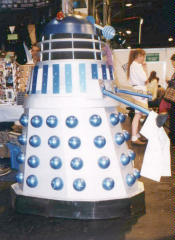
Photo: D. Amon, all rights reserved
Like much of the rest of the blogosphere, many of the Samizdatistas have been waiting for months, weeks, even years for Neal Stephenson to finish writing Quicksilver, his prequel of sorts to Cryptonomicon. We were promised a romp through scientific and other society of the early 18th century, meeting Newton, Leibnitz, Benjamin Franklin, and other luminaries of the time, in a doorstop length tome full of other characters curiously connected to the 20th century characters of the earlier novel. And we waited, waited, and waited some more, as the publication date kept getting put back. It was getting almost as bad as waiting for Godot Vernor Vinge.
But now, hallelujah. The book is here. Eugene and Glenn are happy. We can all get down to some serious reading, and perhaps find out what is in Enoch Root’s cigar case. (I think it is actually fairly obvious, although perhaps it is less so to readers of the American editions of the Harry Potter books).
And that’s the problem. <expletive> American editions. The American edition of Quicksilver has been out since Tuesday. The British edition is not out until October 2. We have to wait another whole week.
Well, if we are desperate, actually we don’t. The Murder One specialist bookshop in Charing Cross Road had a few copies of the American edition for £20 when I was there this afternoon. However, they were going fast. And to tell the truth I don’t have time to read the book now, and the 27 hour plane trip to Australia I will be subjecting myself to in just over a month will likely be a perfect opportunity (plus, somehow, sitting on a 747-400 at 38000 feet while flying in and out of Tokyo seems a somehow approriate place for reading a Stephenson novel. Not quite as good as sitting reading Snow Crash for the first time in 1994 in an emergency hut on a mountain in Hokkaido while waiting out a tremendous rainstorm with lots of Japanese people with much higher tech looking trekking gear than I did but who were somehow just as wet, but still good).
For now I need to be doing other minor things like finding a job. (If anyone feels the need to employ a telecommunications/technology or possibly even media analyst who is also capable of doing just about any quantitative financial job if need be, plus many quantitative jobs in other fields, please let me know. I am presently in London but would be also interesting in working in the US if anyone was willing to sponsor a visa for me).
In any event, I can also save a few pounds by waiting for the British edition: Amazon is selling that for £11.89, which means, as a true overcaffeinated Virginia Postrel devotee, I can have The Substance of Style as well. Or, I could wait and buy a copy at Neal Stephenson’s signing at Forbidden Planet on October 21. (On the other hand, maybe not. I have met Stephenson on previous book tours, and in person he is exactly the classic introvert he says he is. Which means he is great to listen to at a reading, lecture, or Q&A session, but he is rather withdrawn if you try to talk to him one on one. But this is okay. He writes wonderful pooks. However, the signing in London is just a signing).
Or I could just go back to Murder One, buy the book, and then sit down and enjoy Stephenson’s wonderfully unique take on the Baroque period, and his lengthy and fascinating digressions, and his absurdly complicated puns, and his exquisitely nerdy in jokes.
I…….Must……Resist…….
It is a beautiful day here in London, the sun is shining, I am looking forward to a nice relaxing weekend in the countryside. So this story comes along to make me lose a bit more sleep at night.
Whatever you think about George W. Bush’s pre-emption doctrine – and I confess to being a bit more doubtful than some more hawkish folk – this is worrying. Iran may still be some way off from developing nuclear weapons, but it appears the threat is getting closer. Stay tuned.
The BBC reports on the latest application of RFID technology: London Undergound’s new “Oyster” cards.
These are smart cards that will replace existing season tickets. The advantage is that they don’t even have to be swiped through a gate and will hopefully speed passenger flow through the stations.
The disadvantage is that they will be personalised to you and will – surprise, surprise – record full details of every journey you make on a central database. This information will be retained for “a number of years”.
Even more worrying, there have been suggestions that the people responsible for these cards are keen to extend them to “other applications”.
An anonymous card will be available, but will cost more. An estimated £200 pa for an average commuter.
So the question for London commuters is: Are you willing to sell your privacy for 200 quid?
Cross-posted from The Chestnut Tree Cafe
It sticks in the craw to say it, but Hillary is the only one of the Democrats who sounds Presidential. The rest of them are dwarves with limited understanding of the requirements of the job for which they are auditioning.
She and her significant other have consistantly backed Bush on the WMD issue. By admitting they saw the same intelligence reports and by taking responsibility for policy initiatives they set in motion, they appear as statesmen. They have a solidness and class that is severely lacking amongst the Democratic candidates.
I rather look forward to a Condi v Hillary match in 2008. That is an election for which the cemeteries really would get out the vote.
In a recent article Steven den Beste discusses the fate of human shield Faith Fippinger. If I were to look at this in a narrow context I’d probably agree with him. However… there are parts of the argument expressed by den Beste and others which I find troubling.
I cannot imagine myself standing in a Saddamite factory to stop speeding american bullets, but I can indeed arrive at scenarios in which I would find civil disobedience of this sort or even greater personally justifiable. So let us play “invent a scenario”.
It’s now 2015 and a bunch of us libertarians have gotten so fed up with statists that we’ve built a floating island and anchored it to a Pacific seamount. Unlike an earlier group displaced by a Tonga gunboat, we’re well armed, well trained and ready to defend our new country.
Everything goes well for a few years. We expand the island with landfill and more platforms, the population grows and our little libertopia waxes wealthy and happy as we always imagined it would.
We won’t join the UN or become signatories to any of its treaties. After all, how can we? We don’t have a government. Any individuals on our island may sign if they wish, but by doing so they bind no one else. They can not even bind their own children once they leave home… and in some families not even before…
Some are making a good living with little floating pot-patches. Free market banks are popping up all over the island with rules on privacy which would have made a 1930’s Swiss Bank president smile. We do not recognize tax collection attempts by other countries. Sure, a bank may cave in if it wishes, but there are other banks and the market will decide. The new cloning business is bringing in money hand over fist. A bunch of the top nanotech people have moved in and are pushing things ahead quickly. Several commercial space launch companies got fed up with the spaceship size stacks of regulatory paperwork and left America. They now consider themselves citizens of the island… or whatever you call yourself in a place without a government.
However… there is a fly in the ointment. All of the above are extremely threatening to the existing world order. Our very pacific existence undermines the rest of the world. One day after some dastardly world event it is decided by the President and her men that we are an easy target. Our banks won’t give them details on fortunes hidden from tax collectors and we’re getting all too technologically successful.
Now as either a resident of that island or a resident in the US, I know exactly which side I am on. The issues are crystal clear to me. I do not support or give allegience to a flag; I give it to particular principles and the people who at any given time best embody those principles. For most of the last two centuries and certainly for all of my lifespan, that has been the USA.
But what if some place comes along that is freer and is considered a threat to the USA because of it?
I would suddenly find myself an Enemy of the State.
‘Petrol Price Rise Announced’ blares the BBC Headline:
Fuel duty will rise by 1.28p a litre from 1 October, the Treasury has confirmed.
The increase, which will add five pence a gallon to petrol and diesel prices, is in line with inflation, it said.
So it isn’t a ‘price rise’ at all. It’s a tax increase
I think the public has a right to be told in less ambivalent terms.
Ministers are preparing legislation for the next session of parliament to make local authorities create files on every child in England, including intimate personal information about parents’ relationships with other partners and any criminal record, alcohol or drug abuse in the extended family. The files will be available to teachers, social workers, NHS staff and other professionals dealing with children to help them piece together symptoms of neglect or abuse that might require intervention by the authorities.
The green paper produced as a response to the murder of Victoria Climbié, an eight-year-old who died in London in 2000 after months of torture and neglect, said the need to protect children had to be balanced against preserving the privacy of parents. But Charles Clarke, the education secretary, said yesterday that the interests of children “absolutely” took precedence over the civil liberties of adults.
Mark Littlewood, the campaigns director of Liberty, said Mr Clarke’s remarks were even more disturbing than the green paper.
We have to make sure social workers are sharper, smarter and better focused. That’s done by better training, not by casting the net so wide that every child in the country will be in it. That creates the danger that investigations will be triggered by supposition, guesswork, gossip and rumour. Our concern is that there will be witchhunts rather than protection of the relatively small number of children in real danger.
|
Who Are We? The Samizdata people are a bunch of sinister and heavily armed globalist illuminati who seek to infect the entire world with the values of personal liberty and several property. Amongst our many crimes is a sense of humour and the intermittent use of British spelling.
We are also a varied group made up of social individualists, classical liberals, whigs, libertarians, extropians, futurists, ‘Porcupines’, Karl Popper fetishists, recovering neo-conservatives, crazed Ayn Rand worshipers, over-caffeinated Virginia Postrel devotees, witty Frédéric Bastiat wannabes, cypherpunks, minarchists, kritarchists and wild-eyed anarcho-capitalists from Britain, North America, Australia and Europe.
|





Recent Comments