We are developing the social individualist meta-context for the future. From the very serious to the extremely frivolous... lets see what is on the mind of the Samizdata people.
Samizdata, derived from Samizdat /n. - a system of clandestine publication of banned literature in the USSR [Russ.,= self-publishing house]
|
There is nothing a power-freak likes better than replacing a muddle with a slab.
Natalie Solent
Here’s a White Rose Relevant speech in the House of Representatives, from April 16th of this year, by Representative Ron Paul of Texas. Apologies if it’s already been flagged up here, but I don’t believe it has. Paul is not the kind of man who gets to decide the law, but his opinions still count for something.
First two paragraphs:
Mr. Speaker, I rise to introduce the Patient Privacy Act. This bill repeals the misnamed Medical Privacy regulation, which went into effect on April 14 and actually destroys individual medical privacy. The Patient Privacy Act also repeals those sections of the Health Insurance Portability and Accountability Act of 1996 authorizing the establishment of a “standard unique health care identifier” for all Americans, as well as prohibiting the use of federal funds to develop or implement a database containing personal health information. Both of these threats to medical freedom grew out of the Clinton-era craze to nationalize health care as much as politically possible.
Establishment of a uniform medical identifier would allow federal bureaucrats to track every citizen’s medical history from cradle to grave. Furthermore, as explained in more detail below, it is possible that every medical professional, hospital, and Health Maintenance Organization (HMO) in the country would be able to access an individual citizen’s records simply by entering an identifier into a health care database.
Cards on the table. The bosses of this blog are out of town, and although they may be able to stick stuff up here from time to time, they may be distracted. I’m one of the people they hope will keep things buzzing in their absence. So I googled a few obvious things like “surveillance” and “privacy” and got little that was new, and then I tried “Freedom versus Security”, and got to this piece at Mr Blog, from way back in August.
Mr Blog has this to say on the matter:
Defining the debate as “freedom versus security” circumvents the question of whether the various proposals, in fact, improve security. Where is the evidence for this assumption that any of these measures can help ensure security?
He then attacks various supposed US security measures on cost effectiveness grounds. This critique is good as far as it goes. Indeed we do not want to hand on to our grandchildren a society bankrupted by a million futile security measures which weren’t. That’s true.
But I think Mr Blog is making a fundamental error of omission here. The really big consequence of framing things as “freedom versus security” is to smuggle past you the notion that “freedom” can never ever be any good for “security”. Yet plainly it can.
If the populus is numbed into a state of brainless inertia by laws that take away their freedom, and which simultaneously promise to create security, then a major source of security, in the form of individuals protecting themselves and each other, may be switched off, and by the very measures which were supposedly going to make us all more secure. The “cost” of “security” measures isn’t only that they cost us a ton of money, or even that they cost us freedom. What if, by costing us freedom, they also reduce security? That’s the biggest problem with framing this argument as “freedom versus security”.
As I have probably said here before, this debate reminds me of the Economic Calculation debate of a hundred years ago, and Mr Blog is just like one of those anti-economic-planning grumblers of days gone by who complained that planning would be more of a muddle and less of a spur to prosperity than pro-planners fancied, and that it would eat up our freedoms to insufficiently good effect. But that was to miss the vital point about prosperity, which was that in order to get it, you had to have freedom. No freedom, no prosperity.
What if security is the same? No freedom, no security. I think it is, and I think that’s true. And I want some latter day Von Mises to write a huge book which proves it.
Mr Blog’s error is all the more distressing because he frames the question so clearly.
Here is an idea all libertarians can agree with: removing marriage law and regulation from the State.
My only disagreement is they do not go far enough. The State has no place in matters of faith or of love. It is up to individuals to make their own decisions on such matters and self-regulate within the framework of their choice, whether it be church or private marriage registry.
It is nice, just for once, to see a wronged minority calling for a solution requiring less government intervention. The ‘solution’ of problems created by government by demanding more government is sadly the rule, rather than the exception.
I honestly think I have grossly underestimated the entrepreunerial skills of the social-working class. It must take a certain talent to keep inventing new make-work schemes and then successfully sell them to the government.
I cannot imagine how I would begin to pitch this one:
The Government is losing its war against flab after spending £9.6 billion on projects to tackle obesity across all departments.
I just love the idea of porcine civil servants being sent to huff and puff their way around an army assault course but I rather think they are not the intended target of this new ‘war’.
Anyway, it seems the government is losing the war. They cannot make fat people slim again by bureaucratic means. I am shocked, SHOCKED I tell you.
The fat epidemic shows no sign of abating.
‘Epidemic’! Now there’s a panic-inducing trigger-word if ever there was one. I bet that was the deal-closer. ‘Minister, unless you write out a blank cheque there’s going to be an epidemic!’.
Obesity is serious.
At £9.6 billion, yeah I would say that’s bloody serious.
It kills 34,000 people a year in Britain…
And HMG is going to keep spending money until the target of Zero deaths from all causes is reached.
…and costs the economy in England £2.6 billion a year, estimated to rise to £3.6 billion by 2010.
How can they possibly know that?
It cannot, however, be tackled by the Department of Health alone.
Well, it might be helped by fat people going on a diet but we wouldn’t want them taking the law into their own hands, would we.
Strategies to deal with obesity in children and adults now involve four Government departments with support at Cabinet level.
The Department of Health and the Health Development Agency, the Department for Education and Skills, the Department of Environment Food and Rural Affairs, the Department of Culture, Media and Sport are all players in the anti-fat campaign.
Defeating the Third Reich didn’t require this many people.
And, therein lies the rub because even this public admission of failure will do nothing to stop the flab-fighting government juggernaut now that it has been sent rumbling forth onto the highway of national life. The conspicuous failure of fat children to shrink to normal size will merely prompt demands for ‘more resources’ to fight yet another phoney war. Problems are not meant to be solved because careers aren’t built that way. Problems are to be fabricated and then carefully nurtured and maintained until…well, ever.
The £9.6 billion wasted thus far was merely the appetiser. Small change. Petty cash. Mere peanuts already swallowed up with a forest’s worth of reports, initiatives, projections, surveys, committee minutes and action plans. This is Britain where the new national ethos is to throw good money after bad into the bottomless sinkhole of guilt and paranoia.
If any reader is tempted to laugh out loud at the Swiftian absurdity of it all then I can hardly blame them. But really it isn’t funny, it’s pathetic and it is only a matter of time before it moves beyond the sad to the downright nasty:
One is the Food and Health Action Plan which aims to promote healthy eating in all age groups.
An aspect of this is the schools fruit programme, now being implemented, which aims to give all primary school children in their first three years, a portion of fruit a day.
The second is the Game Plan, a strategy for promoting physical activity with the somewhat vague target of ensuring that 70 per cent of the population is “reasonably active” by 2020.
This is what they call a ‘consciousness raising exercise’, a customary pre-cursor to new expansions of state power. ‘The voluntary approach hasn’t worked’, they will cry. ‘What we need is tough legislation’. And they will most likely get it too and disapproved products will start to be pulled from supermarket shelves and nobody will be allowed to open a bank account until they can produce a ‘Physical Fitness Certificate’. This may sound alarmist but the one thing I have never underestimated is the vanity and ambition of our political classes.
Britain isn’t obese, it’s anaemic. It’s life-blood is being drained from it by an army of worthless, self-propogating parasites.
The problem with using technology to look after children is that it is liable also, in due course, to be used to look after adults.
As part of writing for this, I occasionally buy the Times Educational Supplement, and on page 5 of the most recent issue (October 3 2003) it says this (paper only):
Pupils will soon be asked for a thumb-print instead of a password to enter internet chat-rooms.
A firm in the north-east of England has spent three years developing a scanner that will make it harder for paedophiles to prey on youngsters via the internet.
Think2gether, which is based in Gateshead, says the scanner is the first secure access system for chatroom users.
For about £30 schools will be able to buy the thumb-print scanner, which is already being used at the South Tyneside city learning centre and in Leicester education action zone.
Alan Wareham, director of Think2gether, said the system had attracted interest from as far away as Singapore.
“The problem is that children often tell other people their password, which is something adults tend not to do,” he said.
“A child can pass on this information in all innocence and the adult can then lon on as that child and pretend it is them using the chat-rooms.
“The scanner removes this possibility by scanning the child’s thumb-print three times before letting them in. We are also developing hardware which will monitor and record conversations in chatrooms, as additional protection.”
As so often when someone is quoted, the last bit is the scariest.
If I was a Californian I would be wary about expecting too much from the newly-elected Governor Schwarzenegger. Events may prove me wrong but I rather doubt that he will have much impact on life in California. Or even that much impact on politics in California for that matter.
Some people, however, are expecting the worst. Below is a selection on unedited posts from the forum of the Democratic Underground and I give you my assurance that these are far from being the most lurid:
This nation is jam-packed with starfuckers, let’s face it. No one seems to give a damn about issues that affect their own goddamn wallets, but “it would be soooooooo cool to have a movie star for governor, woo-hoo!!!!!!!!”
There are dozens of reasons why Colly-forn-eeya went for Arnie, but don’t underestimate the power of the starfucker vote. It is very, very closely linked to the booger-eatin’ vote.
But who will speak for the ‘booger-eaters’ if not Arnie?
No way in HELL was that recall legit. NO WAY. I don’t care what anyone says, FIX.
We all know the 2000 Pres. election was a FIX, I’d bet the farm that Jeb being re(s)elected was a fix too (keep in mind this state’s election process is brought to you by…KKKatherine Hairass). And there is NO WAY in hell that such a liberal state like California would vote for a roid freak, sexist, Nazi…unless…IT’S A FIX.
Do you honestly imagine that Arnie would work without a script?
what things would these kind of people do to us?
whenever something like this happens the innocent people always suffer first. it is not just a political enemies thing. hitler did not just go after his rivals, he went after defenseless jews. when bush and rove and that gang finally get the power they need what will happen to normal american citizens?
Ze Democrats vill be deported. California vill be ‘democratrein’. Ze pure-blooded Californian Aryan folk must haf ze lebensraum.
DU is a great place, but it would be too easy to be infiltrated and contaminated here. We need someplace online that is well-encrypted and secure from prying eyes to do our serious planning. We also will want to get in touch with ANSWER and MoveOn, work with them, maybe set up some kind of rebel high command.
And while you’re about it, get in touch with Al-Qaeda and Saddam Hussein. They’ve got a score to settle too.
Oh come on, chaps. Stop trying to put a brave face on things. You’re a bit upset, aren’t you. I can tell. I can always tell.
That’s the view put forward by Madsen Pirie in this blog posting and an accompanying essay. Madsen also says that the Conservative Party might not be all that conservative at the moment. Of Hayek, he writes:
It is necessary to draw this distinction between the conservative disposition as a personality trait and the political tradition which bears the same name, because while Hayek eschews the former he can be accommodated within the latter. Hayek’s own desire to move towards a freer society fits in well with the conservative preference for a society whose outcome is the product of actions by its members, rather than that of rules imposed by leaders.
Interesting take – do read it with Hayek’s own essay on the subject.
Ralph Peters bangs one out of the park today, echoing and expanding on the sentiment behind my earlier post on “I hope we win”. A few tidbits:
The truth is that today’s media shape reality – often for the worse. The media form a powerful strategic factor. They’re actors, not merely observers.
The media is a key strategic factor today. And it is profoundly dishonest for so powerful a player to pretend it bears no responsibility for strategic outcomes.
The selectivity with which the news is reported shapes opinion, here and abroad. The news we see, hear and read from Iraq is overwhelmingly bad news. Thus, the picture the American electorate and foreign audiences receive is one of spreading failure – even though our occupation has made admirable progress.
We’re on the way to talking ourselves into defeat in the face of victory. Much of the media has already called the game’s outcome as a loss before we’ve reached half-time. Even though the scoreboard shows we’re winning.
To an extent few journalists will admit, terror as we know it depends on the media as its accomplice, amplifying the terrorist’s deeds and shaping successes out of terrorist failures – the opposite of the media’s approach to American efforts.
From the terrorists’ perspective, 9/11 was, above all, a media event – a global demonstration of their power.
This is not an argument for propaganda, or for turning our press into mindless red-white-and-blue cheerleaders. But the media must face up to the responsibility that goes with their influence.
The terrorists, from Arafat to Hussein to bin Laden, all count on the media as a critical element in their campaigns, relying on the faux objectivity of “the cycle of violence” and moral relativism to conceal their barbarity, counting on the instinctive oppositionism of the Western media to undermine support for the war, and relying on the “news appeal” of bad news to give their side the bully pulpit while draining the life out of our victories.
The media have to understand that they are not neutral bystanders, but, against their will, have been made into combatants in this war. The only question is, whose side will they aid? So far, the verdict is pretty clear that the mainstream media, unwitting as it is, is giving aid and comfort to the enemy.
It is over. Arnold basically has kicked in the teeth of the opposition with a margin of nearly a million votes over his nearest competitor, former Hispanic secessionist Cruz Bustamante.
Through the use of our secret Illuminati time communication technology (Codename Peabody), the Samizdata Editorial staff prepared deep cover for its two covert agents in California well ahead of time.
With a libertarian intelligence matter of such extreme importance facing us – regime change in one of the largest economies on this planet – we have unstintingly sent two of our finest undercover agents: Perry “007” deHavilland and Adriana “Lara Croft” Cronin to look into the matter.
They have left these shores and are expected to remain ‘in theatre’ for several weeks. We hope they will uncover details of the new governor’s purported Weapons of Mass Employment (WME’s).
Good luck and good hunting!
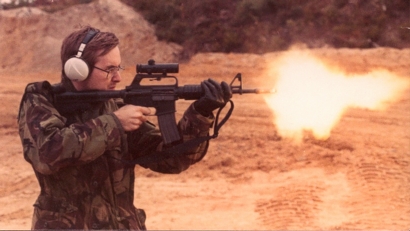
Agent 007 practices laying down protective covering fire…

…while Agent Lara handles team self-extraction from maddened hordes of LA socialists
I was given the names and details by an unnamed high Samizdata administration official who will remain unnamed but should of course be the target of a lengthy Blogosphere investigation so long as it is damaging to the administration and no one dares ask me any questions.
Matt Drudge is predicting a comfortable Ah-nie victory in California.
LATEST EXIT POLLS SHOW 59% VOTE ‘YES’ FOR RECALL, TOP CAMPAIGN AND MEDIA SOURCES TELL DRUDGE REPORT, 51% FOR SCHWARZENEGGER, 30% FOR BUSTAMANTE, 13% MCCLINTOCK….
My prediction: the Guardian will denounce the result as an ‘illegitimate power-grab’ before the end of the week.
Alice Bachini sincerely wants to be rich.
Hello. While I am on light blogging duties, I thought I would set you all some homework. Regular readers of this blog will have noticed that my quest to become a hard-nosed international millionaire businesswoman is still pretty much in its pre-foetal stages. I have considered many career paths, and various means of propulsion along them, including the possibility of multiply launching the whole set, yet somehow time still feels short (which, as we all know, is merely a conceptual illusion and not a true insight on anybody’s reality), learning still seems really difficult due to the technomoronicism curse, and generally other more urgent things seem to get in the way. You know, things like making toast and gallivanting around London.
Therefore, I am calling upon my readers yet again to offer their suggestions, tips and positive ideas (no need to tell me I’m an idiot doomed to failure, thank you) in a financially-improving direction. Whatever I do has to be extremely flexible, realistic, and clever enough to work for me. And that means clever. But you people are clever, right?
Some calling himself “I’m serious, and I’m too lazy”, supplied this really rather intelligent comment:
Interview the twenty richest persons in the UK. Or set your sights higher, and interview the twenty richest people in the world. Write it all down. Find a publisher. Title it, How the twenty richest people in the world became that way and how they keep it. Or just title it, How? and put a big green dollar sign on a yellow background, or pound or euro if you wish. Put your picture on the back in dark glasses (see above). You will make lots if you find a publisher. Even if not all twenty give you an interview, the reasons why they won’t will make a book that sells. If none of this works at least you will have had fun gallivanting, and you will made some excellent contacts and some good stories to tell your grandchildren. By all means wear those dark glasses and only remove them once you have the interview booked.
Anyone here got anything to add to that? Read Alice’s blog a bit to find out what kind of person she is, and then tell her what to do. (You people are clever, right?)
|
Who Are We? The Samizdata people are a bunch of sinister and heavily armed globalist illuminati who seek to infect the entire world with the values of personal liberty and several property. Amongst our many crimes is a sense of humour and the intermittent use of British spelling.
We are also a varied group made up of social individualists, classical liberals, whigs, libertarians, extropians, futurists, ‘Porcupines’, Karl Popper fetishists, recovering neo-conservatives, crazed Ayn Rand worshipers, over-caffeinated Virginia Postrel devotees, witty Frédéric Bastiat wannabes, cypherpunks, minarchists, kritarchists and wild-eyed anarcho-capitalists from Britain, North America, Australia and Europe.
|





Recent Comments