We are developing the social individualist meta-context for the future. From the very serious to the extremely frivolous... lets see what is on the mind of the Samizdata people.
Samizdata, derived from Samizdat /n. - a system of clandestine publication of banned literature in the USSR [Russ.,= self-publishing house]
|
French anti-terror police have arrested five people suspected of links with the Real IRA. This is the splinter group of the IRA that is opposed to the peace process (such as it may be) and has been blamed for a series of attacks since breaking away from the IRA. The most serious was the 1998 Omagh bombing, which killed 29 people and was the worst single atrocity in 30 years of violence.
The suspects were all French nationals and they are suspected of involvement in a support network for the Irish group. They were held after police discovered a cache of weapons and ammunition outside the ferry port of Dieppe.
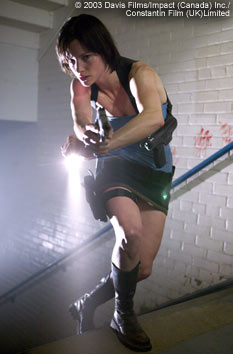
I have mentioned before that I am a great fan of the movie Resident Evil… well the sequel of which I spoke is going to hit the cinemas soon and a tantalising teaser can be found here!
What on earth is the use of having friends in high places if they can’t do you the odd favour now and then?
The wife of Lee Kuan Yew, Singapore’s founding father, was pushed ahead in the queue for emergency treatment at an NHS hospital after Government officials intervened on her behalf, it was claimed yesterday.
Mr Lee said that his wife, Kwa Geok Choo, 82, who had suffered a stroke, was given a brain scan four and a half hours earlier than planned at the Royal London Hospital after medical staff were contacted by Downing Street.
Using political leverage to get better treatment is just so much more ethical than paying for it.
This is excellent news. More and faster, please.
As some of you may be aware, I am presently in Australia. A get together is being held in Sydney this Saturday evening to commemorate the fact, and to allow a whole lot of people who know each other electronically to actually meet one another. A wide assortment of Australian (and other) bloggers will be present. Any additional bloggers and/or readers who will be in the area and would like to come are more than welcome.
When: Saturday November 8 at 6:30 pm until probably quite late.
Where: The Three Wise Monkeys Hotel at 555 George St, Sydney.
Who: Everybody is welcome.
Any questions: Please contact me here
This story offers a new slant on how the USA is preparing to deal with a smallpox terrorist attack: Smallpox: A Musical:
St. Cloud, Minn. – Here’s the way doctors in St. Cloud imagine a smallpox outbreak. Panicked hospital employees scurry about in a blaze of blue scrubs. A doctor dons a biohazard suit and sprays bleach everywhere. The beleaguered workers wring their hands and then belt into song, to an oddly familiar tune.
“Smallpox, smallpox, what a challenge for our docs,” they sing to the tune of “Charleston.”
It’s a performance of Smallpox: A Musical. Covers of hit musical tunes are cleverly revised to tell the story of mucus – that nefarious transmitter of smallpox.
Suddenly, the familiar sounds of music are back.
“The halls are awash, with the sound of mucus. And everyday ills, are now shown the door. ‘Cause deep in our hearts, what has so confused us, is fevers and pustules and festering sores,” sing hospital workers to the melody of “The Sound of Music.”
The musical is the brainchild of Dr. Daniel Whitlock, vice president of medical affairs at St. Cloud Hospital. But these days, in addition to his administrative role, Whitlock is busy making casting calls. His eyes twinkle as he runs a hand through his silver hair.
“I thought you’d be a good one,” he says to a perspective recruit, “because you have stage presence. And you’re dynamic.”
The medical profession has always been a bastion of bad taste and gallows humour. It seems to be my day for confirming stereotypes.
The Cabinet is increasingly split over the issue of introducing compulsory national Identity Cards for innocent British citizens. Despite this the Sunday Times reports that the Queen’s Speech is likely to contain reference to them in the form of a draft Bill.
The Sunday Times suggests that this is just a “fig leaf” to cover Big Blunkett‘s embarrassment and that ID Cards will not actually be introduced before the next general election if at all.
They might be right, but that’s not a risk we can afford to take. We need to redouble our efforts to oppose this dangerous idea.
Cross-posted from The Chestnut Tree Cafe – now with mailing list
Bernie Greene wonders just how scientific is the science behind the smoking debate?
Epidemiology began with a fellow called John Snow investigating to find the cause of a cholera epidemic in London in the 19th Century. He had the idea that it might be coming from contamination in a well. So he took a map showing the locations of wells and plotted the incidence of the disease on the map. Sure enough they were mostly in close proximity to one particular well. He had the well put out of service and there were no more new cases of cholera. That is a simple story of logic and surveying intelligently applied to test a theory.
It is very unfortunate that it was so simple to solve. He might then have left a better example for his followers.
What if he had found that the 166 1 total cholera cases were scattered all over the map pretty evenly but that they all had pink carnations on their coats? One hundred thousand people wore pink carnations and 99,874 did not get cholera.
What does he do now? Well if he were a tobacco investigator he would petition the government to do something about pink carnations. But let’s say he is a brighter boy.
He decides to go and interview the cholera cases in more depth. → Continue reading: Honest science or propaganda?
One of the pleasures of British television as the nights get longer and darker is watching the gloriously laddish and unPC gentlemen on the BBC2 show TopGear, fronted by irrepressible Jeremy Clarkson, a sort of British version of P.J. O’Rourke. I am not quite sure how the great man continues to work in the Guardianista-infested corridors of power at the BBC, but maybe the bosses there feel they need at least someone like him to ‘appease Middle England’ or whatever.
Sunday night’s show had a number of good features, not least the bit when Jeremy and his two co-presenters drove a variety of BMW sports cars, very, very fast around the country lanes of the Isle of Man. Apart from some built-up areas, there are absolutely no speed limits on the island. Yep, not one.
At one point, one of the younger presenters – sorry, I forget his name – said this place was the motoring version of Fantasy Island. And Clarkson waxed lyrical about how the place was a ‘nanny-state free zone’.
Yes, I know it is just about cars. But somehow, I find it mighty encouraging that these sentiments get aired on prime-time British telly.
We rag on the BBC a lot in these parts, and rightly. Well, TopGear is a veritable oasis of petrol-head good sense. Clarkson for Prime Minister!
It’s good to see an ancient stereotype confirmed, this time the one about British judges being less than completely alert and on the ball on all occasions.
One of the men convicted of plotting to snatch £200 million worth of diamonds from the Millennium Dome has lodged grounds of appeal alleging that the judge at his Old Bailey trial fell asleep more than once during the hearing.
Lawyers for Raymond Betson are trying to trace two witnesses who were present at the trial and may be able to give evidence about when Judge Michael Coombe dozed off.
Betson’s claim – part of his challenge to his conviction of conspiracy to rob – was disclosed in the Court of Appeal today when his case was delayed for at least seven weeks.
Betson’s counsel, Edmund Romilly, said: “Statements from two people present at the trial show that the judge fell asleep on a number of occasions. We have been making efforts to contact these people, so far without success.”
All of which confirms that old Peter Cook sketch from Beyond The Fringe about how, when you get old and doddery and useless, you had to stop doing mining, but that this didn’t apply at all if you did judging.
I don’t know what else this proves. Probably that most court cases, even about dramatic events such as this attempted Dome robbery – which was like something in a Peter Sellers movie – are stupefyingly boring.
There’s a long article in today’s New York Times about Diebold, the voting machine company, and their struggle to prevent internal emails about security weaknesses in their software getting around on the Internet. They’re arguing intellectual property. Their opponents argue “fair use”. First three paragraphs:
Forbidden files are circulating on the Internet and threats of lawsuits are in the air. Music trading? No, it is the growing controversy over one company’s electronic voting systems, and the issues being raised, some legal scholars say, are as fundamental as the sanctity of elections and the right to free speech.
Diebold Election Systems, which makes voting machines, is waging legal war against grass-roots advocates, including dozens of college students, who are posting on the Internet copies of the company’s internal communications about its electronic voting machines.
The students say that, by trying to spread the word about problems with the company’s software, they are performing a valuable form of electronic civil disobedience, one that has broad implications for American society. They also contend that they are protected by fair use exceptions in copyright law.
Hurry if you want to read all of it. NYT stuff seems to go behind a payment wall quite soon. They take their property seriously too, I guess. (By the way, is this NYT policy recent, or is it just me having only recently noticed it?)
Okay, hands up all those people who did not see this coming:
France faces a year of turbulent and possibly explosive politics after a tactical alliance was formed at the weekend between two parties of a resurgent far left.
Mainstream parties will go into three important polls next year, with a spluttering economy, rising unemployment, a continuing menace from the far-right and an extreme left which is united and powerful for the first time in 30 years.
In an opinion poll published yesterday, after two leading Trotskyist parties agreed to fight regional and European elections together next spring, 31 per cent of French people said that they would “consider” voting for the far left.
One of the parties, the Ligue Communiste Revolutionnaire (LCR), has doubled its membership in the past 18 months, as young French people, seduced by the anti-globalisation movement and cynical about conventional politics, flocked to the extremes.
France is going down. It may well be too late to prevent this national self-immolation and were it not for their force du frappe that would be that. A tragic historical footnote but no more.
But will anyone be able to rest easy in the knowledge that a substantial nuclear arsenal has fallen into the hands of Les Moonbats? I just hope that someone, somewhere in the Anglosphere defence establishment is drawing up a contingency plan to deal with this. After all, we know for sure that they exist and the task of locating them should not prove too difficult.
What does the government have to say about “human rights”: the collective term for its concerns about civil liberties and the rights of the individual. The answer can be found in three departments: the Human Rights Department in the Lord Chancellor’s Officeand the Human Rights Policy Department at the Foreign and Commonwealth Office. The administrative distinction between these two departments lies in their location: the former is dedicated to the implementation in law of the European Charter on Human Rights and the latter is focused upon human rights as a strand within British foreign policy.
The latest Audit Committee Report on the implementation of the Human Rights Act for managers within local government is a good place to start examining how the law has become a byword for bureaucratisation and regulation. It also has a useful list of further governmental links. Although the traditional freedoms are all recognised in checklists and tickboxes, they are surrounded by a disciplinary atmosphere that has the potential to prohibit any actions considered offensive. Instead of applying common sense and guidance, this Report promotes a stifling conformity in the form of a “human rights culture” in order to avoid liabilities for not applying the law correctly.
By viewing human rights as a possible liability, institutions and the individuals who work within them will come to see civil liberties as a liability and a hindrance to their primary objective. Thus, the Human Rights Act will have the opposite effect to that intended: engendering a culture of compliance that observes the letter, not the spirit of the law, and bringing the actual purpose of the act, increasing the rights of individuals, into contempt.
|
Who Are We? The Samizdata people are a bunch of sinister and heavily armed globalist illuminati who seek to infect the entire world with the values of personal liberty and several property. Amongst our many crimes is a sense of humour and the intermittent use of British spelling.
We are also a varied group made up of social individualists, classical liberals, whigs, libertarians, extropians, futurists, ‘Porcupines’, Karl Popper fetishists, recovering neo-conservatives, crazed Ayn Rand worshipers, over-caffeinated Virginia Postrel devotees, witty Frédéric Bastiat wannabes, cypherpunks, minarchists, kritarchists and wild-eyed anarcho-capitalists from Britain, North America, Australia and Europe.
|





Recent Comments