We are developing the social individualist meta-context for the future. From the very serious to the extremely frivolous... lets see what is on the mind of the Samizdata people.
Samizdata, derived from Samizdat /n. - a system of clandestine publication of banned literature in the USSR [Russ.,= self-publishing house]
|
As Brian Micklethwait recently observed:
When a government starts to slide seriously into the dustbin of history, the very things which it tries to do to halt the slide become part of the slide.
He was referring to Her Majesty’s Government’s rather comical attempt to shore up its plummeting popularity by launching a ‘Big Conversation’ and, for it is worth, I think he is right.
But does this formula have wider applications? If the answer to that question is ‘yes’ then perhaps it can be applied to the democratic process itself:
A public debate on lowering the voting age from 18 to 16 has been called for by the Lord Chancellor, Lord Falconer.
A lower voting age would encourage more young people to become involved in politics, he told the Observer paper.
The Electoral Commission, which advises ministers on how elections can be modernised, began consulting on the voting age in the summer following concern over falling turnouts among young voters.
I can entirely understand why the idea of lowering the voting age to 16 (at present it is 18) should have a certain appeal among the political classes. By every standard that can actually be measured, democratic politics is in steady decline. The membership roles of all main political parties are now so low that corporate donations are the only thing saving them from bankruptcy and voter turnout in elections is dropping year on year.
It is probably to early to pronounce that democracy is in crisis. It is not. Well, not yet. But there is now a sufficiently large block of public indifference to send a shudder down the spines of not just politicians but also the professional classes whose wealth and status is entirely dependent on state activism.
The threat of a creeping but inexorable loss of legitimacy has prompted calls for ‘something to be done’. In the past few years there has been much chundering about making voting complusory. But the trouble with that is that it may, overnight, turn a large block of public indifference into a large block of civil disobedience and that will only make things worse. So, extending the franchise is probably their safest bet.
I am against it, of course. People of all ages tend to vote for three things: more government, more entitlements and more laws. There is no reason to suppose that younger voters will somehow buck this trend. Nor is this merely my customarily gloomy nature at work, it is an analysis borne out by history. From the 19th Century onwards the growth of the welfare/regulatory state has steadily tacked upwards on the same line that marks the growth of enfranchisement. Since governments must respond to the wishes and aspirations of those that elect them, the former will tend to follow the latter.
But if the voting age is going to be lowered then it will be lowered regardless of whether I approve or not. The real question is whether is will achieve its stated aims. Supporters of the lower voting age are hoping that giving 16 year-olds ther right to vote will enable them to express themselves, ignite their imaginations and re-quicken the democratic process.
Well, who knows? Maybe that will be the case. But it seems to me that the opposite effect is just as likely. Namely, that the steps taken to reverse the slide of democratic legitimacy just become a part of that slide as the teenyvoters stay away in droves, thus converting a nagging concern into a slough of despond.
And where do we go from there? Good question.
I am in Antwerp. As well as being a city of great economic importance as one of Europe’s largest ports, and also one of those great Dutch trading cities in which modern capitalism was invented in the sixteenth and seventeenth centuries, Antwerp is today a very cool city: full of great bars, interesting shops, jazz clubs, assorted types of cafe, you name it. This afternoon, after drinking two or three glasses of fine Belgian beer while listening to a piano and bass jazz duo, I got on the metro to go back to my hotel. (The Belgians are the first people I have encountered who have managed to make a single line metro system confusing to use, but I digress). I found myself sitting in a seat on the metro platform, waiting for a train.
Suddenly, quite softly, I heard a familiar song being sung. It was one of the songs from the famous musical epsiode of Buffy, The Vampire Slayer. As I do happen to count knowing the lyrics (and far too much dialogue) of Buffy amongst my many skills, I paused for a moment or two and (perhaps it was the beer) joined in. After a few seconds, the girl noticed that there was somebody else singing and stopped, and seemed slightly embarrassed to be caught doing this. However, I mentioned that as someone who personally owned six seasons of Buffy on DVD, I was unlikely to think less of her for singing songs from Buffy. (There is also the minor matter that she was quite beautiful, and few guys mind it if a beautiful girl is a little embarassed).
She said that she was still waiting for the DVDs of season 5, as she is buying the US versions. (It is a point of dispute amongst Buffy fans as to whether the US or European DVDs are better. The European ones have been released first and are in widescreen, but the US ones are cheaper and have more special features, including a particularly hilarious commentary track on one episode from Seth Green. So we discussed this briefly. But once again I digress).
She expressed her surprise about the whole thing: she said that she sings that song when walking the dog, but that nobody had ever recognised it before. She said this in an accent I couldn’t quite place: it sounded sort of posh English, but it wasn’t quite that. So I asked her. She said that she was Argentine, but that she had lived in England for a time, and also had spent a while in Germany. I could sense that there was more to the story than this, But that was as much as I got.
If I was writing this in a film script, this would have been a wonderful example of what Roger Ebert calls a “meet cute”, and I would have no doubt used the whole episode as an excuse to invite her back to the jazz club, and it would have ended up being a wonderfully amusing story to tell our grandchildren.
But, sadly, there is something that I have left out of this story, which is that the girl in question was not alone. She was with a young Belgian man, obviously a boyfriend. So, I chatted with them a little until my train came, wished them goodbye and boarded my train.
I am not sure that there is a point to this story, other than that a globalised world in which I, an Australian who lives in London, can spontaneously start singing a song from a musical episode of a television series of light gothic horror set in a Californian high school with a beautiful somewhat anglicised Argentine woman in an underground train station in Antwerp is something I like immensely. And also, Joss Whedon is a genius.
Not only am I trying to cope with the steady flow of work related parties that have started to appear in my diary in the run up to Christmas, but I agreed to go out on Friday with Andrew Dodge to the Monster Magnet launch party at the Barfly in Camden, not that it takes much persuading when there is free beer and good music on the agenda. We were treated to a live set from Monster Magnet, and if you have ever been to the Barfly you will know it is not a big place, so it was a real treat considering they were playing the Forum the next day (and that’s a big place). As Andrew points out in his posting covering the same gig we were mixing with the likes of Kelly Osbourne and Die So Fluid , however what he does not mention is that he had the hots for Grog, their lead singer,

so we spent a large proportion of the night chatting to her, not that I was complaining until the next day when I discovered I had lost my voice.
The following night was spent at the Brixton Academy watching The Darkness play. Again I was with Andrew with the added value of Anna of leather catsuit fame from the bloggers party, although this time it was not planned as we had both got tickets separately. I have seen them live before, and they did not disappoint on a second viewing. Their mixture of Rock and Irony (give me a D… Give me an Arkness…) is refreshing in the current world of dance and manufactured pop music you hear on the radio all the time. On the way out we bumped into Nik who had arranged the Monster Magnet party and his voice was worse than mine. At least I was able to talk by Saturday evening!
Achtung! Achtung!
The Slovene Red Army has finally broken through to the leafy suburbs of London!
Dawkins vs. Gould: Survival of the Fittest
Kim Sterelny
Totem Books, 2001
This relatively short book (156pp., no index) should, perhaps be taken at a gulp, which I have not done. Much is made of the ding-dong controversy between Richard Dawkins and Stephen Jay Gould on the mechanisms and implications of evolution (“punch-ups … notorious for its intensity … savage battle …” – from the blurb), but unfortunately not in the words of the two antagonists. Instead Sterelny (a male, by the way) sets about describing what they disagree about. Perhaps unfortunately, as tends to be the way in Biology, it does not seem possible to set up some experiment, or look for a crucial observation, that will settle their differences.
In fact, these fall into two categories, one theoretical and technical, the other philosophical.
For the first, there is the disagreement between Dawkins’ theory of selection at the level of the gene as against Gould’s emphasis of the species as the selective unit (if I understand this aright). While Dawkins seems happy to accept the assumption of a gradual, steady, uniform pace of evolution, Gould has espoused the theory of “punctuated equilibrium”, in which selection acts in short concentrated bursts after some catastrophic alteration to the environment, such as the impact of a meteorite, which has resulted in the wiping out of most other species, as with the dinosaurs at the end of the Cretaceous.
However, as Sterelny says, these disagreements are not adequate to explain the antagonism and in Chapter 12 (p. 123) he gets down to the more philosophical ones. “Dawkins is an old-fashioned science worshipper” he states (and lines up with him), while “Gould’s take on the status of science is much more ambiguous. … In Gould’s view, science is irrelevant to moral claims. Science and religion are concerned with independant domains.”
It should be said that Gould is as much an atheist as Dawkins, but whereas Dawkins sees religions as erroneous explanations of the world with usually unfortunate consequences, “Gould … interprets religion as a system of moral belief” and seems to think that science is in danger of being contaminated by its social milieu. Sterelny does not quite make the point that Gould is scared that science will lead him where he doesn’t want to go, but this is certainly implied by his statement, “Gould hates sociobiology.”
And surely this is simply the old Marxist dogma that human psychology and behaviour have no innate characteristics, but are infinitely plastic and manipulable, together with the social systems that have been and can be founded upon them.
Gould has died. Is that the end of the controversy? After all, as Max Planck said, he didn’t need to convince the opponents of his theory: “They died.”
Wittgenstein’s Poker: The Story of a Ten-Minute Argument Between Two Great Philosophers
David Edmonds and John Eidinow
Ecco, 2001
“Wittgenstein’s reputation among twentieth-century thinkers is … unsurpassed. … A poll of professional philosophers in 1998 put him fifth in a list of those who had made the most important contributions to the subject, after Aristotle, Plato, Kant and Nietzsche and ahead of Hume and Descartes (p. 231).” Yet there is nothing in this book that is comprehensible to the layman about Wittgenstein’s philosophy, or even, I have to say, much of an attempt to make it so. His eminence and influence and his credibility to other philosophers we have to take on trust.
On the other hand, Popper – the antagonist to Wittgenstein’s protagonist – has two well-known and accepted achievements to his credit, his book The Open Society and Its Enemies and his “falsifiability” theory on the structure of scientific hypotheses (though I have often wondered if “vulnerability” would not be a better term). But in Britain and America, Popper is slowly being dropped from University syllabuses; his name is fading, if not yet forgotten … a penalty of success rather than the price of failure (p. 230).” Or perhaps, being transferred from the useless category of philosopher to that of scientist? Far from turning his office there into a shrine, the LSE has had it converted into a lavatory.
The allusion in the title is, of course, to the famous incident with the poker on Friday, 25th October, 1946 about which none of the supposedly acute seekers after truth present could agree. This was the only time the two philosophers actually met, though both came from Vienna, both were of Jewish descent (though neither of religion), and both had to leave Austria when the Nazis took over. As far as I can make out, the dispute was whether philosophy, as a discipline, could or should deal with real “problems” (Popper) or merely with “puzzles” (Wittgenstein), say with language expressions. The meeting was of a discussion group at Cambridge University, called the Moral Science Club (MSC), of which Wittgenstein was actually the Chairman. He was, however, usually overbearing and difficult, tending to hog the discussions, often leaving meetings half-way through – something Popper probably didn’t know.
Popper had been invited to give a paper and Wittgenstein interrupted and shouted his disagreement, making his point brandishing the poker that lay by the moribund fire, laying it down when Russell told him to, and then leaving. Smoothing matters down, someone asked Popper for an example of a moral principle. “Not to threaten visiting lecturers with pokers,” was the reply, provoking a laugh and, I imagine, relaxing the tension. Popper later claimed that Wittgenstein was still present when he made this retort, but the general agreement is that he had gone, one witness even accusing Popper of lying. The poker itself disappeared.
The book, however, is much more than an account or investigation of this episode. Tracing the lives of both personalities, both of them combative and obsessive, the authors also fill in the background they grew up in – the increasingly anti-semitic Vienna of the post-WWI war decades, despite the efforts of those of Jewish ancestry to assimilate, including many who discarded their religion and became Christians. Wittgenstein’s was an extremely rich family (though his grandfather had adopted the name of his aristocratic employer, to whom he was not related) but he divested himself of his own share of its wealth. He had served with distinction in the Austrian Army in WWI, volunteering for dangerous posts, being decorated several times and during it writing his seminal work Tractatus Logico-Philosophicus. He ended the war in an Italian POW camp. On the other hand Popper, some thirteen years younger, came from a bourgeois but impoverished family. He had difficulty in escaping from Austria; with perhaps some exaggeration he claimed that taking a Chair in New Zealand left free for another (Waismann) an opening to a temporary lectureship at Cambridge (p. 221). His “war effort”, he said, was writing The Open Society (p. 71), though he tried, unsuccessfuly, to join the armed forces as well. “Popper’s impact on academic life [in the University of Canterbury, New Zealand] was greater than that of any other person, before or since,” judged that institution; he acted as a kind of intellectual champagne after the dry depression years (p. 172).”
Wittgenstein died in 1951, Popper in 1994. The authors do not try to give much information on the later work of either, though there is a joint chronology (pp. 245-242). They do seem, in my view, to be somewhat biased against Popper, if only because he’s left more evidence against himself; presumably also they cannot help but be influenced by the poll of philosophers given above (and in which, presumably Popper comes nowhere). Neither men come across as particularly pleasant, let alone lovable, though Popper seems to have kept friends as well as making enemies, while the impression is given that Wittgenstein despised everyone – no list of friends is given for him, though mention is made of disciples and acolytes who imitated his mannerisms. Although Popper died only six or seven years before the book was written and published, there is no indication that either author ever interviewed or even met him. It is also a little disappointing that no mention is made of any relationship between him and other thinkers on the right, such as Bauer and Hayek, who, in contrast with both Popper and Wittgenstein, was noted for his courtesy towards opponents. Perhaps these don’t qualify as philosophers. Isaiah Berlin is mentioned, but once only to have his philosophical pretentions pulverised by Wittgenstein (p. 24), and twice in passing.
A minor but irritating typographical blemish is the close resemblance between 3 and 5.
Guy Herbert finds this is a bit worrying.
The BBC reports that six people suspected of terror activities have been re-arrested on lesser charges. All six were originally arrested under section 41 of the Terrorism Act, on suspicion of involvement in the commission, preparation or instigation of acts of terrorism. They were released under terror laws but re-arrested on other matters such as bank fraud and immigration offences.
What’s wrong with this picture? Under the Terrorism Act reasonable suspicion is not required to arrest or search. Therefore it has potential to be used for fishing expeditions – police arrest you and search your property without proper cause. Of course, they’ll have an actual cause, such as being uncooperative with officials or some such pretext, and give themselves a week to find something on you. Once they have found something on you, their actions are justified in the eyes of the Lawn Order brigade.
Given the state of the criminal law and bureaucratic reach, I sincerely doubt there is anyone in the country who could not be charged with some crime after a week of interrogation and search, even among those whose lawns are in perfect order and believe they have nothing to hide.
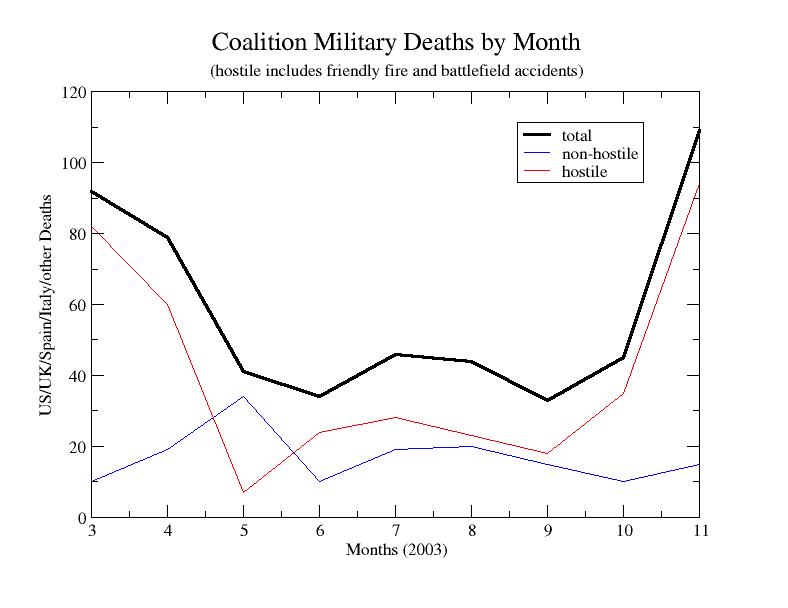
There are no real surprises to the graph this month. It is bad but it has been obvious from the day of the Chinook shootdown that would be so. As I noted last month, I felt it best to delay comments until these numbers were in.
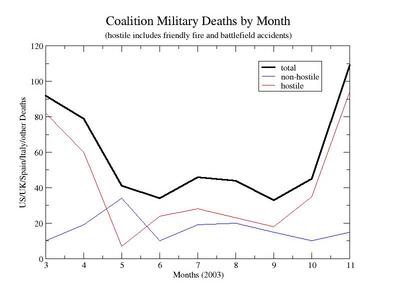
D.Amon, all rights reserved. Permission granted for use with attribution to Samizdata
It is rather obvious to me there has been significant re-organization and re-grouping of the Baathists. They have gone from utterly ineffective to being at least capable of co-ordinating attacks which inflict some damage.
A problem they face is their numbers, while large, are limited. Saddam’s loyal core forces which vanished ‘into the woodwork’ in mid-April numbered perhaps 15-20 thousand. They are at present expending those numbers at an horrendous rate. True, they are doing some damage to the Coalition – but not major damage in any tactical, let alone strategic sense. They attack and they kill some of the Coalition forces… and promptly get their own arses handed back to them on a platter.
It is not as if the Baath have an unlimited pool of personnel and cash. There is no superpower backing them behind the scenes; there is no huge mass of conscripts to fill in the holes left by the fallen. If they fight a war of attrition they will lose unless the populace backs them. Given what the Baathists did to that very same populace for three decades, such a turn about seems unlikely. You cannot turn a butcher into a folk hero in less than a generation.
My crystal ball is rather hazy this month. I expect the casualty rates to drop off a little bit but to remain high for at least several months. The major factor in how long they remain high depends on things for which I do not have the information on which to base a ‘WAG’ let alone a reasoned judgement. I can only say the numbers will stay up until either the reformed Baath command structure is shattered or attrition in the ranks erodes their ability and will to fight.
In the best of worlds, that could take several months.
The British Medical Association cuts to the chase. No shilly-shallying about. None of these namby-pamby half-measures or pathetic, milquetoast compromises, no, they have decided to go for the kill and demand another full-blown drug war:
Smoking should be completely banned in the UK, according to a top medical journal.
The Lancet said tens of thousands of lives would be saved by making tobacco an illegal substance and possession of cigarettes a crime.
Might as well really. The political climate is right, the enforcement apparatus is all in place and resistance will not be futile because it will be non-existant. In fact, they are probably kicking themselves for not coming out with this sooner.
Dr James said the government had already shown it was willing to pass similar legislation, such as banning the use of hand held mobile phones while driving.
Once again we see that appeasement does not work. Give the bullies an inch and next they want a mile. These people cannot be placated.
Forest director Simon Clark said the Lancet was “the true voice of the rabid anti-smoking zealot”.
He said smokers should not be treated as criminals, adding: “The health fascists are on the march.
Oh no, Simon, they have been on the march for decades. Now they have taken the citadel.
“What next? Will they urge the government to ban fatty foods and dairy products?”
Yes. There is no reason for them not to.
Many of people who loathe Rupert Murdoch and who hate the fact he has been able to buy up the TV rights to so many sporting events, are the same people who have supported the regulation of British media companies which has ensured Murdoch never has to face any effective competition.
– Michael Jennings
Patrick Crozier has some interesting thoughts on ‘the war to end all wars’. A blogopotamus of a post in fact!
Who am I to start writing about the origins of the First World War? Many others, far more qualified than me have speculated at great length on the subject. Entire British Library bookcases groan under the weight of tomes dedicated to the minute analysis of the Austrian Ultimatum and the Naval Arms Race. And here am I either adding to or (more likely) replicating that effort.
The First World War was, to me at least, the great disaster of the 20th Century. Millions died. Millions more experienced the horror of the trenches: the cold, the mud, the shelling, the stench, the lice, the exhaustion, the ever present fear, the death. It gave birth to Total War, to conscription and to rationing. It laid the foundations for a massive expansion of the state, the Second World War, brought forth the horrors of communism and, in turn, the Cold War. The chain of events ends in the European Union – that instrument of European economic and political suicide. If only it had not happened. If only it could have been prevented.
Of course, the mere fact that the war was a dreadful thing need not mean that its cause was similarly great. One thinks of President Kennedy and his assassin. But, if lessons are to be learnt then one needs to know what started it.
The reason I am writing this is because I have long been unhappy with traditional, textbook explanations for the outbreak of World War I; the sort of thing you get taught at school (see here for an example). Such explanations tend to harp on about Great Power rivalries or the Alliance system. Some add in the growth of industry, nationalism, socialism and democracy. → Continue reading: The origins of the First World War
Due to a server hickup, Samizdata.net was feeling poorly… we now return you to your regular programming.
|
Who Are We? The Samizdata people are a bunch of sinister and heavily armed globalist illuminati who seek to infect the entire world with the values of personal liberty and several property. Amongst our many crimes is a sense of humour and the intermittent use of British spelling.
We are also a varied group made up of social individualists, classical liberals, whigs, libertarians, extropians, futurists, ‘Porcupines’, Karl Popper fetishists, recovering neo-conservatives, crazed Ayn Rand worshipers, over-caffeinated Virginia Postrel devotees, witty Frédéric Bastiat wannabes, cypherpunks, minarchists, kritarchists and wild-eyed anarcho-capitalists from Britain, North America, Australia and Europe.
|





Recent Comments