We are developing the social individualist meta-context for the future. From the very serious to the extremely frivolous... lets see what is on the mind of the Samizdata people.
Samizdata, derived from Samizdat /n. - a system of clandestine publication of banned literature in the USSR [Russ.,= self-publishing house]
|
More great news, this time on the Ozzy Osbourne front. He’s not going to die:
Rock star Ozzy Osbourne is breathing unaided for the first time since his quad bike accident a week ago.
The former Black Sabbath singer has been taken off a ventilator and has been able to speak to his family.
And with his old verbal fluency unimpaired, I trust.
Not long ago I caught Ozzy and daughter Kelly doing their Christmas single Changes on Top of the Pops, which is now number one in the hit parade apparently. And then immediately after that Ozzy had to be rushed to hospital following his prang, and Kelly rushes there to see him. You can’t buy publicity like that, because you can’t fake it.
This tune, for me, personifies the way that pop music these days, at least the sort of pop music you see on British telly, has become more and more something that your granny can recognise and sing along with. Not like it was in my day. In my day we used to drive elder brothers and sisters crazy, never mind our parents and grandparents. But now the man who used to bite the heads off bats is in that same celebrity category that used to be occupied by the Queen Mother and now also accommodates England’s rugby darling Jonny Wilkinson. (Although, it seems that many elder brother types are angry about Changes. This angry bloke reminds me of how my contemporaries at Essex University in the early seventies reacted to Donny Osmond.)
With his latest effort Ozzy has apparently set a new pop record, of the Guinness-Book-of variety:
The singer has set a new record for the longest time taken to reach number one during a career, reaching the top of the charts 33 years after his first hit with Black Sabbath, Paranoid, got to number four in August 1970.
Ah, Paranoid. Those were the days, eh? Who would have thought that Ozzy Osbourne of all people would live long enough to break a record like that?
Wonderful editorial in the Wall Street Journal today that spins out one of my favorite conceits – that there is no difference between the Mafia (the mob, la cosa nostra, call it what you will) and party politics. The details are very much American politics “inside-baseball”, but I have no doubt that a similar column could be written in England or elsewhere. A taste:
Al Gore’s grandly public endorsement of Howard Dean last week confirms my view that the easiest way to understand the Democratic Party today is by watching “The Godfather.”
I think of Bill Clinton as the Don Corleone of the Democratic Party. In the organization, there is no one above him. Terry McAuliffe is his Tom Hagen, who talks to the outside world. I leave it to others to fill out the rest of the cast.
It has been talked about among the cognoscenti for some weeks now that the new Dean organization, if he secured the nomination, would challenge the Clintons’ control of the party apparatus, meaning mainly the cash flow from contributors and the unions. But I thought it more likely that if Mr. Dean got the nomination, he would be visited over a table in a nice restaurant, the Palm in Washington, by Mr. McAuliffe and Harold Ickes, who would explain that he could win the presidency with them, but not without them.
With this understanding, an alliance of partners would result. The old organization and its traditional sources of income–the patronage mills, the government contracts, the public-bond issues, the legal jobs–would survive, and Mr. Dean’s people would be given significant control, maybe half. Now it’s not so clear that Howard Dean needs to cut a deal with the Clinton factions, because maybe the factions aren’t so close to the Clintons anymore.
I have long suspected that by far the most important aspect of the current Democratic primary is the internal struggle for control of the party that it is part of. Howard Dean has never liked the Clintons, who now control the party, and owes them nothing – he has his own internet-based grassroots and fundraising machinery. If he wins the nomination, he will become the new head of the Democratic Party, displacing the Clintons.
The Clintons have to oppose Dean because they don’t have any hooks in him – if you don’t understand this, you don’t understand power politics at all. The Clintons have always been the primary motivator behind the Stop Dean movement. They must maintain their control of the Democratic Party, or Hillary’s Presidential ambitions will come to naught. Wesley Clark, the quintessential Stop Dean candidate, is wholly a creation of the Clintons. The Clintons aren’t concerned that Dean will win the Presidency and prevent Hillary from running in 2008 (as the incumbent, Dean would be almost impossible for Hillary to challenge). They are concerned that Dean will win the nomination and control of the party, so that they will lose their only remaining fingerhold on influence, and the wealth and power it brings.
I regard the Clintons as a cancer on my country, and so, even though I think Howard Dean would make a dreadful President, I am all in favor of his winning the nomination.
According to an account from Major Bryan Reed, an operations officer for the US army’s 4th infantry division, in an exchange before he was pulled from the hole in the ground he was sheltering in, the former dictator said to US troops in English:
“My name is Saddam Hussein. I am the president of Iraq and I want to negotiate.” US special forces replied “regards from President Bush”.
The Government has been considering congestion charging based on road use. Under the scheme every car would have a tracking device attached. Satellite technology would then be used to track every car journey made. This personal information would be recorded centrally and drivers billed for their road use.
The privacy implications are obvious and frightening.
It seems that in the wake of Big Blunkett’s ID Card announcement privacy concerns are now irrelevant. Transport Secretary Alistair Darling is to push ahead with the plan. Darling has appointed Professor David Begg to head a committee to consider the practicalities.
Begg said:
“It is now a matter of when, not if. Six months ago it was on the shelf, but Mr Darling is now very serious about it.”
BBC Report here
Cross-posted from The Chestnut Tree Cafe
The cost of gathering information determines the size of organizations.
– Ronald Coase, quoted by Everett Ehrlich in
yesterday’s Washington Post
Someone should check carefully.
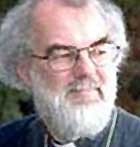 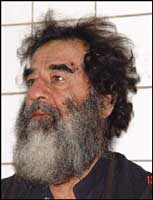
One of these men is the Archbishop of Canterbury, Rowan Williams.
Just so as to confirm that no mistake has been made the Americans should ask their captive whether terrorists can ever have ‘serious moral goals’.
I’ve spent nearly the entire evening watching the news. BBC1 and ITV4 in particular had a great deal of coverage of the event here. It is of course about politics according to the BBC Washington correspondents… as if Dean ever had a prayer of a snowflake chance in hell of winning next fall.
Ken Adelman gave two marvelous remote screen debate performances within an hour and on both channels. Jon Snow was at a loss for words when he said to Adelman: “Of course you will be for that (Saddam’s execution)” And Ken had him off balance simply by retorting, “Why do you assume that?”
But the biggest laughs I had this evening were the constant use of the Q word. On BBC1 there were two different reporters using it within minutes of each other.
Hey, the BBC lads in Iraq have to invent some silver lining in all this!
Times has an article up that contains notes from Saddam in custody. Many bloggers and their readers have been wondering what Saddam will reveal in interrogations. The first questioning has not produced much it seems, the transcript was full of “Saddam rhetoric type stuff,” according to the official who paraphrased Saddam’s answers to some of the questions.
When asked “How are you?” said the official, Saddam responded, “I am sad because my people are in bondage.” When offered a glass of water by his interrogators, Saddam replied, “If I drink water I will have to go to the bathroom and how can I use the bathroom when my people are in bondage?”
More importantly, Saddam is denying everything and replying with really dumb answers to questions that might incriminate him.
Saddam was also asked whether Iraq possessed weapons of mass destruction. “No, of course not,” he replied, according to the official, “the U.S. dreamed them up itself to have a reason to go to war with us.” The interrogator continued along this line, said the official, asking: “if you had no weapons of mass destruction then why not let the U.N. inspectors into your facilities?” Saddam’s reply: “We didn’t want them to go into the presidential areas and intrude on our privacy.”
Hm, Saddam as a champion of privacy?
From Dodgeblogium, to Harry’s Place, to this, from today’s Observer:
Not the least of the casualties of the Iraq war is the death of anti-fascism. Patriots could oppose Bush and Blair by saying that it wasn’t in Britain’s interests to follow America. Liberals could put the UN first and insist that the United States proved its claims that Iraq had weapons of mass destruction before the court of world opinion. Adherents to both perspectives were free to tell fascism’s victims, ‘We’re sorry to leave you under a tyranny and realise that many more of you will die, but that’s your problem.’
The Left, which has been formally committed to the Enlightenment ideal of universal freedom for two centuries, couldn’t bring itself to be as honest. Instead millions abandoned their comrades in Iraq and engaged in mass evasion. If you think that it was asking too much to expect it to listen to people in Iraq when they said there was no other way of ending 35 years of oppression, consider the sequel. Years after the war, the Kurdish survivors of genocide and groups from communists through to conventional democrats had the right to expect fraternal support against the insurgency by the remnants of the Baath Party. They are being met with indifference or active hostility because they have committed the unforgivable sin of cooperating with the Americans. For the first time in its history the Left has nothing to say to the victims of fascism.
Or, as I recall Mark Steyn putting it in a recent piece, the left now echoes Cold War anti-Communist and pro-any-other-anti-Communist USA in saying: “Saddam Hussein may be a son-of-a-bitch but he’s our son-of-a-bitch.”
The French Government has reacted with fury to the news that Saddam Hussein has been captured by US forces.
Speaking to reporters in Paris this evening, the Foreign Minister Dominique de Villepin, denounced the arrest of the former Iraqi leader as ‘an act of international piracy’:
“Saddam Hussein has been kidnapped by America. You cannot simply seize and detain people without proper negotiations. The Americans should have given more thought beforehand. This situation requires the careful application of justice not cowboy tactics”
His words were echoed at a meeting of EU Ministers in Brussels this evening. Speaking on behalf of the assembled ministers, Dutch Commissioner Willy Van Der Pimp issued a warning to the Americans not to ‘go it alone’:
“If the Americans think that they alone can administer justice, then they are very mistaken. The international community will not tolerate being ignored in this fashion. Europe has a vital role to play in deciding the future of Saddam Hussein”
The Council of Ministers will meet again tomorrow in emergency session to draw up an action plan.
French reaction to Saddam’s capture is varied. The media call it a great victory for the US, the politicians are finding it harder to make up their minds what to say and public comment ranges from when will the US come and take Chirac? to No, they can’t have captured him, it’s impossible!.
Coming after the setback over the EU constitution – it will be harder to push through when the other countries join – this is a rotten weekend for Saddam’s pen-pal Jacques Chirac. If the Iraqis stick him on trial, will we hear all about the attempt to sell nuclear technology in the 1970s by a former French prime minister? Now what was his name?
It was wonderful to see the footage of Saddam after his capture as he was given a medical. It fulfilled at least two objectives – it put pictures to the words (an important message in this image driven times) and showed the captured dictator unkempt, disheveled and in an undignified situation. I imagine the contrast between the images of Saddam at the height of his power and those broadcast in the last 24 hours will go a long way in demolishing his personality cult.
This leads nicely to my reference to Stalin in the title of this post. Saddam Hussain is of the same breed as the monstrous Josef Dzhugashvili – a powerful, resilient, personally courageous, charismatic, megalomaniac and psychopathic dictator. It may be banal to compare Hussain to Stalin when there are still people who consider Stalin just a bit authoritarian but let’s face it, the man industrialised Russia and you can’t make an omelette without breaking…blah, blah, blah… I expect the familiar herds of barking moonbats to come out in droves with words ‘human rights, international law, due process and fair trial’ on their lips and the hate of all things American and Western in their hearts and minds. They have already learnt how to look over the mass graves of innocent Iraqis while protesting against the coalition’s war on the Ba’athist regime in Iraq, so it should not be too difficult to gloss over Saddam’s crimes yet again as they attack the coalitions efforts to “give Saddam the justice he denied to millions of Iraqis”.
It is an unfortunate historical fact that Stalin died a natural death. Since Nazism there has been no precedent about how to deal with murderous dictators and the international law, created by the impetus of the Nuremberg trial, has failed miserably to deliver what could be, even remotely, considered justice. The scores of African and Middle Eastern tyrants roam free and inflict untold suffering on their subjects under the benign gaze of the international and human rights community. Genocidal national leaders and their retinue are getting treatment and ‘fair trial’ that make their victims weep with despair as retribution for their crimes disappears in the maze of international law and its convoluted processes. Nowhere the gap between law and justice has been greater than in international law.
So when I hear the commentators calling on international and human rights experts hours after Saddam’s capture, the good news turns sour. I worry that in the coming months justice will be the next concept bandied about and stretched beyond recognition. Tony Blair has already talked about “putting the past behind” and has called for ‘reconciliation and unity’. (Judging from recent actions I fear this means sucking up to the French, Germans and Russian.)
It seems that the lesson from “purging of the fascist elements” in post-war Germany and Japan has been long forgotten. Many of the problems in Central and Eastern Europe originate from the photogenic pseudomoral posturing of the dissidents that rose to power after the communists vacated their seats. “Forgive and forget”, “draw the line behind the past”, “move on to a better future” and platitudes to that effect resonated across the former communist bloc and the West marvelled at the civilised and moral manner of the Velvet Revolution(s).
In my book, forgiveness comes after repentance. In post-communist societies, forgiveness was the only thing left that the battered populations felt had any control over. And so ex-communists, although no longer communists in the name but still embedded in the fabric of the society, unrepentant and powerful, could make sure that the future is to their advantage. Justice does not even get a foot in the door.
Nevertheless, let’s not be unduly pessimistic. For once. We will certainly be following with interest how and what justice will be dispensed to Saddam and his cronies and what the Big Media make of the whole affair. We live in interesting times and with blogosphere there is a way of making them even more interesting.
|
Who Are We? The Samizdata people are a bunch of sinister and heavily armed globalist illuminati who seek to infect the entire world with the values of personal liberty and several property. Amongst our many crimes is a sense of humour and the intermittent use of British spelling.
We are also a varied group made up of social individualists, classical liberals, whigs, libertarians, extropians, futurists, ‘Porcupines’, Karl Popper fetishists, recovering neo-conservatives, crazed Ayn Rand worshipers, over-caffeinated Virginia Postrel devotees, witty Frédéric Bastiat wannabes, cypherpunks, minarchists, kritarchists and wild-eyed anarcho-capitalists from Britain, North America, Australia and Europe.
|





Recent Comments