We are developing the social individualist meta-context for the future. From the very serious to the extremely frivolous... lets see what is on the mind of the Samizdata people.
Samizdata, derived from Samizdat /n. - a system of clandestine publication of banned literature in the USSR [Russ.,= self-publishing house]
|
As we mark the sombre 60th anniversary of the opening of Hitler’s murder factories in Belsen and elsewhere, those prize asses at the Labour Party come up with an anti-Conservative poster portraying leader Michael Howard and shadow finance pokesman Oliver Letwin as flying pigs. Both men are Jews.
Now, I will be charitable to the Labour Party and assume that the creators of this piece of rubbish were so dumb as to fail to think through the significance of this poster and are not anti-semitic, which is an extremely serious charge to make. As I am a hardline defender of free speech, I would of course say Labour is entitled to engage in any manner of roughhouse advertising. I certainly do not think the party should be dragged before the courts. In fact I think Labour has scored a bit of own goal. Some Jewish voters may shun Labour at the national polls, widely expected later this year.
This poster may suggest something quite encouraging to the Conservatives. Maybe this government, which is not exactly shooting the lights out in the opinion polls, is rattled at the Tories’ willingness to talk regularly about cutting the State down to size and cutting taxes. The Tory plans are hopelessly cautious, in my view, but credit to them anyway for pointing out that the government’s spending binge has failed to deliver discernible results and that a major reorientation of policy is required.
Mind you, I still haven’t forgiven Mr Howard for his support for compulsory ID cards.
We curse and rage at the BBC here, a lot, but you have to admit that this is a great story.
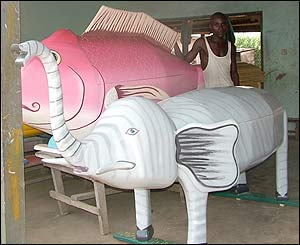
Even Ghana’s director of tourism may have to admit that Accra has its work cut out competing with other tourist destinations in Africa. Yet just outside the capital, is the suburb of Teshi and it is here that tourists are coming to look at a relatively new tradition – the fantasy coffin makers.
So how did this happen?
The story goes that in the first half of last century one Ata Owoo was well-known for making magnificent chairs to transport the village chief on poles or the shoulders of minions.
When Owoo had finished one particularly elaborate creation, an eagle, a neighbouring chief wanted one too, this time in the shape of a cocoa pod. A major crop in Ghana.
However, the chief next door died before the bean was finished and so it became his coffin.
Then in 1951, the grandmother of one of Owoo’s apprentices died.
She had never been in an aeroplane, so he built her one for her funeral.
And a tradition was born.
The only bit of what might be BBC politically correct boringness that I could detect in this report came a few paragraphs before that last quote, where it said:
Many of their clients want to bury loved ones in something that reflects their trade.
Even if that means being buried in a Coca-Cola bottle.
Even? I suppose if you are the BBC, that is the ultimate horror. But, if being buried in an airplane or a car or a cockerel or a cocoa pod is okay, then what on earth is so wrong with being buried in a Coca-Cola bottle? (Not Diet Coke obviously. That would be stupid.)
Something tells me that in these post-Christian times, this might spread to other parts of the world. Our boring British death industry could certaionly do with a shake-up. What kind of giant object would you like to be buried it?
It is good to read some good news coming out of Africa. True, African people are dying, but they are mostly dying of natural causes and are going out in style.
If you have not checked out the marvelous Social Affairs Unit blog recently, please let me commend some simply splendid articles that have appeared of late, such as Stumbling towards the EU door marked exit. In particular, keep an eye out for all the ‘Maurice and Gerhard’ articles.
I was on the road again today, or perhaps I should say ‘rail’. The US northeast is still very much in the deep freeze as one can see from this photo I took somewhere before Baltimore.
 Photo: Copyright Dale Amon, all rights reserved. Photo: Copyright Dale Amon, all rights reserved.
The AMTRAK Acela train seemed to require more resets than a Microsoft Operating system. We were stopped a half hour on a siding while they attempted to ‘reset the air’; and later for problems in the lead locomotive. My ‘express’ train trip took nearly five hours from Penn Station NYC to Union Station DC and wrecked my plans for meeting up with some aerospace types in town. I will not complain too loudly though. The trains have normal AC power available for your laptops, you have enough legroom and arm room to actually type… and you can use your mobile phone.
As opportunity arises – I am now on another gig and my meter is running – I will catch up on a few photo stories left over from Manhattan.
At a Samizdata social gathering a few months back, one of the attendees (I think it was Patrick Crozier) posed the question of how much influence the blogosphere was having on the ‘real’ world.
The answer I gave at the time was plain and direct: none. A rather negative prognosis for sure but sincere and truthful as far as I was concerned.
However, my candour was not well-received. My dear chum Brian Micklethwait, in particular, took issue with me claiming that the blogosphere could well have be having an impact in ways that were not yet manifest. I countered this with the contention that in the absence of evidence of influence, one must assume that there is no influence at all.
Anyway, if memory serves, the rest of the bickering trailed off into a lake of libation and no firm conclusions were ever reached (are they ever?).
Since then, I have been forced to qualify my above-stated position because, in common with most other bloglodytes, I am all too familiar with the ‘Rathergate’ scandal over in the USA; a incident of such profile that it has made it impossible to deny that blogging is now having some degree of impact on the wider American polity.
But, as far as the UK is concerned, I have maintained my stance. Sadly and frustratingly, neither the blogosphere nor anything else seems to have been able to lay a glove on the great, heaving, suffocating beast of the hegemonic British intellectual climate.
That was my view. Until today. I required some proof to the contrary and now there is infallible proof:
Online journals and camera phones are a “paedophiles’ dream” which have increased the risk to children, the Scottish Parliament has been warned….
Rachel O’Connell said adults could use weblogs to learn about children….
She said: “This is just a paedophile’s dream because you have children uploading pictures, giving out details of their everyday life because it’s an online journal.”
I refuse to even attempt a rebuttal of this ludicrous and obviously desperate smear, preferring instead to let it stand naked in all its ignominy. Besides, it will not be the last. Blogging has clearly begun to make an impression on the minds of the political classes and they fear it.
The blogosphere has now landed in Britain.
Although Samizdata concerns itself with more important things than mere politics (thankfully for our collective sanity), it seems wrong that we should pass let without record the government’s announcement of its intention to introduce indefinite executive detention for UK citizens. For those who missed the vigourous Parliamentary debate (which must have lasted at least 15 minutes), in future anyone may be locked up indefinitely in their own home on the say-so of the Home Secretary, based on evidence known only to him.
The Daily Telegraph appears to blame the Human Rights Act, noting that this decision is ostensibly being taken because the Law Lords said that it was illegal to empower the Home Secretary only to detain foreigners arbitrarily. This view is advanced notwithstanding Lord Hoffman’s ditcta that applying such a equally rule to British citizens is no more defensible. But it is an absurd idea that such unlimited arbitrary power of arrest and detention is something the government reluctantly finds has been thrust upon it.
On the 60th anniversary of the liberation of Auschwitz, I am tempted to wonder about the timing. Is this just a good day to bury bad news? Is it some kind of sick joke? Is the government double-daring libertarians to announce the beginning of the police state on the day we remember the ghastly outcome of arbitrary rule? Whatever the truth, it is a black day.
… it pays to ask if they are in a shark-repellent salesman before deciding just how risky swimming really is.
Do bad people use the Net to find victims? Without doubt they do and I would not make light of the harm that can be caused by ‘paedophiles’. Yet so often when I hear of the ‘epidemic’ of child abuse going on, it turns out that the story emanates from some agency or NGO who just so happens to have its funding come up for review or who are in some way rattling their begging bowl. But of course who would deny funding to people who only want to protect children? And who would questions the additional motivations of people who make their living in this line of work, not to mention the veracity of the figures for just how serious a problem it really is? To ask those sort of things runs the risk of having your motivations and ‘interests’ questioned in ways that would make most decent folks rather uncomfortable.
But just as legitimate grievances about civil rights have in many countries spawned monstrous civil rights industries that are little more than vehicles for shaking down certain sections of society and which have a vested interest in perpetuating the idea that some problems are worse than they really are, I have little doubt that legitimate concerns about internet predators have already led to something similar in the ‘preventing child abuse industry’. Oh, do not get me wrong, I neither doubt child abuse is a real and legitimate issue nor do I think everyone who works to prevent it is just looking to pad their bank accounts, but given how much I surf the net, I cannot help thinking that the scale of this problem does not seem to match the shrill rhetoric we hear on the subject. To listen to some people the fact I managed to grow up going to untended playgrounds and not treating adults as probable abusers… and yet somehow managed to never attract the attentions of a ‘kiddie fiddler’ must make me the luckiest lad around. Yet somehow I rather doubt that.
Cynical? You bet.
This is beyond the pale. It is completely insensitive and at a time like this, what idiot would shoot an advertisement for TV that used suicide bombers? Appalling…
…Yeah. But I must confess, I howled with laughter.
Due to busy schedules of infiltration and meme planting, Jane Galt and I were only able to meet briefly in a Moroccan bar, a mere hour stolen from our labours.
Photo: Copyright Dale Amon, all rights reserved.
But… it was time enough for plotting the conquest of the Universe and giving thanks to RAH (All blessings be upon him). We also pondered her possible infiltration into London.
Might Jane one day appear at a super secret Samizdata HQ party? Might she and Adriana sit and discuss the quiet feminine art of marksmanship and trade product information on their favorite gun cleaning products?
Should it ever happen, we will be certain to bring you the spy camera photos posthaste!
Orange seems to be a pretty good colour at the moment. After all, the soundest thing to ever come out of the Liberal Democrats was called The Orange Book. Now there is a website by some classical liberals (rather than Liberal Democrats) called The Orange Path. The authors claim that liberalism is “bright, zesty and Orange”. They point out that:
Whether knowingly or accidental, some of the landmark texts of classical liberal scholarship have orange front covers – a curiosity easy to overlook. The University of Chicago Press published FA Hayek’s The Constitution of Liberty in 1960, Milton Friedman’s Capitalism and Freedom in 1962/1982 and James Buchanan’s The Limits of Liberty in 1975 – all liberal, all free, and all undeniably orange
Well, whatever. The point is that The Orange Path is a useful resource, aimed at helping the left to understand classical liberal ideas. Take a look.
There is a fine article by Tory MEP Daniel Hannan in the Telegraph called The EU’s four-stage strategy to reduce Britons to servitude. It is an entirely accurate and reasonable article about the process of stripping British (and other European national) institutions of power and replacing them with Euro-level institutions.
He finished up with the notion that Michael Howard and the Tories will finally turn things around:
Mr Howard understands this very well. Not only is he a lawyer himself but, as home secretary, he clashed almost weekly with our judges – not least on immigration cases. He must have known that the EU would react as it did to his proposals: indeed, I suspect he was banking on it. He has said before that he wants to take powers back from Brussels but, until now, the issue on which he was planning to go into battle – the recovery of our fishing grounds – seemed rather marginal to most inland voters. Now he has found a casus belli where the country will be behind him.
It has been a besetting British vice that we ignore what is happening on the Continent until almost too late. But, when we finally rouse ourselves, our resolve can be an awesome thing. I sense that this may be such a moment.
But there is just one problem with that. The slide into the Euro-maw did not start under Tony Blair’s government. In fact it would be no exaggeration to say that the UKIP would not exist today if significant numbers of Euro-sceptic voters were not sick of being lied to again and again and again by Tory politicians. As I said to a table full of captive Tory grandees when I spoke at an event commemorating the end of Exchange Controls, a great many Tory voters simply no longer believe that the Conservative Party actually wish to conserve the things they care about and I very much doubt that any amount of rhetoric by any Tory will win back the trust of days gone by. Many of those former Tories who joined UKIP did so not just to oppose the destruction of Britain as a separate political entity but also because they truly hate their former party and see UKIP as a way to destroy it by making it permanently unelectable.
So what Mr. Hannan says is all good stuff, but what makes him think people should trust the party of Michael Heseltine, Ken Clark and Chris Patten to actually turn things around?
By all means, wear pyjamas in the privacy of your own bedroom. Wear them round your own house, even. But I am frankly disturbed that the art of dressing oneself has transmogrified these days into a competition to see who looks most like they got their clothes out of a recycling bin. We don’t all have to look like the poor and starving in order to persuade others that we care. It’s a big lefty trend, and now is the time to reclaim the clothing-sphere as something capable of expressing more valuable ideas than, “I wouldn’t wear a Gucci suit if you paid me.” Improving your style isn’t about getting different writing on your t-shirt. It’s about conveying who you really are. You are not a sack of potatoes.
– Alice Bachini last Sunday (good to see she still knows how to spell pyjamas)
|
Who Are We? The Samizdata people are a bunch of sinister and heavily armed globalist illuminati who seek to infect the entire world with the values of personal liberty and several property. Amongst our many crimes is a sense of humour and the intermittent use of British spelling.
We are also a varied group made up of social individualists, classical liberals, whigs, libertarians, extropians, futurists, ‘Porcupines’, Karl Popper fetishists, recovering neo-conservatives, crazed Ayn Rand worshipers, over-caffeinated Virginia Postrel devotees, witty Frédéric Bastiat wannabes, cypherpunks, minarchists, kritarchists and wild-eyed anarcho-capitalists from Britain, North America, Australia and Europe.
|





Recent Comments