We are developing the social individualist meta-context for the future. From the very serious to the extremely frivolous... lets see what is on the mind of the Samizdata people.
Samizdata, derived from Samizdat /n. - a system of clandestine publication of banned literature in the USSR [Russ.,= self-publishing house]
|
I suppose most readers around these parts would reckon that actors should stick to acting, and keep their political opinions to themselves.
But what about these opinions?
“People think more aid will help, but it won’t,” said Ms. Driver, an actress who is working on her second music CD. “Trade is the surest way of decreasing the savage amount of poverty in our world. These countries have got to be able to trade fairly.”
And the point is, by “fairly”, she does not mean being paid artificially high prices; she means getting rid of agricultural subsidies in the rich countries.
It was never a practical project to silence the acting profession. These people are famous. Having acquired their fame, they then want to use their fame to do good, and in the process to become even more famous. This is only natural, especially when you consider that doing good and being heroic is what, according to the entertainments these people spend their lives making and acting in, life is all about. Trying to stop famous actors from expressing what they consider to be virtuous and heroic opinions in public is like trying to stop the wind from blowing or the sea from being wet.
No, the task that faces us is not to silence the acting profession from ever opining about goodness. That would be impossible, to say nothing of censorious and unpleasant. Rather is our task to change the definition of goodness that actors of sufficient fame to care about such things reach for when they get to the public virtue stage in their careers, and to make goodness really mean goodness.
Ms. Driver’s pronouncements concerning the superiority of trade over aid as a means of rescuing the world’s poorest people is evidence that some progress is being made along these lines.
Many actors surely already believe such things, on the quiet. But it is still a fine step forward when one of them feels able to say such things in public.
UK authorities may be faced with a bit of a struggle in extraditing a man, now in Rome, for his alleged involvement in the failed July 21 terrorist attacks on the London transport system, according to this report.
So could some nice person remind me what the EU-wide arrest warrant is suppose to achieve, exactly? Oh, er, wait a minute…
The oldest “mini-aircraft carrier” used by Britain’s Royal Navy, HMS Invincible, is being retired from service. The vessel, from which Sea Harrier jets can operate – as well as helicopters – is more than 20 years old and was used in the Falklands War, among other theatres of operation.
As I said a while back, I have no ideological issue one way or the other about the exact composition of our armed forces, which must change with the times and respond to different threats to this country. Coming from a bit of a navy family myself and being an enthusiast over our island’s naval history, I am nevertheless the first to realise that sentiment must not trump hard calculation when it comes to manning our defences. But it bothers me that our navy has been reduced to a level that makes independent military action by this country a logistical impossibility. It is probably quite unlikely that we could mount a Falklands-style operation on our own again. The present government wants, so it is reported, to build two new massive carriers but as is usually the case in these matters, the likely date of construction seems to stretch into the horizon, rather like the prospect of England beating Australia at cricket.
In an age when we fret about islamofascist psychos letting off bombs on the Tube, it may be tempting to think that the Senior Service’s role is little more than to patrol the coasts and put on commemorations about the Battle of Trafalgar. How complacent that would be. Given that we are an island nation, still reliant on shipping for a huge amount of our economic and physical wellbeing, such an attitude is fraught with danger. We could run the risk of cutting the fleet so hard that we lose the inner core of skilled men and women needed for the service.
With the exception of anarcho-capitalists, even the most hardcore classical liberal realises that defence is a baseline requirement for a proper state. And for an island nation like Britain with a long coastline, that means having a workable navy.
Yesterday, I travelled as a foot passenger to Calais on the ferry from Dover, as part of a group celebrating the birthday of a long-standing friend. It was ironic to read the Times on embarkation controls and experience the poorly organised efforts of the Immigration Service. After checking in, all foot passengers are taken on a courtesy bus towards the ferry. However, as the embarkation infrastructure was dismantled in 1998 to save money, they have established an ad hoc arrangement. You have to exit the courtesy bus twice, once to show your passport, the other time: to check your luggage. Such practices were not in evidence on the return journey from France.
We noticed that there were two or three Asian men holding camcorders and filming stairwells, restaurants and the maps of the ferry. This may be innocent behaviour but we took photos of them. The photos have been passed on to the Kent constabulary. This could be something or nothing, but vigilance is the purview of the alert citizen, not a monopoly of our less than competent authorities.
Calais, itself, is a nondescript town whose tourist potential is undermined by the large numbers of illegal immigrants who loiter around the parks and telephone boxes. Most appeared to be from the Middle East of the Horn of Africa. For a Saturday afternoon, they did little apart from sit or chat, cultivating indifference to the French or the holidaymakers. When attempting to look at a map of the town of Calais, that a group of them were obscuring, they quickly got out of the way. Perhaps this indicated past encounters with the French police and a fear of transgressing unspoken rules. Whatever the set-up, they have no place to go apart from the public spaces.
The local beer is worth imbibing and we found a well-stocked Irish pub near the main square that deserves patronage. Nearby is the local war museum, housed in a bunker, with jumbled momentoes of the occupation. Calais suffered heavy damage during the Second World War and testament is apid to this suffering with the photos of local landmarks, just situated outside the bunker, surrounded by piles of rubble and destroyed buildings. A vivid and revealing contrast of sixty years of peace.
To conclude, Calais does not cater for the tourist. We had to walk out of the ferry terminal and into town. Unlike any previous country I have visited, there was no sign for taxis or taxi ranks to pick up arrivals. One existed at the local station in the town although we had to wait for some time before a people carrier appeared. One could muse at the unmet demand for transport from strangers which the locals did not appear to consider a profitable enterprise. You could not help commenting that, in Britain, some of those sitting in the parks would obtain work by driving minicabs, and relieving the taxi drought.
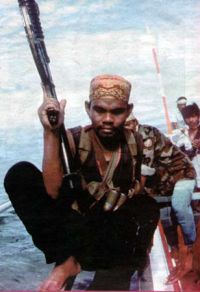
Piracy in the Straits of Malacca has been a serious problem for many years now and shipping companies have grown tired of waiting for governments in the region to do something effective to stamp it out.
So they are hiring private companies to do it instead. Sounds like an exciting line of work.
Attempts to use the Kelo ’eminent domain’ ruling to take property in New Hampshire from US Supreme Court Justice David Souter have now been extended to trying to do the same to Supreme Court Justice Stephen Breyer.
This is splendid but maybe it would be good to extend this to Senators and Congressmen and particularly much lower level local politicians who collude with property developers. Some of these people often have property outside the jurisdiction they live in (and thus maybe be vulnerable to politically or personally motivated grudges from other elected representatives).
The important thing is to make as many members of the political class uneasy that they could be targeted. What is sauce for the goose is sauce for the gander.
Franklin Cudjoe, Director of the Ghanaan think tank Imani, who has been visiting the UK in order to contest the nonsense being spouted about how to solve Africa’s problems by Live 8 etc., gave a fingerclickin’ good talk at my home on Friday. The fingerclickin’ being a reference to the amount of money stolen every second – $4,700 – by African governments. My thanks to Helen Szamuely for also reporting on this event.
Ghana sounds like a relatively prosperous and urbanised country, by African standards, and it was interesting to hear an African talking about the complications of airline deregulation and exactly how much members of parliament get paid per day (enough to keep them snugly on board the gravy train, no matter what they may have said at election time), rather than just famine, malnutrition, etc.
The anti-globalisation crowd say that multinational corporations are causing corruption in Africa. Actually, they often find it a huge barrier to trading in Africa. KLM wanted to run some flights from Ghana to neighbouring African countries, but the bribes demanded of them were too extortionate, and they pulled out. Travelling between countries in that part of Africa seems to involve choosing which bunch of state highwaymen you prefer to be shaken down by. It is understandable that, economically speaking, lots of colonial African countries used to look outwards, so to speak, with most of their trade being organised by their colonial masters. It is not so understandable why this is still the pattern.
I asked Franklin who in Ghana he thinks is doing the most to improve the place. His answer was the Ghana Centre for Democratic Development. What Africa needs is good government. And the way to start trying to get good government is to talk and write out loud with anyone who will listen – especially the next generation – about what that is and ought to be. There as here, in enterprises of this kind, the internet has helped
Franklin sounded a lot like Hayek – which is no coincidence, because he talked about how much Hayek had influenced his early thinking – in his insistence upon the intellectual struggle as the first step in trying to achieve anything more concrete. You get nowhere by nagging politicians direct. You have to change the assumptions within which they work. That takes time but it can be done, and by the sound of it he is doing his best.
Michael Jennings pointed out that all over the Far East, lots of those little upwardly mobile trading niches that used to be occupied by the Chinese diaspora are now occupied by the Ghanaan diaspora. Clearly there is nothing wrong with the talents of the Ghanaan people. They just need the right setting to flourish in.
Forgive me if I am not breaking out the champagne just yet at the announcement that the ethnic collectivists of the IRA have declared their ‘armed campaign is over’. Of course the fact their ‘decommissioning’ of arms will take place in private, in marked contrast to the indecent haste with which the UK government has started very publicly ripping down its fortifications, just conforms my view that Blair is a credulous fool.
Contrary to the woolly impression some of the media’s dafter talking heads are giving (I really must stop watching early morning TV, bad for the blood pressure), the IRA is not disbanding and unless I see large piles of semtex being burned in front of Stormont, I very much doubt anything more than a token number of already unserviceable weapons and expired explosives will be put beyond their reach as an organisation.
I may not be a huge fan of the ethnic collectivists of the DUP either, but they are the ones who seem to me to be exhibiting the most appropriate amount of continuing distain for Sinn Fein/IRA and so are offering only highly contingent acknowledgement of this latest ‘breakthrough’.
My guess is there is a lot less to this that meets the eye. Like the song says: “Don’t believe the hype.”
Police have now arrested all four of the would-be suicide bombers who attempted a second round of terrorist mass murders in London on the 21st July. This is splendid news. Kudos also to Italian police who picked up one of the targets in Rome.
Unsurprisingly, there is a lot of comment out there in dead-tree media and the electronic versions about religion and its relation vis a vis the state at the moment. (Full disclosure: I am a lapsed Anglican Christian who read a lot of David Hume, much to the annoyance of my old vicar, no doubt). There is a bracing essay in the Spectator this week about the nonsense spouted in the usual places about “moderate” Islam.
The blog Positive Liberty, which has become a group blog like this one – has an excellent piece looking at the religious, or in some cases, decidely lukewarm religious, views of the U.S. Founding Fathers. These men, to varying degrees, were acutely conscious of the dangers of religious fundamentalism, having seen within their lifetimes the human price of it. As we think about the dangers posed by Islam in our own time, the insights of Madison, Adams, Jefferson et al are needed more than ever. The linked-to article is fairly long but worth sitting back and sipping on a coffee for a good read, I think.
It is in my view essential for the west’s future that the benefits of separating what is God’s from what is Cesear’s is made as loudly and as often as possible. Muslims must be made abundantly aware of this point for if they do not, the consequences could be dire. Maybe because of the role played by the Church of England in our post-Reformation history, we don’t have the tradition, as in the States, of keeping a beady eye on the blurring of the edges of temporal and spiritual. Cynics have of course argued that nationalising Christianity via the CoE has helped the cause of fuzzy agnosticism and atheism more than the complete works of the Englightenment. Well, maybe. It may have as much to do with the relative openness of British society, our ironical sense of humour (religious enthusiasm has often struck the Brits as slightly silly or unhinged, ripe for Monty Python treatment) and desire not to give offence.
I fear that sense of humour is going to be tested for the remainder of my lifetime.
People should not be afraid of their governments. Governments should be afraid of their people
Oh I am soooo up for this…
A powerful tornado has swept through the city of Birmingham in the West Midlands.
The twister struck earlier today, cutting a swathe of devastation through the districts of Kings Heath, Moseley, Quinton, Balsall Heath and Sparkbrook.
Mercifully, there are no reports of any fatalities but initial estimates put the cost of the damage as high as £7.50.
|
Who Are We? The Samizdata people are a bunch of sinister and heavily armed globalist illuminati who seek to infect the entire world with the values of personal liberty and several property. Amongst our many crimes is a sense of humour and the intermittent use of British spelling.
We are also a varied group made up of social individualists, classical liberals, whigs, libertarians, extropians, futurists, ‘Porcupines’, Karl Popper fetishists, recovering neo-conservatives, crazed Ayn Rand worshipers, over-caffeinated Virginia Postrel devotees, witty Frédéric Bastiat wannabes, cypherpunks, minarchists, kritarchists and wild-eyed anarcho-capitalists from Britain, North America, Australia and Europe.
|





Recent Comments