We are developing the social individualist meta-context for the future. From the very serious to the extremely frivolous... lets see what is on the mind of the Samizdata people.
Samizdata, derived from Samizdat /n. - a system of clandestine publication of banned literature in the USSR [Russ.,= self-publishing house]
|
The Buddha and the Sahibs
Charles Allen
John Murray Publishing, 2003
It came as something of a surprise to me that so much that is now known about the Buddha (the “Wise One”, not an exclusive title in his time) seems to have been discovered by Europeans, who, later joined by the Americans, played a large part in the revival of Buddhism in the East, as well as its spreading into the West. It may be a fault in this book that the reader is really left in the dark as to the actual tenets of Buddhism. There have been plenty of investigators eager to claim significance for their discoveries, but their painstaking translations are rarely quoted and Asoka’s famous much-carved edict, triumphantly deciphered after 2000 years of incomprehensibility, and generally deploring violence, is more noted for the rarity of such an expression of its sentiments than for anything profound or even unusual about them.
Undoubtedly a historical person, the Buddha was born Siddhartha, prince in a small Sakya kingdom on what is now the Indian-Nepali border, into the Gautama tribe or clan: Sakyamuni and Gautama are thus other designations, as well as Burkhan (holy). The trouble with written records in the subcontinent at this time and for many centuries to come is that they were extremely perishable, ranging from bark in the north to palm leaves in the south. There were inscriptions on rocks and pillars, but ability to read them had long been lost. Oral traditions, however venerated, could not be regarded as reliable.
Most histories and reference books I have looked up give 568-463BC for the Buddha, or a few years earlier, linked to the known reign of the Mauryan king Asoka, 273-232BC. Allen favours the Sri Lankan source for 624-542BC, as Buddha’s lifespan, while Keay in his India, a History puts his death between 400 and 350BC, two or three generations before Alexander the Great’s incursion.
Enter the sahibs, from the late 1700s on, mainly younger sons or others from impoverished families or both, joining the East India Company, where it was possible to make a fortune, if one survived, for in that climate mortality was heavy. Enough of them manifested curiosity about the country to which they’d come to learn its languages and look at its monuments. Sanskrit (spelt Sanscrit by those who wrote about it at the time), the ancient language, from which the various languages and dialects of North India were derived, was kept by the Brahmins as far as possible a secret from others trying to find out anything about it. → Continue reading: The Light of Asia into western eyes
In the debate on software patents, the defenders of patents use moral and theoretical arguments, but avoid using data or facts. Different people are good at making different types of arguments. I am a believer in the division of labour. So not everyone will use empirically-rooted arguments. But it seems a bit odd to me that I cannot find anyone who writes things like:
Because Microsoft did not have a patent on the graphical user interface, it made a decision not to invest in operating systems, but because it had a patent on X it increased R&D in that area by 582%.
Instead, the supporters of software patents concentrate on theoretical arguments. As an example, take this article by a patent lawyer writing about software:
In a market where inventions cannot be protected in order to yield a return on the invested resources, very few would be prepared to make those investments available.
I like theoretical arguments, and the argument in the paragraph above is a perfectly reasonable position to have. But if patents really do have a beneficial effect in software, shouldn’t someone somewhere be able to give us some figures to back up that idea? Where is the empirical evidence?
Peak Talk has the perfect summation of the tragic affair of the murder of Dutch film maker Theo Van Gogh by a Muslim fanatic.
Anthony Batty asks if we really need the Competition Commission to promote competition between UK supermarkets.
In the news recently, the UK’s Competition Commission has been flexing its muscles in the area of supermarkets. Somerfield may have to sell stores, after buying what Morrson’s did not want after acquiring Safeway (a one-time subsidiary of the American supermarket company).
Do these people really feel that by virtue of the fact a supermarket has two stores within some arbitrary distance they have a monopoly? Or are able to raise prices and earn large profits? For starters the barriers to entry for say Iceland to open a new store are simply planning permission. If they feel customers would use the shop I am sure at least one of the major players would open up a store. Not to mention continuous competition from supermarket home delivery, local shops and the fact people may just drive another few miles if they do not like the selection they are offered. Supermarkets are one of the most competitive areas in the modern economy, if a company does not keep pace with the efficient supply chain, changing demand (such as the low carb craze that swept through the UK) it will find itself the target of a takeover bid, or in administration. This is not because of the work of government departments; rather it is the free market at work. Only through this competition can we find which stores give us what we want, at a price we are prepared to pay. If one firm is not performing we go elsewhere, if prices are too high we use an alternative retailer. There simply is no need for bureaucrats to be in charge.
I do agree however, with the basic premise of more competition. For this reason I find myself reverting to a point made by the late Screaming Lord Sutch, why is there only one Competition Commission? (In his day, the Monopolies and Mergers Commission.) Surely in the interests of competition we should have several. By allowing new entrants and getting rid of the protected monopoly that exists at present, firms can choose between different conclusions and suggestions. Lower administration costs and fewer worries about whether or not an action will be allowed, means lower prices for consumers. In that way we will have free and fair trade, without the diktats that are not in the interests of firms or consumers.
About a year and a half ago, Terence Kealey gave a talk at a Hobart Lunch at the Institute of Economic Affairs arguing that a world without patents would be more innovative. Dr Kealey is a biochemist who is Vice-Chancellor of the University of Buckingham and the author of The Scientific Laws of Economic Research.
It was one of the most interesting events I have been to at the IEA, and the audience was very much split which made for an entertaining Q&A session. I disagreed with Dr Kealey at the lunch, but I recognized there was something to what he said. The lunch was something of a life-changing experience because I have subsequently moved towards his position, though I’m not there yet.
One of the most difficult aspects of thinking about a world with less or no patent protection is that it is so hard to imagine. When thinking about a Britain with a denationalized National Health Service, you can visit mainland Europe or America and see how systems work in other developed countries. Country comparisons aren’t so easily available when it comes to patents.
But one market – that of software – clearly shows that fast innovation can occur without patents, at least in the area of software. If software patents had existed in the US from day one, and if there had been a culture of patenting everything, we might live in a very different world today. We might sit in front of our computers today and see this:

And people would pronounce in public: “Thank goodness that we have software patents. Just as property rights in physical property enables economic development, software patents enable software development.” And they would post articles to that effect on the internet, known in this alternative reality as The Microsoft Network, which might look like this:

And everyone would be thankful that we have a system that clearly and undeniably promotes innovation.
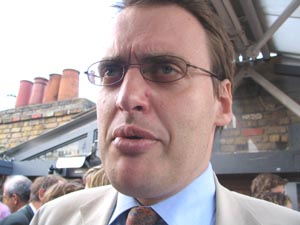
Harry Phibbs is one of those people who is not nearly as much of an ass as he often pretends to be. In fact, often pretending to be an ass is just about the only assinine thing about him.
Here he is, pictured at that Globalization Institute launch that everyone who was anyone was at, talking about I have no idea who, but almost certainly saying that they ought to be horsewhipped.
But he is and has long been an excellent writer. Here is his excellent description, at the SAU blog, of what it is like being a school governor (while remaining Harry Phibbs of course). I particularly liked this bit of reminiscence:
School governors are entitled, indeed encouraged, to visit the school once a term or so. They also have a chance to report on their visit. I once caused consternation at a primary school in St John’s Wood where I was a governor a few years ago. Reporting on a visit I had made to the school, I named a Bosnian child who had recently arrived at the school. He was unable to speak English but was very good at sums. Essentially his entire time at school was being wasted. For most lessons he stared blankly unable to understand what was going on. In the maths lesson however he managed to correctly complete a whole sheet of sums within seconds which kept the rest of the class going for the whole lesson. Of course he should have been given harder sums and special help to learn English. “We are letting him down”, I declared. Later it was proposed by one of the teachers that reports of governor’s visits should be restricted to general comments as it was “inappropriate” to make comments which should be made by school inspectors.
But I was backed up by the other governors who agreed there was little point in having school visits if specific criticisms could not be made. I never found out if the boy was given harder sums to add up.
Harry also writes about the beneficial effects of Jamie Oliver on school meals, and gives chapter and verse of how much money is spent on each pupil, and who by. (Clue: bureaucracy.)
Read, as we bloggers so often say, the whole thing.
Now this is what I call ‘global justice’:
A thirsty thief is being blamed for downing a bottle of water, valued at £42,500, at a literary festival.
The two-litre clear plastic bottle containing melted ice from the Antarctic was devised to highlight global warming by artist Wayne Hill….
The piece, entitled Weapon of Mass Destruction, vanished half way through the festival. Mr Hill fears the bottle was taken and then drunk.
“It was there and then it was gone,” he said.
Just like dozens of claptrap, modish, end-of-the-world theories then.
Yes, yes, I know, his girlfriend is Sheryl Crowe, he is supported by John “doh” Kerry, which may suggest he is in need of ideological help, but can anyone doubt, after winning the Tour de France for 7 times in a row, that Lance Armstrong is one of the greatest athletes to have ever lived?
And he comes from Texas. If I was a Frenchman, that has to hurt.
More from the “You couldn’t make it up” department. David Carr is fond of saying that the satyrist’s trade is hard these days, because reality has a habit of being so very much more satirical.
This is presumably the kind of thing he means:
Slovakia and Hungary are being served notice that the Commission is about to take them to the European Court of Justice for not complying with certain parts of EU legislation.
Apparently, neither country has implemented a number of directives on maritime safety. Slovakia is being warned about having no legislation to do with passenger ships and prevention of pollution.
Hungary has no “availability of port facilities for ship-generated waste”. Actually, Hungary has no ports or ships, being land-locked, as is Slovakia. That, apparently, is not the point.
The history of the USSR is repeating itself as farce. EUSSR. And the USSR was pretty farcical to begin with.
Speaking of David Carr and the EU being farcical, whatever happened to Bertrand Maginot. I miss him. The imposition of environment-friendly port facilities on landlocked countries sounds like something he would understand perfectly. It would be interesting to hear his view on this issue.
Steve Ranger of Silicon.com reports that the British Foreign and Commonwealth Office is spending 5 million pounds (about $8.7 million) to equip its embassies and consulates around the world with the technology to issue biometric passports. Technology company 3M will install new passport issuance systems that can identify biometric information at 104 embassies, consulates and high commissions.
Great, who needs ID cards, when you get your fingerprints in the passport.
Although they have come late to this story, The Times has also noted Scott Burgess’ TKO of the Guardian regarding their employment of an Islamic extremists and subsequent firing of him once the story came to light.
It is a pity The Times did not also pick up on the bad grace in which The Guardian took their lumps, what with their snarky no-by-line remarks about how “Scott Burgess, a blogger from New Orleans who recently moved to London, spends his time indoors posting repeated attacks on the Guardian”, recalling the “guys in pyjamas” sneer made by someone at CBS following a similar humiliating mauling they received at the hands of the blogosphere. If ever you need a clear indication you have landed a painful blow against a MSM target, you have but to look for a petulant ad hominim response.
Moreover, it is fascinating how The Guardian inaccurately (follow first link to Media Guardian) attributes this incident breaking into the mainstream media down to “rightwing US bloggers” when the truth is that whilst Scott Burgess (an American living in London) sounded the charge, he was rapidly followed by Labour supporting British blog Harry’s Place and ourselves (no great fans of the Tory party either), to name but two of many largely UK based blogs. The Guardian’s take on this is therefore either shoddy reporting or a case of seeing what you choose to see.
Still, nice to see that the broadsheet newspapers do not feel any need to close ranks over this story.
The Sage of Edmonton has been listening to the cricket, and has stumbled on Australia’s dirty little secret:
The Australian networks are picking up the BBC feed, so the network observes a strict one-Brit one-Aussie rule at all times in the booth. This leads to a lot of barbed, culturally volatile exchanges covered by a transparent shellac of collegiality. The English are generally poor at hiding their commingled fascination and horror at the gusto and glowing health of the Australians. The Aussies, for their part, maintain a suitable Zarathustran superciliousness–but it sure seems like homo australis is awfully vulnerable to the verbal stiletto that every Englishman above the age of four carries in his boot. Every time the various English broadcasters start to wax acerbic, their Australian colleagues become flustered and try changing the subject to the events on the field (as well they might, since their squad is making England’s cricketers look more like Scotland’s). Has any attention been paid to the Australian sense of humour, or absence thereof? They seem to mostly export soap and pop stars to the wider world while their British and Canadian brethren airlift comedians. It’s not a good sign when your most sophisticated national ironist is Dame Edna Everage.
Most Australians will deny it, but Colby Cosh is right on the money. In my own case, I never had a chance; not only am I Australian, but I am descended from Germans. I could not tell a funny joke to win the Ashes.
This is not to say that Australians do not have a sense of humour. Comedy is a big thing here, but Australian humour does not translate well, being full of allusions that only the locals understand. And I sadly suspect, the quality is not that good either.
Why is it so? Or is it obvious, and, me being Australian, I missed the punchline?
|
Who Are We? The Samizdata people are a bunch of sinister and heavily armed globalist illuminati who seek to infect the entire world with the values of personal liberty and several property. Amongst our many crimes is a sense of humour and the intermittent use of British spelling.
We are also a varied group made up of social individualists, classical liberals, whigs, libertarians, extropians, futurists, ‘Porcupines’, Karl Popper fetishists, recovering neo-conservatives, crazed Ayn Rand worshipers, over-caffeinated Virginia Postrel devotees, witty Frédéric Bastiat wannabes, cypherpunks, minarchists, kritarchists and wild-eyed anarcho-capitalists from Britain, North America, Australia and Europe.
|





Recent Comments