We are developing the social individualist meta-context for the future. From the very serious to the extremely frivolous... lets see what is on the mind of the Samizdata people.
Samizdata, derived from Samizdat /n. - a system of clandestine publication of banned literature in the USSR [Russ.,= self-publishing house]
|
The British Government can solve its pensions crisis. But it doesn’t want to. Having spent all their lives trying to persuade everybody that they can offer something for nothing because somebody else is paying, all policians find themselves unable to break the habit. Having quietly seized exorbitant benefits at the general taxpayer’s expense (on the excuse that they are poorly paid, which isn’t true now, if it ever was), public sector employees are not letting go.
In the Carboniferous Epoch we were promised abundance for all,
By robbing selected Peter to pay for collective Paul;
But, though we had plenty of money, there was nothing our money could buy,
And the Gods of the Copybook Headings said: “If you don’t work you die.”
– R.Kipling
An unfunded national pension scheme avaialable to the majority of the population is much like a Ponzi scheme: a pyramid ‘investment’ trick that is illegal everywhere–except when operated by governments. It depends on ever more suckers paying over ever more money (in this case, compelled by taxation) to finance the unfeasible returns promised to those entering earlier. The trimming of the Turner Commission just beds the con in deeper. We can expect a trivial postponement to distract attention from more pensions, more taxation, and a bigger future squeeze.
The simple (and only) solution is to follow the example of Bismarck when he invented the national pension. Convert an unsustainable Ponzi into a Tontine: a survivor benefit scheme. The pensionable age must be raised above the expectation of life, so that most people do not live to receive it. How much above depends on the benefits one wants to grant.
The corollary is even more unpalatable to politicans. The much more generous unfunded pensions for public sector workers, including themselves–unless they are to take an ever greater and ever more resented share of national income–must begin at *older* ages than the open national scheme. Until civil servants retire at 80+, and unfunded pensions for the general public start at 75, we will know the government (with both sizes of G) only cares about looking after its own, and that the vapourings about “crisis” are a just a smokescreen for more control over private income and savings.
An unfunded pension is like a university education. If everyone has one, you can’t expect it to be worth anything.
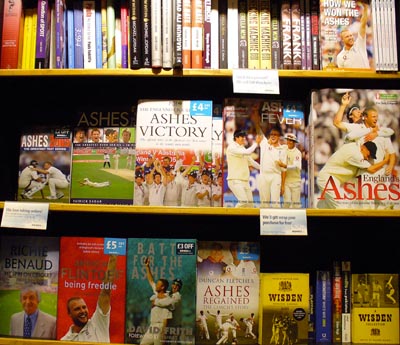
How quickly this (click on this picture to make the triumph even bigger!) . . .
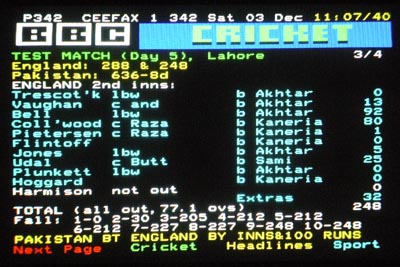
. . . has turned into this:
After England sneaked the Ashes 2-1, they have now been soundly beaten 2-0 by Pakistan. Ashes to ashes, dust to dust. If Warne don’t get you then Shoaib Akhtar and Danish Kaneria must. I wonder what Al Qaeda will make of that.
All very catastrophic. Until you turn your mind to a real catastrophe. To put all of the above in perspective, spare a thought for cricket in Zimbabwe, a grain of sand through which to see the chaos of the world out there. → Continue reading: Cricket and not cricket
Mr Drucker says that modern government can do only two things well: wage war and inflate the currency. It’s the aim of my administration to prove Mr Drucker wrong.
– Richard Nixon
MP Andrew Dismore has blocked attempts to clarify the law on self defence in Britain being proposed by MP Anne McIntosh, because he thinks it would be ‘vigilante law’.
Well I have thought for some time now that non-state use of force in defence of life, limb and private property is exactly what is needed in this country and to make no apology for robustly defending what is yours. Take the law into your own hands because it is indeed yours to take, not Andrew Dismore’s to deny. I realise that if you are old, infirm or a small woman living alone, the fact the state has disarmed you means you have no option whatsoever but to surrender your property and just pray the criminal(s) will not harm you, but those of us still physically able should be encouraged to use whatever weapons they can find at hand to assert some self ownership. Just do not make the mistake of calling the Police in Britain after the fact if you can possibly avoid it as they work for the likes of Andrew Dismore and are not there to serve you.
You may not have the legal right to fight back effectively, but you will always have the moral right to defend yourself and what is yours. Look at it this way, if you are the only one left alive after some son of a bitch breaks into your house, well, that means it is going to be hard for him to sue you or contradict your version of events, doesn’t it. If they do make it out, then just clean up the mess and deny everything.
Vigilante law? As so many members of the political class in Britain leave us with little alternative, I am all for it. When the state fails in its most fundamental duty, it is time for society to remember whose law it really is. If you are able to, fight back, just keep in mind you will be fighting back against the state as well and act accordingly when the plod turns up a few hours or days later to ‘protect’ you.
Both of which are generally lacking in the public discourse, on the war in Iraq.
First, Mr. Scott accurately captures the view of Iraq held by the quagmiristas:
I can only imagine the perception that many Americans have of Iraq; some nation in the Middle East where jihadists multiply, the Iraqi security forces resemble the keystone cops, U.S. forces are helpless against roadside bombs, and the situation is so dire that only disengagement can solve the problem.
Sound familiar? It contrasts rather markedly with the data, which Mr. Scott summarizes to paint a picture of an Iraqi insurgency that peaked in the months before last year’s Presidential election (and Kerry still couldn’t beat Bush!), and is now transitioning from decline to defeat. Interesting stuff, and food for thought.
Its a damned shame you never see anything approaching this level of factual detail and context in the media, and even in most specialty press, accounts of the Iraqi war.
My first posting on the Globalization Institute’s blog is about the almost hidden but massive transfers of cash by migrants workers to their families in under-developed countries. The following quote comes from Time magazine:
Mass migration has produced a giant worldwide economy all its own, which has accelerated so fast during the past few years that the figures have astounded the experts. This year, remittances – the cash that migrants send home – is set to exceed $232 billion, nearly 60% higher than the number just four years ago, according to the World Bank, which tracks the figures. Of that, about $166.9 billion goes to poor countries, nearly double the amount in 2000. In many of those countries, the money from migrants has now overshot exports, and exceeds direct foreign aid from other governments. “The way these numbers have increased is mind-boggling,” says Dilip Ratha, a senior economist for the World Bank and co-author of a new Bank report on remittances. Ratha says he was so struck by the figures that he rechecked his research several times, wondering if he might have miscalculated. Indeed, he believes the true figure for remittances this year is probably closer to $350 billion, since migrants are estimated to send one-third of their money using unofficial methods, including taking it home by hand.
There are two things I especially like about this growing trend. One is that unlike other forms of aid (including private giving by Westerners), the money tends to be better spent, because the donor is immediately related to the recipient. The second is I think unique to migrant workers. Normally there is a dependency trap: the money coming in is for a set term and will only be renewed if the recipient pleads continuing poverty. But migrant workers who leave their families behind have a strong incentive to watch out for improving economic conditions back home. As families achieve a tolerable standard of living they tend to reduce the amount of migration. The whole bureaucracy of aid is bypassed.
Thinking about it, perhaps giving a Christmas bonus of £100 to the office cleaner from Ghana or the Ukraine does more to make the world a better place than £200 given to an aid charity. We often hear about the benefits of cutting taxes, but here’s a new one. For each pound in taxes saved by low-income migrant workers, up to 40p will be transferred to a family in the developing world. That’s got to be a better return than the government makes of our money.
Unbelievable. Blair is actually going to fold on the EU rebate for the UK? Why? What possible advantage could it bring him politically to give away even more of our money to the parasites in Brussels?
What ever happened to:
If we cannot get a large deal, which alters fundamentally the way the budget is spent, then we will have to have a smaller EU budget
– Tony Blair
We were told that the British rebate would only be negotiable if the monstrous EU agricultural subsidies were also negotiable. Yet France et al have give up nothing whatsoever of any consequence, and yet the halfwit in Downing Street is going to give them want they want anyway? WTF?
I must be missing something here.
I receive many emails from something called UK Conservatism, but fear that if I try to stop them I will then receive further emails about sex toys, Asian ladyboy brides and such. So they keep coming.
The latest from UKC contains this easily misunderstood question, from the probably quite soon to be late Lord Tebbit:
The party recently fought its worst campaign ever. It offered cleaner hospitals, better schools, safer streets, limits on immigration and almost imperceptible tax cuts. But who campaigned for dirtier hospitals, worse schools, less safe streets or unlimited migration?
Yes. That is what the Conservative Party should have been saying!
I know what Tebbit meant, and he has a point. But meanwhile, seriously, if we did have a government committed to supplying “dirtier hospitals, worse schools, less safe streets” and “unlimited migration”, we would almost certainly end up with cleaer hospitals, better schools, safer streets, and the ideal immigration policy consisting of lots of the right people and far fewer of the wrong ones. Why? Because when we all know that the government is not handling a problem, there is a decent chance that the right things will then get done. By mere people.
Actually, I have had some very good experiences with extra large prawns.
– Michael Jennings
This is a remarkable story, concerning the DVLA. It is yet another case of the evil way in which the mixed economy is often mixed these days. What happens is that a government agency is compelled by some idiot law or other to pretend that it is a business, and to sell its “product”, to businesses who then stop being proper businesses and become crypto-state parasites.
And something like this happens:
What is happening is this: requests come in from businesses that have relevance to parking – clampers, car park managers, even a financial services company that happens to have a car park in which, notionally, people might leave their cars without permission. The DVLA charges a few thousand pounds for a link to its database, and thereafter the commercial company has only to tap in any registration number to be sent the owner’s name and address. If crooked, it could collect car numbers from anywhere in the country, enter them and thereafter know when you are away from home. Or it could send you threatening letters, of extortion or blackmail, citing your car details and claiming a violation.
But the DVLA wouldn’t deal with such people, would it? Yep. It does. It has been forced to hand over its list of the 157 companies registered to buy personal information about drivers – the list includes bailiffs, debt collection agencies and financial services companies. DVLA bleats that it is obliged – under an undebated Statutory Instrument of 2002 – to sell the information to anyone with “reasonable cause”.
As Libby Purves goes on to say:
. . . this piece of roughshod arrogance, done in the interests of tackling only the moderate nuisance of bad parking, throws a lurid light on what could happen to our privacy if we get ID cards to boost the “war on terror”. So far I have been lukewarm on the issue, only doubting that the cards would be good value (every atrocity so far has been committed by people whose papers were in order). But now I am not lukewarm. I am almost prepared to join Simon Hughes, the fiery Lib Dem, who has just pledged to go to prison over the issue. Given the casual attitude of the DVLA, willing to turn a penny by selling our addresses to any old crook, what would happen with information-rich ID cards and bureaucrats of similar calibre?
Indeed.
Finally someone has explained to me why such as fuss is made, and not just by idiot Frenchmen, about the military genius of Napoleon.
All I have seen for the last forty years or so is a very self-important general who liked presiding over slaughters, sometimes of the other fellow’s army, sometimes of his own, and frequently both. I have seen a land-locked leader who was comprehensively defeated by Nelson several times. And I have seen a hubristic fool who invaded Russia, with catastrophic consequences. Okay he also won several battles, and wrote out lots of laws. But why the adulation?
Recently, however, I have been reading General Sir Rupert Smith’s new book, The Utility of Force: The Art of War in the Modern World.
Reading the Introduction was sometimes a little like wading in lead boots through treacle. It contains sentences like: “Force is the basis of any military activity, whether in a theatre of operations or in a skirmish between two soldiers.” “Military force when employed has only two immediate effects: it kills people and destroys things.” And: “Military force is applied by armed forces of men, materiel and their logistic support.” Even a civilian like me knows these things, although to be fair to Smith these thudding revelations of the obvious immediately become the basis of distinctions and qualifications that were more subtle.
However, as soon as Chapter One got started, things livened up considerably. And Smith began his story proper with: Napoleon.
What made Napoleon different was that the French Revolution had created something quite new, in the form of a vast and almost infinitely replenishable army of conscripted citizen enthusiasts, rather than the human farm animals who were herded into battle by his contemporaries. Eighteenth century infantry tactics were as much about preventing desertion by one’s own soldiers as they were about defeating the other lot, which does much to explain why actual battles were generally avoided and manoeuvre and negotiation were often all that happened in pre-Napoleonic military confrontations.
Besides which, in the eighteenth century, armies were hard to replace. They did not flock to any banners. They had to be chased after and caught.
Napoleon did not invent the solution to this problem, but the Revolution presented him with it, and he seized upon it.
This is the bit of the story I never did properly understand, and I guess I still do not. What was the big difference between being a subject and being a citizen? Some non-aristocratic thug standing on a balcony bellowing at you that you were now a “citizen”? Big deal. But apparently, in those days, it was a big deal. In exchange for this title Napoleon’s citizen army became something quite new.
Napoleon realised that, provided that he looked after his men – fed them properly, clothed them properly, and so on – he could demand of them things that his rivals could only dream about. In exchange for such solicitousness, Napoleon was able to split his vast citizen army into independent corps, each able to fight on their own, and trust them to do as they were told and not to run away. While his opponents could manoeuvre only as one docile mass, his armies would split up and march this way and that (which also made them a lot easier to supply because this made foraging so much easier), like a Kung Fu master waving his hands hypnotically, and only converging on what Napoleon decided would make a good battlefield on the day of the battle itself.
Once there, Napoleon was not afraid to get stuck into a pitched battle, because unlike the opposition, he could whistle up another army in the event of defeat, or for that matter of costly victory. Apparently his fellow “citizens” did not mind this. Risking death, in exchange for “gloire” was, they reckoned, a good deal. Fighting for Napoleon was like playing football for Brazil, in an age of mud-bound cloggers. Dying was worth it, because until then, you lived! Was that it? I do not really know.
Even after the amazing Russian fiasco, Napoleon was still able to magic another army together out of nowhere, and have another crack at the coalition that confronted him from 1813-1815. As Smith himself points out, this was truly remarkable.
So I guess I still do not fully understand Napoleon’s achievement. But thanks to General Smith, I have, as it were, isolated the bit of the story that is still a mystery to me. And once I take that bit on trust, the rest of the story falls into place.
Maybe me not fully understanding the “citizen” bit is because, as Smith has already made very clear, the “paradigm” of industrial warfare that got started with Napoleon is now, in his opinion, in a state of advanced crisis, and is in fact pretty much history. It was this paradigm shift argument that got me interested in this book in the first place, and why I intend to press on until I have finished it, despite any further treacle I may encounter. General Smith is, I think, a man worth following, through a book anyway, and the price of following him is worth paying.
Smith apparently played a big part in the Balkans in the nineties. I wonder what he did there, and what he will say about it. And I wonder whether Perry de Havilland approves of this man or has in the Spawn of Satan box, in the company of people like Harold Pinter.
|
Who Are We? The Samizdata people are a bunch of sinister and heavily armed globalist illuminati who seek to infect the entire world with the values of personal liberty and several property. Amongst our many crimes is a sense of humour and the intermittent use of British spelling.
We are also a varied group made up of social individualists, classical liberals, whigs, libertarians, extropians, futurists, ‘Porcupines’, Karl Popper fetishists, recovering neo-conservatives, crazed Ayn Rand worshipers, over-caffeinated Virginia Postrel devotees, witty Frédéric Bastiat wannabes, cypherpunks, minarchists, kritarchists and wild-eyed anarcho-capitalists from Britain, North America, Australia and Europe.
|





Recent Comments