We are developing the social individualist meta-context for the future. From the very serious to the extremely frivolous... lets see what is on the mind of the Samizdata people.
Samizdata, derived from Samizdat /n. - a system of clandestine publication of banned literature in the USSR [Russ.,= self-publishing house]
|
John Lettice in The Register calmly points out how so much ‘anti-terrorist’ activity and supposed ‘terrorist threat’ arises from the dogs of war chasing their own tails:
Real terror cases and claimed terror plots frequently include plans to attack major public buildings, tall buildings (e.g. Canary Wharf), international airports, and references to CBRN weapons use. Few if any of those that have been “frustrated” or documented so far include convincing plans (even plans, full stop) for actually mounting the attacks, sourcing the deadly poisons and constructing the weapons. Transcripts meanwhile are peppered with lurid and unfeasible attack ideas (often sounding uncannily like the sort of thing a mouthy teenager would say to impress his mates) and references to ‘terror manuals’ which often turn out to be dodgy survivalist poison recipes and/or the ubiquitous Encyclopaedia of Jihad which, as it includes references to tall buildings, is a handy fall-back if the prosecution is in want of a target list.
Read the whole thing here.
Meanwhile we have testimony from an amateur bomber that makes it pretty clear how coherent the ‘mouthy teenager’ Islamist ideology and planning is:
He says non-Muslims of Britain “deserve to be attacked” because they voted for a government which “continues to oppress our mothers, children, brothers and sisters in Palestine, Afghanistan, Iraq and Chechnya.”
Jabbing his finger emphatically, he warns: “What have you witnessed now is only the beginning of a string of attacks that will continue and become stronger until you pull your forces out of Afghanistan and Iraq and until you stop your financial and military support to America and Israel.”
(From The Guardian)
This quote no longer appears on the BBC site. Maybe they think it is somehow persuasive. But the misconceptions that Blair’s government can have any influence on the Russians in Chechnya, that it oppresses (rather than in fact succouring) the Palestinians, or that it provides financial support to either Israel or the US, ought to show how clueless these guys are about the real world. As should the idea that bombing the general population can make any difference to the policy of a state. (What touching faith in democracy!) As should the empty braggadocio of continuing, stronger, attacks. Compare that with what we’ve actually seen: outside the Middle East only wildly sporadic and variable isolated actions.
Unfortunately, if there’s anything more stupid than Mr Tanweer it is the fear-frenzy of the mainstream media. What has been continuing and strengthening is fuss and panic. A fevered but entirely vacuous piece by Gordon Correra, BBC Security Correspondent says: “Shehzad Tanweer’s videotape provides more evidence linking the London bombers to al-Qaeda.” Er, no it does not. It provides evidence for the not very shocking hypotheses that videotapes made for purposes of self-satisfaction can travel almost anywhere in a year, that post production is cheap and easy these days, and that the chief function of ‘al-Qaeda’ is as a brand-name. Mr Correra has spent too much time reading ‘security’ briefings and too little considering celebrity sex tapes. A clip in a video package of someone drawing a circle on a map has more worldwide effect than any physical activity in a real place, just as watching Paris Hilton, et al., has led to more considerably more sexual stimulation than they could ever have achieved personally.
This isn’t a clash of civilisations; it is a clash of fantasists. It is just a pity that both sides have some capacity to do real harm to the peaceful lives of non-players.
Yesterday… I saw a homemade butane-powered cannon shoot a saboted blueberry muffin across my lawn.
– Tamara K
A budget impasse caused by New Jersey state governor Jon Corzine attempting to increase taxes has caused many of the state’s functions to be shut down for the first time in New Jersey’s history.
This is of course splendid news and I hope the longer the shut down lasts, the more people in that bastion of statism that is New Jersey will realise that life goes on without the nanny state constantly interfering. More than half the state work force, 45,000 people, have been ordered to stay home. Perhaps people will eventually conclude this is actually rather a good thing and wonder why they have been paying for these people all these years. Moreover when it comes to things people really do seem to want, I would be willing to bet that most of the statistically challenged folks who entertain themselves in the now closed Atlantic City casinos would be just as happy to gamble without state regulators on the premises (who after all are there primarily to make sure the state gets their tax money).
Jon Corzine is showing the way: the world is not going to come to an end when large chunks of the state stop functioning. More and faster please.
Must go, got a government to destabilise.
– Guido Fawkes explains the brevity of his comment on this posting at my blog
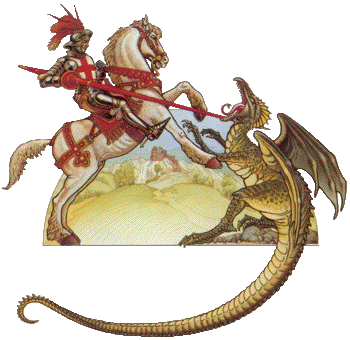
It may sound like an odd thing to claim that a ‘saint’ has nothing to do with religion but in the case of St. George, that is quite a reasonable thing to say. Thus when the politically correct functionaries of the Church of England start floating the idea of replacing St. George with St. Alban as the patron saint of England, I would have to say that the Church of England are flattering themselves if they think it is actually up to them. Dating from the reign of Edward III, a certain conception of St. George has been part of English iconography considerably longer that there has been a Church of England and I suspect the association of this mythic dragon-slayer with ‘Englishness’ will outlive England’s established church comfortably.
In a post-Christian society like England, St. George, who may or may not have been a Roman general, is really just a cultural construct that embodies certain mythic values ascribed to England. And that is, of course, why the emasculated appeasers who make up the leadership of the Church of England really want to replace the mythic warrior St. George:
But the Church of England is considering rejecting England’s patron saint St. George on the grounds that his image is too warlike and may offend Muslims.
And given that Britain is fighting two wars at the moment in Iraq and Afghanistan, against an enemy who are Muslims, I can think of nothing better to commend St. George to a nation which may feel the need to summon the fortitude of warlike archetypes more than it needs an irrelevent and collapsing Church.
In what bizarre universe is this guy ‘liberal’ while someone like me – who is strongly pro-gay marriage, pro-easy availability of pornography, against the stupid drug war, and stridently anti-authoritarian – is often described as ‘conservative’? If he’s a liberal, I’m a Prada handbag.
– Jackie Danicki
Or, rather, Independence Evening, which brought a motley crew of celebrants to Chelsea for some of Adriana’s salad, Nancy’s pasta, and some rather scandalous conversation. What is said at Samizdata HQ stays at Samizdata HQ, but a few of the photos can – as ever – be shared…
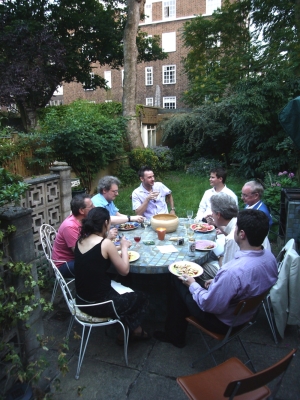 Three authors, an editor, an engineer, an actress, a Cambridge student, and a Brian
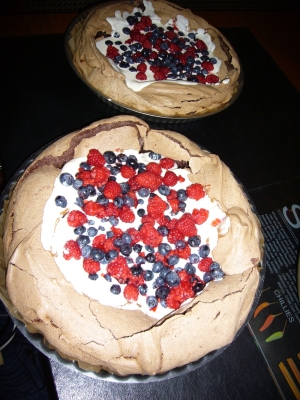 Two patriotic pavlovas (with thanks to Nigella)
 Now that she had cleaned her plate, Jo hoped to be granted a refill of vino
Thanks to all who braved the heat to come along, and do not worry – your secrets are safe with Samizdata…
I am in the US at the moment sharing today’s festivities with all manner of creatures…
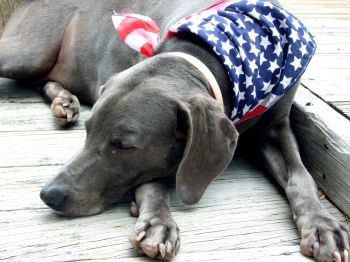
Mike Hudack of blip.tv wishes all a happy Independence Day with a few thoughts worth noting:
The Fourth of July isn’t significant simply because it marks the beginning of independent American politics. It’s significant because it marked one of the first times that a group of people threw off the yolk of foreign leadership and chose self-government. It is significant because of the emphasis placed on individual empowerment and individual choice. It is significant, most of all, because of the ideal of America created on or around July 4, 1776 — an ideal that we have yet to realize, but that we continually strive for.
His personal hero of the American revolution is Thomas Paine, the author of Common Sense, whose arguments created conditions for writing the Declaration of Independence.
“[the] distinction of men into kings and subjects… [is something for which] no truly natural or religious reason can be found.”
and
“I challenge the warmest advocate for reconciliation to show a single advantage that this continent can reap by being connected with Great Britain.”
It is allowed to be idealistic today:
The moral here is a simple one. In 1775 and 1776 one man’s words ignited the firestorm that led to the Declaration of Independence. One man’s views on democracy, on republicanism, on individual rights and individual responsibility. One man’s views that almost didn’t get printed because no printer would dare put those words down in ink. Thomas Paine’s access to the printing press, thanks to Robert Bell, changed the world.
Such words are very encouraging, especially coming from someone who has set up and runs a videoblogging community. It means that this particular community and the company behind it is driven by an understanding of the profound impact that individual creativity and its distribution will have on the future. And, surely, that is a Good Thing.
This is daft:
POLICE issued two stallholders at a farming show with £80 fines for displaying T-shirts bearing the slogan “Bollocks to Blair”. Officers questioned staff on two stands at the Royal Norfolk Show after receiving a complaint, subsequently issuing two fixed-penalty notices of £80 for the offending garments.
But, it is entirely legal, given the state of the law these days. Someone says something is offensive, and if they say it is offensive it is offensive, because offensive is whatever offends anybody. Then, once the complaint is made, the police are legally obliged to inflict over-the-top and ridiculous summary justice.
Last night Norfolk police defended the action. A spokesman said: “Officers from Norfolk Constabulary issued two fixed penalty notices, each with a value of £80, at the Royal Norfolk Show in relation to two trade stands displaying T-shirts emblazoned with offensive language. The notices were issued under Section 5 of the Public Order Act as the language was deemed to cause harassment, distress or alarm at an event, where a cross section of people were present including families and young children who may have found the displays offensive. Police did receive a complaint from a member of the public.
Quite so.
I reckon that a creative application of this law could render illegal just about any damn thing anybody took against, definitely including the Police, Tony Blair, etc. Has Tony Blair never used language that was “deemed to cause harassment, distress or alarm at an event”? Selling the Koran would definitely be illegal, provided only that the Police received the complaint about it through the proper channels.
My guess is that Police morale is now so low that a lot of them are now in Good Soldier Schweik mode, i.e. doing every stupid thing that the law says they must, just to show everyone how ridiculous the law now often is.
My late father, who was a rather distinguished lawyer, used to tell us about a bloke who sat in Whitehall somewhere looking at all new laws that they were threatening to pass, pointing out inconsistencies and collisions with other laws, and unintended but possible consequences, and then deftly rewriting all the laws so that they achieved only what they were intended to achieve, and stopped only what they were supposed to stop. (He himself, apparently, had no firm opinions about what the law should do, other than what the people passing it said they wanted it to do.) Then he died, and they were never able to replace him. That must have been, if I remember it rightly, round about forty or fifty years ago. And that, my dad reckoned, was when, legally speaking, the rot set in.
There is a fine article in the Telegraph rebutting anti-Americanism and another which features a splendid quote from an unnamed US embassy spokesman who responded to claims that a poll has found many British people are opposed to the US decision to overthrow Saddam Hussain and suggesting many had a low opinion of US civil society:
“We question the judgment of anyone who asserts the world would be a better place with Saddam still terrorizing his own nation and threatening people well beyond Iraq’s borders. With respect to the poll’s assertions about American society, we bear some of the blame for not successfully communicating America’s extraordinary dynamism. But frankly, so do you [the British press].”
Quite. Never apologise to your enemies.
|
Who Are We? The Samizdata people are a bunch of sinister and heavily armed globalist illuminati who seek to infect the entire world with the values of personal liberty and several property. Amongst our many crimes is a sense of humour and the intermittent use of British spelling.
We are also a varied group made up of social individualists, classical liberals, whigs, libertarians, extropians, futurists, ‘Porcupines’, Karl Popper fetishists, recovering neo-conservatives, crazed Ayn Rand worshipers, over-caffeinated Virginia Postrel devotees, witty Frédéric Bastiat wannabes, cypherpunks, minarchists, kritarchists and wild-eyed anarcho-capitalists from Britain, North America, Australia and Europe.
|

 The author of
  The ladies of
  The first




Recent Comments