We are developing the social individualist meta-context for the future. From the very serious to the extremely frivolous... lets see what is on the mind of the Samizdata people.
Samizdata, derived from Samizdat /n. - a system of clandestine publication of banned literature in the USSR [Russ.,= self-publishing house]
|
The Ministry of Defense released a paper for public discussion (pdf) on missile defense today. Mr. Hoon would like the public debate on the issues to begin now because deployment will take many years here from the start of such discussion.
The media reports claim there is currently no threat. I was surprised not even Mr Hoon pointed out how even an existing short range ballistic missile can be fired from a tramp steamer outside of the UK territorial waters.
I hope to find some mention of this in the aforementioned document which I have not yet had a chance to read.
You may email your comments to the UK MoD on this subject at:
Missile-Defence@mod.gsi.gov.uk
 Dec. 3, 2001 Prototype Kill Vehicle
launch from Mecklin Island.
Courtesy US DOD
Self-defence is not necessary because we have the police to protect us, right. That’s their job. That’s what we, the tax-payers, pay them to do. So, we can all sleep safely in our beds at night, knowing that the agents of the state will keep us safe from those who would do us harm.
That’s the theory; this is the practice:
“Police have launched an inquiry into why it took officers an hour to respond to an emergency call from a Jewish couple who were the victims of a terrifying burglary at their Southgate home.”
Well, as long as there’s no ‘hate speech’ involved, it probably isn’t a real emergency.
“Officers eventually arrived at 6:40am, long after the intruders had driven off with their haul in the couples’ two Mercedes saloons.”
Laughing their arses off, I’d wager.
““Although I am disgusted with the police who should have been there to help us, they have been very supportive and efficient since. It was just a break-down in communication and it shouldn’t have happened.”
‘It shouldn’t have happened’!!. Oh, that’s all okay then. As long as this kind of thing ‘shouldn’t happen’, we can all go back to sleep again.
A police officer was shot and seriously wounded after stopping a motorist in North London.
In the West Midlands, two men have been fatally shot in separate incidents.
Just what is wrong with these people? Don’t they know that guns are supposed to be banned in Britain?
A British court today has ruled that Darren Taylor, a burglar who was stabbed to death with his own knife by homeowner John Lambert, was lawfully killed.
Taylor and his accomplice, Ian Reed, both high on drugs and drink, burst into the Lambert’s home and held a knife to the throat of Mrs Lambert, demanding £5,000 from the couple. In the ensuing melee, John Lambert managed to kill Taylor and drive off Reed.
When the police finally arrived, they arrested Mr Lambert for murder, although all charges were later dropped against him whilst the surviving criminal, Ian Reed, was sentenced to eight years in prison for robbery.
It would be nice if there was a presumption of innocence when the cops show up and see situations such as these. After all, when the cops shoot a man dead for no good reason at all, it is just taken as a given that it was lawfully done. In John Lambert’s case, his rights were ultimately upheld but it is hard to escape the feeling that there is one rule for agents of the state and another for its subjects.
I don’t recall ever having reproduced an article in full on this blog and, only on the rare occasion, will I publish a letter in full. This is one such occasion and the quality of the letter merits it:
Modern changes ignore old gun laws
“Sir – Alan Judd is hesitant to advocate a “firearms free-for-all” (Comment, Dec 2), but one might recall that, before the First World War, when almost any British citizen could possess and carry any gun without a licence (and frequently did so, for there was a massive domestic firearms industry), armed crime in London ran at only two per cent of what it is today.
In 1946, the year the Home Office first moved against the licensing of pistols for self-defence, there were only 25 armed robberies in London: today, we have more than that every fortnight.
Confusion over our right to self-defence has not arisen because, as Mr Judd at one point suggests, we have “renounced” that capability. It is a right enshrined in our central constitutional document, the Bill of Rights of 1689, which is still in force as statute law. The right to possess arms for self-defence was one of only two rights of the individual guaranteed by the Bill of Rights, and was indeed the ultimate surety of the subject’s other liberties.
While it had been the Restoration disarmament of Protestants that provoked the arms provision of the Bill of Rights, the equal right of Catholics to self-defence was guaranteed in the same year, and case law upheld the right to bear arms for self-defence through to the 20th century.
When the first Firearms Act was introduced in 1920, it was recognised that the normal justification for owning a revolver was self-defence; it was only in 1946 that the Labour Home Secretary indicated that this would no longer necessarily be accepted as a good reason.
When the Home Office advised Lord Cullen, in the prelude to the pistol ban of 1997, that “as a matter of policy” British law did not permit the citizen any weapons for self-defence, it was therefore asserting a new policy without legal foundation that simply chose to ignore the Bill of Rights.
It is the text of a letter written to the Daily Telegraph by a gentleman called Richard Munday whom I know not but admire much, not just because he is correct, but also because he has not forgotten his heritage.
Unlike our political rulers and most of fellow citizens who have shed their birthright like dead skin in the headlong rush to serfdom. But despite having been so outrageously and cynically trampled underfoot the 1689 Bill of Rights is still the law of the land and it does, indeed, bestow on every citizen the right and ability to defend their life, liberty and property.
However, the Bill of Rights is an Act of Parliament and, since no parliament can bind its successors, it could easily be repealed by another Act of Parliament. The fact that it has not yet been so repealed is doubtless due to the Old Bill being more honoured in the breach than in the observance.
So dragging the glorious old Bill of Rights from its musty chest and waving it in the face of the policeman who will come to arrest you for exercising your rights is all very back-stiffening in theory and may earn your day in Court to shout your case. But, in practice, the merest hint of any such happening would spur HMG into passing a repealing Act which would sail smartly through the House of Glove Puppets with nary a whisper of dissent nor a turn of a single hair.
And that would be that. Back to square one.
Still, the publication of Mr.Munday’s most righteous missive brings a twitch to my jowels. It proves that some people have not buckled to the maladies of crass hysteria and infantile paranoia. Some people remember what freedom really means and more and more of them are prepared to shout it from the rooftops.
In addition to being miserable, it seems that the British (or a few of them anyways) are also getting a bit uppity:
“Police have issued a nationwide alert after discovering a deadly explosive device attached to a speed camera.”
No-one has yet claimed responsibility but I think it is safe to pretty much rule out the Islamofascists.
From being the envy of the world, the British armed forces are in danger of becoming merely average: a cut-price, camouflaged UNICEF…
My sources tell me that this is an accurate account of what’s going on in the British Army at the moment. Or more precisely, how the New Labour government has been undermining one of the most respected and professional British institutions:
The British military and New Labour are politically and philosophically polar opposites. The government has made these differences even more acute by spending much of the last few years forcing soldiers to adopt a work ethic more in line with commerce than with combat. Who Dares Wins has been replaced by Health and Safety. The government believes that it has a duty to look after soldiers by protecting their ‘rights’, but this approach to soldiering seriously undermines the ability of the men and women of the armed forces to get on with a difficult and dangerous job.
[…]
The government’s obsession with political correctness has been applied to the military with such relish that at times it seems almost insane. I have lost count of the number of forms I have had to fill in giving details of my ethnic origin. These forms used to be anonymous, but the last one I had to complete carried my name, rank and service number. Perhaps this was a reaction to an earlier (anonymous) form, which had revealed that in our all-male unit there was a huge number of Bangladeshi single mothers!
[…]
Health-and-safety inspectors are blamed for recommending that chlorine be introduced into the underwater tunnel, in case some poor Commando picks up a bit of dysentery or a sore throat as a result of wading through dirty water. The steep ravines worn into the slopes that recruits had to run up and down at various points on the seven-mile course were also contrary to all sorts of well-meaning legislation. The recommendation was for proper steps and handrails to be installed — just like the ones you find in the mountains of Afghanistan or the wadis of Iraq.
The armed forces in the UK are currently so over-streched that their management amounts to a permanent crisis-management. The professionalism and high quality of the British army currently rests on the dedication of its officers. Let’s face it, they are not there for the money and they don’t get to shoot much these days either. The British military doesn’t lobby, speak out, point out the ignorance of the current government of military matters (which has no limits as this is the first government where nobody has a direct military experience) or do anything that would undermine its strong ethos as a ‘civilian’ army. Her Majesty the Queen, a civilian, is head of the Navy, Army and Air Force of Britain.
Perhaps they should.
I briefly toyed with the idea of posting this under the ‘Humour’ category but, the trouble is, I am not making this up. I couldn’t possibly make this up.
In a country where virtually all forms of private firearm ownership have been outlawed, there was a march today in South-East London by a group calling itself ‘Mothers Against Guns’ in protest at rising gun violence.
But that thigh-slapping irony descends into tragi-farce:
“The march had to be re-routed away from the crime scene of the early morning shooting outside Pharaoh’s Pub in Peckham Road.
Police confirmed one man was killed on the spot and that another was in a stable condition in hospital after the incident.
Sometimes I feel as if this isn’t a nation anymore. More like an open-air Theatre of the Absurd.
David Carr is happy, because now not only is he sunk in gloom but he reckons all of us are, and especially me, Samizdata’s Optimism Correspondent. Bad news David, I’m happy now.
I have a number of reasons to be happy, but I’ll focus on just one. Britain’s Chancellor of the Exchequer Gordon Brown has been taxing the British economy at a higher rate, but, to his surprise and consternation, the extra tax revenue that he assumed he would get by putting the rates up has not proved to be forthcoming. In the House of Commons yesterday, he had to explain. He blamed the world economy. (Don’t they all?)
Well guess what. I told you so, on Tuesday May 28th. This makes me happy.
What this confirms …
(I was referring to a piece by Paul Staines)
… is that British government income is now as high as it can be. Increasing the percentage rate of taxation doesn’t increase government tax income, it merely slows the economy down and causes government income to remain static. Similarly, if the government were to reduce the percentage rate of tax, government income wouldn’t decrease. This would merely cause the economy to surge forward, and the smaller slice of a bigger cake would end up being the same size as the bigger slices of smaller cakes. Britain is now at the top of the Laffer Curve. Isn’t that exciting? In plain English, the bastards are taking us for the absolute maximum amount they can, and if they get any greedier we stop coming through their bit of the forest.
Gordon Brown’s response to his problem is that he has decided to take the government a lot deeper into debt than he originally had in mind to do, which is a further – albeit disguised – increase in the rate of taxation. If the government borrows the kind of money it now intends to borrow, it will raise the interest rates that all other borrowers have to pay.
So let me leave all my winnings from my previous bet on the table and give this prophecy game another whirl of the wheel. Brown’s latest decision will slow the economy down some more, and he still won’t get his hands on enough money to finance his spending spree. These plans can never materialise, and that fact will have to be recognised if Britain is not to be pushed down the far side of the Laffer Curve towards economic meltdown.
What this all shows is that, as usual, there are, in the words of Noel Coward, bad times just around the corner. What it also shows is that enjoying life is all about attitude. It’s not the facts that make you happy or unhappy; what counts is how you look at them and what you make of them.
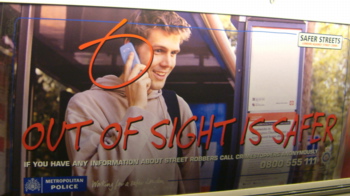
This poster can be seen all over London. In it a young man standing at a bus stop chats on his mobile phone, a sight one sees all the time on London’s busy streets.
What the Metropolitan Police are saying is that doing this, talking on a mobile phone in London, in public, is unwise behaviour. Okay, fair enough, London is a big city and all big cities have their fair share of street crime, so what is the problem with this message from the boys in blue?
The problem I have is that this poster is not warning criminals who might attack us and steal our phones of the sure vengeance of the law. Not it is calling on us all to refuse to tolerate thieves in our midst and to resist to the best of our ability. Hell, how about suggesting “if you have a mobile phone in your hand and you either witness a mugging in progress or think you are in danger, dial 999 and the Police, whose paychecks and cars with flashing lights come from your taxes, will come rushing to the rescue”.
No, it does not say that at all. The real message here from our appointed protectors is not “we will protect you from crime” and certainly not “protect yourself from street crime”, but rather HIDE from street crime.
OUT OF SIGHT IS SAFER
The state cannot protect you, it will not permit you to protect yourself effectively, so all it can do is offer advice… and the advice is hide. Do not show anyone you have something worth stealing. I expect we will soon see posters across London saying “it is safer not to wear Armani suits, you might get mugged” and then “don’t wear short skirts, you might get raped” and finally “don’t go out at all, the streets are not safe”.
Perhaps when the state has taxed everything and we no longer have anything left to hide, we will indeed have ‘safer streets’.
The state is not your friend.
I don’t suppose any of our readers can have failed to notice the patina of despondency that has, of late, descended upon this corner of the blogland.
I am the usual and evergreen suspect. Optimism has always stood in stark contrast to my natural grain and my comrades have long-since stopped denouncing me for it and learned to live with my periodic predictions of impending doom. However, I am but Pollyanna herself compared to Paul Marks, the poster-boy of the Euthanasia Movement.
There was a time when our brooding presence was felt but nonetheless heavily diluted by the ebullient, thematic jolliness of the remaining Samizdatistas. But now Perry de Havilland seems to have stumbled into a pit of despair and even the stomach-churningly cheerful Brian Micklethwait has ‘fessed up to an onset of the highly contagious Carr-itis.
But why, I hear you inquire. Is this a neurological condition brought on by over-exposure to the internet? Is it because we are perenially-disappointed libertarians? No, it’s because we are British:
“People are growing increasingly pessimistic, with a majority believing that Britain is “grinding to a halt”, a YouGov poll for The Daily Telegraph has found.
The survey shows a country depressed by the prospect of falling pension values, failing hospitals, pot-holed roads, unspoken fears of terrorism and a possible war against Iraq.
Eighty five per cent of people worry that they can no longer rely on public services, while 53 per cent agree with foreign media reports that “nothing in Britain works”.
See, for all these years I was not being contrary, I was merely ahead of the curve and now that all my compatriots are conforming to national type, I can take nought but scant consolation in feeling vindicated.
All exhortations to cheery optimism are futile. It’s too late for therapy and prozac won’t work. We’re not depressed, we’re just British. Pity us.
Paul Marks laments attitudes in Britain to anti-tax protests.
Those people who know me will know that I like family owned enterprises (more common in Germany than in Britain these days) and that I like the people who are at the top of manufacturing companies to be trained in such things as engineering rather than such things as law (I sometimes feel that many British managers think a “machine tool” is something to do with kinky sex). But, have no fear, I will say no more about my personal prejudices – and I fully accept that Germany has higher government spending and (in some ways) more government regulations than Britain.
However, something has caught my attention recently. In Germany a pop song denouncing the German government’s tax increases has reached the top of the charts.
In Britain taxes are increasing much faster than in Germany (government spending and regulations are increasing at a faster rate also) and, sure enough, a pop song has been written that attacks this increase in taxation – and the song was mentioned on B.B.C. Radio 4’s “Today Programme”.
But in Britain the anti tax protest song is not being treated seriously even, it appears, by the man who wrote it. Nobody expects this song to get to the top of anything – even though the British government have also told lies about tax and are increasing taxes more than the German government is.
Is the basic culture of Britain so collectivist that a protest against statism is automatically a joke?
Paul Marks
|
Who Are We? The Samizdata people are a bunch of sinister and heavily armed globalist illuminati who seek to infect the entire world with the values of personal liberty and several property. Amongst our many crimes is a sense of humour and the intermittent use of British spelling.
We are also a varied group made up of social individualists, classical liberals, whigs, libertarians, extropians, futurists, ‘Porcupines’, Karl Popper fetishists, recovering neo-conservatives, crazed Ayn Rand worshipers, over-caffeinated Virginia Postrel devotees, witty Frédéric Bastiat wannabes, cypherpunks, minarchists, kritarchists and wild-eyed anarcho-capitalists from Britain, North America, Australia and Europe.
|




