Claire Fox lays out the folly of trusting the state and state-adjacent institutions to decides what constitutes disinformation.
|
|||||
|
June 28th, 2026 | 2 comments - (Comments are closed)
 “Labour’s spyware plan for phones is straight out of North Korea”, writes Silkie Carlo in the Telegraph. Quote:
and
June 11th, 2026 | 22 comments - (Comments are closed)
Our statement on the UK government’s demand that all content on all devices sold or used in the country be scanned, on the presumption of nudity, using a dystopian combination of age verification and content scanning. This proposal will not safeguard children. It endangers us all. – Signal official statement June 8th, 2026 | 20 comments - (Comments are closed)
On 7th May 2026 the Guardian published the following article by its regular correspondent, George Monbiot, a supporter of the Green Party: “Imagine a technique that can heal Britain of division and keep out the hard right. I call it ‘radical listening’” He says,
Done honestly, non-judgmental listening is an excellent idea. “We have two ears and one mouth so that we can listen twice as much as we speak”, as the Stoic philosopher Epictetus once said. Far though Mr Monbiot’s political beliefs are from mine, I acknowledge that on several occasions he has demonstrated both honesty and a willingness to listen, by publicly stating that he had changed his views in directions that made him unpopular with his fellow Greens. In the aftermath of the Fukushima nuclear accident, he surprised many by saying that he had changed his mind in favour of nuclear power, and, so long ago that I cannot find the reference, he realised that the policy of autarky that the Greens then recommended for the UK was equivalent to the sanctions on Iraq that they were denouncing, and said so in public. Unfortunately, as it did for a lot of people, the Covid-19 pandemic de-magnetised his moral compass and in 2021 he came out in favour of censorship, writing an article called “Covid lies cost lives – we have a duty to clamp down on them”. Censorship and seeking to listen “without arguing or judging” are matter and anti-matter; they cannot coexist. To censor is to judge certain opinions as so pernicious that they must be suppressed. In the world that Mr Monbiot has said he wants, if one of the people “exhausted with politics” to whom he is listening were to express the anti-vax views that a lot of such people hold, his next action would be to report them to the police. In our world – in our Britain – there are plenty of opinions about migrants and transgender people that are widespread among the alienated masses that when expressed have resulted in state punishment, ranging from sending the police round to issue a “friendly warning” (for most of my life I thought that sort of thing only happened in dictatorships), through people being forbidden to access social media without the permission of their police minder and having their devices seized, up to arrest and jail. Even if Mr Monbiot were to bind himself during his radical listening sessions by something like the seal of the confessional, the mind that holds it to be desirable to legally suppress certain bad opinions cannot hear expressions of those opinions without categorising them as crimes that it is not convenient to punish right now. Three quarters of a century ago in 1956, Chairman Mao Zedong – whose name was then usually romanised as Mao Tse-Tung – launched the “Hundred Flowers campaign”. Under the slogan “Let a hundred flowers bloom; let a hundred schools of thought contend”, the communist authorities proclaimed that from now on they would no longer punish critics. All would be free to speak, the better to promote new ideas to improve China. Tentatively at first, some did offer their criticisms. When nothing bad happened, the trickle became a flood. Then, having established who their critics were, the communists arrested them and sent them to labour camps. May 22nd, 2026 | 11 comments - (Comments are closed)
The way in which they miss the point, is exactly why Labour does. It describes a desire for democratic control of institutions as a ‘dark path’ yet simultaneously support a party that is bringing in Digital ID, curtailing jury trials and the rest. We are on a dark path already. May 12th, 2026 | 2 comments - (Comments are closed)
I thought that this apparently minor news story from the Telegraph, the comment made by someone called Bernie@Artemisfornow while linking to the story on Twitter, and the reply to that comment with an apt quote by Alexis de Tocqueville were all worth highlighting. In case the screenshot goes away, the Telegraph story has the headline “Volunteer banned from cleaning graves over ‘health and safety’ fears” and the standfirst “Ben McGregor says South Tyneside authority has threatened him with legal action, despite praise from families“. It continues,
To which Bernie@Artemisfornow replied,
and TurnedFourthing @turnedfourthing in turn replied,
May 5th, 2026 | 38 comments - (Comments are closed)
Today please remember the victims of the Katyn Massacre. In 1940, thousands of Polish officers and intellectuals were executed by the Soviet paramilitaries. We will never let this be forgotten. April 13th, 2026 | 42 comments - (Comments are closed)
[AIUI etc, etc.] In the beginning there were wireless sets. But the government worried that these could be used by spies for a foreign power. So it demanded that wireless owners took out licences. The licences were free the government just wanted to know who had a wireless. Just in case. Then someone came up with the idea of broadcasting. Music, lectures, news, that sort of thing. The government came up with a scheme. They would charge a fee for the licence. It would also demand that wireless manufacturers make a contribution. To sugar the pill it would make it illegal to sell a wireless set that wasn’t made by a member of the British Broadcasting Company. The minister responsible for this? One Neville Chamberlain. And so in late 1922 the BBC, in the shape of such regional broadcasters as 2LO, came into being. And it was very popular – save for the fact that building one’s own set was illegal. But the arrangement had an expiry date. And a committee was set up to decide what to do next. A hundred years ago it reported and as you can probably guess, the manufacturers were ditched with the recommendation that a public body to be known as the British Broadcasting Commission be put in its place financed entirely through the licence fee. Why? I seem to remember being told that the Company was in dire financial straits. But there’s not a hint of it in the report as published in The Times. Actually, there is very little justification at all. Although they do say this:
So you are getting rid of something you “readily acknowledge” is a success for something that might work?
I’ve got some bad news about how that’s going to work out.
The Times’s own report of the report has this to say:
So, the whole thing was a communist experiment. Great. And then there was this doozy:
Clearly that argument falls because it is not true that broadcasting is a monopoly. But even if it were, as a libertarian, in principle I would prefer such things to exist in an unfettered free market. 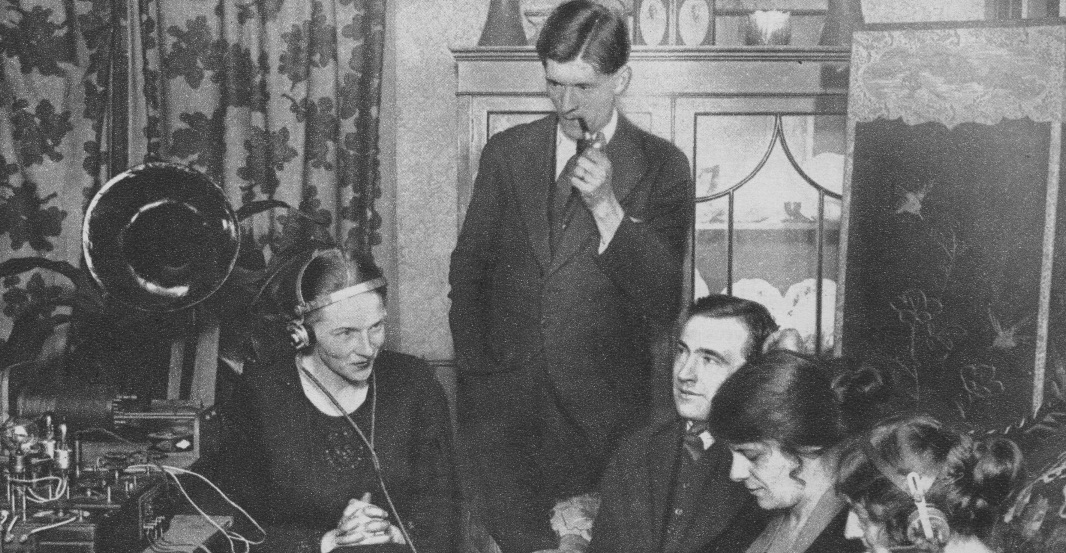 Before it became Lenin in the lounge Update 10/4/26. Incredulity has been expressed over the idea that d-i-y wireless sets were illegal. They were but only for about a year or so. And I don’t think there were any prosecutions. Oddly enough, when “interim” licences were first issued – for just such sets – the number of licences doubled more or less overnight. April 8th, 2026 | 17 comments - (Comments are closed)
The other day I found this Swedish video giving a perspective (from around 2018) on radical feminism. Tip is to set the video to give you English subtitles if you aren’t fluent in Swedish. Assuming that it is satire, let it be put in the balance when one assesses the contribution of the land of Olaf Palme and Gunnar Myrdal to the World, And again, if this was so obvious in 2018, why did it take so long for these types to be called out for what they are elsewhere? March 29th, 2026 | One comment - (Comments are closed)
Maybe I imagined it. I thought I saw the first few seconds of a scary video, either put out by the Home Office “Prevent” scheme or by some NGO with a similar remit. The video featured a teenage actor – white and male, obviously – portraying a boy lamenting that he had got a criminal record after impulsively posting hate speech online. I remembered the title as being something like “It just takes a few seconds to get a criminal record” or “It only takes a few words to get a criminal record”. From what little I saw of it, the video seemed more sinister than 99% of the hate speech it aimed to combat – because it was not put out by some Twitter-addled rando with thirteen followers but by His Majesty’s government, or an organisation closely associated with the same. Ya know how it is. I just saw a second or two and thought, “I might blog about that”, but I was too busy to note it down. And now it’s disappeared. I put a query into CoPilot, which might have been unwise, and got this:
The link https://www.youtube.com/watch?v=G8hE1G9FqJw says “This video isn’t available anymore” That “anymore” suggests it did once exist, but I am beginning to wonder if I did not hallucinate the whole thing and spur the A.I. to join in my hallucination by means of my prompts. Assuming I did not imagine it, can I get this video back from the void? I’ve tried the Wayback Machine without success. UPDATE: That was quick. My thanks to commenter nbc who said, “This one?” Yes. This one. https://xcancel.com/Steve_Laws_/status/2029317472059359438 It took me about a second of scrolling down from that post to find views expressed by Steve Laws that I strongly disagreed with. For instance, he mocks Laurence Fox for saying, in the context of the child-killer Ian Huntley being attacked and killed by another prisoner, that even the most depraved criminals should be protected from vigilante justice in prison. Steve Laws appears to be an actual far-right person. They do exist. But as I have said before, “if there is a truth respectable people shy away from mentioning, do not be surprised when the despicable people who will say it aloud are listened to.” The video appears to have been put out by the police rather than the Home Office, and shows a boy – not “a boy” in the sense of “a young man”; a child of about thirteen – tearfully saying “I just got all my devices taken away by the police. My mum couldn’t believe it. I might get a criminal record and not be able to go to college. I only shared a link. I just thought it was funny. But it was terrorist content, and that is not a game, it’s real life.” That is a deeply sinister message for the police to be putting out, particularly in that it is aimed at children. ANOTHER UPDATE: Ted Schuerzinger has provided a direct link to the video: https://www.instagram.com/terrorismpolice/reel/DVd1g1bkg7I/. It came from an Instagram account called “terrorismpolice”. The final frame shows a police logo and the words:
and the caption to the Instagram video says,
Two questions occur to me: 1) Why was the video removed from YouTube? Hostile comments? 2) Is the video an accurate portrayal of the likely “real-world consequences of sharing harmful extremist content online” when the sharer is a child and the content is something the child shares because they think it is funny? If it is not an accurate portrayal, then the police officers or police employees who made the video are deliberately frightening children with misinformation regarding the law. People have had the police turn up at their doors to issue a “friendly warning” for less. If, however, it is an accurate portrayal of the real world – that is, if children really are being given criminal records for sharing (not creating, sharing) comic memes of whose extremist origin they were unaware, then we are further along than even I thought. March 7th, 2026 | 11 comments - (Comments are closed)
Message from BitChute: Due to what we view as ongoing harassment from Ofcom, as well as our unwillingness to cooperate with a regime we view as hostile to our values and principles, we have disabled all remaining comment access entirely for UK video creators. To our valued users in the United Kingdom, after careful review and ongoing evaluation of the regulatory landscape in the United Kingdom, we regret to inform you that BitChute will be discontinuing its video sharing service for UK residents. The introduction of the UK Online Safety Act of 2023 has brought about significant changes in the regulatory framework governing online content and community interactions. Notably, the Act contains sweeping provisions and onerous corrective measures with respect to content moderation and enforcement. In particular, the broad enforcement powers granted to the regulator of communication services, Ofcom, have raised concerns regarding the open-ended and unpredictable nature of regulatory compliance for our platform. The BitChute platform has always operated on principles of freedom of speech, expression and association, and strived to foster an open and inclusive environment for content creators and audiences alike. However, the evolving regulatory pressures—including strict enforcement mechanisms and potential liabilities—have created an operational landscape in which continuing to serve the UK market exposes our company to unacceptable legal and compliance risks. Despite our best efforts to navigate these challenges, the uncertainty surrounding the OSA’s enforcement by Ofcom and its far-reaching implications leaves us no viable alternative but to cease normal operations in the UK. Therefore, effective immediately, BitChute platform users in the UK will no longer be available to view content produced by any other BitChute user. Because the OSA’s primary concern is that members of the public will view content deemed unsafe, however, we will permit UK BitChute users to continue to post content. The significant change will be that this UK user-posted content will not be viewable by any other UK user, but will be visible to other users outside of the UK. Users outside the UK may comment on that content, which the creator will continue to be able to read, delete, block, reply and flag. Users outside the UK may share UK-user produced content to other users outside of the UK as normal. In other words, for users in the UK, including content creators, the BitChute platform is no longer a user-to-UK user video sharing service. We deeply regret the inconvenience and disappointment this decision may cause to our UK users and partners. This decision was not taken lightly. It reflects our commitment to maintaining the highest standards of compliance, protecting our community, and ensuring that our platform remains a safe and sustainable space for creative expression globally. We recognize the value of our UK community and extend our sincerest apologies for the disruption caused by this necessary step. Our support team remains available to answer any queries or concerns regarding this transition. Thank you for your understanding. So… use a VPN if you are in the UK to access BitChute videos (of which there are many on Samizdata). March 6th, 2026 | 9 comments - (Comments are closed)
Taylor Lorenz is the one who doxxed Libs of TikTok, who came this close to lionising the murderer Luigi Mangione, and who for some reason habitually lies about her age, but she makes some excellent points in this article: “The world wants to ban children from social media, but there will be grave consequences for us all”. Excerpt:
March 2nd, 2026 | 10 comments - (Comments are closed)
|
   |
||||

All content on this website (including text, photographs, audio files, and any other original works), unless otherwise noted, is licensed under a Creative Commons License. |
|||||
Recent Comments