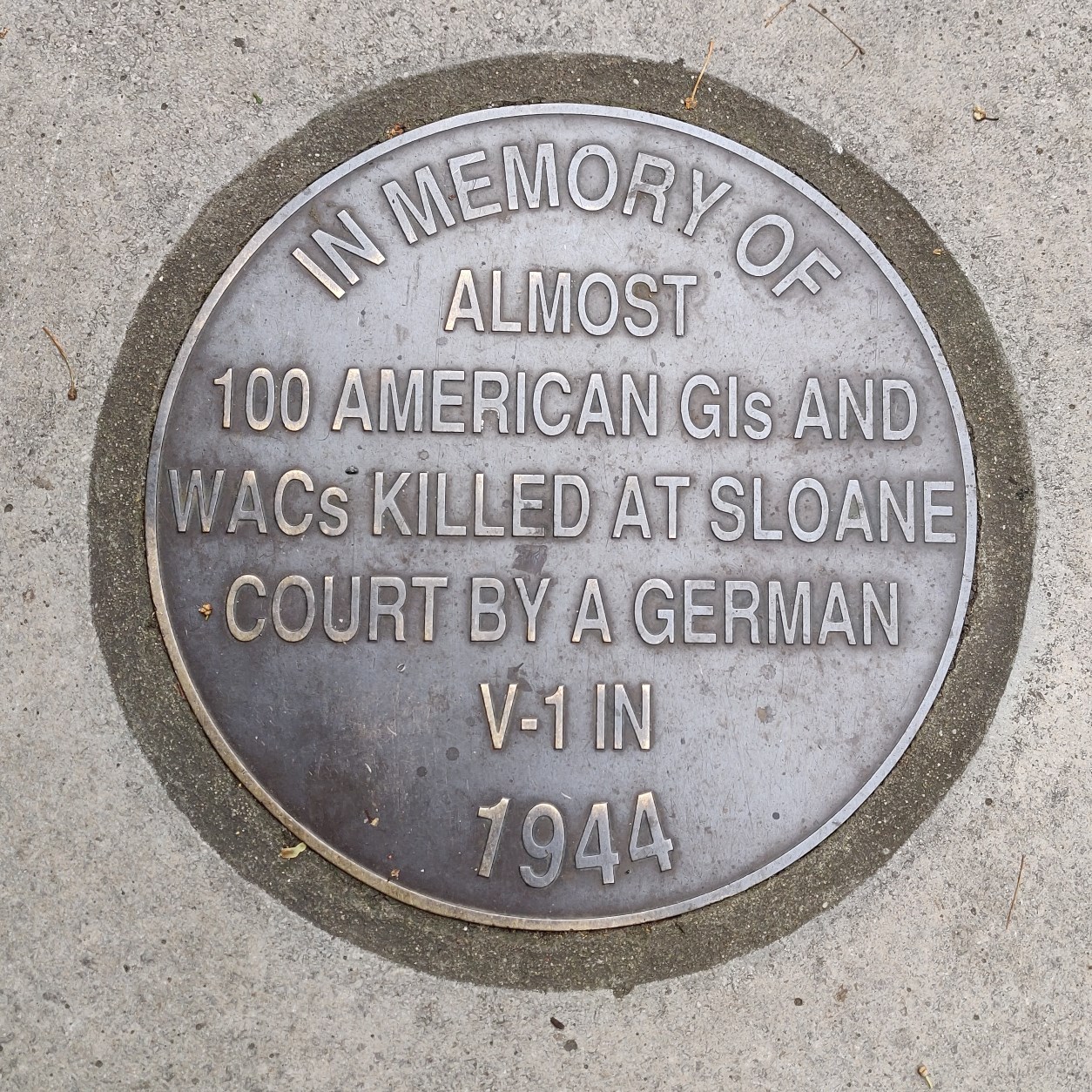
I was walking down a London street today and came upon a reminder that the reason Donald Trump is visiting the UK is not entirely about current affairs. And whatever you think of him personally, it is worth remembering why he is here.
|
|||||
|
I was walking down a London street today and came upon a reminder that the reason Donald Trump is visiting the UK is not entirely about current affairs. And whatever you think of him personally, it is worth remembering why he is here.
June 3rd, 2019 | 17 comments - (Comments are closed)
 The UK government led by Theresa May really is quite something, is it not?
The article is written by some chap called Bruce Newsome, and it makes a good deal of sense. Even if you are sceptical of some of his points about how accountable US intelligence operations are (not very, judging by what has been going on vis a vis Mr Trump) its contention that it makes more sense to trust the US rather than China seems correct to me. This current government is endangering the UK’s long-standing intelligence co-operation under the “Five Eyes” pact with the US, Australia, Canada and New Zealand. And it is being done by a government that failed to deliver on taking the UK out of the EU by 29 March, giving comfort to those who still dream of taking the UK more fully into a developing European state with its own military command structure, at odds, as it will inevitably be, with NATO. The rollout of a 5-G network in the UK will, hopefully, bring major benefits to users, but you don’t need to watch a lot of scary thrillers to understand the risks in getting a firm involved that is so closely embedded with the Chinese state. (Sure, many Western firms are also embedded in their respective states, so it comes down to a judgement call on which states are less evil, and I think I know the answer to that). Even those of an anarchist/minarchist turn of mind when it comes to intra-government intelligence sharing processes ought to worry that the UK seems keener to do deals with Chinese state-backed tech firms than protect an alliance that helped to win the Cold War. Such matters should not be discussed behind closed doors of government, but be out in the open. As far as Theresa May is concerned, my contempt for this individual has gone from gale warning to hurricane-force levels, with no signs of improvement soon. May 3rd, 2019 | 88 comments - (Comments are closed)
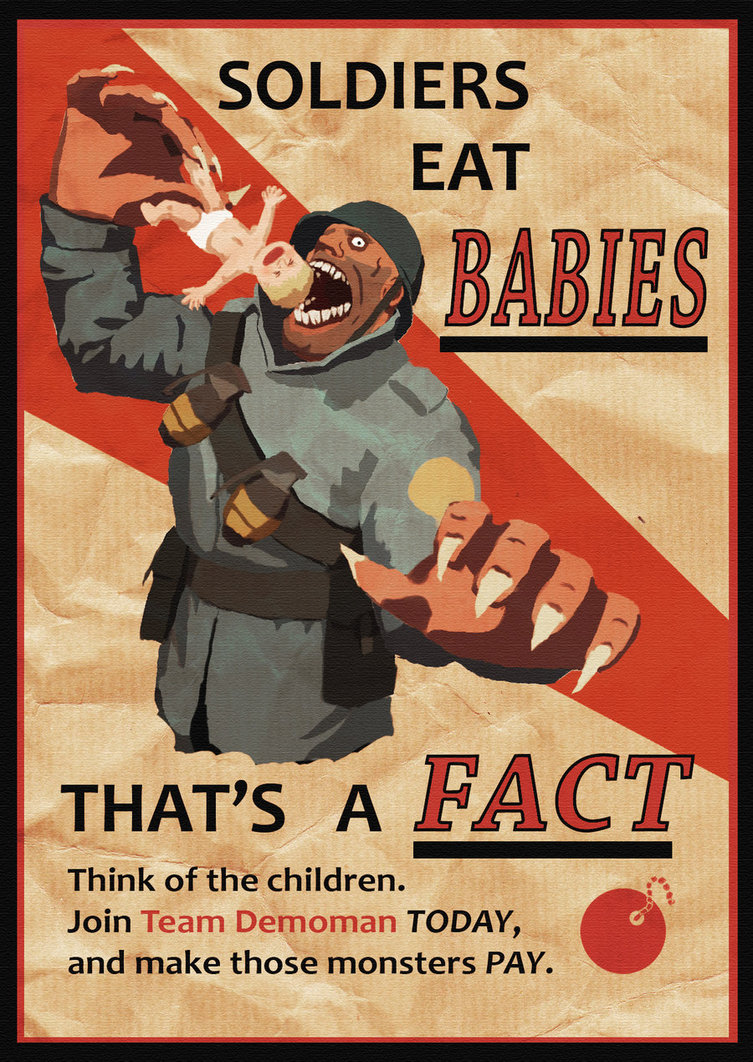
The British Army continues to morph into the Blairmacht, it seems. Its new recruitment posters had me thinking that I had fallen into a coma and woken up a few days after our glorious independence due on 29th March. Here is what I mean: ‘The Army targets ‘snowflake’ millennials‘ (as recruits, not legitimate uses for ammo). The posters, taken as fair use: 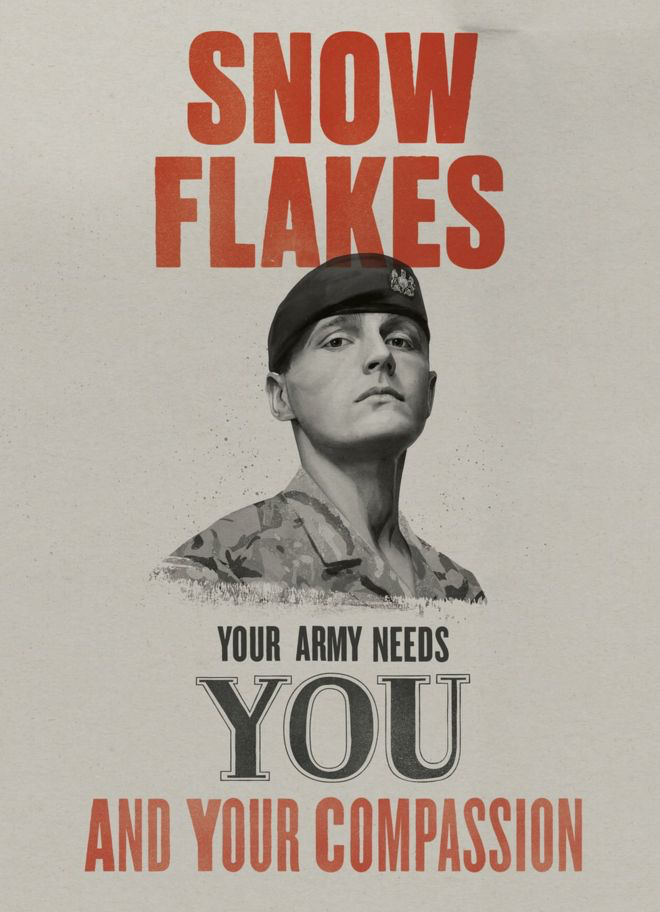 and this: 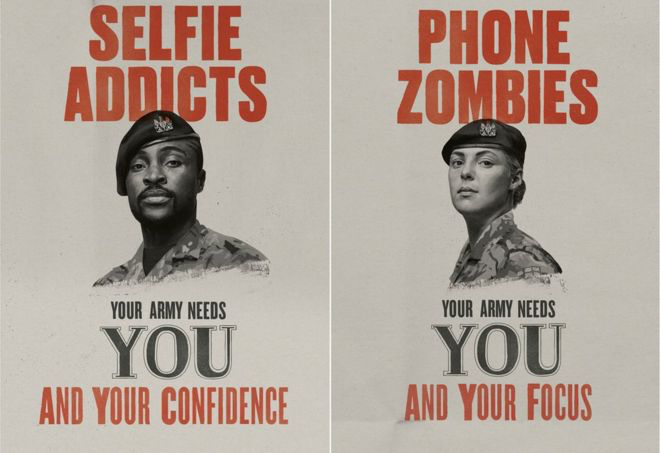 Now there are two possibilities I see here, not mutually exclusive, the less likely that someone is trolling the MoD and being paid for it, and the other is that someone is being paid for it. Still, as posters go, I would grant that it is better than this blatant mickey-take. And in terms of assuring the civil population that the Army is no threat, it doesn’t really beat this, but I do wonder if the thinking behind the current Army it is more similar to what produced this. And we should remember that for some British Army recruits, the heat is not the problem, but the cold may be:
Naseby, the Civil War, what would Prince Rupert or Halifax say? But, may I remind you, it is the law of England that the categories of negligence are never closed…
AFAIK, the case continues… What would Field Marshal the Earl (Horatio Herbert) Kitchener say were he spinning in his cold, watery grave? That Wing Cdr Ken Gatward DSO DFC* AE was named for him, and lived up to it, might give one pause for thought. January 3rd, 2019 | 35 comments - (Comments are closed)
This coming Sunday, January 6th, I am to give a talk at my friend Christian Michel’s home in London, about the historical impact of the technology of information storage and communication. The somewhat cumbersome title I have supplied to Christian goes like this:
Yes, a bit of a mouthful, but it’s a complicated story. The pre-talk blurb underneath that title, that I also sent to Christian, and some of which Christian has just emailed out to his list of potential attenders, went like this:
I’d be interested in what the Samizdata commentariat has to say about all or any of this. For now, I will merely elaborate a little, as I will on the night, on the matter of those “civilisational divisions and nationalist passions”. → Continue reading: On human culture – and on how it got printed and then electrified January 2nd, 2019 | 16 comments - (Comments are closed)
I was always taught that the Maginot Line was a military white elephant – colossally expensive and easily by-passed. But this guy begs to differ – kinda sorta. Short version: it would have worked if it hadn’t been for those flibbertygibbet Belgians! Even so he doesn’t address the question of how Germany would have been brought to heel by means of an entirely defensive strategy. I love this sort of challenge to the narrative and I understand that Samizdata’s own Bertrand Maginot will be joining me. For once. November 23rd, 2018 | 22 comments - (Comments are closed)
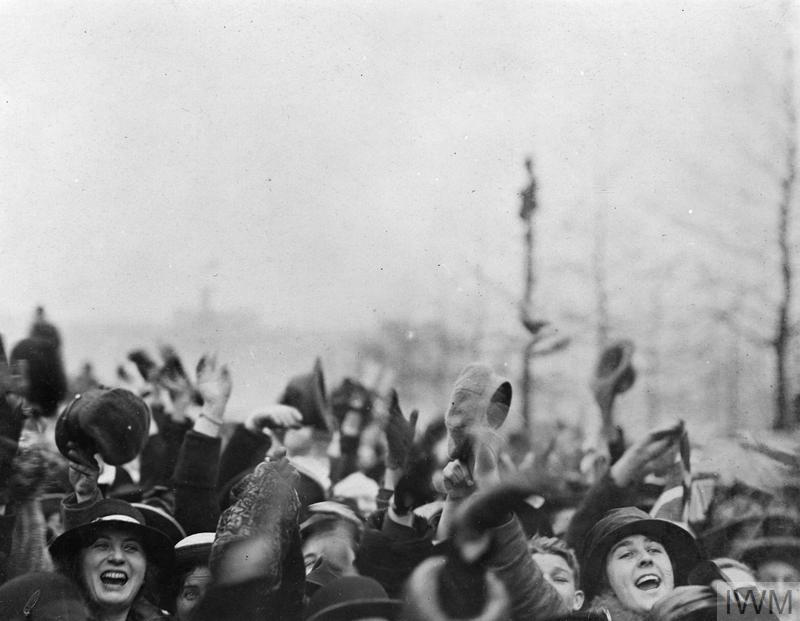 THE ARMISTICE DAY, NOVEMBER 1918 (Q 80135) Crowd cheering outside Buckingham Palace during the Armistice Day, 11 November 1918. Copyright: © IWM. Original Source: http://www.iwm.org.uk/collections/item/object/205324739 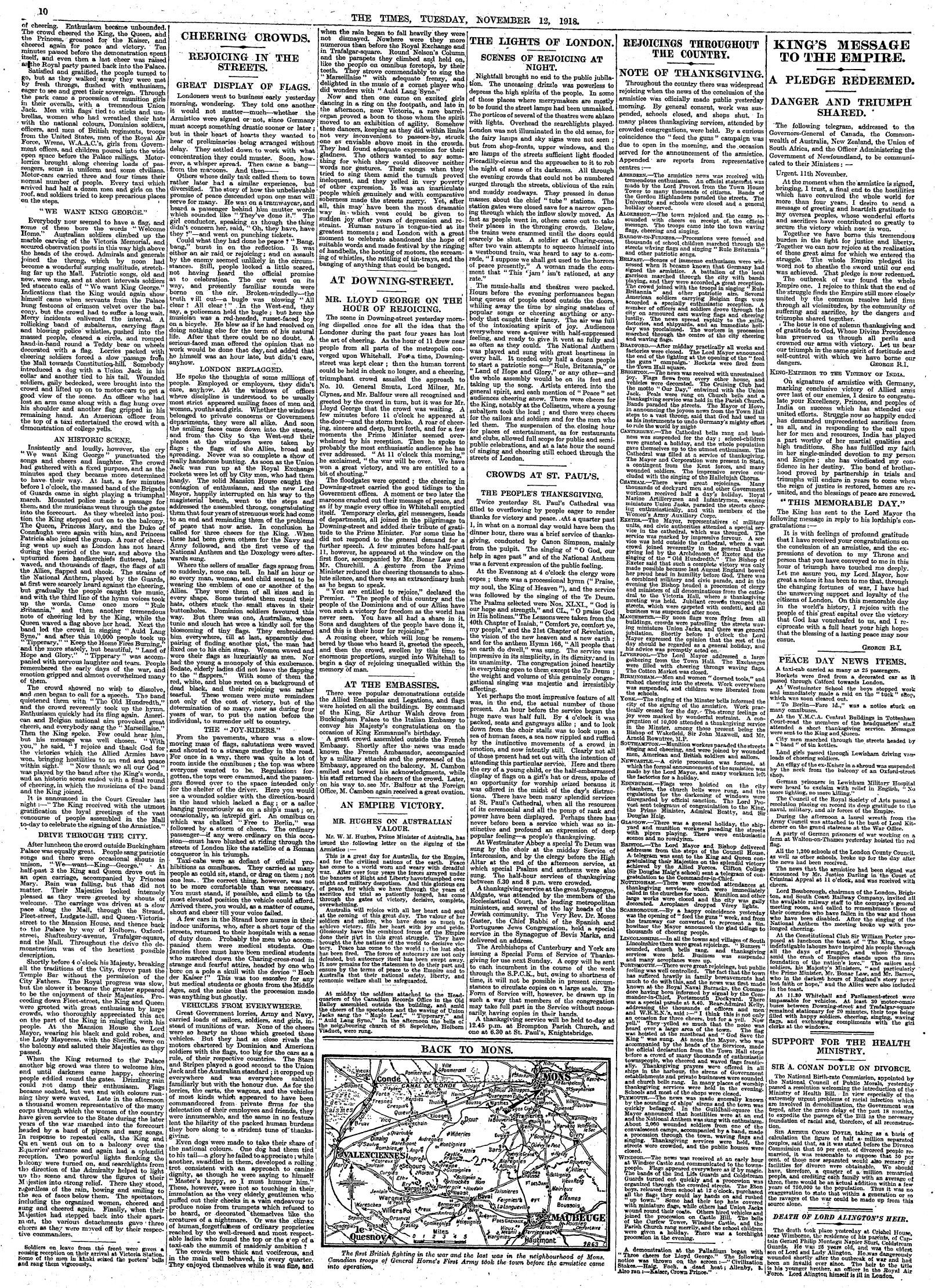 The Times 12 November 1918 p10. Right click for full page. → Continue reading: Victory November 11th, 2018 | 19 comments - (Comments are closed)
Of course, officially speaking there was never a First Battle of Passchendaele but most of us are aware that in 1917 in the space of 3 months at the cost of 80,000 dead the British advanced from just outside Ypres to Passchendaele Ridge. In September 1918, they – along with the Belgians(!) – did it in a day. A day. A couple of months ago I wrote about the Battle of Amiens. I still find it astonishing. And I find this astonishing too. Because it is so difficult to explain. The British army had been battered in the Ludendorff Offensive. It had been clinging on. It had lost huge numbers of men. The sense of panic went right up to the top. And yet, when it went on the offensive itself it found it was seemingly pushing at an open door. Second Passchendaele – as I choose to call it – wasn’t even the biggest victory that week. Sure, the British Army had got a lot better at attacking. There is a clear line of progression from 1916 to 1917 and one must assume that that continued in 1918. But there is nothing to suggest this amazing series of victories. I imagine that German morale must have suffered a catastrophic collapse. But even that doesn’t make sense. More Britons died in the Hundred Days Offensive than at First Passchendaele. The Germans might have been down but they weren’t out. At least not yet. 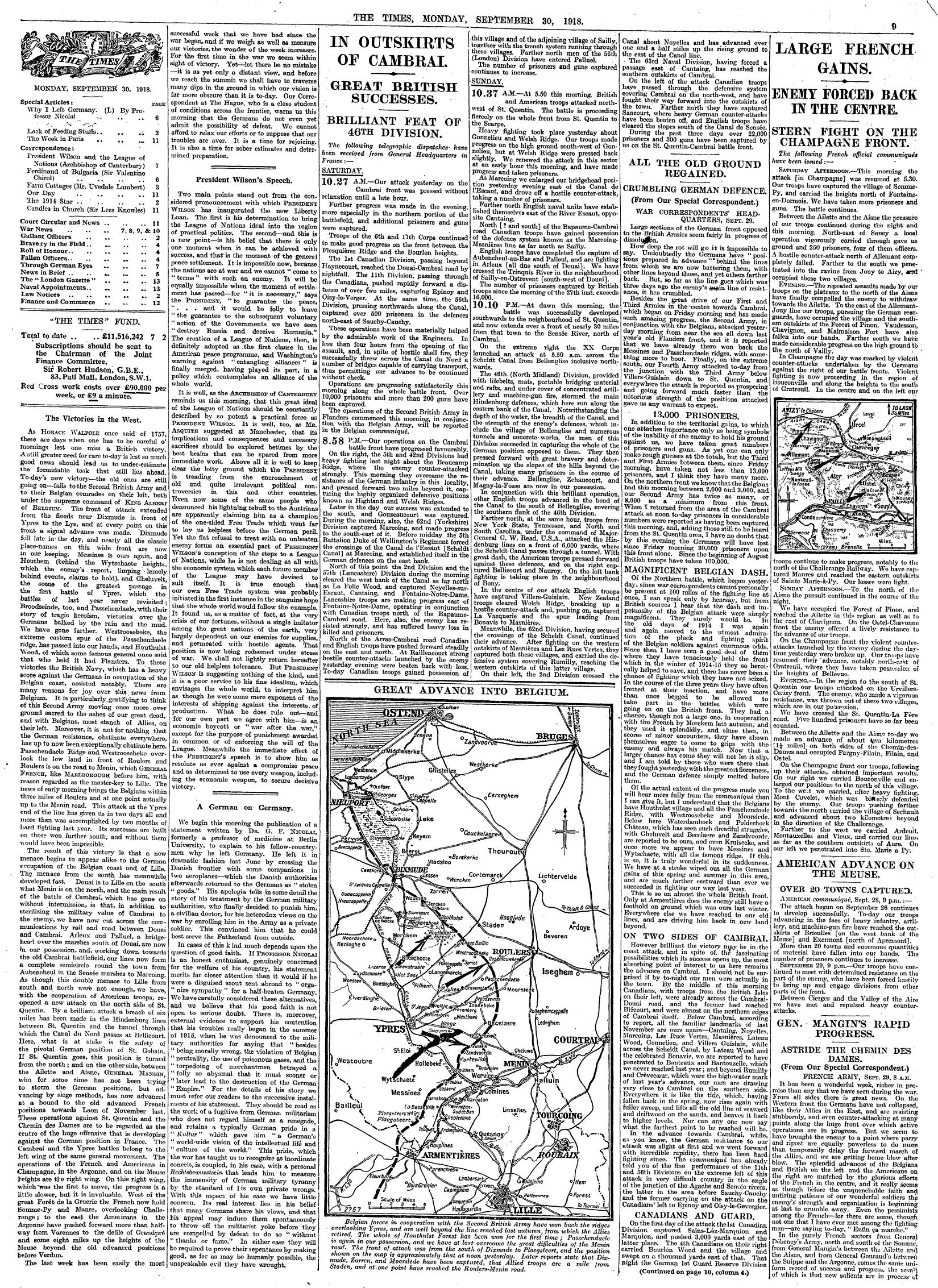 The Times 30 September 1918. Right click for the full page. October 7th, 2018 | 10 comments - (Comments are closed)
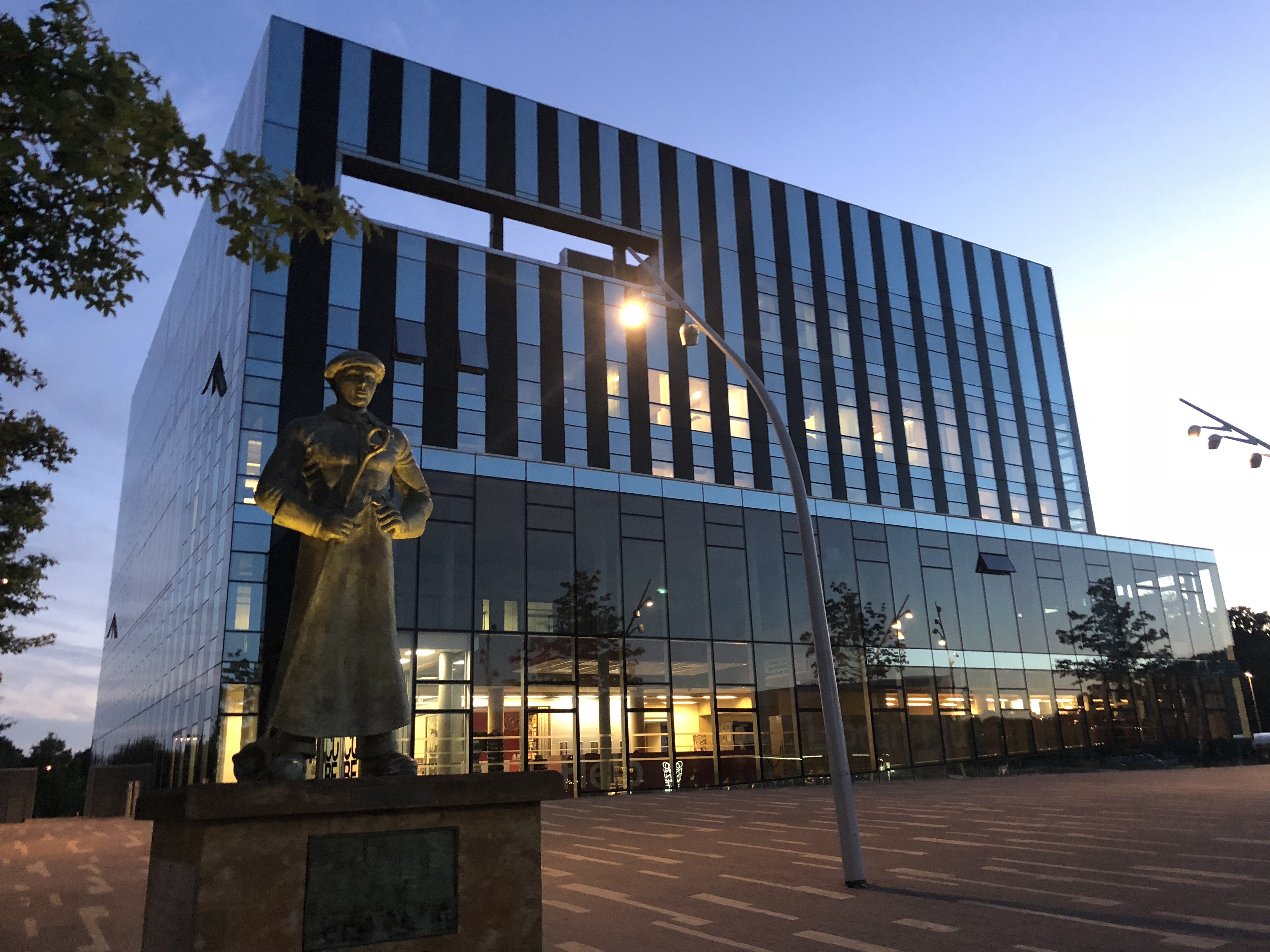
Hurricane opened recently, I went to see it with the Sage of Kettering. The film tells the story of the Polish 303 Squadron in the Battle of Britain. The film starts with Polish pilots working their way to England in the chaos of falling France. One pilot, with some Swiss ancestry, pretends to be a Swiss Swiss watch salesman, another steals a biplane from a French airforce aerodrome, a fine Czech pilot is also in the Squadron. They end up at RAF Northolt, sharing the base with a plotting station and hence a large number of WAAF personnel, with predictable consequences. The Poles appear to be a ramshackle lot, lacking the discipline and bearing that the RAF expects. A Canadian officer is given the apparently thankless task of knocking them into what the RAF would recognise as ‘shape’, the pilots (many very experienced and some aces) are frustrated as they are kept back from action whilst they learn English and how to manage their fine steeds. There is some humour as a truculent Warrant Officer is brilliantly mis-translated by one of the pilots as he barks to his colleagues. It should be said that whilst the Hurricane, Sir Sydney Camm’s wonderful, chubby little puncher is the nominal star of the film, with it featuring in all the fighting and airfield scenes, it hardly gets any mentions, except a passing comment that a pilot thinks it is wonderful. They start off with training flights and escorting Blenheim bombers (There is still one flying in the UK, for what those guys went through, here is a 1989 documentary). Some of the Polish pilots are sent off to bombers, despite their experience. From what I have read, at the time, RAF training didn’t include simulating combat or even gun firing for some pilots. The Poles harmonise their guns at around 150 yards, because they like to get close before firing. After a bit of indisciplined flying (breaking mission orders by going to attack German aircraft), the squadron is declared operational and success starts to come, one pilot has the foresight to make a rudimentary chapel in an old hut. News of their success spreads, Air Chief Marshal Dowding and Sir Keith Park discuss the squadron and are pleased with it (there are no politicians in this film). They are not introduced, and the actor playing Dowding looks a bit more like Park than he does Dowding imho, but you eventually find out who they are). The Poles have a constant awareness of the horrors being visited on their homeland, going to the Polish government-in-exile offices for invariably bad news of relatives executed, which the film shows in grim ‘flashback’, one shot by firing squad, another NKVD-style, another hanged. The contrast with the attitude of the British, who seem to regard the war almost as an unpleasantness is brought out with a trip to the Dorchester where Society ladies treat the pilots to a reception in their honour, which turns out to be an awkward occasion. A press visit to the Squadron ends with one reporter getting punched for ghoulishness. The generally good publicity leads Dowding to hope out loud that it might induce friendly volunteer pilots from overseas to turn up and help. Relations with the Poles and British crews aren’t good at the start, but they improve. May I digress? There is a little bit of a sub-plot with a passing incident of ‘domestic violence’ towards a WAAF, which may explain why there was an advert in the trailers for Women’s Aid, which to me gave the misleading impression that only men commit domestic violence, the man in the trailer hits the woman, but he vapes rather than smokes, you can’t show really bad things you know. In the film, everyone seems to smoke, well, not when refuelling. The film suffers a bit in the depiction of aerial combat, the CGI has an old video game feel to it at times, and we appear to be seeing the same scenes over and over again. As the film goes on, they start to take casualties, some get horribly burned, some crack up and can’t get themselves to kill Germans. The film does not pretty-fy the war, it does get across the burning hatred that the pilots had for those who had destroyed their homeland. At one point, a British officer says that they will be back in Warsaw soon, and the Sage and I muttered ‘1989’ and ‘1990’. The film skips forward to the end of the War once the Battle of Britain concludes, the characters not apparently any older 5 years on, and the Poles are excluded from Victory Parade, and they are fully aware of what Stalin is doing to Poland, and they are told that they are to be booted out and sent home, one of the Attlee government’s choicer crimes, but it turned out that many were allowed to stay or emigrate to a third country. Some of the pilots are seen in Civvy Street, one a newspaper vendor (apparently people used to buy newspapers). It cites an opinion poll stating that 56% of the British population wanted the Poles to be sent back to Stalin’s new Poland. The film is a great tribute to those fine men and their ground crews and it’s well worth seeing if you get the chance. It’s better than Dunkirk, with its wet Bank Holiday at the seaside feel, if not as tense as Darkest Hour. And we saw the film in Corby, after a fine carvery in Rockingham. Corby is perhaps a strong contender for the most soulless town in Britain, a riot of 1960s and newer architecture, complete with its own ‘mass hero’, the Steelworker. We go there, so you don’t have to. It does however, name a square for James Ashworth VC. September 17th, 2018 | 11 comments - (Comments are closed)
On 3 September 1939 the United Kingdom and France declared war on Germany. But we are in no danger of forgetting that. When did you last think about Beslan? September 3rd, 2018 | 16 comments - (Comments are closed)
The most recent of my Last Friday of the Month meetings was actually not on the last Friday of March because that was Good Friday, and my speaker Bruno Nardi and I decided to hold it a week earlier, on the 23rd. Bruno Nardi is a Brazilian libertarian and he spoke, unsurprisingly, about Brazilian libertarianism. The Brazilian state having become more than usually obtrusive and kleptocratic in recent years, libertarianism in Brazil is doing rather well just now. (I very much fear that libertarianism in Britain may soon be about to do rather well also, but that is another story.) Before telling us about the contemporary libertarian scene in Brazil, Bruno prefaced that story with some Brazilian history, which I am rather ashamed to admit was almost entirely new to me. On the other hand, his basic point was that Brazilian history is rather undramatic, so maybe I needn’t be so ashamed after all. Brazil started out as a Portuguese colony, but did you know that, in or around 1814, it became an independent Kingdom? Perhaps you did, but I didn’t. I did know that around that time, various armies were crashing about in Spain and Portugal, because the Duke of Wellington and his army were busy pushing Napoleon’s army back over the Pyrenees. But as to what happened in Brazil as a result of its Mother Country being invaded, well, I had never given it a thought. If Hitler had managed to invade Britain in 1940, you can well imagine Churchill and our Royals and a boat full of government functionaries hopping across to Canada, and setting up a new and “independent” kingdom of Canada. In Brazil, this is what actually happened. (Googling has made me more confused about the exact date of all this, but it definitely happened around then.) In general, however, the history of Brazil is notable for its paucity of dramatic history dates. After 1814-ish, the next history date that Bruno focussed on was some time around 1880 or 1890, when there was this big Constitutional change, the nature of which I now forget, and which in any case, said Bruno, had little effect on regular life for most Brazilians. Then something else political happened in 1930. And then the next date to be discussed was 1964! I thought: hang about. Weren’t the times between 1930 and 1964 rather dramatic for the world? Well, yes, these were dramatic times, for the world. But for Brazil, not so much. Brazil pretty much sat out World War 2, just as it had pretty much sat out World War 1. A little light googling has told me that Brazil has been involved in warfare, a bit, as Bruno did mention, especially during the nineteenth century against neighbouring states, notably Paraguay. There were a number of internal rebellions, all defeated. And Brazil did get involved in the world wars, fighting against Germany in both, a bit. So there definitely is such a thing as Brazilian military history. But Brazilian involvement in war was indeed nearly nothing compared to what the European nations were doing to one another and to the rest of the world during those same times, or compared to such events as the American Civil War. War, we libertarians are fond of telling each other, is the health of the state. Peruse the most recent posting here by our own WW1 historian, Patrick Crozier, to see how we often think about such things. So, what about that increasingly obtrusive and kleptocratic Brazilian state that has been putting itself about lately, stirring up misery and libertarianism? There have been no big wars to make the Brazilian state as healthy as it now is, and especially not recently. What of that? The story Bruno Nardi told made me think of the book that explains how peace is also the health of the state, namely Mancur Olson’s public choice theory classic, The Rise and Decline of Nations. It is years since I read this, but the story that this book tells is of the slow accumulation and coagulation of politics, at the expense of mere business, as the institutions of a hitherto thriving nation gang up together to form “distributional coalitions” (that phrase I do definitely recall). The point being that if you get involved in a war, and especially if you lose a war, the way Germany and Japan lost WW2, that tends to break up such coalitions. The last thing on the mind of a German trade unionist or businessman, in 1946, was lobbying the government for regulatory advantages or for subsidies for his particular little slice of the German economy. Such people at that time were more concerned to obtain certificates saying that they weren’t Nazis, a task made trickier by the fact that most of them were Nazis. Olson’s way of thinking makes the post-war (West) German and then Japanese economic miracles, and the relative sluggishness of the British economy at that time, a lot more understandable. Winning a war, as Olson points out, is not nearly so disruptive of those distributional coalitions, in fact it strengthens them, as Crozier’s earlier posting illustrates. You’ll get a bit more of the flavour of Olson’s thinking if you read this SQotD from 2012. I met up with Bruno Nardi again last week at a Libertarian Home meeting, where I spoke to him along the lines sketched out in the previous paragraphs, mentioning the title of Olson’s book, and I ended up by asking: Does that ring any bells with you, as a way of talking about Brazil and its history? Yes, he said, that’s what it was like. Gradually the political crooks got their various acts together and made their various deals and accommodations, and it got worse and worse and the state that they negotiated between them got bigger and bigger. In Brazil, the idea of libertarianism has usually been felt as foreign. But it’s an idea that Brazilians are now definitely getting told about. You can read Bruno Nardi’s recent postings at Libertarian Home by going here. I particularly like the one entitled Take the hypothetical seriously. What if? What if, although Bruno didn’t ask this in that piece, Brazil was governed differently, in a more freedom-friendly way to the way it has been governed for the last few decades? And what if the same applied everywhere else? April 15th, 2018 | 14 comments - (Comments are closed)
Some questions: Was there a chemical attack? If so, who was the perpetrator? More to the point, do we care? Yes, I know there is a treaty and all that but is chemicalling someone so much worse than shooting them? And is it worth fighting a war over? April 12th, 2018 | 77 comments - (Comments are closed)
Today marks the centenary of the Royal Air Force, established for bureaucratic convenience at the start of a financial year in 1918, beaten in the age stakes by the Finnish Air Force, formed on the preceding 6th March, a Force which has higher scoring aces, with implausible names like Hans Wind, but I digress. Whilst I am not one to celebrate bureaucracies (and the RAF is a bureaucracy), it has the merit of having done much to banish tyranny from the world, and has many tales of heroism in its relatively short history, even if for one-fifth of that, it has been part of the Blairmacht. Today I would like to note one incident in the RAF’s history, which came at the ‘half-way’ mark, when in 1968, (actually on 5th April) after Harold Wilson’s Labour government decided not to commemorate the RAF’s 50th anniversary with a fly-past, and this did not go down well at all. In fact, it went down so badly that one RAF pilot, the heroic Flight Lieutenant Alan Pollock, threw away his career and very nearly his freedom in the ‘Tower Bridge incident‘, when, in protest at the lack of a commemoration, in his Hawker Hunter jet, he ‘buzzed’ the Houses of Parliament. Then on the spur of the moment, going down the Thames towards the sea, he flew under the top span of Tower Bridge at around 400 mph, and also ‘beat up’ a few airfields inverted, before landing, getting arrested but avoiding a court martial after being demobilised on health grounds by superiors eager to avoid the publicity of a trial, which is a weird echo of a similar ruse used in Viktor Suvorov’s ‘The Liberators’ when a Soviet Army soldier’s conduct presented a bureaucratic embarrassment that could not be concealed from higher authority. The jet only just missed hitting the top span of Tower Bridge with its tail, so no harm was done, however, it was close, there was a double-decker bus on the bridge at the time, and a cyclist on the bridge ripped his trousers dismounting in haste. Flt-Lt Pollock gallantly offered to pay for the trousers, but the cyclist declined. It is a tribute to the political culture of the UK that discontent manifested itself in this way, rather than in something like a tanquetazo . The World would also be a better place if more people, like Flt-Lt Pollock, placed acting out of good principles over doing what is needed to maintain one’s position or career, when one is led by disgusting ones. UPDATE: The Daily Mail have done a full interview with Alan Pollock, here it is. April 1st, 2018 | 30 comments - (Comments are closed)
|
   |
||||

All content on this website (including text, photographs, audio files, and any other original works), unless otherwise noted, is licensed under a Creative Commons License. |
|||||