We are developing the social individualist meta-context for the future. From the very serious to the extremely frivolous... lets see what is on the mind of the Samizdata people.
Samizdata, derived from Samizdat /n. - a system of clandestine publication of banned literature in the USSR [Russ.,= self-publishing house]
|
I just got an email from the End of the World Club, about their next meeting. This will be at 6.30pm on Monday September 30th, at the Institute of Economic Affairs, London SW1.
Corrie Chipps will talk about “Lessons from Zimbabwe: A Broke Billionaire’s Survival Guide”, discussing her personal experience of watching a prosperous economy spiral into total collapse and how Zimbabweans have adapted.
Email me (click top left here, where it says “Contact”) if you are interested in this, or other EotWC meetings, and I’ll put you in touch.
I have the feeling that there might be rather more than the usual EotWC turnout for this one. Here is a case where the political and the personal overlap, big time. I for one will definitely be attending, barring disaster or memory failure, and I expect to learn a great deal.
Further to yesterday’s SQotD, which was an MP dissing the Climate Change Act, I spotted this propaganda, on the big expensive greenhouse type front door, in Victoria Street near where I live, of the governmental organ that now calls itself the Department for Business Innovation & Skills:
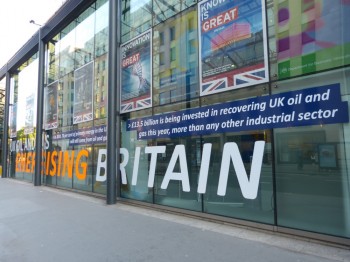
Those wanting to say that my title for this posting is nonsense won’t have to go very far to prove themselves right, in their own eyes. All they need to do is go to the Department for Business Innovation & Skills website, where they will find no prominent mentions of anything about Energising Britain with such things as oil or gas, but plenty of mentions of things like Offshore wind industrial strategy and Multi-million pound investment in offshore wind industry to unlock billions in UK economy. Unlock billions from the UK economy, more like.
I agree, sort of, in other words, with a commenter on that SQotD, who said:
Too late, the scam has been running long enough that there are now too many snouts in the trough.
The above piece of propaganda that I photoed may not be an actual lie, in the trivial sense that 13.5 billion quid may indeed be being invested in Britain this year in oil and gas, despite everything that the Department for Business Innovation & Skills may have done to discourage such investment by instead prattling on about wind farms for the last decade or more. But as an exercise in saying what the Department for Business Innovation & Skills is now concentrating on, it is a lie. The racket continues.
But this is often the way with big government bureaucracies. The truth, and a consequent forthcoming shift of policy emphasis (that later cascades into a truly new and totally different policy), often first impinges in the form of public lies about what they are now doing, even as they persist behind the scenes with the old discredited nonsense.
Never underestimate the reverse-impact of public relations departments, in the form of them telling the other people in the building what they now all ought to be doing. The collapse of the USSR, no less, began as a big old Soviet lie about how the USSR was going to start being efficient and nice and good, by doing something called “Glaznost”. It was wall-to-wall bullshit, but it was wall-to-wall bullshit that helped to change the course of history. The USSR, like “green energy”, “climate change” and so on, was another huge scam that went on for far, far too long, and by the end snouts in the trough was all it was. And the snouts only changed things when the trough was getting seriously near to totally empty. But change things they did. Millions had already died, and millions more had endured lives of utter misery, and in this sense, the change came too late, far too late. But change like that is never not worth doing. There is still a future worth improving, for many millions more.
Suppose you were a green fanatic who had weaselled your way into the Department for Business Innovation & Skills, and got yourself a job giving money stolen from British taxpayers to friends of yours who construct wind farms for a living, and emitting Niagaras of lies about how that was going to “energise Britain”. How would you feel about walking past all this stuff about oil and gas, every time you went into work in the morning?
You might think that all that lovely oil and gas tax revenue would perhaps enable you and your lying friends to keep the wind farm scam going that little bit longer, and if you did feel that, you might well be right. But I don’t think, on the whole, you’d like what you were seeing every morning. Just keeping your little scam going for a few more years until you are safely retired is hardly what you had in mind when you began it. Then, it was a cause, and you and your pals would be all over the history books, in a nice way. Now, history is looking like it might be taking a somewhat different turn.
For starters, there is no mention in this big lump of verbiage, of green, either as a word or in the form of the actual colour green. There is only a rather garish, shamelessly industrial, orange. “BRITAIN” in big letters also has a nasty, nationalistic taste to it. Whatever happened to saving the world?
More fundamentally, “oil and gas” is everything you hate. Oil and gas is vast, clunky metal structures noisily gouging dirty old energy to set fire to out of defenceless Mother Earth like it’s 1925, or if it now isn’t that, you still think it is, as do millions of others who also think: Hurrah! It’s a whole generation of people saying: Bollocks to wind farms, let’s get rich, again. It’s the whole world saying: “Climate catastrophe? Let’s not worry about that when it doesn’t happen, okay?” Despite all the wind farm idiocy that the Department for Business Innovation & Skills is still shovelling out, I think I smell change here, and for the better.
LATER: Green bloodbath in Australia.
SEE ALSO: Alex Singleton, at the ASI blog, says that Parliament’s cushy consensus over climate change is dead.
What follows is based on a talk I gave at the end of August at one of Brian’s Fridays. See also Parts I, III, IV, V & VI.
Little is said about the economy – not that that was a term in common use at the time. Unemployment – known as idleness – seems non-existent but there is some inflation – referred to as an “advance in prices” or “an increase in living costs”. Seeing as the pound was tied to gold at a rate of about £4 per troy ounce this seems surprising although the enormous gold finds in South Africa may have had something to do with it. Inflation may have been the cause of the many strikes at the time and it may have been the effect. The tax take is about 10%. Today it is over 40%. Northerners are better off than Southerners.
In 1912 the Titanic, the largest moving object in the world, set sail on its maiden voyage. Most people are aware that it sank, which is notable enough. But the really amazing part is that it got out of port at all. There had been a month-long national coal strike immediately beforehand and supplies were extremely low. Strikes are extremely common. In addition to the national coal strike, recent years have seen a national rail strike, a London dock strike and a Hull dock strike. London is currently undergoing a painters and decorators’ strike and Dublin a tramworkers’ strike.
In a previous coal strike, in 1910 in South Wales, troops had been used to put down a riot. At about the same time troops were also used to put down a riot in Liverpool.
The state is starting to nationalise things. In 1911 it nationalised the National Telephone Company. I should explain that this isn’t quite as dramatic as it sounds. The state already owned the trunk lines. The National Telephone Company owned everything else and operated them under licence. In 1911 the licence simply wasn’t renewed. In London, the County Council, late in the day, built an electric tram network. It was completed just in time for motor buses to take their market away from them.
It is difficult to detect any class, race or sex prejudice in the pages of the Times.
In 1913, the world is undergoing a transportational revolution. The horse is being swept from the streets of London to be replaced by electric trams, motor buses, motor lorries and motor cars. Below the streets, the deep-level, electrified tube lines are being built while steam trains are being replaced by electric ones on the older cut and cover lines. We are seeing the beginnings of surburban electrification.
Buses, in particular, are allowing people to travel much further to work and to shop. The only downside is that a lot of people are getting killed on the road.
Talking of buses, this is still a time when entrepreneurs are able to think big. Flushed from their success in London, the London General Ominbus Company, which incidentally bought up most of the Underground in 1911, is selling shares in a planned national bus company.
Quite rightly, Ronald H Coase, the Nobel Prize winner in economics, who died a few days ago at the remarkable age of 102, is being remembered as an exceptional thinker in economics. He is probably best known for this analysis – which seems obvious to us now – about why firms exist in the first place.
The University of Chicago Law School, with which he was associated for many years, has this nice appreciation of him. And here is the final paragraph:
Coase said in 2012 that his main scholarly talent was to identify solutions that were in plain sight. “I’ve never done anything that wasn’t obvious, and I didn’t know why other people didn’t do it,” he said. “I’ve never thought the things I did were so extraordinary.”
RIP.
As is now a familiar theme, many people oppose immigration into the UK because they fear the social and cultural effects (eg, from Muslim parts of the world) more than they do for the economic impact (supposed negative/positive effects on low-skilled wage rates, effects on productivity, and so on). In general, the classical liberal “open borders” approach states that the issue, in as much as it is an issue at all, is immigration+state welfare. The problem is the state welfare.
An argument that has got an airing today in the Daily Telegraph, via Jeremy Warner, is that immigration, of the “low-skilled” sort, hits productivity. The argument goes something like this: firms have less of an incentive to invest in improved methods of producing goods and services if they can hire cheap labour instead. This is a simple issue of factors of production (labour/capital) being substituted for one another depending on the relative costs of each. Now of course we want higher productivity in the medium to long run so that the whole pie expands; but that is not just a function of increasing output per hour by some restriction on the number of people in a workforce – there is also the increase in the division of labour that one can get with a larger number of people, at least potentially. And even if people are seeing wages for low-skilled labour hold steady rather than rise, it is better that people are in work rather than sitting idle. (Again, one has to consider the welfare impact here in shaping the incentives to take or not to take certain types of job.)
In any event, the supply of people able/willing to perform types of labour is not infinite (let’s not forget that a large number of people have also emigrated from the UK). History also does not seem to back up Warner’s fears: In the 19th Century, there was a population explosion in the industrialising West, for all sorts of reasons (lower infant mortality, better nutrition, health care, and so on), and yet by the turn of the century, real wages, when adjusted for inflation were higher than it was in 1800. (That is hardly a controversial statement. Data by the likes of Jeffrey Williamson and Peter Lindert, in “English Workers’ Living Standards During the Industrial Revolution: A New Look, The Economic History Review, 1978, clearly backs up this point.)
But what Warner seems to overlook is that if an influx of immigrants can be blamed for holding down productivity, cannot the same be said if, say, a significant number of British citizens move from one part of the country to another, as indeed happened in the early parts of the Industrial Revolution when people moved from farm-based jobs to factories and offices? Warner says he favours a sort of levy on employers who use “cheap labour”:
“No free market liberal would argue the case for preventing employers from hiring foreign labour but there are other forms of state intervention that might indeed be appropriate were it not for the fact that the European Union makes them unlawful – for instance, imposing levies on use of cheap foreign labour. By making low skill employment more expensive, the levy system would provide a powerful incentive for productivity gain in construction, retail, social care and other largely domestically bound industries. These levies could then be channelled back into tax incentives for training and other forms of business investment.”
Warner is damn right that no free market liberal would touch such regulation with a bargepole. The levy idea is also foolish, in my view, since how does Warner know how high/low to set it? What is the supposed ideal rate of productivity growth that he thinks should be the target, and in any event, should there be any target at all?
Ultimately, Warner’s analysis involves an unconscious assumption that there is a “UK plc” where we are all working towards a single, or fixed, set of ends, rather than an open society in which people transact and enter voluntary exchanges with others for things/services they wish to buy and sell. Of course, that leaves open other issues surrounding the proper role, if any, of a state, of welfare, of the need to protect borders against those who would enter this territory to do its inhabitants harm. But on the economic point of view, Warner’s argument makes no sense to me. He also ignores the rather basic fact that with a larger population entering an already advanced economy, that increases the potential division of labour, which increases overall productivity. If a person can now afford to hire a cleaner for his home, a child-minder to care for the children, or a gardener, or any other “low-skilled” job, that frees up that person to do something else, and possibly, increase the whole economic pie. And of course these “low-skilled” people can get more skills, develop a track record of reliability and diligence, and become more valuable and productive themselves than they would have been had they been forced to stay in presumably less favourable places where they moved from – since why did they move in the first place?
As a response to Warner’s kind of thinking, I can recommend this article from Daniel Kuehn.
Last night I attended a meeting of the End of the World Club, and by the end – of the meeting, not the world – the conversation had turned uncharacteristically optimistic. Oh, there were the usual prophecies of doom, and it is hoped that the next meeting will be someone talking about what it was like living through the Zimbabwe hyper-inflation. But the second of the two speakers last night was Rory Broomfield, speaking about the Better Off Out campaign, as in: Britain would be better off out of the European Union. That is an argument where at least some headway is now being made. How big the chances are that Britain might either leave or be kicked out of the European Union some time in the next few years, I do not know, but those chances have surely been improving. I can remember when the fantasy that “Europe” was going to cohere into one splendidly perfect union and lead the world was really quite plausible, if you were the sort already inclined to believe such things. EUrope, in those days, was a boat that Britain needed not to miss. Now, EUrope is more like a swamp into which Britain would be unwise to go on immersing itself, and should instead be concentrating on climbing or being spat out of.
Mention was made of shipping containers, i.e. of the story told in this fascinating book. Compared to the arrangements it replaced, containerisation has damn near abolished the cost of transporting stuff by sea, which means that the economic significance of mere geographical proximity has now been, if not abolished, at least radically diminished. Regional trading blocks like EUrope now look like relics from that bygone age when it would take a week to unload a ship, and when Scotch whiskey could not be profitably exported from Scotland because half of it would be stolen by dock labourers.
Containerisation also exaggerates how much business Britain does with Europe, because much of this supposed trade with EUrope is just containers being driven in lorries to and from Rotterdam, and shipped to and from the world. The huge new container port now nearing completion in the Thames Estuary is presumably about to put a demoralising (for a EUrophile) dent in these pseudo-EUropean trade numbers.
Mention was also made of a recently published map (scroll down to Number 29 of these maps). This map shows the economic centre of gravity of the world, at various times in history. A thousand years ago, this notional spot was somewhere near China. And the point strongly made by this map is that this centre of economic gravity is now moving, faster than it has moved ever before in history, from northern Europe (it was in the north Atlantic in 1950), right back to where it came from, leaving Europe behind.
Broomfield talked about how you convince people of such notions. For younger audiences, he said, just moaning on about how terrible EUrope is doesn’t do it. You have to be positive. But the trick, said Broomfield, is to be positive about the world. The important thing is that Britain, and you young guys, should not held back by EUrope from making your way in that big world.
The actual End of the World is not nigh any time soon, but the world is changing.
Here is a short (under four minutes) video, of a designer and exhibition curator Tom Dixon talking about the changes being brought to the world by 3D printing.
Whenever something new comes along, people typically describe it with a noun which says what it is like, but also with an adjective attached to explain how it is different from that. Think “horseless carriage”. (What will “driverless cars” be called twenty years from now?)
So it has been with 3D printing. This is “printing”, sort of, but not printing as we know it.
Listening to Dixon makes me think is that “3D printing” is actually less like printing, and more like blogging. The crucial difference it makes is in enabling people with opinions about how a … 3D thing … should or could be, but who has not been able or who could not be bothered to interest a Big Manufacturer (think Mainstream Media for bloggers) can now just go ahead and make it (just like a blogger publishing his hitherto ignored opinions). And this new-style designer can sell his new design on the internet too, because distribution has also, already, been taken out of the hands of old school Big Distributors (unless you count Amazon and eBay as Big Distributors). Not all such new designers will do as well as they hope, in fact almost all of them will not. But a few will surely succeed spectacularly, and many will presumably be making lives and livings that could not have been made before.
Dixon uses the phrase “taking matters into their own hands”. These words were my first version of the title of this posting.
There is a Samizdata team joke that the difference between American arrogance and British arrogance is the British think they run the world, whereas the Americans think they are the world.
Well just last week I started doing some business with a European bank… a quite mainstream one I might add… and discovered something remarkable. I had to sign a series of statements that I did not do business in the USA, had no assets in the USA and was not a US citizen or resident. Only then would they do business with me. Indeed I had to sign more papers regarding this than any actually pertaining to the business I was doing with them.
And this is why…
The Internal Revenue Service on Monday launched an online registration program for the hundreds of thousands of financial firms around the world that must comply with a U.S. anti-tax evasion law or risk being shut out of financial markets.
Surely a significant European bank must do some business in the USA, I asked. Can the world’s largest economy really be so onerous that you truly want nothing whatsoever to do with it?
Well he was rather guarded and he knew I was a blogger, which I suspect made him a bit uneasy at the prospect of being quoted, which is why I am naming no names. But to paraphrase the reply I coaxed out of him, it was “yes, the USA is simply not worth the trouble and so rather than complying with their endless diktats and the uncertainties of what are increasingly capricious rules… well… there is a whole great big world out there for us to do business with that does not include the United States.”
Yet I suspect the powers-that-be in Washington could not care less and moreover the notion that sophisticated foreign bankers are starting to see American not as the land of opportunity, but as a place to be avoided at all costs, would strike them as preposterous. Indeed had I not had those documents laid in front of me asking me to attest to a complete lack of economic links to the USA or anything associated with the USA that the US state might claim extraterritorial jurisdiction over… well, I would not have believed it myself.
Moreover, after our business had been concluded and he relaxed a bit, the banker in question, who I very much doubt is on any Interpol wanted lists (well I certainly hope not given that he now has some of my money) said he would not even visit the USA or transit a flight through it, due to the US authorities propensity to detain foreign bankers and ask them questions if they even suspect any involvement with US nationals, particularly from ‘non-compliant’ banks such as his.
Am I the only one who is astonished things have come to this? I am suddenly very glad I do not actually live in Arkham, Massachusetts (not sure which is worse, the IRS or the Deep Ones).
Why does the BBC sneer about Britain’s recovery but go crazy if Euroland’s corpse so much as twitches?
– Stephen Glover
In fact I suspect the UK’s “recovery” is as bogus as the Euro-zone’s “recovery” but the approach of the BBC is nevertheless… interesting… in a very predictable sense.
Neill Blomkamp must be living in some parallel universe as he speaks about his new film “Elysium”:
The 33-year-old film-maker, who moved from South Africa to Canada as a teenager, adds that “healthcare, immigration and class” are his targets, and “it’s not really the future I’m talking about”. “It’s not science fiction. This is now. The divide between rich and poor is getting more and more extreme.”
Actually Neill, never in human history has there been a smaller percentage of humanity living one failed harvest away from communal starvation. Is the divide between rich and poor actually increasing and more extreme than, say, in the eighteenth century? Or any time before then actually? In reality never has a larger percentage of humanity been, by any reasonable definition, middle class, than right now.
The fact large areas of poverty exists at all in our technologically advanced age is a dark miracle wrought largely by state imposed impediments to trade, disincentives to employ, insecurity of private property title and many other government policies of the sort Matt Damon (that tireless supporter of state education whose children are in a private school) strongly approves of.
If I had the option of living in a nifty orbital torus filled with fellow capitalists, I would want it to be well defended too, Neill… mostly in order to keep out all the champagne socialists.
Fears over NSA surveillance revelations endanger US cloud computing industry:
American technology businesses fear they could lose between $21.5bn and $35bn in cloud computing contracts worldwide over the next three years, as part of the fallout from the NSA revelations. Some US companies said they have already lost business, while UK rivals said that UK and European businesses are increasingly wary of trusting their data to American organisations, which might have to turn it over secretly to the National Security Agency, its government surveillance organisation.
Of course it is highly unlikely that GCHQ or its French and German counterparts are actually any less intrusive, but that said, I suspect the budget for these organisation would not keep the NSA’s staff in Cheetos and RAM upgrades, so on that basis alone I suppose your data is probably safer anywhere but the USA.
But the perception that the USA is the very worst option in the First World from a security perspective is now going to be very hard to change, whatever the truth of the matter. I did see this coming.
Central banks cannot solve the problems they created any more than an arsonist makes a good firefighter.
– Steve Baker MP remembers the words of Steve Horwitz, to help him explain why he is not impressed by the latest doings of Bank of England Governor Mark Carney.
The IEA is not happy either.
|
Who Are We? The Samizdata people are a bunch of sinister and heavily armed globalist illuminati who seek to infect the entire world with the values of personal liberty and several property. Amongst our many crimes is a sense of humour and the intermittent use of British spelling.
We are also a varied group made up of social individualists, classical liberals, whigs, libertarians, extropians, futurists, ‘Porcupines’, Karl Popper fetishists, recovering neo-conservatives, crazed Ayn Rand worshipers, over-caffeinated Virginia Postrel devotees, witty Frédéric Bastiat wannabes, cypherpunks, minarchists, kritarchists and wild-eyed anarcho-capitalists from Britain, North America, Australia and Europe.
|







Recent Comments