We are developing the social individualist meta-context for the future. From the very serious to the extremely frivolous... lets see what is on the mind of the Samizdata people.
Samizdata, derived from Samizdat /n. - a system of clandestine publication of banned literature in the USSR [Russ.,= self-publishing house]
|
Guy Herbert this morning posted a piece commenting on Australian Prime Minister John Howard’s decision to “ban” the Australian cricket team from touring Zimbabwe later this year. I generally have little time for Mr Howard, but in this case I can not personally be very harsh on him. What clearly happened is that the Australian Cricket Board (which these days prefers to call itself “Cricket Australia”) begged him at length the make such an announcement, and he eventually gave in despite considerable resistance, and he did this because the alternatives open to him were probably worse. I have no disagreement with Guy that the outcome is essentially a dishonourable one, but the other easy options were worse. Some background.
In international cricket, there are only three countries for who the game is directly profitable. These are India, Australia, and England (in decreasing order of profitability). The other countries that regularly play international cricket make money by playing the national teams of these three countries, and then selling television rights and other sponsorship opportunities for these matches. Thus it is very important to (say) Sri Lanka for (in particular) India and Australia to regularly tour Sri Lanka and play matches.
In order to assure its members of some sort of regular cricket and regular income, the International Cricket Council (ICC) has in recent years created a mandatory tour program, requiring each of its members to play each other both home and away over a five year period. Reactions to this rule have varied, and compliance with it has been variable. The rule allows two sides to postpone a series if both are in agreement, which has allowed India and Australia to at times get their way by offering more money or more matches if the matches are played at some undefined “later”. However, if a team takes a hard line, then (at least theoretically) the other side must tour, or must pay a fine to the ICC which will be then forwarded to the host team as compensation for the lost revenues from the matches that were to have been played. The ICC’s rules allow for two situations in which a fine is not payable: firstly in cases where there is a genuine issue of safety – tours of both Sri Lanka and Pakistan have been called off for this reason in times of high political tension and terrorist threat – and in cases where a government forbids a tour. This second rule has come into play more in cases where Zimbabwe were potentially the touring side, most notably when Zimbabwean players were refused visas by the government of New Zealand.
Zimbabwe are a full member of the ICC. In the mid 1990s Zimbabwe had quite a decent cricket team (of mostly but certainly not entirely white players) but in the years since then Zimbabwean cricket has gone the way of most other things in Zimbabwe. At the demand of the government, white players were pushed out of the team, as were any non-white players who dared to say anything critical of the government. Officials who ran the game and actually cared about cricket were replaced with compliant government yes-men. The organisation of cricket in Zimbabwe became a shambles, and we are not sure right now to what extent the domestic cricket is even taking place. (The Association of Cricket Statisticians and Historians has recently been complaining about being unable to get scorecards for the domestic Logan Cup, which it has documented with no trouble for over a century). Inevitably, the standard of the national team has dropped from “decent, but not world beating”, to utterly woeful. Their performance in the recently completed World Cup was dreadful, and they have dropped to 11th in the world rankings, way behind the rapidly improving Bangladesh, and behind even Ireland, a side just consisting of part time Australian and English expatriates and who are not a full member of the ICC.
However, through all this Zimbabwe has maintained its full membership of the ICC. Zimbabwe has been “temporarily suspended” from playing test matches due to its declining standards, but it is still playing one day international cricket, and other teams are expected to tour in order to play these games. Australia was scheduled to tour Zimbabwe this year.
The obvious thing to do would be to expel Zimbabwe from the ICC, not necessarily on political grounds explicitly, but simply because cricket in Zimbabwe is no longer being administered and organised properly, that the board is no longer independent of government, and because selections are no longer taking place on the basis of merit. However, there are two reasons why this has not happened. The first is that there is a “third world” versus “first world” divide in international cricket, and some aspects of the administration of the game are a post-colonial nightmare. For many years Australia and England (and, prior to their expulsion from international cricket in the apartheid days, South Africa) had the right of veto over any decisions made in the ICC, and the other countries still have a lingering resentment of this. Once this veto was abolished, the Asian cricketing powers were eager to elevate other countries to membership of the ICC so as to gain a voting majority against the former “colonial” powers, and this is one factor that led to the elevation of Zimbabwe in the first place. Expelling Zimbabwe would increase the voting power of the “first world” bloc, and many people in India, Pakistan, and Sri Lanka do not want this.
Secondly, what are the objections to Zimbabwe playing international cricket? For one thing, Zimbabwe is ruled by a dictatorship that restricts civil liberties. Well, other members of the ICC include Bangladesh and Pakistan, who are not exactly wonderful on this score either. South Africa is ruled by people who consider Robert Mugabe to be one of their old comrades in arms. If Zimbabwe were kicked out of world cricket on these grounds, then this would “set a bad example” to Pakistan and Bangladesh in particular. Did I mention that the governing body of cricket in Pakistan is traditionally a branch of the army and the head of its board is usually a general? That complicates matters further, and rules out the “We should expel Zimbabwe because the government controls cricket in the country” argument. The government of Sri Lanka appoints that nation’s cricket board too (although not through the army). As for “Zimbabwe selects players on something other than merit”, well, South Africa does that too. (Affirmative action with respect to black and coloured players). One would think that “Zimbabwe should be expelled because Zimbabwean cricket is a shambles” might be enough, but the organisation of cricket in a number of countries is a shambles (most notably Pakistan again, also (sadly) the West Indies). The ICC is also a shambles, having demonstrated in its organisation of the recently completed World Cup that it is an organisation that could not collectively get pissed in Porto)
Australia was scheduled to tour Zimbabwe later this year. The Australian players did not want to make the tour. The Australian government definitely did not want the tour to go ahead. → Continue reading: On cricket, Zimbabwe, John Howard, the ICC, Pakistan and Bob Woolmer
John Howard, Australia’s Prime Minister, is quite rightly critical of the Mugabe regime in Zimbabwe, and does not like the idea of the Australian cricket side touring there. He has had to struggle with his conscience:
“I am jammed between my distaste for the government getting involved in something like this and my even greater distaste for giving a propaganda victory to Robert Mugabe.
But not that much of a struggle. The next sentence:
Obviously if there is a way legitimately that the tour can be cancelled and there not be an exposure by Cricket Australia to any fine, then we’ll go down that path.”
Later in the week this was backed by threatening to withdraw the players’ passports, and the federal government undertaking to pay any ICC fine.
What a pity. Mr Howard plainly understands that the administration of sport is not the government’s business; but he feels bound in the pursuit of maintaining Australia’s national image to intervene in private sphere. Talk of the tour being a victory for Mugabe is just justifying cant: a ban is a much bigger target for racialised anti-colonial rhetoric. The quasi-ban – notably exercised by bullying and bribery rather than any lawful power – is a lurch of Zimbabwe-style arbitrary government and propagandising state action.
Western politics is not so far from the world of Comrade Bob, and we forget that at our peril.
I nearly spilled my tea when I read this:
Western countries are concerned about the expected appointment of Zimbabwe to head a key UN body, the Commission on Sustainable Development.
“We don’t think that Zimbabwe would be a particularly effective leader of this body”. (A US state department spokesman, Tom Casey)
Concerned?! Particularly effective?!!
So this is what they mean by diplomatic language… I think I shall start interpreting people’s remarks about my need to be more ‘diplomatic’ in an entirely different manner. Or is the term ‘reality-challenged’?
FYI: Zimbabwe is enduring the world’s highest inflation, at more than 2000%, mass unemployment, and there are widespread accusations of civil rights abuses.
Sorry to link to a depressing story on such a beautiful Friday morning here in ol’ London town, but this Bloomberg article on what is happening in Zimbabwe is a good read – about the monster who has crippled that beautiful country and the desperation of the people living in it.
Just think of the missed opportunity: a country with some of the richest natural resources in the world, a great climate for agriculture, English-speaking. Zimbabwe, liberated from the worst aspects of white rule and under the rule of law, could have been the Australia or New Zealand of southern Africa. I fear it will serve as a textbook example instead of the evils of political cronyism and warmed up Stalinist economics.
I have heard it said many times that a country with natural resources is almost cursed, while a tiny island with no resources other than the entrepreneurial gusto of its inhabitants is blessed. Zimbabwe certainly adds to that idea.
One of the sad things that happened in the cold war was that the two sides each found allies in the third world, and what was best for poor countries got lost in the global realpolitik. This was saddest in Africa, where in many cases the anti-colonial rhetoric of communism and the money and weapons provided by the Soviet Union (combined with the fact that many of the African colonial powers were American allies of one form or another) led to many countries embracing socialism. This was of course a catastrophe, in that pretty much without fail the countries that took the socialist road were impoverished by it, not to mention being involved in wars that could and should have probably been avoided. The socialist rhetoric is now largely gone, and most African countries are now more over-bureacratic and corrupt than particularly ideological. That said, the ideas live on in the minds of many of the people who were involved in African struggles. Listening to South African government officials talking about appropriating private propery is rather depression. One would hope that they could look north at Zimbabwe and see what is not the solution.
And it lives on in other ways. One way is in the names of streets in places like Maputo. I think it would be a good thing at this point to formally disavow certain aspects of the past. But there seems to be a certain lack of that kind of bravery.
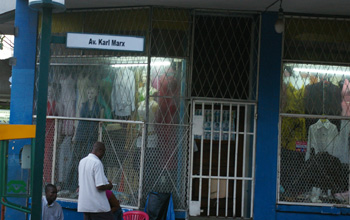 Tosser Tosser
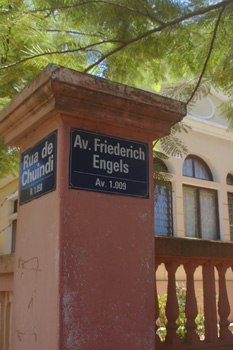
Tosser
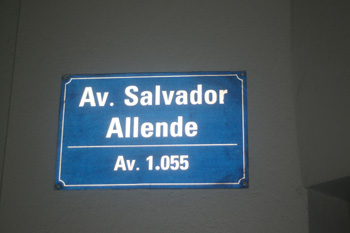
Tosser, although whether Pinochet was a bigger or smaller tosser is a matter for dispute
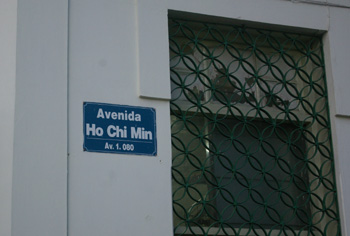
Tosser
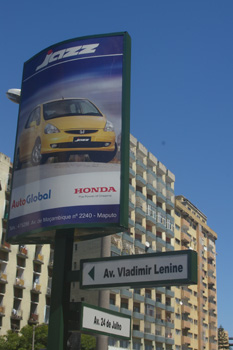
Big tosser, although I suppose we can at least say “Japanese car manufacturers 1. Soviet Union 0”
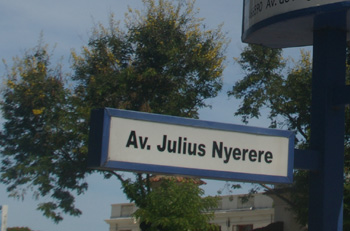
Well, okay, he was at least another African independence leader, and his country has at least managed to remain peaceful, which is more than many can say. He did utterly impoverish it, just the same. Could be worse
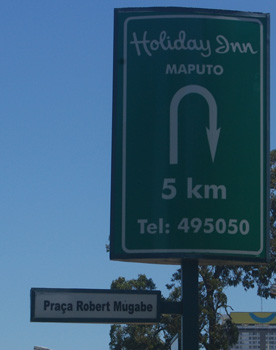
Much worse, in fact.

Perhaps we could also have streets named after Hitler and Stalin so that the three great murderers of the 20th century all get equal treatment?

Okay, at this point I think we may have reached the indescribable
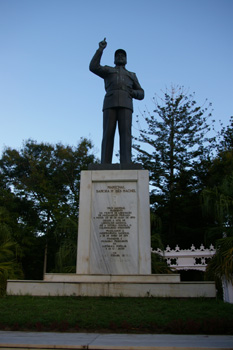
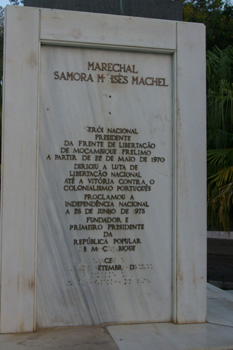
There is perhaps one redeeming feature, however. Near the botanic gardens is to be found a statue of Samora Machel, the first post-independence president of Mozambique. As it happens, this statue was given to Mozambique by the North Koreans and Kim Il Sung, which perhaps explains the slightly wacky style.
However, the statue hasn’t received much maintenance, and many of the words on the plaque below it have crumbled away. In particular, the whole section explaining when and how the statue was erected is gone, and there appears to have been no attempt to repair the sign and return Mr Kim’s credit. That is something to be thankful of, I suppose.
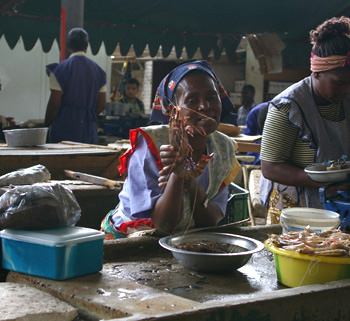
As advertised, the seafood is excellent.
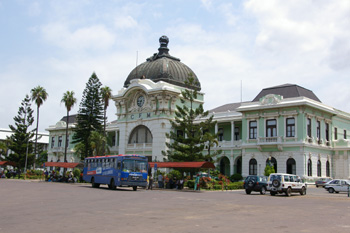
The colonial archiecture (and for that matter the relaxed friendliness of the people) is Portuguese. A beer costs about 25p,
and Brian is right.
(Actually, there is a book to be written on why mobile phones and their applications in Africa have evolved differently than mobile phones in the rest of the world, and the biggest things (besides their being so useful) is the lack of legacy. That means legacy in terms of business methods as much as legacy in terms of technology. In Europe and (paritcularly) America, mobile phones networks are run by the same old telecommunications businesses as were traditional phones, and these companies are both terribly bad at retail and figruring out what customers want rather than just telling them what they should want. Plus they are far too busy trying to protect their existing business (including their existing mobille phone businesses) to want to innovate, and sometimes they will actively oppose innovation. Africa is much more a matter of “Try and see what works”, and that really works. But I digress).
I was in Johannesburg for a few days before coming here, and while the northern suburbs of that city have all modern amenities and in many ways feel like modern American suburbia around a couple of Edge Cities, every building and business in that city is fortified in a way that is not normal elsehwere. It is a dangerous city, and that influences the way that people go about every moment of their lives.
Maputo is not like that. Walking down the street there is no air of threat whatsoever. I feel perfectly safe walking down the street with my digital SLR around my neck and using my iPod, which I certainly would not in Johannesburg. Occasionally people try to sell you things fairly aggressively, but they are simply trying to sell you things.There is no implied threat whatsoever. By the standards of the thirld world this is a very relaxed place. So far I am enjoying it very much.
Rageh Omaar, writing in the New Statesman, makes an interesting observation:
Each time I return [to Somaliland] I am struck by the increasing influence of puritanical interpretations of Islam. […] Generations of young Somali men have attended seminaries and Koranic schools, but they never used to wear turbans or red and white keffiyehs, increasingly a symbol of Sunni sectarian identity.
Somalis have been guest workers in the Gulf, especially Saudi Arabia, for decades, giving Saudi Arabia considerable economic and cultural influence over the people and institutions of the as yet unrecognised Republic of Somaliland. One influence has been the financing of schools based on the puritanical Wahhabi interpretation of Islam. Western governments seem unperturbed. They are more worried, in the case of Somalia, by the emergence of a loose alliance of home-grown Islamists who came to power because they got rid of hated warlords, than with the large sums of money being spent by Saudi institutions to spread an austere version of Islam.
It was ever thus. I know some in the commentariat will dismiss anything Omaar says because he’s an ex-BBC journalist writing in a lefty publication. But his point, supported by these facts, boils down to a simple one, with which I concur: Islamism won’t weaken in the rest of the world while it continues to be spread from Riyadh.
You would not want to start from here, but the West must find ways to stop sucking up to the Saudis and, more, to begin to counter their theological export industry. 30 years late is better than never. Killing people is beside the point. Offering cultural alternatives is not.
If the report turn out to be true about the success of the US military attack in Somalia, that is good news indeed. It is being claimed that some of the people targeted were those responsible for the horrendous 1998 bombings of the US embassies in Nairobi in Kenya and Dar es Salaam in Tanzania, and 2002 atrocities on in Kenya against Kenyan and Israeli civilians. If those are the bastards who have indeed been killed then that is a cause for some satisfaction.
It is interesting that the attack, which took place in Somalia, has attracted praise from the Somali president, who is no friend of the Islamists. But rather more baffling is that the EU has criticised the attack, with a spokesman for EU development commissioner Louis Michel saying “Any incident of this kind is not helpful in the long term”. I wonder how killing members of Al Qaeda is not ‘helpful’ in a fight against Al Qaeda?
Alex Singleton has been watching the Running Man. I have just been watching a Newsnight report about mobile phones in Kenya. The gist of the report was that mobile phones in Kenya in particular, and Africa generally, are a stunning success. As if by magic, they are transforming the prospects of ordinary people in Africa, and the relationship between ordinary people and their corrupt, aid-gobbling governments.
We watched a deeply impressed BBC reporter, Paul Mason, being told by a black lady, who I rather think may have been one of the authors of this report that indeed, mobile phones are having an impact upon Africa comparable to the switch from dictatorship to democracy – she mentioned other technology as well, like fire, the wheel and the railways – and that the mobile phone industry provided a model for progress in other areas of African life, such as education and healthcare. Her message to the governments of Africa: get out of the way, at let the business people do these things, and the people pay for these things, themselves.
Paul Mason went deep into the Kenyan countryside, braving the chaos of Kenya’s government supplied road system, into Masai territory, to study the difference between places where mobile phone technology was working its magic, and where the wretched of the earth did not have mobile phones. He was, in other words, looking for one of those gaps. But he did not find any gap. The Masai already have their mobiles, and they love them.
Not all the news nowadays is good, to put it mildly, but this Newsnight news was very good news indeed, and not just because of its news about Africa. It was what it said to me and to my fellow countrymen, and (via the BBC’s excellent internet operation) to the entire world, that really pleased me.
The French involvement in the Rwandan genocide in 1994 has been something about which the chattering classes have been largely indifferent, much to the annoyance of many Rwandans. The Rwandan government recently unceremoniously threw out the French embassy, and any French institutions with links to the French state, after a court in France issued arrest warrants against several leading Rwandans (including the president) for assassinating former President Habyarimana, whose death was the event that sparked the genocidal murder of 800,000 Tutsi. That was rather like France in 1956 calling for the arrest of the few surviving conspirators behind the (sadly failed) plot to assassinate Adolph Hitler in 1944.
I cannot escape the suspicion that if somehow, however tangentially, the USA was involved then articles about Rwanda would be a far more common thing in the media. That said, I have no doubt that someone, somewhere has concocted a conspiracy theory that it was the CIA, rather than France, who was backing the Bad Guys in 1994, supplying the Interahamwe with machetes from a secret Halliburton machete factory in somewhere in Texas.
Today I received, from the Globalisation Institute, a press release, which began as follows:
Monday 6 November – A new report released today by the Globalisation Institute says that microfinance is not being taken seriously by the Department for International Development.
In October, it was announced that the Nobel Peace Prize would go to the founding father of microfinance, Dr Muhammad Yunus, who created the Grameen Bank in Bangladesh. However, microfinance remains tiny in Africa and receives scant support or encouragement from DFID.
Okay, cards on the table. I am a big fan of the Globalisation Institute and of its bosses Alex Singleton and Tom Clougherty. I write quite frequently for the Globalisation Institute blog, my latest posting there, about mobile phones (which makes much of a comment at my blog by Michael Jennings on the subject), having gone up there only last Friday. Tonight, I am attending a Globalisation Institute do, to which I have been invited so that I can take photos. David Cameron will be present, and they want to be sure that his presence there is immortalised pictorially, so that they can blog about it and impress their many donors with their political plugged-in-ness. Very sensible.
But… and you could hear that word coming a mile off couldn’t you?… I have severe doubts about these latest pronouncements of theirs. → Continue reading: Memo to DFID – please do not take microfinance seriously
I have just done a posting on my personal blog about Sierra Leone, where a British Army friend of mine is now working. He is back in London just now, and passed on some photos of Sierra Leone that he and one of his friends had taken, and I picked out my favourites to put on my blog.
They illustrate an idea I have had for a while now that maybe one of the nice little things that digital photography, in combination with the internet, will do for the world is to present to it a slightly more balanced notion of what life in Africa is like just now. On rich country TV we only ever get slaughter and catastrophe from Africa, because only slaughter and catastrophe is news. But now, in addition to superbly photographed famine and mayhem, we get less well photographed … well, just stuff. Photos that a generation ago would (a) have been far less numerous, and would (b) have merely languished in the photo albums of a certain sort of expat, are now being displayed to the anyone in the world who cares to glance at them.
I do not claim that the slaughter and catastrophe is not happening. Sierra Leone itself had a horrific civil war less than a decade ago. “Worse than you can possibly imagine”, my friend said. But now, touch wood, things are going better.
Mobile phones have been a particular success, apparently, mostly because regular landline phones, such as rich countries have long had, have been such an abject failure, but perhaps also because mobiles enable Africans to cooperate much more effectively while still not having to commit to something days in advance. My friend says that Africans, just as Western stereotypes have always said, at any rate the Africans in Sierra Leone, are still very bad at doing this.
That is a mobile phone top-up and recharging booth. Mobile phone companies are now making lots of money in Africa. Good for them.
|
Who Are We? The Samizdata people are a bunch of sinister and heavily armed globalist illuminati who seek to infect the entire world with the values of personal liberty and several property. Amongst our many crimes is a sense of humour and the intermittent use of British spelling.
We are also a varied group made up of social individualists, classical liberals, whigs, libertarians, extropians, futurists, ‘Porcupines’, Karl Popper fetishists, recovering neo-conservatives, crazed Ayn Rand worshipers, over-caffeinated Virginia Postrel devotees, witty Frédéric Bastiat wannabes, cypherpunks, minarchists, kritarchists and wild-eyed anarcho-capitalists from Britain, North America, Australia and Europe.
|