We are developing the social individualist meta-context for the future. From the very serious to the extremely frivolous... lets see what is on the mind of the Samizdata people.
Samizdata, derived from Samizdat /n. - a system of clandestine publication of banned literature in the USSR [Russ.,= self-publishing house]
|
Beauty of Grey criticizes a couple of our recent offerings:
This sort of shrill extremism is a big reason why most people view libertarians as a third party wacko fringe group, just on this side of the Larouchies on the respectability scale. The sneering condescension Perry displays probably won’t help their poll numbers any, either.
Firstly it was Brian Micklethwait, not me, who wrote the first piece ‘Beauty of Grey’ mentions. Also the fact is that the majority of libertarians in the USA who deign to vote actually vote Republican, not Libertarian. Ever heard of Ron Paul? That should be obvious and as a ‘small l’ libertarian that is of no concern to me.
I would have thought the jocular tone would have made it apparent that Brian was not seriously supporting the idea of people being mugged. He is just saying that if people advocate and legitimise political actions that result in a more violent society, he is not going to be too concerned if they reap the harvest they have sown and I certainly agree. That ‘Beauty of Grey’ should decry our lack of moral relativism and therefore our sentiment that people are responsible for the consequences of their actions in the ballot booth, is certainly rather revealing. But that is not the same as Brian actually advocating mugging. Victim disarmament supporters “deserve” being mugged because they are responsible for people being helpless when confronted by an emboldened mugger, not because Brian is going to organize bands of libertarian muggers to roam the streets looking for ‘liberals’. To read his remarks any other way strikes me as bizarre.
Secondly, ‘Beauty of Grey’ clearly has no idea what modern self-described socialist parties who are in power in various western European countries actually advocate and do. He can delude himself that the pervasive incrementalist approach to regulating economic activity that pretty much defines the Democratic Party (and elements of the Republican Party) in the USA is materially different to that of the French or British or German or Swedish government’s ‘democratic socialist’ model but it is not. The only difference is that there is more effective political opposition to it in the USA.
Modern ‘democratic socialism’ is a strange hybrid between paleo-socialist aims of outright national ownership of the means of production and the national socialist approach of allowing nominal ownership of the means of production but regulating the ways in which they can be used to require the support of National Objectives: control by overt ownership vs. control by regulation… but the end result is still control by the state, it is only how you get there that varies. How does this differ from the ‘liberalism’ of the Gore/Kennedy/Schumer way? These are people who constantly advocate ‘National’ solutions driven by regulations rather than free markets. The only difference is the language they use to describe what they want.
That Gore’s plank does not explicitly lay out the pervasive role of the state, and that ‘Beauty of Grey’ therefore thinks that there is a huge difference between the ‘liberal’ and the modern democratic socialist, says more about ‘Beauty of Grey’s’ credulity than the political process he describes. Vast areas of economic (and private) life are subject to regulation and thus the owners of the means of production find their control ever more circumscribed by the state as it tells you who you may or may not trade with, who you may hire or fire, how you educate and interact with your children, how (and if) you protect yourself from harm, the manner in which you may marry, how you must clear the snow from property you do not even own in front of your house, how you install plumbing and electrical wiring in your own home etc. etc. Yet we are to believe that the sanctity of private property is alive and well and living in ‘liberal’ constituencies in the USA.
Or maybe I just missed the plank in Gore’s platform that called for a state seizure of the means of production and an abolition of private property? They do try to sneak things by you in the fine print, those scoundrels.
I could not have put it better myself. Beauty of Grey’s remarks demonstrate exactly how effective the incrementalist approach is. Al Gore wants exactly what Gerhard Schroder, Tony Blair and Lional Jospin want. And what do Gerhard Schroder, Tony Blair and Lional Jospin all call themselves? Socialists.
If Beauty of Grey is going to talk about ‘the fine print’ it would behoove him to read it first. Perhaps he should start by getting the author right on things he criticizes.

The British government feels it no longer even has to hide the fact it wishes to be the centre of a vast spider web of surveillance. Gone are the days of ‘no comment’ regarding Echelon and Carnivore. Now the state is demanding the ability to control all communications between British scientists and foreign colleagues on pretty much any subject the state deems appropriate.
The situation is little better in the USA and as the editorial in the latest print edition of New Scientist aptly puts it:
The government there is withdrawing thousands of technical papers that amount to cookbooks for chemical and biological weapons. It has also asked journal editors to leave out details from papers that would be essential for anyone replicating the work. This undermines the whole notion of ensuring that research results can be checked by others. It also raises a paradox: terrorists, it seems, are deemed smart enough to understand arcane science, but too dumb to fill in the gaps in research papers
The deadening effect this will all have on a vast swathe of scientific progress is not hard imagine. Inevitably some types of research will just migrate to places where the state does not impede its development resulting in more, not less, diffusion of critical knowledge and technologies. Rather than a narrowly targeted moderation of clearly weaponised technologies, the state has elected to implement an Orwellian oversight on all technical discussions on subjects to be determined by semi-qualified bureaucrats who will always have a presumption of the legitimacy of intervention. A disappointing response but hardly a unexpected one to someone such as myself who assumes the worst of states and is rarely surprised.
 When The State watches you,
dare to stare back
We received an e-mail from Kevin Connors on the issue of the term ‘liberal’
I believe David’s piece on the label “liberal” is quite ill-advised. I have a hard enough time trying to explain libertarianism to people and differentiate it from conservatism without swimming against the tide on an issue of semantics.
However I must disagree with Kevin. I think this is a useful point to raise for several reasons.
It is useful to put the evolution of the term into historical perspective, as Tom Burroughes has done, in order to understand the evolutionary process by which a term can come to mean the opposite of its original meaning, at least in the USA and to an extent the UK.
It is also useful to note that in the process of defining a word, it forces people to contrast it against opposing concepts and thus discover synonyms and antonyms. It is very helpful indeed to be able to point out that liberal is just a synonym for socialist and that it is mostly because ‘socialist’ has such negative connotations in the USA that members of the Democratic party use the term liberal. Thus a little discursive musing on the term ‘liberal’ makes that point rather hard to avoid. There is little daylight between modern ‘democratic socialists’ in Europe, Liberal Democrats in the UK and Democrats in the USA: they are just the modern faces of socialism.
Pointing this out is far from ill-advised. Many in the UK who vote for the ‘Liberal Democrats’ do so because of quaint ideas that they are the ‘middle way’, whereas the truth is that they are further to the socialist left than the Labour Party. In the USA many who would sooner use the star-spangled banner as a doormat than vote ‘Socialist’ nevertheless vote ‘Democrat’.
All we are doing is trying to introduce a little coherence into the political taxonomy!
Stephanie DuPont has suggested that the female guests at the British Blogger Bash were ‘paid escorts’. Two were computer programers at the top end of their professions, one was a manager with the English National Opera, one was a TV producer and one runs a hotel and a small data services operation.
Stephanie is obviously just jealous she was not invited to the bash, or maybe she is looking for a spanking to relieve the tedium of being Brian Linse’s gopher. Yes, she strikes me as the kinky type, that must be it.

At the Brit Blogger Bash: elegant, articulate and easy on the eyes
The Capitalist Chicks site has had a major update, featuring interesting articles (including one from Samizdata’s capitalist non-chick David Carr), the beginnings of a picture gallery and other good things, such as…
The Ethical Philosophy Selector is an amusing attempt to see what a person’s philosophical influences are. Many blogs seem to be taking the test so I thought “what the heck”… My results leave me rather bemused given my dislike for Sartre.
1. Rand (100%)
2. Mill (90%)
3. Sartre (75%)
4. Epicureans (73%)
5. Kant (73%)
6. Nietzsche (70%)
7. Bentham (69%)
8. Prescriptivism (65%)
9. Aristotle (61%)
10. Stoics (60%)
11. Aquinas (59%)
12. Hume (56%)
13. Augustine (53%)
14. Plato (48%)
15. Spinoza (48%)
16. Cynics (47%)
17. Hobbes (47%)
18. Ockham (33%)
19. Noddings (23%)
Tentative greetings from Hangover Headquarters.
The 1st Blogger Bash in London was a definite success with four blogs represented, and a host of would-be bloggers and blog readers also in attendance, eighteen people in all.
Blogs represented were Samizdata (obviously), Aint No Bad Dude, Dodgeblog and Layman’s Logic.
Unfortunately Adil Farooq of Muslimpundit sent regrets earlier and was unable to attend and the evil Busheyspon was a no-show.
Proceedings started at 7:00 pm and continued until 6:30 am today (I kid thee not) when the last diehards staggered off to an uncertain fate into the cold Chelsea night.
It looks like at least two new blogs will probably emerge as a result of the contacts between existing bloggers and interested attendees. Samizdata will also gain two more contributors to the bristling libertarian phalange in the form of Adriana Cronin and Patrick Crozier.

Samizdata Team reminds Brian Linse of Aint No Bad Dude that we have not forgotten the ‘Interblog Gun Wars’

We can confirm that contrary to rumours, Andrew Dodge is not in fact possessed by demons

Ben Sheriff of Layman’s Logic was envious of Brian Micklethwait’s finely tuned social antennae

The party was characterised by sober discourse and probity
 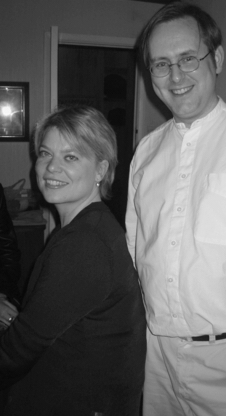

All the attendees were bleary guys with beer bellies

Dale was very impressed when Tom Burroughes demonstrated the famous Reuters Break Dance technique
Proper after-action reports will have to wait until tomorrow but here is the hard core who are still partying at 3:55 in the morning…
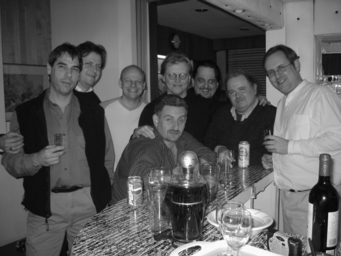
L to R: Walter Uhlman Pat Crozier Dave Shaw David Carr (seated) Brian Linse Andrew Dodge Dale Amon Perry de Havilland
One of the reasons for the low volume of bloggage here has been the distracting influence of our pet pinko, Brian Linse, who has somehow managed to weasel his way into Samizdata HQ. He has barricaded himself into the downstairs guest room and we cannot get him out. The horror. The horror.
The London based Libertarian Alliance has issued a press release about an outrageous case in Britain in which a man who defended himself from knife wielding home invaders finds himself on the wrong end of the law:
“Drop all charges against householder who killed burglar. This man is a hero“, says free market and civil liberties think tank.
58 year old John Lambert, of Spalding, Lancashire, has been released on bail following two days of arrest after the death of one of two burglars who had broken into his home and put a knife to the throat of his wife, according to press reports.
During a struggle to defend himself and his wife Mr. Lambert killed the burglar with his own knife. Rather than suffering the indignity of arrest and police inquiries Mr Lambert should be hailed as a hero and public benefactor. So claims the Libertarian Alliance, Britain’s most radical free market and civil liberties think tank.
Libertarian Alliance spokesman and Director, Dr Chris R. Tame, says:
“It is a sign of a morally corrupt society that Mr Lambert should have been held by the police for two days and is even now facing the insult of further police inquiries. In a free and moral society the individual has the complete right to self defense, including the use of deadly force, against those who attack and rob them. Any one who invades the home of another constitutes a deadly threat to its inhabitants, and should be dealt with accordingly. Mr Lambert has behaved both honourably and morally in defending himself, his wife and his property – and is a public benefactor by ridding society of one more predatory looter who threatened the safety of us all.
Yet again it is quite clear that the police, like all nationalised industries, have no real interest in their “customers”, but would rather persecute both those who defend themselves and other easy targets. Whilst the restoration of law and order in this country depends upon many things – including the removal of legal impunity from children and adolescents, the restoration of strict sentences and real punishment for real crimes, the return of capital punishment, full restitution by criminals to their victims, the abolition of victimless “crimes” and pointless persecution of politically incorrect lifestyles, and the overthrow of the culture of socialist excuses and social determinism – a great step forward would be the full legal recognition of the right of individuals to defend themselves and others – and indeed, the restoration of their right to do so with firearms and other weapons.
A message must be sent to the criminal vermin that the workers of this country are not prey, that people will fight back, and that the police and the judicial system will no longer side with the predator rather than the victim.”

A meta-context is not a philosophy or a political belief, but rather the lens through which someone sees the world. It is a tradition of thought, a vibe, set of ‘givens’, the frames of reference within which questions are posed and answers found.
A person’s prevailing meta-context has an enormous impact on the way they make decisions and evaluate evidence. Imagine a series of laws has been enacted to create programmes for alleviating poverty in London or Warsaw or Accra or Miami. Imagine also that year after year poverty remains in those places much as before, regardless of the well intentioned programmes. Many would say, most in fact, that clearly better laws are needed and better programmes. This is not a matter of ‘left versus right’. The socialist (or ‘liberal’ in the USA) might argue that the reason the worthy programmes have not succeeded is that the root causes remain, and more needs to be spent on state education/racial sensitivity training/murals on playground walls. Laws must be adjusted to serve the objectives of ‘social’ need. The conservative however might argue that what is needed is less dependency on state handouts and demand that people take whatever jobs can be found or lose all state benefits… and maybe a partnership between state and faith-based organisations to do something or other would be good. Laws must be adjusted within the bounds of some form of ‘constitution’. The state does much the same sort of thing, just a bit less of it and favouring different ‘social’ objectives (discouraging single mothers/pornography/extroverted sexuality etc.).
Both left and right see themselves as opposed, and on some levels indeed they are. Yet both are arguing with each other within a profoundly statist meta-context: if only the unitary state was organised this way with our safe pair of hands on the political tiller, things would get so much better.
An example of this mindset on the right can be found in the United States when people cannot have a discussion about economics, philosophy or even morality on the Internet, addressing a global audience, without bringing up constitutionality, in every case meaning the US Constitution, and not the constitution of Uzbekistan or Australia or Senegal. Not only is this amusingly provincial, it presupposes that all matters of morality and interaction revolve around boundaries defined by the state and its legal documents.
A leftist example however is something I heard on the BBC News just today, reporting that disgruntled university students in England are ‘forced to work part-time due to the fact they now receive student loans rather than student grants from the state’. The news reader put emphasis on the word ‘forced’. Clearly it is implicit, a meta-contextual ‘given’, that the fact a person is having to earn the means to support a service they are receiving (education) for their own benefit, is regarded as an imposition, a questionable compulsion. I wonder if the BBC feels students are ‘forced’ to pay for the food they eat, the beer they drink and the clothes they wear? Perhaps they do.
To view the world within a statist meta-context is to view the world as being entirely politicised and politics is just a euphemism for the application of force-by-proxy. No interaction between people can therefore be truly free of the state. Unregulated interaction becomes interaction not yet regulated. Most people would not care to have their neighbours provide unsolicited and mandatory input on their conduct as parents. Yet the democratically mandated state does that all the time, politicizing the act of raising your own children. Only a pervasive statist meta-context allows this to happen at the same time as people bizarrely think they live in a ‘free society’. In fact they hardly live in a ‘society’ at all, but rather a state which has nationalised private life itself.
Tom Paine would not have approved.
That sound is the return of Will Wilkinson to the blogosphere. He has writen an excellent piece on the psychology of the post modern/anti globalization left called Pathologizing Dissent
In short, the rational, progressive ideology of the left came to be perceived by its adherents not so much as an ideology, but as a definition of social “health.” And as the case for socialism shattered, the conviction that the state must benevolently tend to the pathologies of its citizenry remained quite intact. Indeed, it was only too easy to substitute the rhetoric of health for arguments of reason. If you disagree with the left, you are not so much wrong as you are sick. Bring evidence against affirmative action; find yourself assigned to sensitivity training. In a brilliantly Foucauldian turn of phrase, Gottfried argues that the left undercuts disagreement by “pathologizing dissent.”
Terrific stuff.
|
Who Are We? The Samizdata people are a bunch of sinister and heavily armed globalist illuminati who seek to infect the entire world with the values of personal liberty and several property. Amongst our many crimes is a sense of humour and the intermittent use of British spelling.
We are also a varied group made up of social individualists, classical liberals, whigs, libertarians, extropians, futurists, ‘Porcupines’, Karl Popper fetishists, recovering neo-conservatives, crazed Ayn Rand worshipers, over-caffeinated Virginia Postrel devotees, witty Frédéric Bastiat wannabes, cypherpunks, minarchists, kritarchists and wild-eyed anarcho-capitalists from Britain, North America, Australia and Europe.
|