We are developing the social individualist meta-context for the future. From the very serious to the extremely frivolous... lets see what is on the mind of the Samizdata people.
Samizdata, derived from Samizdat /n. - a system of clandestine publication of banned literature in the USSR [Russ.,= self-publishing house]
|
It would be fair to say that when I heard that 70’s space opera ‘Battlestar Galactica’ was going to be remade, I was dubious: face it, the original made Star Trek seem like Shakespeare. Moreover when I later discovered that a leading character in the original series called ‘Starbuck’ (well before the term became synonymous with coffee) was going to be ‘re-imagined’ as a woman, I became downright contemptuous: “Oh gawd, another sickeningly politically correct bit of drivel spewing forth from Hollyweird”. Moreover womanising hard drinking cigar smoking Starbuck was one of the few engaging characters from the original series.
In a sense I acquired the DVD of the mini-series more as something to blog about, so I could actually say I had seen a piece of science fiction that was worse than that hymn for a limp-wristed California vision of ‘inclusive transnational socialism’ (well, maybe not all that inclusive), called Star Trek, a series which hit its nadir with the execrable Enterprise. So yes, I fired up this disc with extremely low expectations.
The show starts slowly, setting the scene in some detail, such as the fact we foolish humans were the ones who actually created the Cylons, the show’s homicidal robotic bad guys, and that Battlestar Galactica itself (more or less an aircraft carrier in space) was an obsolescent relic of a pervious war against the Cylons some 50 years earlier and was due to be retired from service after many years of peace. We see the back story of Gauis Baltar, who in the original series was a comical pantomime style ‘villain’ and arch-traitor, and who is this time ‘re-imagined’ as a deeply flawed genius (sort of a cross between Albert Einstein and Bill Gates, brilliantly acted by James Callis) who is psychopathically self-centered and thus tricked by an all too human looking ‘female’ Cylon into unwittingly dooming humanity. All better acted, better directed and far better written than I expected but only Baltar was particularly engaging initially.
But then the Cylons make their move…
Wow. A show which truly, truly, truly does not pull any punches and proffers a middle finger to the sugar coating of so much of Hollywood’s offerings that are aimed at the mainstream. We see nothing less that genocide: the steady nuclear annihilation of the human race. We see men women and children (yes, children) killed pitilessly in one of the darkest bits of sci-fi TV drama I have ever seen: the Götterdämmerung on 12 planets. Moreover we see the handful of dazed and traumatised survivors on the Galactica and the refugee fleet which forms around this last remnant of the human military, act like, well, people who have just seen their entire civilisation and 99.9% of their species exterminated by an implacable enemy.
In many ways this is a story that owes much to the dramas set in World War II that were made in the 40’s and 50’s and posit that there is a great deal more to being in command than saying “Make it so”. Even the look of the Galactica itself is a million miles away from the antiseptic interiors of Star Trek’s spaceships: it has manually opened pressure doors, old fashioned wire cable intercoms and chinagraph pencil plotting tables that would not have looked out of place on USS Yorktown during the Battle of Midway. As in that earlier genre of movies from a less timid era, heart rending decisions are forced on characters, and not just the military commanders (who I am pleased to say actually act like real military commanders in Battlestar Galactica) but also the new president of the colonial government (very well played by Mary McDonnell), who is faced with desperate no-win life and death choices. The biggest surprise for me however was the character of Starbuck, who I was simply determined to hate. Actress Katee Sackhoff plays Starbuck as a hard drinking cigar smoking tomboy and does so with an almost feral gusto and real panache. Her hard bitten mocking grin, snappy dialogue and the almost maniacal gleam in her eyes had me won me over within about 15 minutes.
I have no idea if the series following the mini-series will live up to its potential but damn, it is nice to see such a refreshing bit of drama in the science fiction genre.
And by that question I do not mean ‘might they give nukes to Al-Qaeda’ or sundry other Islamic loonies, but rather is the claim that they would promptly nuke Israel as fast as they could strap a warhead onto a missile actually credible?
The author of the linked article, Edward Luttwak, is a good but uneven commentator and analyst. His book Coup d’Etat: a practical handbook is probably the definitive ‘how to do it’ book on the subject… however his prediction on the outcome of the western attacks on Iraq were embarrassingly off-target. Luttwak says that Iranian government figures said:
Some members of the government have even boasted how they would use them: to destroy Israel. “Islam could survive the retaliation,” they insist, “but Israel would be gone forever.” The thought of ayatollahs with nuclear bombs should terrify everyone – especially in Europe, because the Iranians could soon put those bombs on the top of rockets that could reach European capitals.
And whilst I feel it is entirely possible they said exactly that, given the nature of the Islamic theocracy in Iran, I do not think I can just take Luttwak’s word for it. Oh how I look forward to the day when newspapers do what blogs do: always always always link to a supporting source when you say “they said this”.
Can anyone helpfully provide links to other reports where Iranian government figures have actually said such things? Forming a sensible view on how to react to the Iranian state is far too serious a matter and the more sources of information that can be gathered, the better we can form theories about what would be the best course of action and what sort of policies should be supported by whom.
Hubris and self-absorption are almost pre-requisites for a career as a professional politician, but I suppose it is always possible to have ‘too much of a good thing’ in any line of work.
When Robert Kilroy-Silk joined the UKIP in a blaze of messianic self-publicity, I suppose those good folks at head office should have realised that his arrival was going to be a very mixed blessing. And of course no sooner did he arrive than he launched a bid to take over the leadership of the party from Roger Knapman.
I suppose the Knapman/Kilroy-Silk relationship never had particularly good auguries as Kilroy-Silk’s core political beliefs have always struck me as rather hazy for the most part and when actually glimpsed, of rather variable geometry. Knapman on the other hand is that rarest of rare things in British politics, an ideological man of conviction who often says what he really thinks whilst actually making sense. Upon hearing that Kilroy-Silk was flouncing off in a huff because the UKIP proved somehow inexplicably immune to his charms, Knapman is quoted as saying “break open the champagne”, and “It was nice knowing him, now ‘goodbye’. I would love to hear what he said in private.
But Kilroy-Silk has said he will start up a new political party called Veritas, so the best prankster in British politics since the late lamented Lord Sutch will still be around to entertain us. No doubt if the Kilroy-Silk Party does emerge, it will quickly be known by many as the ‘In Vino’ Party.
The Labour government is planning to introduce ceremonies for ‘citizenship’ and ‘coming of age’ to add the imprimatur of The State to being ‘British’. Yet surely one of the things that has always made the British so different from many of the people’s of Continental Europe who live with the legacy of Napoleon is that we have not really needed the state to tell us via ceremonies and ID cards that we are British… or that we are in reality ‘subjects’, a far more honest term that ‘citizen’. Even the United States has its strange hand-on-heart ceremonies in some schools in which they pledge of allegiance not just to the principles of constitutional governance but also to a bit of coloured cloth. Yet in Britain such notions of social identity have generally been, well, social and not some propagandising artifice of the state.
This is yet another part of moving Britain into the more Napoleonic traditional in which the state is the core around which everything rotates in a politicised fashion and the highest virtue is political engagement (not a view I share, to put it mildly, given my view of politics). Such things are alien in this country and yet another sign that our political masters are obsessed with the fetishizing democracy as a way to make as many aspects of life as possible political in nature and requiring the intermediation of the state for ever more things. Such ‘ceremonies’ may be banal but what they represent is far from trivial.
The decline of post-Soviet Russia continues apace and an article on the Weekly Standard site points out that one of the major exacerbating factors in that decline is Vladimir Putin. The crushing of the media, the confiscation of a large company because it was owned by a political rival on trumped up charges, the failed attempt to direct the result of the Ukrainian elections and the pathetic reaction by the Kremlin to the Beslan atrocity are described at the key indicators of the probably terminal decline of the current regime.
The article is summed up at the end from a very narrowly ‘American policy’ perspective but the most interesting point for me was author Ander Aslund’s contention that the Putin regime is not long for the world. Whilst the Russia of 2005 may be a banana republic without bananas, political instability in a nuclear power that may well be unable to protect its nuclear weapons (Russia’s corrupt and famously inept military are somewhat like the ‘Keystone Cops’ with live ammunition) is something that is of interest to the rest of the world. I wonder when the focus of attention will start shifting away from the Middle East…
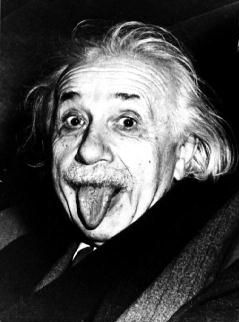
There can be little doubt that Albert Einstein was one of the most influential figures of the 20th Century, as his enduring appeal to so many indicates. How many other people in such arcane fields as theoretical physics and mathematics can generate such interest? Not many.
Yet sometimes I think Albert Einstein is also the poster boy for the axiom ‘stick to what you know’. Of course in Einstein’s case, what he knew was rather a lot: E=MC2 is a legacy that will speak to the centuries.
But then all you have to do is read much of what he wrote about economics and politics to realise how clueless Einstein when it came to many things, with an attachment to nightmarish notions of supranational government. I share Einstein’s distain for nationalism but the cure for the excesses of governments is not super-nationalism but rather a culture of individualism that demands less government rather than yet another tier of it to regulate our lives and take our money.
Likewise in his apologia for socialism, he got it spectacularly wrong in 1947 when he wrote that…
Private capital tends to become concentrated in few hands, partly because of competition among the capitalists, and partly because technological development and the increasing division of labor encourage the formation of larger units of production at the expense of the smaller ones.
…when in fact technology and capitalism means that small business and diffusion of capital have expanded vastly more that ‘one size fits all’ big business since 1947. Technology has created diseconomies of scale in ways that Einstein never imagined in spite of the evidence already being there (pity he did not spend some time with Frederic Hayek). Globalisation (rather than ‘supernationalisation’) of capital markets has likewise put hitherto unheard of quantities of capital into the hands of small businesses beyond counting. He even bought into the daftest and most pernicious economic absurdity of them all, the ‘fixed quantity of wealth’ fallacy.
Albert Einstein. A fascinating genius for sure, but like everyone, he had his limitations.
Our hosting company has been under sustained DOS attacks from some worthless scrotes over the last couple days and if you have been finding it hard to reach samizdata.net, that is why.
It is also why there has been a low volume of posts here as we have frequently been unable to access our blog’s ‘back-end’. The good folks at Hosting Matters have been doing their best to keep things operational under difficult circumstances.
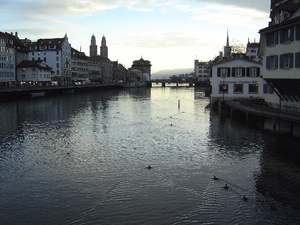
Just imagine a country with a low crime rate yet loads of people own guns and finding a fully automatic rifle in someone’s house is not at all unusual. Imagine that this country does not even have a single unifying language, has a weak central government and strong regional government, yet is politically stable. It has few natural resources compared to many other parts of Europe yet has low unemployment, a diverse economy and one of the highest per capita incomes in the world (about the same as the USA). Of course like everywhere it has its problems and it is not a paradise on earth, but it is a pretty nice place to be and an even nicer place to do business. It is also a place that has been praised on this blog before.
Yes, I just got back from Switzerland.
Iran has apparently won a ‘victory’ over the National Geographic Society by pressuring them into dropping references to the ‘Arabian Gulf’ and stucking with the admittedly more usual ‘Persian Gulf’ on its maps.
During the map row, the Iranian government warned that it “will act against any media” using the term “Arabian Gulf.”
It seems that the mullahs had banned National Geographic magazone and excluded anyone working for the society due to their choice of terminology in their publications and on-line (and also pointing out that Iran’s control of several islands is contested). I have no idea if National Geographic changed its policy because of Iranian pressure or just because ‘Persian Gulf’ is in fact the more common description for the body of water in question.
This is a fine demonstration of the absurdity to which nationalism drived people generally and the sheer banal immaturity of the men in preposterous hats running Iran. It is as if the British government banned anyone working any French publication using the term ‘La Manche’ rather than ‘English Channel’. Do these people really not have anything more pressing to worry about?
If you live in Britain and you do not think crime, casual violence and the background of anti-social behaviour is mounting problems based on the evidence of your own eyes, then stop reading now and keep taking the NHS prescribed Prozac. For all the rest of you, take a look at this report by Civitas.
Of course the government and police claim the truth lies elesewhere. No prize for guessing who I am inclined to believe.
If we can have an ‘absurdity of lawmakers’, I suppose we can have a ‘stupidity of doctors’. In the face of attempts to deregulate drinking in Britain, a nation which is unusually restrictive when it comes alcohol compared to most western nations, we have Prof Ian Gilmore, a spokesman for the Royal College of Physicians (an extreme statist professional organisation and political lobby) saying:
“We are facing an epidemic of alcohol-related harm in this country, and to extend the licensing hours flies in the face of common sense as well as the evidence we have got.”
Prof Gilmore said plans to stagger the times people left pubs were an attempt to manage drunkenness rather than prevent it.
He added that the key to tackling the problem was reducing the availability of alcohol and increasing the price.
“I think it is fanciful to think we can turn ourselves into a French-style wine-tippling culture merely by licensing regulations,” he told BBC Radio 4’s Today programme.
However he does not explain why digging the same hole deeper will make things better, given that Britain is already far more regulated than France and also has more serious alcohol related problems. Like most regulatory authoritarians, Gilmore and the RCP simply do not have either the imagination to think that perhaps the over-regulation caused the problem, nor do they have the socialisation to have the notion occur to them that imposing their views on others is immoral.
If people get drunk and commit crimes, punish the criminals, not those who drink and do not commit crimes. And in any case, the true criminals are those who added times limits to drinking hours which more or less institutionalised binge drinking.

The political class at work
… no, not really, but that is scarcely less daft than the statement by the Archbishop of Canterbury that the calamitous tsunami made him doubt the existence of God. As a ‘shoulder shrugging agnostic’ well on his way to just calling myself an atheist, I have serious doubt about the existence of God myself but surely re-evaluating a belief in God every time someone, or 130,000 someones, die does rather suggest a lack of having thought things through in the first place.
Unless we are nothing more that meat puppets dancing to a pre-ordained celestial script (which is certainly not Anglican doctrine), the fact we make use of our free will and thereby make decisions that result in us dying in a certain manner (such as, for example, deciding that we will live in a coastal community in southern Asia) neither proves nor disproves anything about the existence of God.
Now I have no doubt that the Archbishop is well aware of those arguments and is just indulging in the usual Anglican tradition of fogging issues whilst sounding concerned and looking earnest as an alternative to clearly articulating easy to understand (and thereby easy to attack) positions based on long established doctrines.
But then the current Archbishop is a strange bird and the things in which he has ‘faith’ suggests to me that placing too much stock in his judgement is faith misplaced. He says that he, like Tony Blair, has faith in the UN but thinks it should be reformed and improved by giving religious groups (naturally!) and nations not on the security council more power (such paragons of civil rights as Myanmar, Libya, Syria, Zaire and Iran perhaps?)…yes, he wants to have some official say over how the UN’s tax funded patronage gets doled out. And presumably in the spirit of ecumenicist tolerance would also extend that to other religious leaders as well. It is a marvel how the UN gets held up as even a potential source of moral authority by people like Rowan Williams who are supposedly in the ‘moral authority business’, when by design the UN is a club of national leaders that admits mass murderers, fascists, communists, rabid nationalists and kleptocrats of every strip into its rank.
|
Who Are We? The Samizdata people are a bunch of sinister and heavily armed globalist illuminati who seek to infect the entire world with the values of personal liberty and several property. Amongst our many crimes is a sense of humour and the intermittent use of British spelling.
We are also a varied group made up of social individualists, classical liberals, whigs, libertarians, extropians, futurists, ‘Porcupines’, Karl Popper fetishists, recovering neo-conservatives, crazed Ayn Rand worshipers, over-caffeinated Virginia Postrel devotees, witty Frédéric Bastiat wannabes, cypherpunks, minarchists, kritarchists and wild-eyed anarcho-capitalists from Britain, North America, Australia and Europe.
|