We are developing the social individualist meta-context for the future. From the very serious to the extremely frivolous... lets see what is on the mind of the Samizdata people.
Samizdata, derived from Samizdat /n. - a system of clandestine publication of banned literature in the USSR [Russ.,= self-publishing house]
|
For the last couple of weeks I’ve been trying to treat my setback at work as a chance to contemplate things like The Transient And Illusory Nature Of Material Things and Attachment As The Root Of Suffering – the bits of yoga that actually matter. And today I did a fairly intensive backbending practice – perhaps not the best possible idea in the circumstances. Backbending has a tendency to be emotional-turmoil-inducing at the best of times, let alone at the end of a weekend spent brooding on the Cruelty Of Fate. Even today, though, the peace that comes from just watching the breath going in, watching the breath going out, was there eventually. Even if it was only for the last four or five breaths of a two hour practice, that’s enough.
– Alan Little just breathes
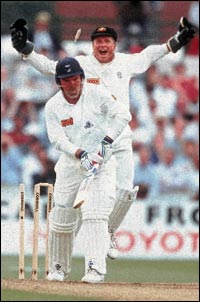
The Ashes are about to start. God it is wonderful.
The UK Olympic Games of 2012 are shaping up nicely to be the expensive, possibly corrupt affair that many of us crusty cynics claimed it would be over a year ago. There is only the grimmest of satisfaction to be gained from having been proved so emphatically correct. Given the history of publicly-financed construction projects in recent years, or even projects in which public finance is only a part, the predictions should not have been difficult (think of the Scottish Parliament, or Wembley Stadium, or the Channel Tunnel, to take just three).
The likely bill – to the taxpayer – of these Games is likely to be far higher than originally projected. It is almost certain that this fact was known to British politicians and sports-establishment types who lobbied to hold the Games in Britain over a year ago. If a company had bid for a contract with the same degree of financial acumen, probity and sense as the idiots in the UK public sector, rather long gaol terms, fines or hefty compensation packages might now be the order of the day.
We are remembering the late, very great Milton Friedman a lot at the moment, digesting his contributions to the fields of technical economics, monetary theory, politics, education and much else. But I think that his often disarmingly simple statements about the role of the state and the dangers of government will endure the longest, if only because they carry truths from the start of human history:
There are four ways in which you can spend money. You can spend your own money on yourself. When you do that, why then you really watch out what you’re doing, and you try to get the most for your money.
Then you can spend your own money on somebody else. For example, I buy a birthday present for someone. Well, then I’m not so careful about the content of the present, but I’m very careful about the cost.
Then, I can spend somebody else’s money on myself. And if I spend somebody else’s money on myself, then I’m sure going to have a good lunch!
Finally, I can spend somebody else?s money on somebody else. And if I spend somebody else’s money on somebody else, I?m not concerned about how much it is, and I’m not concerned about what I get. And that’s government. And that’s close to 40% of our national income.
(Via David Farrar’s blog)
I think the Olympic Games falls into the final category. I do agree with Stephen Pollard on the possibly sensible idea of cancelling the Games, even at this stage. The lead article in the Times (UK), by contrast, is remarkable for its breezy indifference to the cost of the Games and the fact that the money for it will be screwed out of the pockets of people who regard the whole spectacle as an expensive joke.
Oh, and before any commenters of a pro-state sympathy start to wonder, no, I am not a sport-hater. I enjoy watching football, cricket and other sports, and play one or two sports myself (not very well, I will admit). However, I do not expect my fellows to support my enthusiasms. Is it too much to ask the same of others?
For those who might enjoy a non-virtual session on the growing New Space market sector, I will be talking at the Libertarian Alliance conference The National Liberal Club in London this coming Saturday afternoon.
Be there or be Earthbound.
On Saturday I went to the annual conference of the Bruges Group – an organization that has moved from a critical attitude to the European Union to an understanding that the United Kingdom should get out of the of the E.U.
One of the speakers was Mr Booker of the Sunday Telegraph a man who has specialized in detailing the exact harm done to business after business (normally small business enterprises) by EU inspired regulations after the Single European Act of 1986 allowed E.U. directives to be applied to most areas of British life. Small damage at first (just a few people’s lives destroyed) but over the last two decades more and more enterprises (and the people who go with them) destroyed. Although, of course, much of the damage of the EU (such as the CAP and the CFP) go back to when we joined back in 1973.
I will not go into the mistakes of some British politicians (such as Mrs Thatcher) who were tricked by the EU people and their British supporters, or the actions of other British politicians (such as Sir Edward Heath or Lord Howe) who deliberately acted for this hostile power against their own country. Other than to say that I do not accept the Benedict Arnold defence – i.e. that brave service in war means that a man should still be considered a patriot if he later changes his coat.
I am more concerned with a minor matter here. As I heard Mr Booker’s speech I thought “it is a long time since I bought the Sunday Telegraph – I will buy it tomorrow”.
And so I did buy it – and was reminded why I do not buy it any more. → Continue reading: Why buy the Sunday Telegraph?
This evening The Ashes start to burn again. I have Australia as heavy favourites.
We all had them as heavy favourites last time around, last summer, after game one when McGrath ruined England in the space of hardly more than a few minutes. And if McGrath had not trodden on a ball just before game two, we would have all been right. Having been the Aussie match winner in game one, he was never the same bowler for the rest of the series.
Since then, on the bowling front, England have lost the excellent and under-rated Simon Jones, and for Australia McGrath is now fit again. Gillespie, the weak spot in the Aussie bowling in 2005, has been replaced. For England, is Saj Mahmoud good enough, or will the Australians rip him apart as he has already been ripped apart in one-day cricket? They are just the ones to do it. Ditto Monty Panesar.
On the batting front, England have lost Vaughan and now Trescothick. Meanwhile Australia, who batted poorly in England, look likely to bat batter. Katich is now gone, and Hussey will surely strengthen them. Hayden, Langer and Gilchrist did badly in England and will surely improve, and if they do not, Jacques is ready in the wings.
Australia have surely lost any thought that to win they only have to show up, and all in all, I think, as I thought before the 2005 series only more so, that England have a chance, but only a chance, and this time around only an outside chance. When you consider that, despite doing better than Australia for long periods in 2005, England only just managed to squeak to their two wins (England were one dodgy caught behind from being 2-0 down), having been heavily defeated in game one (by McGrath – see above), it will not take much to change the 2005 result.
England might still win, or draw and keep the Ashes, if Harmison and Pietersen both play out of their skins, and if Flintoff is his usual excellent self despite also being the captain, and if Panesar does well, and Bell, and Strauss, and blah blah blah if if if, and if Australia again underperform (perhaps through more bowling injuries), all of which might still happen. But there are far two many ifs for my liking. But I hope I am wrong and I live in hope.
Samizdata may be intermittently unavailable today as we are scheduled for a server upgrade… nothing serious hopefully.
I found it via engadget and The Raw Feed, but I might have found it in the Guardian. The Raw Feed reported it this way:
In the belief that the world’s most surveilled society isn’t surveilled enough, eight London cops are getting HEAD-MOUNTED VIDEO CAMERAS to record their run-ins with drunks, soccer hooligans and unrestrained American tourists. The battery-operated cams will record police interactions, and may be used in court.
I do not see this as a problem. But what if the day ever comes when only government employees may use such gadgets? If present trends continue that may become the rule, especially when you consider that in a few short years time, we will be talking about devices that are pretty much invisible.
Next step, having to have a license.
A few weeks back yours truly and Mrs P. decided to find out what all the hype was about and went to see the film Borat. I guess unless you have been living on the South Pole or some other remote part of planet Earth, you will not have heard of this film. Borat is a spoof “journalist” character created by Sasha Baron Cohen, the Jewish comedian who also created characters such as Ali G. The basic idea is that Borat goes to different places and countries and tricks folk into either revealing more about themselves and their views than they would otherwise do, or to simply make assholes of themselves. A few of his victims do misbehave although most seem to emerge with most, if not all, of their dignity intact.
I have mixed opinions about the film. Some parts of it were so funny that I laughed along with the rest of the cinema audience. He does want to send up the insanity of anti-Semitism, which seems to be the serious core of this film, if it has one at all. There is always the risk, I suppose, that some of the thicker viewers will not get the joke and think that anti-semitism has been legitimised by this movie, but you would have to be pretty dense to do so. Beyond that, though, I did not think the movie was all that funny, and not much beyond scatalogical humour of a basic sort. Part of the idea is to play on the natural desire of the victims – in this case, ordinary Americans – to be polite to strangers, even a crazy-looking chap with a big moustache claiming to come from central Asia. Some of the victims on the New York subway tell Borat to go away, but pretty much most of the victims put up with it up until the point when the behaviour gets too bad to ignore.
I guess if you want to see a film that makes you want to experience a deep fuzzy glow of superiority to supposedly simple redneck Americans, this is the movie for you. On the other hand, for comedy of genius that does not target the ordinary Joe but tries for genuine wit, I’ll be relying on my beloved Monty Pythons and Blackadder collection. And for the silly stuff, there is always Peter Sellers, Terry Thomas and those supremos, Laurel and Hardy. Their brilliance will never fade.
Richard North shares my opinion, although he is a bit harsher.
I sometimes watch nature programmes and often as not, the narrator(s) of such programmes will wax lyrical about the complexities, the marvels of the natural world. (Programmes such as The Blue Planet by David Attenborough). In moving over into the Man-made world, we often get similar sentiments of praise and wonderment at things like great buildings, bridges or even whole cities, but seldom is such language employed in looking at the area of human commerce.
All the more reason to savour expressions such as this, written over at the admirable Cafe Hayek blog a while back:
This winter morning I bought a bouquet of wildflowers from the supermarket. Its price was $5.99. The flowers are fresh, beautiful, fragrant – and from Ecuador.
Ponder this fact.
For a mere one hour and eight minutes of work, a minimum-wage worker in the United States can acquire a bouquet of fresh flowers grown in South America. In other words, for 68 minutes of working in the U.S., a minimum-wage worker can take home some of the beautiful fruits of the efforts of strangers in Ecuador who plant, tend, and pick flowers – of other strangers (where?) who make the protective packing material used for shipping the flowers – of yet other strangers who pilot the planes and drive the trucks that transport these flowers fresh from Ecuador to U.S. supermarkets – and of the countless other strangers who build the planes and trucks, who fuel the planes and trucks, who pave the runways and roads used by the planes and trucks, who feed the pilots and drivers, who insure airlines, trucking companies, and supermarkets against casualty losses, who wake up at pre-dawn hours to put the flowers into an attractive display in the supermarket.
These and millions of other strangers all worked — all cooperated — to make it possible for me and my family to enjoy a beautiful bouquet of fresh flowers in the deep winter. And all for a mere $5.99.
The time you hear or read someone complaining about the supposed evils of global trade, remember sentiments such as that.
Where coercive institutions are strong a fanatical minority is well placed to capture them and turn them to its own purposes.
– Natalie Solent, in this discussion, which is a an interesting touchstone of liberalism.
The PM has a new gimmick. We are invited to petition him via the interweb thingy.
Now I think it interesting in itself that a Prime Minister should so wrap himself in the purple to invite petitions, as if he were sovereign and we the petty subjects whose wishes he might deign to consider. But the content of the petitions themselves is getting quite weird.
Leading the pack is a petition to repeal the Hunting With Dogs Act 2004. But there is also one to “ignore the petition to repeal the hunting act 2004” and another (which no-one has signed) to “to ban the signing of petitions asking to repeal the hunting act 2004”.
Some are gloriously vague (“change renting laws in UK”); some insanely specific, requiring arcane knowledge and an odd personality to understand, let alone support. (E.g. We the undersigned petition the Prime Minister to require A-G energy-efficiency ratings to make explicit the A+ and A++ categories (and any future, higher categories), so that consumers are aware that energy efficiencies greater than ‘A’ can be achieved with products so rated.”) Some are both vague and specialised at the same time. Some founded on malapropism. There are numerous semi-duplications, where individuals who might agree with an earlier, simpler, better-supported proposal, have added their own refinements, not caring that it may be a distraction from the main cause.
In short, all the faults of that fetish of radicals, participatory democracy, are on display. As are pretty much all the green-ink political obsessions.
My favourite: “We the undersigned petition the Prime Minister to replace the national anthem with ‘Gold’ by Spandau Ballet” – I urge you to support it. But there is something to give joy to everyone.
|
Who Are We? The Samizdata people are a bunch of sinister and heavily armed globalist illuminati who seek to infect the entire world with the values of personal liberty and several property. Amongst our many crimes is a sense of humour and the intermittent use of British spelling.
We are also a varied group made up of social individualists, classical liberals, whigs, libertarians, extropians, futurists, ‘Porcupines’, Karl Popper fetishists, recovering neo-conservatives, crazed Ayn Rand worshipers, over-caffeinated Virginia Postrel devotees, witty Frédéric Bastiat wannabes, cypherpunks, minarchists, kritarchists and wild-eyed anarcho-capitalists from Britain, North America, Australia and Europe.
|





Recent Comments