We are developing the social individualist meta-context for the future. From the very serious to the extremely frivolous... lets see what is on the mind of the Samizdata people.
Samizdata, derived from Samizdat /n. - a system of clandestine publication of banned literature in the USSR [Russ.,= self-publishing house]
|
I am writing this in an airport bar in Prague, where I am having a beer before flying back to London after a weekend away. I will probably write most of the post on the flight home, but it probably will not get posted until I am back in London tomorrow( and this is indeed what has happened. MJ )
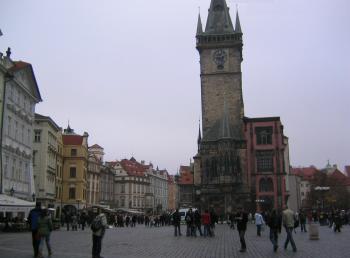
This is my second trip to Prague. I was first here in 1992. That trip also involved (amongst other places) Warsaw and Budapest. I had not been back to any of these places again until this year, when I have been back to both Warsaw and Prague. Both Poland and the Czech Republic are much easier places to visit than in 1992 in the sense that I do not need a visa to visit either country, there are lots of ATMs from which I can obtain money, there is less bureaucracy, there are western branded shops on the high street, there are Starbucks clones (although not yet Starbucks itself). In 1992 there were none of these things and travel was harder (I was also in my early 20s and a much less experienced traveller, so my perception may be distorted). However, although Poland and the Czech Republic are now both members of the European Union, the cities both lack the shining new Metro systems, motorways of poorer countries (Spain and Portugal, particularly) that have been dipping in the cohesion fund for longer. Infrastructure works in both places, but it is more spartan.
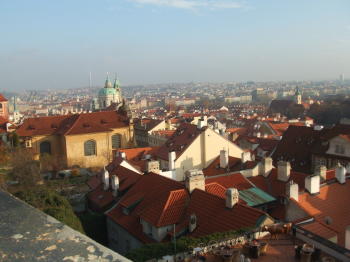
In 1992, Warsaw felt rather bleak and Prague felt to be a glorious gothic fairytale of a city that had been left behind by the world but which was perhaps catching up. (Budapest was the first city I had been to with a strong Ottoman character about it, and the dominance of the buildings on the high hills overlooking the Danube from the Buda side was and no doubt still is very striking). This year I rather liked Warsaw – it has the feel of a place where business is being done. Prague is still a glorious gothic fairytale of a city, there is lots of good music to listen to, the beer is very good and very inexpensive. The food options are much more diverse than they were 14 years ago. Since the invention of the euro gutted the Dutch money changing industry, the strip between the Charles Bridge and the Old Square in Prague seems to have taken over from that between Centraal Station and Dam Square in Amsterdam as the leading venue in Europe for dodgy money changers and slightly dubious pizza restaurants (the ‘Museum of Medieval Torture Instruments’ seems very old Amsterdam, too).
However, Prague seems to now be perhaps a little too obvious a destination for the more trendy sorts of tourist. People who are seen at the Netherlands Architecture Institute or the Oslo School of Design, and drink in bars with lots of black and chrome and 45 different kinds of vodka (and wear a fair amount of black, but probably only about the right amount to be in keeping with the chrome) tend not to be seen here. It seems more now to be a destination for Anglophone backpackers and American students from universities outside the Ivy League. It is a backpacker destination. It has not moved as far up the tourism food chain that I had hoped it might.
And, alas, I feel I am being a little unkind. I have, in truth had a bad experience today, which has to do with the way in which the tourist ecosystem in Prague has evolved to take advantage of the people who have visited.
Regular readers of this blog will know that I travel a lot. (I will eventually explain what I did in Denmark last weekend. Honest). I generally know what I am doing in a foreign city. I like to believe I am fairly defensive and steet smart, and as I am also a relatively large and scruffy male who at least thinks he does not look prosperous, I have seldom had anyone try to rob me, or otherwise hassle me.
 In fact, the only time anyone previously tried to rob me was in Prague in 1992. I started the trip by myself, but by the time I was leaving Prague I found myself in the company of a girl from Brisbane in her early twenties and a slightly mad television journalist from Los Angeles. The three of us went to a railway station in the evening in order to catch the overnight train to Budapest. As we were about to get into the train, a group of loudly talking people crowded around and towards us. My wallet was foolishly in my back trousers pocket, but I was smart enough to respond by immediately putting my hand on it. I discovered that there was another hand on it, trying to pick my pocket. Once the thief realised I was on to him, he rapidly withdrew, but his friends did not. I should have yelled thief at that point, but I am shy and unassertive, so I did not. I few seconds later, I did hear a yell, as the American TV journalist realised that his bag had been unzipped and a hand was in it. He yelled loudly, and the thieves withdrew. Although they tried to rob us, looking back I am struck by what amateurs the pickpockets were in 1992. We were pretty naive too, but still they failed to rob us.
Since then, I have always put my valuables in my front pockets, and I do continue to look a little scruffy, which I have believed meant I was perhaps not an obvious target. Alas, though, this afternoon the thieves figured me out and robbed me anyway. This time they were good at it. → Continue reading: Of Prague and pickpockets
We have been unkind to Conservative Party leader David Cameron at Samizdata, but I think he can count himself as having gotten off lightly compared with what they are doing to him at the EU Referendum blog. All I can say is that I agree with them completely.
I must admit that the stuff about the Russian poisoning story is reminding me of when the Cold War was pretty chilly. It is also, its perverse sort of way, a reminder of what the world was like when a former naval officer, journalist and stockbroker began to churn out thrillers at his Jamaican holiday home back in 1953. Casino Royale, the first and one of the best James Bond adventures has been turned into a film that yours truly will be seeing on Thursday night. I admit that when Daniel Craig was first cast in the role, I had my doubts, but the reviews so far have been mostly favourable. Craig, even though he looks like a well-groomed football hooligan, seems to have conveyed the darker side of Fleming’s creation, showing that Bond is a bit more than a dude in a suit, as well as keep most of the bits that cinema viewers have come to expect, such as amazing stunts, special effects and the odd witty one-liner.
Yes indeed:
Miss Israel has been given permission not to carry her assault rifle during service in the Israeli army because she says it bruises her legs.
This has everything that a Samizdata quote of the day should have. It is about a beauty queen. It is not just something said by or about some dreary politician. Plus, guns are involved.
But: Is this decision evidence that Israel is going soft, or does it display a fine understand of the balance that must always be struck between the needs of national defence and the need not to damage that which is being defended?
Putin, a former member of the KGB, became the leader of Russia in 1999, eight years after the fall of the USSR. Would anyone have considered it acceptable for a former member of the Gestapo to be leading West Germany in 1953?
– David Emami
It’s the danger of tidy-minded people…
– Andrew Marr, in an extempore line, almost thrown away, to close an item on the surveillance state on the BBC’s radio talk-show Start the Week.
I think Marr pins it down precisely. Oppressive regimes are frequently driven by a desire for order, seen as conformity to explicit rules. The most insidious, most universally oppressive castes, don’t seek order because they want to be obeyed. They seek order for its own sake. They want the security of rules for everything, and recording everything.
The attempt assassination in London of a critic of Vladimir Putin, Alexander Litvinenko, almost certainly carried out by the Russian intelligence services, highlights that it is long past time to stop treating Russia as ‘just another European government’.
But there is another rather interesting twist to this story that I did not spot in the media yesterday, courtesy of the UKIP.
Update: sadly it is not longer an ‘attempted’ assassination.
It looks like Congressman Rangel is at it again.
I guess he just thinks enslaving your fellow man is a great idea.
Our thanks to Glenn Reynolds for the link.
As regular readers here all know, the state is not your friend… but sometimes its petty tyrannies and inanities are bloody funny:
The makers of Welsh Dragon Sausages were warned they could face legal action if they did not specify which meat they were using. “I don’t think any of our customers actually believe that we use dragon meat,” said Jon Carthew, of the Black Mountains Smokery at Crickhowell, after receiving a warning letter from trading standards officers.
A quick check and sure enough, these people fail to mention their sausages are not in fact made from dragon meat (which I had assumed was ‘self-smoking’). Hell, I only bought them because I thought they contained the ultimate in ‘endangered species’.
A brigadier general (retired) writes to The Times:
Last week, a security scanner at the Waterloo Eurostar terminal detected a credit-card-sized toolkit in my overnight case as I set out for Paris on business. …
Read the whole thing. It is not long.
I am reminded that we are only a fortnight since St Crispin’s day.
He that outlives this day and comes safe home
Will stand a-tiptoe when this day is named
And rouse him at the name of Crispian.
He that shall see this day and live t’old age
Will yearly on the vigil feast his neighbors
And say, “Tomorrow is Saint Crispian.”
Then will he strip his sleeve and show his scars
And say, “These wounds I had on Crispin’s day.”
Old men forget; yet all shall be forgot,
But he’ll remember, with advantages,
What feats he did that day.
What did you do in the “War on Terror,” Daddy?
I wonder why this has not set any fur flying yet?
The Dutch cabinet has backed a proposal by the country’s immigration minister to ban Muslim women from wearing the burqa in public places.
The burqa, a full body covering that also obscures the face, would be banned by law in the street, and in trains, schools, buses and the law courts.
The cabinet said burqas disturb public order, citizens and safety.
Is it because the French did it first? Possibly. Though it does seem to me that the Dutch prohibition is much broader than the French one. Perhaps it is something to do with the fact that France is a more prominent and important country than Holland.
Anyway, whatever the reasons, this news from the Netherlands remains (for the moment at least) on the mere periphery of the radar. The more interesting question, as far as I am concerned, is whether this is (a) an unacceptable state repression of personal liberty and freedom of choice or (b) a necessary and welcome bulwark against the growth of radical Islam in Europe?
NO2ID has demonstrated how it is possible to clone the Home Office’s wonderful new ePassport while it is still in the post, without taking it out of the envelope.
The Home Office is unconcerned: with classic disingenuity its spokesman told The Guardian, which carried the first part of an unfolding story:
By the time you have accessed the information on the chip, you have already seen it on the passport. What use would my biometric image be to you? And even if you had the information, you would still have to counterfeit the new passport – and it has lots of new security features. If you were a criminal, you might as well just steal a passport.
But of course the Home Office does not care. If there is a conflict between your personal security and official convenience in logging the details of passports at borders – which is what it means by ‘improving the security of passports’ (note plural) – then there was never any doubt which would win.
An Anonymous Coward on slashdot pinned it down:
The basic problem isn’t the algorithm they choose. It’s that their goal is incompatible with security.
They wish to establish a world where all people can be instantly identified, correlated with commercial profiles, and tracked wherever they travel.
How can this be done “securely”? It cannot.
Thank you, Admiral Poindexter.
|
Who Are We? The Samizdata people are a bunch of sinister and heavily armed globalist illuminati who seek to infect the entire world with the values of personal liberty and several property. Amongst our many crimes is a sense of humour and the intermittent use of British spelling.
We are also a varied group made up of social individualists, classical liberals, whigs, libertarians, extropians, futurists, ‘Porcupines’, Karl Popper fetishists, recovering neo-conservatives, crazed Ayn Rand worshipers, over-caffeinated Virginia Postrel devotees, witty Frédéric Bastiat wannabes, cypherpunks, minarchists, kritarchists and wild-eyed anarcho-capitalists from Britain, North America, Australia and Europe.
|





Recent Comments