We are developing the social individualist meta-context for the future. From the very serious to the extremely frivolous... lets see what is on the mind of the Samizdata people.
Samizdata, derived from Samizdat /n. - a system of clandestine publication of banned literature in the USSR [Russ.,= self-publishing house]
|
It is not often I read the Independent but even that haven of fluorescent idiocy seems to be on the right side of the need to face down Vladimir Putin’s increasingly sinister regime. There is a very interesting open letter by journalist Yelena Tregubova on the importance of not pretending that everything in Russia is just fine and dandy.
Of course over the last few days Putin has made the task of those shouting warning about the dangers posed by Russia a great deal easier, what with him threatening to target nuclear weapons at Europe again and pretty much announcing that he is about to appropriate BP’s investments in Russia.
Clearly Putin needs to be taken down a peg or two because if there are no consequences for his theft of foreign investments in Russia and the murders of opponents to his regime both at home and overseas, all we can look forward to is ever more destabilising antics coming out of the Kremlin.
“Blair calls for homegrown Imams”
A quiet revolution is taking place in this green and pleasant land. In allotments and smallholdings all over the country the age-honoured and customary rows of marrows and ornamental cabbages are rapidly being replaced by a new and exotic species.
Spurred on by a combination of Tony Blair’s exhortations and the availability of generous government grants, farmers and market gardeners from Penzance to Perthshire are nurturing the first green shoots of what they hope will be a bumper crop of Muslim clerics.
Competition between growers is already hotting up as early adopters of the new fashion vie with each other for horticultural prestige. At the 78th Annual Chipping Sodbury Country Fair, Mrs. Gladys Whinge of Tetbury won First Prize for her record-breaking 254lb Imam which she calls ‘Yusuf’.
“The important thing is to use plenty of steaming, fresh horse manure”, said Mrs. Whinge “so I read the Guardian to him every day”.
The retail markets is already gearing up for what they hoping will be a huge demand for the homegrown Imams in 2008 with supermarket chain Waitrose leading the way by announcing that locally-produced Imams will be sold under their new ‘Koranic’ range.
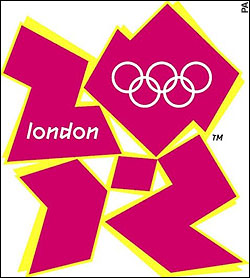
The new logo for the 2012 London Olympics has been unveiled and it has produced howls of outrage. Yet I beg to differ. I think it is perfect.
What does it look like to you? To me it is obvious: a collapsing structure of some sort, perhaps a building at the moment of demolition. The sense of downwards motion towards the bottom of the page is palpable.
Breathtaking. I mean what truly magnificent symbolism. The entire Olympic endeavour has been a massive looting spree with already grotesque cost over-runs (and it is only 2007), so surely something that conjures up images of collapse and disaster is really on the money… and speaking of money, at £400,000 (just under $800,000 USD) for the logo, it perfectly sums up the whole ‘Olympic Experience’ for London taxpayers.
No, if ever there was ‘truth in advertising’, this is it. Well done Lord Coe, I salute you.
Which Western country will be the first to become an Islamic state?
to·tal·i·tar·i·an
–adjective
1. of or pertaining to a centralized government that does not tolerate parties of differing opinion and that exercises dictatorial control over many aspects of life.
2. exercising control over the freedom, will, or thought of others; authoritarian; autocratic.
–noun.
3. an adherent of totalitarianism.
Random House Unabridged Dictionary
But are those really the best definitions of totalitarian?
When someone uses the term ‘totalitarian’, we think of Stalin’s Soviet Union or Hitler’s Germany or Pol Pot’s Cambodia or Mao’s China. Those were indisputably totalitarian states. We think of gulags and killing fields. We think of secret police and surveillance.
Yet I would argue that all those things can just as satisfactorily described as ‘tyranny’ of whatever political completion. The thing that makes a place ‘totalitarian’ is not the nastiness of it or even the repressiveness of it, but the totality of state control. The real defining characteristic of totalitarian seems obvious from the word itself.
And what is a total state? It is a state in which there is no civil society, just politically derived rules by which people may interact. And I would argue the key to that is removing the right to free association, usually on grounds of ‘fairness’ or ‘diversity’ and by declaring private property to be ‘public’.
Britain has no gulags, no killing fields, it has a relatively free press (though less so than it was), it has no internal passports (though they are working on that with ID cards and panoptic surveillance)… but every year we take more and more steps towards the destruction of a voluntary civil society of free interaction and its replacement with a state in which no aspect of life is not politically regulated. This is often described as making things ‘more democratic’… and in that the supporters of the total state are not being disingenuous, for democracy is just a type of politics after all.
We are headed for a different kind of totalitarianism than that of Stalin or Hitler or Mao, but a total state really is what a great many people have in mind for us all. They seek a sort of ‘smiley face fascism’ in which all interactions are regulated in the name of preventing sexism, promoting health, and defending the environment. The excuses will not invoke the Glory of the Nation or the Proletariat or the Volk or the King or the Flag or any of those old fashioned tools for tyrants, but rather it will be “for our own good”, “for the Planet”, “for the whales”, “for the children”, “for the disabled” or “for equality”.
But if they get their way it will be quite, quite totalitarian.
Freedom is not feeling like an outcast in the face of mainstream consensus.
– Adriana Lukas at the Apeldoorn conference in the Hague
There is an excellent article in the Telegraph by Charles Moore called What if Israelis had abducted BBC man?, addressing the morally demented attitude amongst the tranzi media and government set.
But just suppose that some fanatical Jews had grabbed Mr Johnston and forced him to spout their message, abusing his own country as he did so. What would the world have said?
There would have been none of the caution which has characterised the response of the BBC and of the Government since Mr Johnston was abducted on March 12. The Israeli government would immediately have been condemned for its readiness to harbour terrorists or its failure to track them down. Loud would have been the denunciations of the extremist doctrines of Zionism which had given rise to this vile act. The world isolation of Israel, if it failed to get Mr Johnston freed, would have been complete.
If Mr Johnston had been forced to broadcast saying, for example, that Israel was entitled to all the territories held since the Six-Day War, and calling on the release of all Israeli soldiers held by Arab powers in return for his own release, his words would have been scorned. The cause of Israel in the world would have been irreparably damaged by thus torturing him on television. No one would have been shy of saying so.
But of course in real life it is Arabs holding Mr Johnston, and so everyone treads on tip-toe. Bridget Kendall of the BBC opined that Mr Johnston had been “asked” to say what he said in his video. Asked! If it were merely an “ask”, why did he not say no?
Whatever one thinks of Israel’s policies on various issues, the nauseating double standards so consistently in play by so many ‘news’ organisations are something that need to be pointed out often and unapologetically. Charles Moore is to be commended for his article. Read the whole thing.
I am sometimes told that I should not “bang on” about the Economist journal (much in the way that Mr. Cameron tells everyone that they should not “bang on” about the endless regulations that come from that absurd extra layer of government called the European Union), as it is just another leftist publication like the Guardian, the Independent, the Financial Times (the newspaper for corrupt, politically connected, “business people”) and so on.
However, people continue to defend the Economist so it is worth “banging on” about it.
The Economist stands, at least most of the time and in the case of most nations in the world, for more money for the various ‘pubic services’ and for more regulations (gun control, anti trust – competition policy and so on) as part of its Welfare State ideology and ‘perfect competition’ (i.e. neo-classical excuse for endless government intervention) conception of economics. So its defenders’ claim that it is ‘free market’ is very obviously false.
However, the defenders of the Economist make another claim – that the journal provides coverage of world news that an ordinary newspaper does not.
In a break in a series of Kettering council events I popped out to the town library and had a look at the Economist – I wanted to read its reports on the local elections in Spain and Italy.
There was one line “centre left governments do badly” – no reports on the elections, nothing on what cities and regions were won by who. Even concerning nations in the European Union – the entity that the Economist supports and claims to know so much about.
The Economist fails the final test – it did not even bother have a proper report on either set of elections. It does not provide coverage that ordinary newspapers do not.
There is only one race greater than the Jews, and that is the Derby.
– Victor Sassoon.
Until recently, there was a shop named popXpress in Piccadilly near the Ritz hotel in London. This was a little store devoted entirely to selling Apple iPods and iPod accessories. When it was opened, people who analyse this sort of thing found it an interesting experiment, but were not terribly optimistic about its success, at least partly because it was situated only a short walk from the London flagship Apple Store in Regent Street. Higher hopes were held for the other popXpress store near Liverpool Street in the City of London, which was close to many cashed up City workers and far from an Apple Store. Thus it was not a terribly great surprise when parent company Computer Warehouse announced in March that the Piccadilly store was to close (the store in Liverpool Street remains open and quite possibly profitable). Upon learning this, most of us would have said “Oh”, and then gone back to sleep. However, the explanation, when it came, was stunning.
Next to the popXpress store in Piccadilly was and is a sushi bar, a branch of a chain named Itsu. This is what is known as a “fast casual” restaurant: a bit more expensive and with food a bit tastier than McDonald’s, but designed for people in a hurry or on their lunch breaks who want a quick meal and do not want to spend too much money. Itsu belongs to Pret a Manger, probably the king of London fast casual dining (and, incidentally, 30% owned by McDonald’s) . There are a couple of Itsu outlets near where I work in Canary Wharf, and from time to time I eat lunch in those outlets myself. The food is not bad, but it is not exactly worth writing home to Mum about either. I have never eaten at the branch in Piccadilly, and I suspect that few people who know the area do, because the (possibly Japanese government subsidised) Japan Centre at Piccadilly Circus is just down the road, and this manages to both be inexpensive and to serve some of the best Japanese food in London.
However, the Itsu restaurant in Piccadilly gained notoriety last November as the place where Alexander Litvinenko had lunch with his Italian acquaintance Mario Scaramella, where it was for a time believed he was poisoned and where traces of Polonium 210 were later discovered, leading to many radioactive sushi jokes.
As I mentioned, a couple of months after this, the popXpress store next door announced it was closing. Few would have thought there was a connection, but when asked, management explained that that had received “an offer they couldn’t refuse” from Itsu, who wanted to expand their store. Apparently, business had been absolutely booming since the Polonium 210 incident, and they wanted to expand the restaurant (no, I will not speculate as to why this offer could not be refused, and which if any isotopes were involved). Apparently Itsu also brought forward plans to open their first store in New York, as the publicity was apparently a godsend. It would seem that all publicity is good publicity, even when you are a change of restaurants and the publicity was that your food might be radioactive.
Actually, that may not be entirely true. Or at least it can be further tested. For come to think of it, another chain restaurant in London was in the news recently. At the Strand branch of pizza chain Zizzi, a man recently entered the restaurant at dinner time, obtained a knife from the kitchen, and used it to sever his own penis in front of diners.
Upon walking past that particular restaurant a couple of days later, I will confess that I was struck by a strong urge to walk in the opposite direction. Really, though, I should go in and ask management what the publicity has done for business. For I may want to take an interest in the business next door.
The latest weird twist in the Alexander Litvinenko assassination has been the release by prime suspect Andrei Lugovoi of his promised ‘stunning revelations’ about the case. His claim was that Litvinenko was in fact working for the British intelligence services and that MI6 had in fact attempted to recruit him as well
Now what makes this all really puzzling to me is that even if this is all true, far from taking the heat off himself and the Russian security services, he seems to in fact be providing the Russian spooks with an excellent motive for wanting to kill Litvinenko.
Am I missing something here?
I am always looking for new and exciting ways to increase the size of my carbon footprint. For example, I actively seek to buy products that originate in far-flung corners of the world, such as New Zealand, China, Chile, California or Japan. I resolutely boycott all modes of transport that do not involve the burning of fossil fuels and, during the bleak British midwinter, I loll around the house in a T-shirt and shorts with the central heating thermostat set to ‘Nuclear Meltdown’ level.
But I still feel that I could be doing more and, indeed, I would be doing more if only I had the kind of information that would help me to make proper, ethical choices. Well, my long wait is finally over. The dark pall of ignorance that has hung over me like the emission cloud of a coal-fired power station is about to be blown away by the sweet, zesty breezes of eco-enlightenment:
Shoppers will be able to tell how much damage their purchases do to the environment, under a government plan unveiled yesterday…
Consumers have little way of judging the environmental impact of goods and services, often relying on the miles such products have travelled from their country of origin.
Praise be! For the first time in a very, very long time the British government has actually done something useful and beneficial. From now on, my conscience will be at peace knowing that not a morsel of food will pass my lips unless it has previously been schlepped from the other side of the world in a huge, smokey, belching diesel-powered container vessel. Not a stick of furniture will adorn my home unless it has been hewn from the arboreal habitat of an exotic, endangered species. Not a stitch of clothing will I wear on my back unless it has been made in a factory that operates on full power for 24 hours a day, seven days a week and whose unscrupulous and profit-hungry owners dispose of their toxic effluents by pumping them into the nearest nature reserve.
I firmly believe that individuals can make a difference and, thanks to this wonderful labelling system, I will be better equipped than ever to do my bit for the environment.
|
Who Are We? The Samizdata people are a bunch of sinister and heavily armed globalist illuminati who seek to infect the entire world with the values of personal liberty and several property. Amongst our many crimes is a sense of humour and the intermittent use of British spelling.
We are also a varied group made up of social individualists, classical liberals, whigs, libertarians, extropians, futurists, ‘Porcupines’, Karl Popper fetishists, recovering neo-conservatives, crazed Ayn Rand worshipers, over-caffeinated Virginia Postrel devotees, witty Frédéric Bastiat wannabes, cypherpunks, minarchists, kritarchists and wild-eyed anarcho-capitalists from Britain, North America, Australia and Europe.
|





Recent Comments