We are developing the social individualist meta-context for the future. From the very serious to the extremely frivolous... lets see what is on the mind of the Samizdata people.
Samizdata, derived from Samizdat /n. - a system of clandestine publication of banned literature in the USSR [Russ.,= self-publishing house]
|
Unlike terrestrial radio transmissions, satellite transmissions come from a point source in the sky. One must point their antenna in the right direction to receive such signals. Different people may launch satellites in different positions and broadcast without interference. The case for licensing radio spectrum is already weak. There can be no argument for the need for a third party to license satellite radio spectrum.
In satellite television, the satellites are privately owned and launched by private space vehicles.
And yet in the UK one needs a broadcasting license from Ofcom to squirt photons encoded with television signals towards the Earth from space.
In addition, Ofcom gets to decide who is “fit and proper” to hold such a license. There is no definition of “fit and proper”. This is the rule of the whim of bureaucrats.
The movie was, as I had expected, a great deal of fun. It was also worlds better than the also admittedly fun comics based movies that have become so popular. It was Science Fiction of the Golden Age, swords and ray guns and a gorgeous and scantily clad Martian princess… what is there not to like?
There are two technical issues I had, which are perhaps more due to being true to Edgar Rice Burroughs than to being careless. The two moons of Mars are in very different orbits and do not appear that large and in any case Deimos is not quite round. Also, with 1/3 Earth gravity, you would indeed be able to do some rather amazing leaps, but not quite the altitudes and distances John made in his regular rescues of the Princess. Again, to be fair, even I could probably make a standing jump to a window on the second level of a building; an Olympic high jumper could probably make the roof of a 3 story building.
I loved their Dejah Thoris. She was everything you could imagine in a Burroughs Martian Princess. Drop dead gorgeous, athletic, a deadly swords-woman and a voice like Bettany Hughes. The more I think about it, Bettany would make a rather good Dejah in real life. I wonder what she is like with a sword?
I thought it appropriate that a true Southern man like John Carter quickly got himself a dawg. And not just any dawg, but the god damndest ugliest old houndog you ever did see.
So lets see: great CGI? check. Beautiful, scantily clad warrior Princess? check. Heroic and dashing hero who just wants to stay out of other people’s fights but can’t? check. Great action scenes? check. Swords, Ray guns and supertechnology? check. An ancient race of super-scientists trying to run worlds? check. Touching love story? check. Brilliant panoramas? check. An Edgar Rice Burroughs plot and adventure with interesting characters? check. Fascinating and alien aliens? Yep.
So why the hell do the reviewers hate it? Is it a statement about their lack of education beyond feminist studies, Foucaultian historical and Marxist Class Analysis? Do they actually teach anything useful in colleges these days?
Things seem to be a bit quiet here this weekend, so here’s a picture I took earlier this evening:
Click to get it bigger.
This is not Photoshopped. That’s exactly what came out of my camera when I got home.
What it is is a picture of the Shard, taken by me from the front seat of a D(ocklands) L(ight) R(ailway) automated train, as the train approached its central London terminus, which is near to the Tower of London.
Taking photos through train windows is, as all photographers know, fraught with peril, because of all those stupid reflections in the glass of the window that you inevitably get, of such things as lights inside the train. But this time, what was reflected in the window was a tower on the other side of the train, namely the Gherkin. And since the train was going very slowly at the time, I was able to line the two towers up with each other.
Well, I like it.
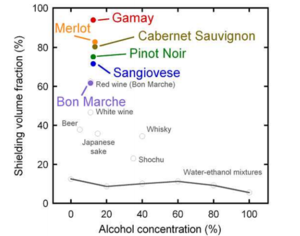
Last year, physicists discovered that red wine can turn certain materials into superconductors. Now they’ve found that Beaujolais works best and think they know why.
– The Physics arXiv Blog (with thanks to the ever alert Instapundit – how does he keep doing it?)
The battle, sir, is not to the strong alone; it is to the vigilant, the active, the brave . . . Is life so dear, or peace so sweet, as to be purchased at the price of chains and slavery? Forbid it, Almighty God! I know not what course others may take; but as for me, give me liberty or give me death.
– Patrick Henry, March 23, 1775, at the second of the Virginia Conventions.
The full speech is available here It’s not long so, as Glenn Reynolds would say, “read the whole thing.”
“The religious factions that are growing throughout our land are not using their religious clout with wisdom. They are trying to force government leaders into following their position 100 percent. If you disagree with these religious groups on a particular moral issue, they complain, they threaten you with a loss of money or votes or both. I’m frankly sick and tired of the political preachers across this country telling me as a citizen that if I want to be a moral person, I must believe in ‘A,’ ‘B,’ ‘C’ and ‘D.’ Just who do they think they are? And from where do they presume to claim the right to dictate their moral beliefs to me? And I am even more angry as a legislator who must endure the threats of every religious group who thinks it has some God-granted right to control my vote on every roll call in the Senate. I am warning them today: I will fight them every step of the way if they try to dictate their moral convictions to all Americans in the name of ‘conservatism.'”
– Barry Goldwater, as quoted by the blog, Unforeseen Contingencies. He is talking in relation to the absurd Rick Santorum. The Republican Party has, in my view, paid a high price for not heeding Goldwater on this issue. I sometimes wonder if a similar thing could ever happen in Britain with the Tories. I think it is, hopefully, unlikely, although the spirit of old puritanism does stalk the land in different guises, some of them not, on the face of it, remotely religious as traditionally understood.
“There is nothing original in the reflection that football has a frightening capacity to make shocking hypocrites of us all.”
So writes Matthew Norman, apropos the recent changing circumstances of a player who at one point was on the verge of being fired and shamed for refusing to play, and is now regarded as a great guy for his recent performances.
What all this tells us is that sports fans, like others who have a tribal loyalty to an institution, can convince themselves of contradictory views with ease. On the positive side, if sport allows people to channel their atavistic urges in a vaguely harmless way, all well and good. Alas, the absurdities of the situation do become quite irritating particularly in cases where a sportsman is a villain one minute for allegedly saying or doing something nasty, and is treated as a god the next for being able to, say, kick a ball accurately over 50 yards.
George Orwell, by the way, was very harsh on team sports, particularly when national alliegances were involved, but the same on a smaller scale applies to clubs within the same nation. Here is a quote:
I am always amazed when I hear people saying that sport creates goodwill between the nations, and that if only
the common peoples of the world could meet one another at football or cricket, they would have no inclination to meet on the battlefield.
Set against all this, it has to be said that it is heartening to see what appears to be mostly genuine sympathy for a Bolton footballer who had a heart attack during a match a few days’ ago. He’s very lucky to be alive. I do wonder if one problem with football these days is that in the English Premiership particularly, it is played at a helter-skelter pace. If you look at a match of, say, 40 years ago when the likes of George Best or Jimmy Greaves were strutting their stuff, the game seemed to be a bit slower. Just a thought.
As noted here, first there was this. Now there is this.
Delingpole quotes Aussie blogger Jo Nova at length, and also Detlev Schlichter, thereby also giving another plug to the Cobden Centre, and mentions that meeting at the House of Commons where Schlichter spoke.
The Jo Nova quote ends thus:
If real people had to earn real money, investment bankers would need to make real decisions, scientists would have to find real evidence, and politicians would have to come up with real reasons.
To which Delingpole adds:
Exactly, Jo. Welcome to the Austrian School – the only economic education worth having right now.
Is the parallel between climate “science” and economic “science”, or between climate skepticism and the Austrian school, that exact? Details. I said in my posting earlier that if Delingpole did decide to take all this paper money stuff seriously, it might really be something. He clearly has and it truly might.
“I will not hesitate to move swiftly, without notice and retrospectively if inappropriate ways around these new rules are found. People have been warned.”
– The ‘Right Honourable’ George Osborne MP
The rule of law is officially dead in the United Kingdom
It’s funny, BTW, how the Left are against rich white immigration, and the “Right” are against poor brown immigration – they do have something in common, don’t they.
– serial commenter Alisa
“To the nearest whole number, the percentage of the world’s energy that comes from wind turbines today is: zero. Despite the regressive subsidy (pushing pensioners into fuel poverty while improving the wine cellars of grand estates), despite tearing rural communities apart, killing jobs, despoiling views, erecting pylons, felling forests, killing bats and eagles, causing industrial accidents, clogging motorways, polluting lakes in Inner Mongolia with the toxic and radioactive tailings from refining neodymium, a ton of which is in the average turbine – despite all this, the total energy generated each day by wind has yet to reach half a per cent worldwide.”
– Matt Ridley
Reuters carries this rather biased piece (well, at least the headline gives the game away) about London and the “rise of the plutocrats”:
“London’s population of millionaires has boomed in the last decade, both because of the lucrative jobs on offer in the finance industry and the arrival of thousands of foreign super rich, for whom it has become a favoured playground. The process has turned central London into a boom town, increasingly decoupled from the wider British economy. Land values and other economic variables bear little relation to national trends. But while it is a rare bright spot in a sluggish British economy, economists are starting to warn of the dangers of displacing the middle classes and exaggerating a broader trend of rising inequality by importing more plutocrats.”
The article goes on to quote those leftists at The Tax Justice Network:
John Christensen, an economist who runs Tax Justice Network, which campaigns against tax havens, equates the dominance of finance in the UK economy to the “resource curse” that exacerbates inequality in the developing world. Finance in the UK, like oil and gas or mining in the developing world, has crowded out other sectors and therefore narrowed opportunity for the working age population. “The Finance Curse is every bit as corrupting as the Resource Curse which hits mineral rich countries,” he says.
(Update: Tim Worstall fisks this piece of nonsense).
This seems to be wrong on a number of levels, while superficially plausible. First, unlike oil or gas, Londoners did not benefit from some discovery by others, as is the case when Western firms developed the oil reserves in the North Sea, the Middle East or wherever. Instead, London has seen the benefits of a number of largely Man-made factors, such as the rule of law; stable property rights; a cluster of legal, accounting, banking, insurance and other industries; a relatively benign tax and regulatory environment (at least until recently), a measure of peace; the English language as the language of global business; the timezone in how it intersects Europe, North America and Asia, and finally, its proximity to Europe and its attractions. Transport, despite all the moaning and groaning of we townies, is still broadly effective, although things might deteriorate if we don’t improve air and rail links. But in general, this “curse” – if it is a curse – of having lots of money in London is something that cannot be likened to the oil or energy industries of say, Russia.
The problem with the whole thrust of this approach – as perhaps is hinted at if you read the entire Reuters piece, is the zero-sum mentality. I don’t become poorer because a rich guy moves in next door. Yes, if I am not yet a homeowner, then the presence of more rich people will make housing more costly if – and this is the crucial bit – there are planning restrictions on new housing, or if it is very difficult for me to easily commute in from a cheaper part of town. In fact, if house prices rise due an influx of say, wealthy foreign investors from Asia, then that is the sign of prices doing their job in communicating the shift the relative supply and demand for X, and if a market is working with some measure of efficiency, it will generate a response, such as people selling up and moving to cheaper places to capture a benefit, or more high-rise developments, or more development of brown-field and green-field sites, or more remote working from low-cost areas, etc. In fact, if the “curse” of London being an incredibly expensive place remains, then expect other towns and cities outside London to start taking a bigger share of business from the aspirational middle class that no longer wants to live in London.
We might start to see more stories of whole businesses moving up to the Midlands, East Anglia, west country, etc, as a result of this “curse”. If transport networks are up to the job, I see no reason not to regard this as wholly favourable.
Some other thoughts occur to me. For one, it is sometimes said, even by people who like to think of themselves as pro-market, that London’s financial services industry is “too large” compared with the rest of the economy and it is “distorting” the economy. That rather begs the question of how anyone can imagine a counterfactual reality in which we would know how large London’s financial industry would be if other things had been different. Also, I dislike the implicit notion that there is some “right” or “wrong” size for any economic segment. At the present time, it would be nuts to say that the energy sector is “too large” in Russia; if the division of labour and the relative cost/benefits are such that energy is the big industry in Russia, how is this an issue?
And talk of division of labour leads me to this point. London now benefits from the global division of labour. London is not just the banking, insurance and legal hub for the rest of the UK (apart from Scotland, maybe), it is, increasingly, providing such a hub for much of the planet. So it makes perfect sense for London to have the pull and economic clout that it does.
There are no doubt the effects of a period of very low interest rates to consider. The current phase of Quantitative Easing is surely bound to underpin a part of this prime central London property boom, and bear in mind that the asset bubble was in part caused by such derangement of the monetary order in the first place. Debt has tended to be more favourably treated in tax terms than equity – it would be better for the balance of the economy if that were not so.
Another point which I have challenged before is the idea that this situation would be less severe if we had a land value tax. Although not directly comparable, jurisdictions such as Hong Kong have taxes similar to an LVT in some respects. But property markets in places such as Hong Kong are highly volatile, so maybe property taxes are not effective in making things more stable. Another bad feature of LVT in this context is that people in central London who are not that well off but who have seen their property values skyrocket would have to sell up to one of those “plutocrats” – hardly quite what those socialists at the Tax Justice Network would intend.
In fact, an LVT is a plutocrat’s dream. Another tax suggestion is some sort of punitive tax on homes worth more than a certain amount, but I read that such a tax is not as simple to enforce as some think, and also that driving the wealthy from the UK is bad policy (as well as being objectionable generally). Also, remember that whenever one of these evil “plutocrats” buys a house in Kensington or Hampstead, they already pay a shedload in stamp duty – a transaction tax – which, ideally, could be used to finance cuts in income taxes on the rest of us, possibly. (That would be a good idea and of course, general taxes should be cut anyway, for all sorts of reasons).
And a final point, as mentioned by the Reuters piece. Yes, it may be the case that an influx of rich folk is not always going to benefit those who are temporarily priced out of the housing market, but then again, such rich immigrants are also going to spend a lot of money here, or they should be encouraged to do so, and that surely will translate into good things for those able to capture that spending and investment. If we really do believe in the mutual benefits of voluntary exchange, then complaints about “plutocrats” and foreign investors should be seen as a rather dodgy hybrid of nationalistic dislike of foreigners and socialistic misunderstanding of capitalism.
Those who seem to want to drive wealthy foreign investors from the UK should beware the old saying: Be careful what you wish for. It might come true.
|
Who Are We? The Samizdata people are a bunch of sinister and heavily armed globalist illuminati who seek to infect the entire world with the values of personal liberty and several property. Amongst our many crimes is a sense of humour and the intermittent use of British spelling.
We are also a varied group made up of social individualists, classical liberals, whigs, libertarians, extropians, futurists, ‘Porcupines’, Karl Popper fetishists, recovering neo-conservatives, crazed Ayn Rand worshipers, over-caffeinated Virginia Postrel devotees, witty Frédéric Bastiat wannabes, cypherpunks, minarchists, kritarchists and wild-eyed anarcho-capitalists from Britain, North America, Australia and Europe.
|






Recent Comments